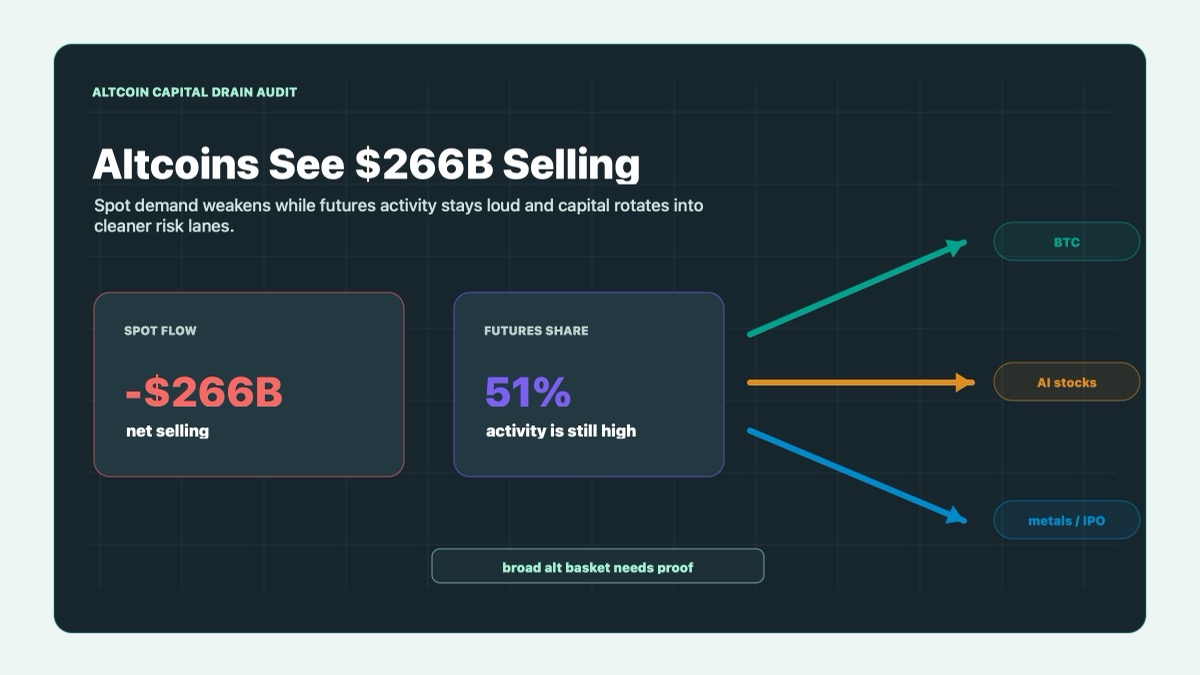
Key Takeaways
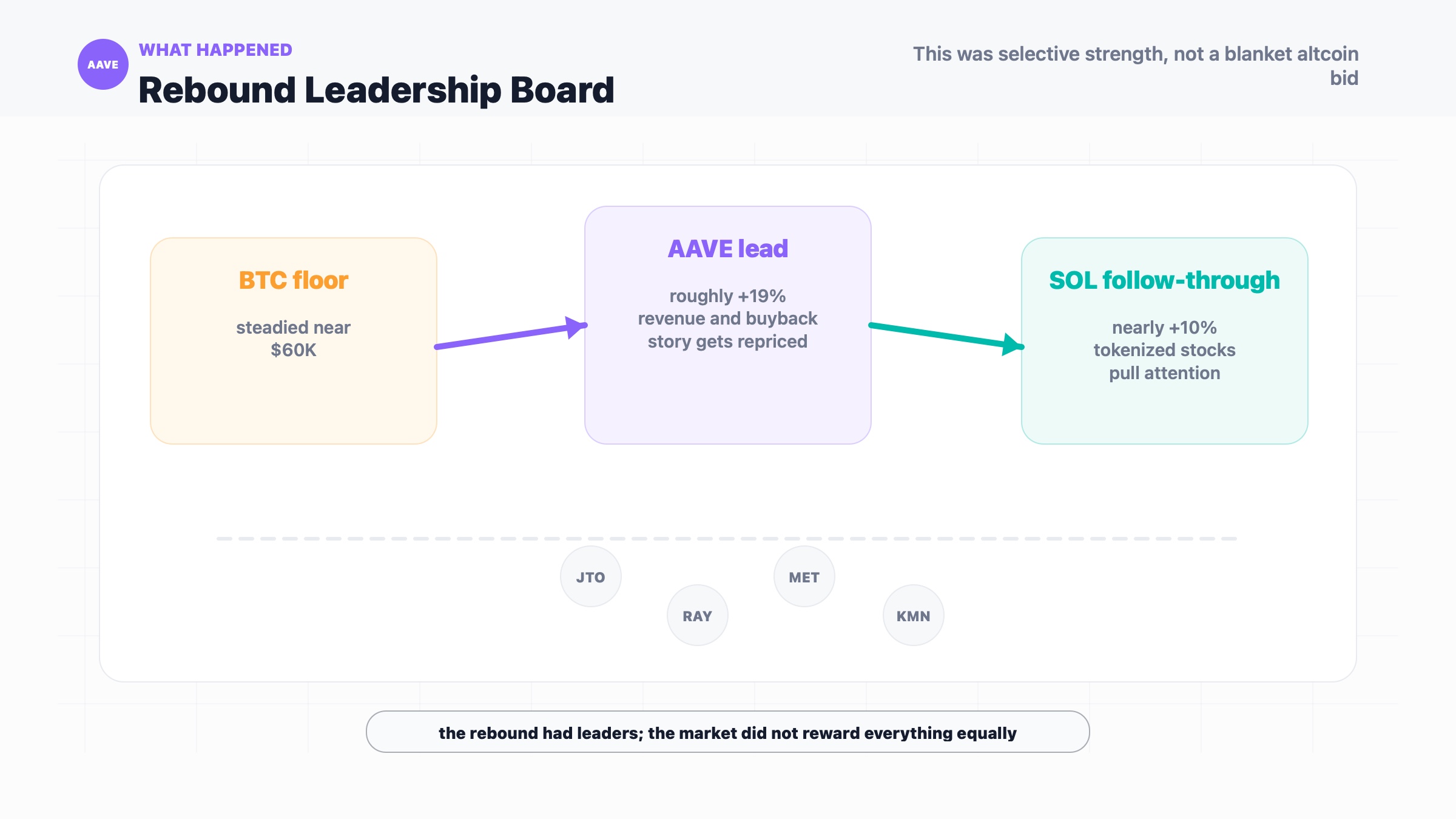
- Bitcoin steadied near $60,000 after the selloff, but the strongest action moved into AAVE, Solana and several Solana ecosystem tokens.
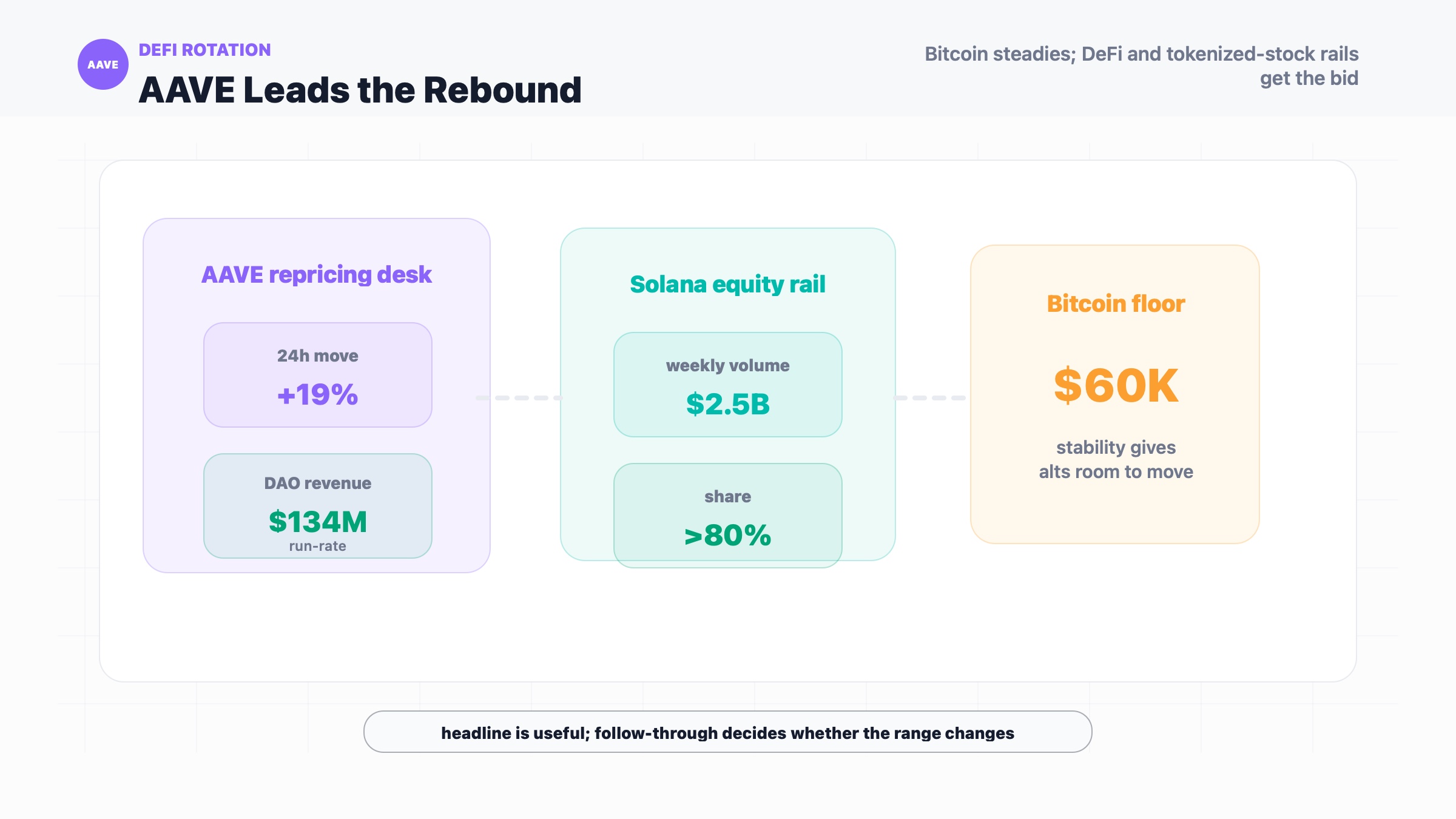
- AAVE jumped about 19% as traders focused on a reported Kraken strategic investment, protocol revenue and the possibility of automated buybacks under Aavenomics 3.0.
- Solana gained nearly 10% as tokenized stock trading on Solana reportedly topped $2.5 billion in weekly volume and captured more than 80% of blockchain-based equity trading.
- The AAVE chart is constructive only if buyers defend the $90-$92 retest zone and then turn $100 from a headline target into accepted price.
What Happened
At first glance, this looked like a normal crypto rebound: Bitcoin stopped falling, altcoins bounced, everyone exhaled for about twelve minutes.
But the useful version is more specific. Bitcoin found footing around $60,000 after a rough week, while the real leadership came from assets with fresh stories attached to them. AAVE rose roughly 19% over 24 hours to around $93.86. Solana climbed nearly 10%. Several Solana ecosystem names, including JTO, RAY, MET and KMNO, also moved higher.
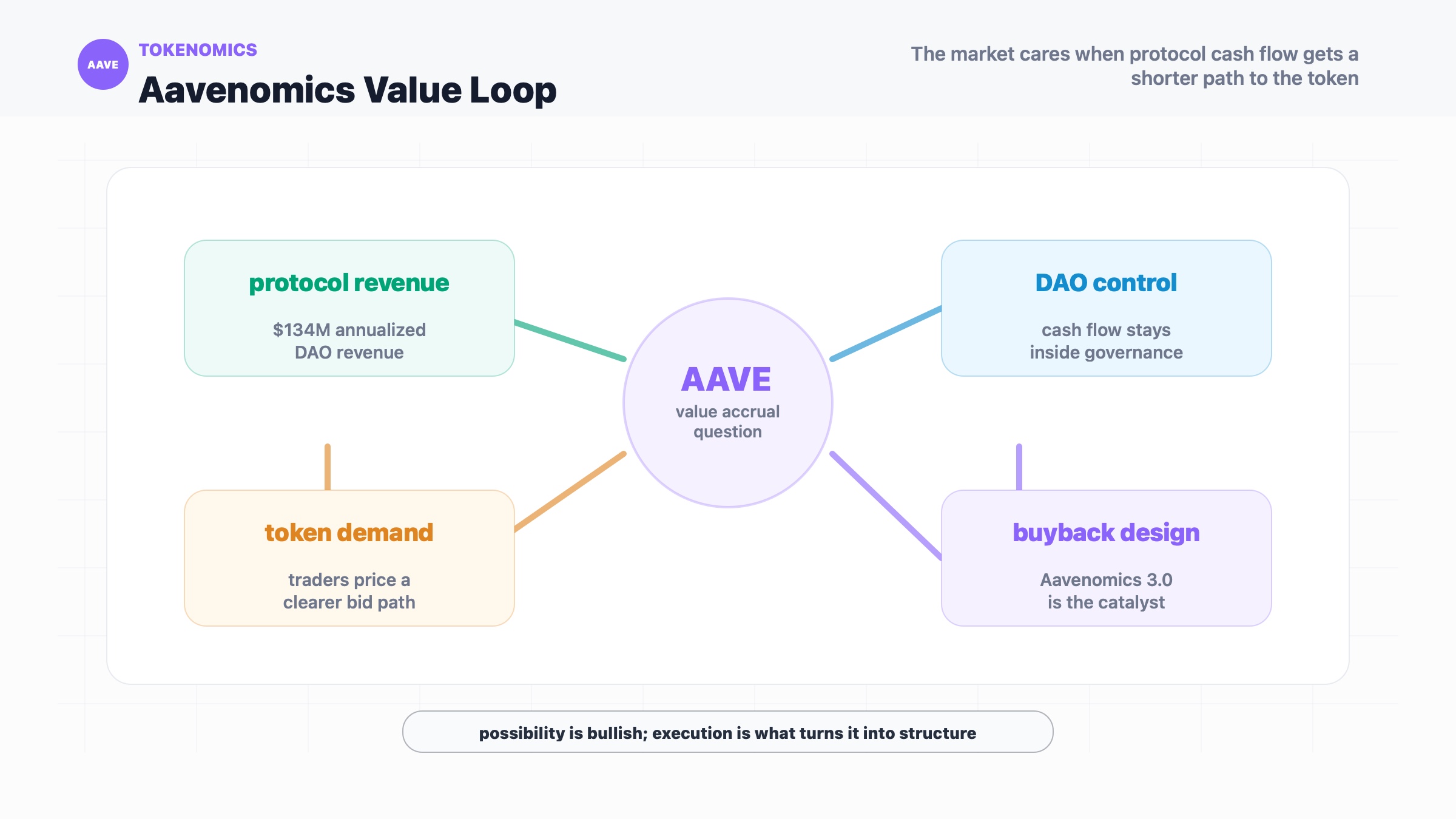
The AAVE move had two parts. The first was a CoinDesk report that Kraken has explored a strategic investment tied to Aave, including the acquisition of a 15% stake at a $385 million valuation. The second was the tokenomics angle. Aave founder Stani Kulechov pushed back against the idea that the valuation implied a steep discount, arguing that Aave DAO receives all protocol revenue, currently annualized around $134 million, and that this value can benefit AAVE holders under the broader "Aave Will Win" framework.
Then came the sentence that traders enjoy maybe a little too much: Aavenomics 3.0 may introduce an automated buyback mechanism.
Solana's move had a different engine. Tokenized stock trading on Solana reportedly topped $2.5 billion in weekly volume, about ten times the level from a month earlier, according to RWA.xyz data cited by CoinDesk. Solana also accounted for more than 80% of tokenized equity trading across blockchains.
So the news was not simply "crypto bounced." It was: Bitcoin stopped bleeding, DeFi revenue narratives got a fresh bid, and tokenized equities gave Solana a clean infrastructure story.
That is a much more interesting structure. It also has more moving parts.
Why This Matters for AAVE, Solana and Crypto Markets
The simple model is this: in a tired market, traders do not reward every token equally. They look for a reason to care.
AAVE gave them one. If you are an AAVE holder, the attractive story is not just that Aave is a large lending protocol. People already knew that. The attractive story is that protocol revenue might have a clearer path back toward the token. Revenue is nice in theory. Buybacks are a more direct language, and markets are famously fond of languages that involve a bid.
That does not make the rally automatically durable. A buyback framework is not the same as buyback execution, and protocol revenue is not the same as guaranteed tokenholder return. The market is pricing the possibility that AAVE becomes less like a governance token floating near a business and more like an asset with a visible value-accrual mechanism attached.
That is the key distinction.
Solana's story is about a different kind of control. If tokenized stocks keep moving real volume on-chain, the chain that wins that activity gets more than a marketing bullet. It gets order flow, developer attention, wallet activity and the right to become the default place where users expect these assets to trade. That is a lot of future being quietly negotiated through today's volume chart.
For Bitcoin, this is both supportive and a little awkward. BTC holding $60,000 gives the rest of the market room to take risk again. But BTC was not the main character in this rebound. It was the floor. AAVE and SOL were the actors walking around on it.
That matters because market bottoms often begin with selective strength before they become broad strength. The catch is that selective strength can also be just a rotation trade with a good story and a short shelf life. The difference shows up in follow-through: whether AAVE can hold the breakout area, whether Solana volume remains real, and whether Bitcoin can keep the floor from turning into a trapdoor.
Historical Parallel
The useful historical parallel is MakerDAO's 2023 Smart Burn Engine and the MKR rally that followed. It is not a perfect match, which is exactly why it is useful.
In July 2023, MKR rallied sharply after MakerDAO's token buyback scheme went live. The basic idea was simple: Maker had protocol surplus, governance approved a mechanism to use that surplus in a way that could reduce token supply, and the market suddenly had a cleaner story for why protocol cash flow might matter to the token. Before that, "DeFi protocol revenue" could feel like a nice spreadsheet item floating somewhere near governance. The buyback mechanism made the line shorter: protocol earns money, mechanism buys token, token market notices. Traders do not require poetry when a flow chart will do.
The similarity to AAVE is obvious. In both cases, the market cared less about vague DeFi optimism and more about value accrual. Aave has a major lending protocol, reported annualized DAO revenue, a possible strategic investment angle and a teased Aavenomics 3.0 design that could introduce automated buybacks. That is the kind of package that lets traders tell themselves a concrete story: this token may be getting closer to the cash-generating machine.
The difference is just as important. MakerDAO's Smart Burn Engine was an implemented mechanism. AAVE's current catalyst is still partly anticipatory: reported investment interest, founder commentary and a coming design update. Also, Aave is a lending market with different risk, governance and revenue dynamics, while MakerDAO was centered on stablecoin collateral, surplus management and governance-controlled balance-sheet mechanics.
The lesson for current BTC and crypto market judgment is not that AAVE must repeat MKR. History is not a vending machine. The lesson is narrower and more useful: when DeFi tokens move from "protocol has revenue" to "token may capture some of that revenue," the market can reprice fast. But the repricing has to survive the boring part: execution, parameters, governance votes, actual buybacks and price acceptance after the first excitement fades.
AAVE Price Reaction and K-Line Analysis
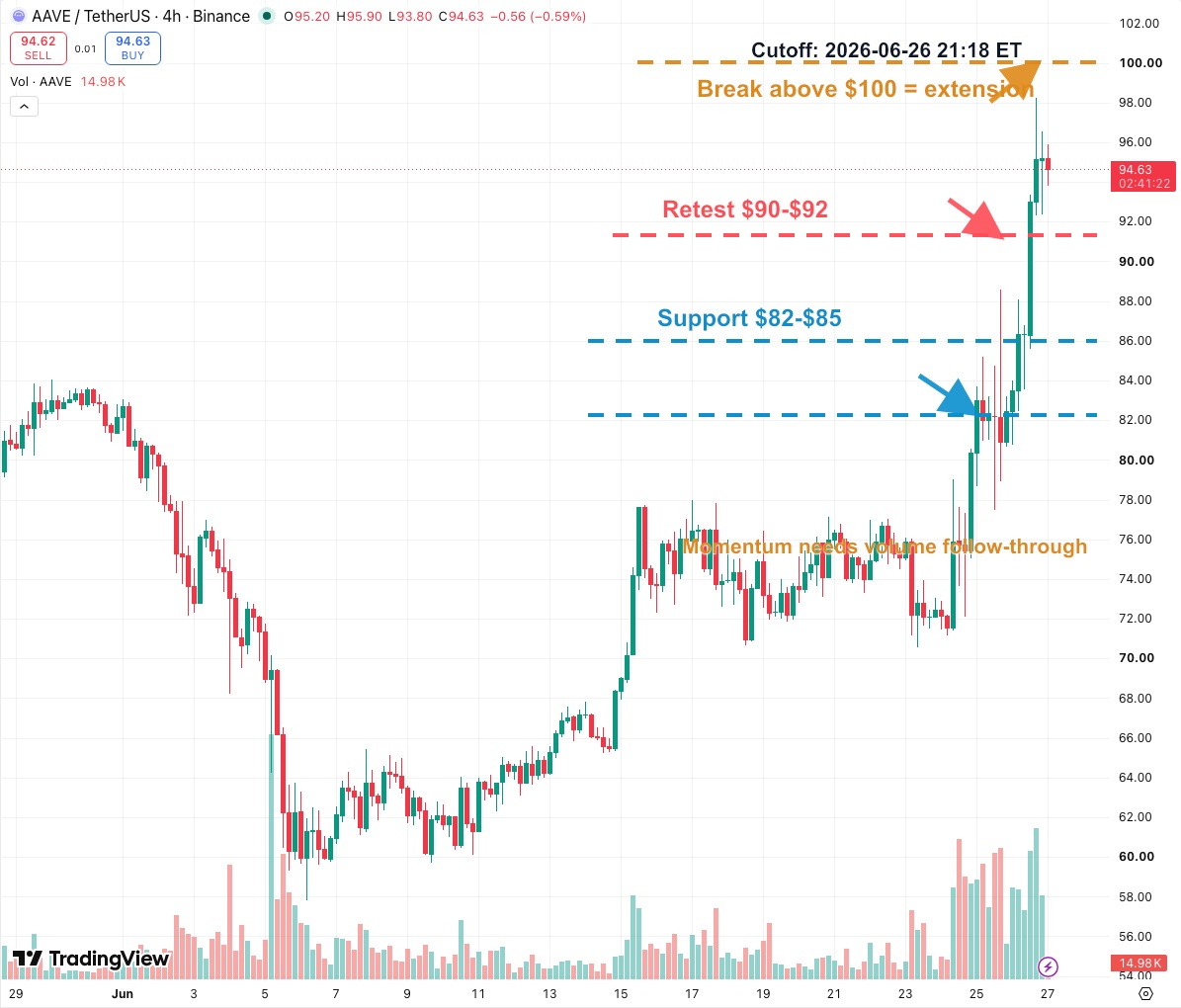
The 4-hour AAVEUSDT chart shows exactly what a catalyst-driven repricing looks like when it works: first a base, then a violent vertical leg, then the uncomfortable question of whether anyone still wants the token after the headline is no longer new.
AAVE spent early June falling into the low-$60s, rebuilt a base through the middle of the month, then pushed sharply higher from the low-$70s into the mid-$90s. The move was not quiet. Volume expanded into the rally, which matters because a thin squeeze and a real repricing can look similar for a few candles. Volume is one way the chart asks the market to show receipts.
The first upside line is $100. This is the clean psychological level and the next place where traders will test whether the buyback-and-revenue story can keep pulling in marginal demand. A break above $100 would not prove a new long-term uptrend by itself, but it would show that the market is willing to pay above the first obvious round number after the news.
The more important zone may be $90-$92. If AAVE pulls back and holds there, the rally starts to look healthier: buyers are defending the breakout instead of merely chasing the top candle. If that zone fails quickly, the move begins to look more like a headline burst that ran ahead of confirmed demand.
Below that, $82-$85 is the deeper support zone. Losing it would not erase the entire recovery, but it would make the market question whether the tokenomics story changed price behavior or only gave sellers a better exit.
Key Levels to Watch
$100: Upside extension level. A clean 4-hour break and hold above this line would show that buyers are willing to accept a higher AAVE range after the catalyst.
$90-$92: First retest zone. Holding this area would keep the breakout structure constructive.
$82-$85: Deeper support. A pullback into this zone can still be normal after a sharp rally, but losing it would weaken the whole rebound.
$75-$78: Former base area. If price falls back here, the market is probably no longer trading the Aavenomics headline as a near-term repricing catalyst.
Conditional Forecast
If AAVE holds $90-$92 and breaks above $100 with volume, the next phase can become an extension trade. In that case, the market is saying that the Aavenomics 3.0 and buyback discussion changed more than the daily percentage move. It changed the price range traders are willing to accept.
If AAVE rejects near $100 but holds $90-$92, the setup is still constructive. That would look like a normal digestion phase after a fast move.
If AAVE loses $90 and then breaks below $82-$85, the rally becomes much more suspect. The tokenomics story may still matter long term, but the short-term chart would be saying that traders bought the rumor and then lost interest when the candle stopped being vertical.
My base case is cautiously constructive, with a simple condition: AAVE has earned attention, not trust. Trust starts with a successful retest.
Investment Takeaway
This is the kind of crypto rebound that is easy to misread if you only look at the green candles.
The obvious story is that altcoins bounced because Bitcoin stabilized. That is true, but too small. The better story is that the market had been waiting for a reason to reward specific tokens, and AAVE and SOL gave it two different reasons: one about value accrual, the other about tokenized asset activity.
For traders, the AAVE setup is now level-driven. Above $100, momentum gets room. Above $90-$92, the breakout remains alive. Below $82-$85, the market starts taking back the benefit of the doubt.
For longer-term investors, the question is not whether buybacks sound good. Of course they sound good. That is why people keep inventing them. The better question is whether Aave governance, revenue and execution can turn the idea into a durable mechanism rather than a one-day slogan.
That is where the real analysis lives.
Sources
- CoinDesk: Aave, Solana ecosystem tokens lead crypto rebound as bitcoin steadies near $60,000 (https://www.coindesk.com/markets/2026/06/26/aave-solana-ecosystem-tokens-lead-crypto-rebound-as-bitcoin-steadies-near-usd60-000/)
- RWA.xyz: Tokenized stock market data (https://app.rwa.xyz/stocks)
- Aave Governance: Aave buybacks program update (https://governance.aave.com/t/arfc-aave-buybacks-program-an-update/23290)
- CoinDesk: MakerDAO's MKR soars 28% in a week as token buyback scheme goes live (https://www.coindesk.com/markets/2023/07/21/makerdaos-mkr-soars-28-in-a-week-as-token-buyback-scheme-goes-live/)
- TradingView: BINANCE:AAVEUSDT 4-hour chart (https://www.tradingview.com/chart/?symbol=BINANCE%3AAAVEUSDT&interval=240)
|
DISCLAIMER:
1. All content on this website (including but not limited to articles, data, charts, and analyses) is for general informational purposes only and does not constitute any form of investment advice, trading recommendation, or financial guidance. 2. Cryptocurrencies and digital assets are subject to extreme price volatility and high investment risk; you may lose part or all of your principal. Past performance does not predict future results. 3. The information on this website is based on sources we believe to be reliable, but we do not guarantee its accuracy, completeness, or timeliness. Any investment decisions made based on this website’s information are at your own risk. 4. We strongly recommend that you conduct your own thorough research and consult an independent, licensed financial advisor before making any investment decisions. |
Recommended reading
Latest News