
Key Takeaways
- Bitcoin fell below $71,000 after Strategy disclosed a 32 BTC sale worth about $2.5 million.
- The sale is financially small, but symbolically large because Strategy is the market's most important corporate Bitcoin treasury signal.
- BTC needs to reclaim $72,000-$73,500 before the selloff looks like anything more than a weak bounce attempt.
- The $70,000 area is the line traders are watching; a clean break would shift the conversation from "dip" to "deeper reset."
What Happened
Bitcoin slipped below $71,000 in early Asian trading on June 2, 2026, extending a weeklong slide. CoinDesk reported BTC down 3.4% over 24 hours and 7.5% on the week, with price trading near $70,830 and a 24-hour range between $70,120 and $73,458.
The obvious trigger was Strategy.
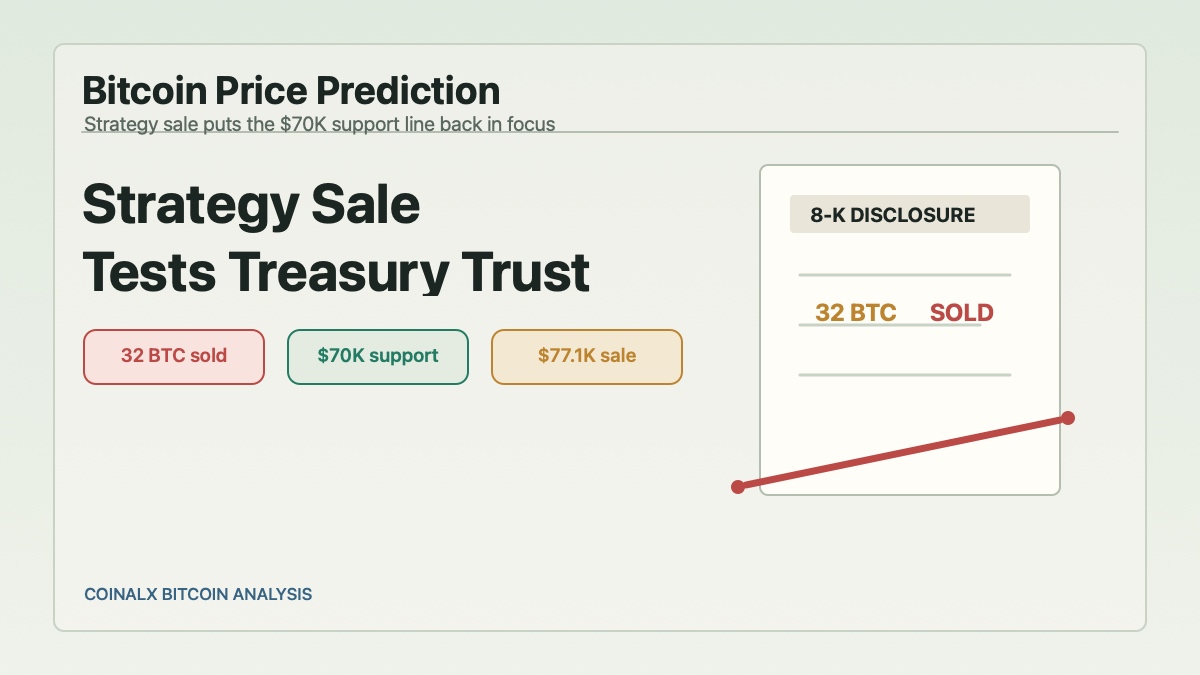
According to the report, Strategy disclosed in a Monday 8-K filing that it sold 32 bitcoins for about $2.5 million at an average price of $77,135. The proceeds were earmarked to fund preferred stock distributions.
Now, 32 BTC is not a large sale in market-impact terms. Bitcoin does not usually fall because one company sells $2.5 million worth of BTC. That is not how a market with global liquidity, ETFs, derivatives and professional market makers works.
But markets are not only spreadsheets. They are also symbol machines.
Strategy is not a random corporate holder. It is the corporate Bitcoin treasury company. For years, the simple mental model was: Strategy buys Bitcoin, raises capital, buys more Bitcoin, repeats until the chart gets tired of hearing about it. So when the same company appears as a seller, even in a tiny amount, traders do not just measure the coins sold. They measure the myth being dented.
That is the real story.
The rest of the backdrop did not help. CoinDesk also noted that ETF demand was still negative, stocks were pausing near highs, oil was firm around $94.40 amid U.S.-Iran tensions, and there was no obvious near-term bullish catalyst. In other words, Strategy did not knock over a strong market. It gave a tired market one more reason to lean lower.
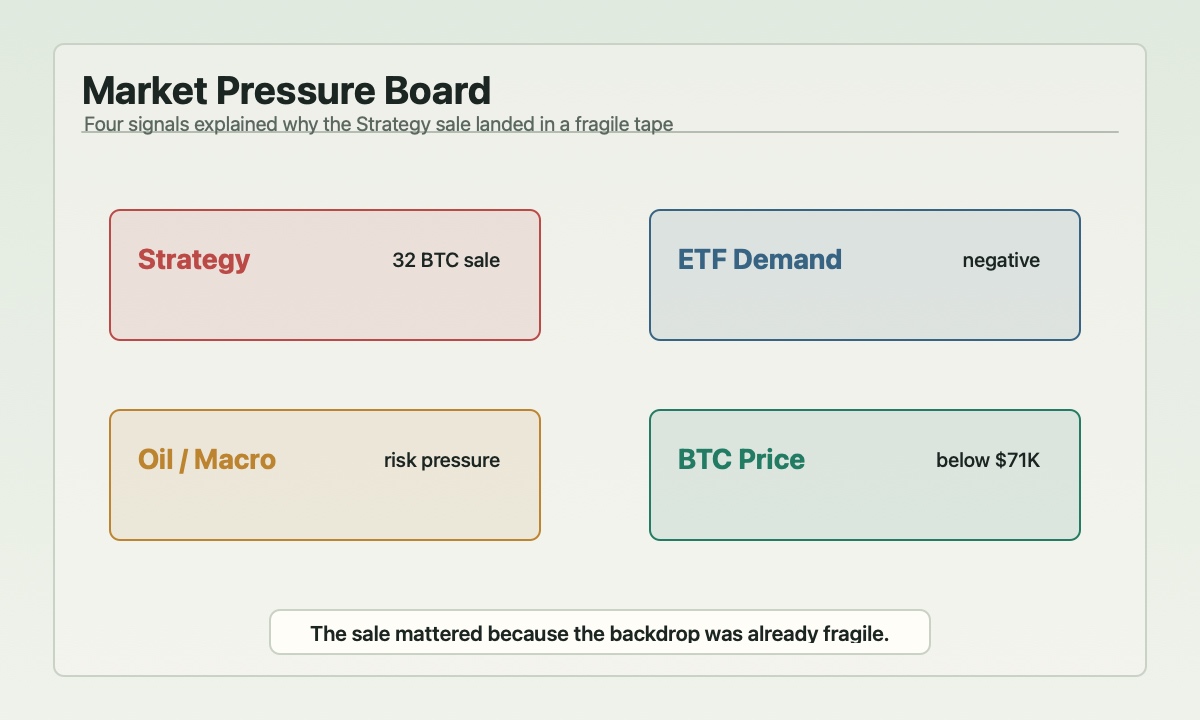
Why This Matters for Bitcoin and Crypto Markets
This matters because Bitcoin's current weakness is not about one sale. It is about what kind of buyer the market thought it had.
For a long time, Strategy played a very specific role in the Bitcoin imagination. It was not just another holder. It was the most public example of a company turning its balance sheet into a Bitcoin accumulation machine. That machine gave the market a comforting idea: corporate treasury demand could be sticky, long-term and somewhat insensitive to short-term price moves.
The 32 BTC sale does not destroy that idea. Let's not get melodramatic. The number is too small.
But it does complicate the idea.
Once a supposedly permanent buyer sells even a small amount, the market starts asking new questions. Was this a one-off treasury-management move? Could preferred stock obligations create recurring selling pressure? Does the capital stack matter more than the Bitcoin headline? If BTC keeps falling, will other treasury companies behave the same way?
That is where the psychology shifts.
The important distinction is between flow and signal. The flow was small. The signal was not. A $2.5 million sale is not enough to break Bitcoin's market structure by itself. But it can change how traders interpret weakness, especially when ETF flows are negative and macro risk appetite is fading.
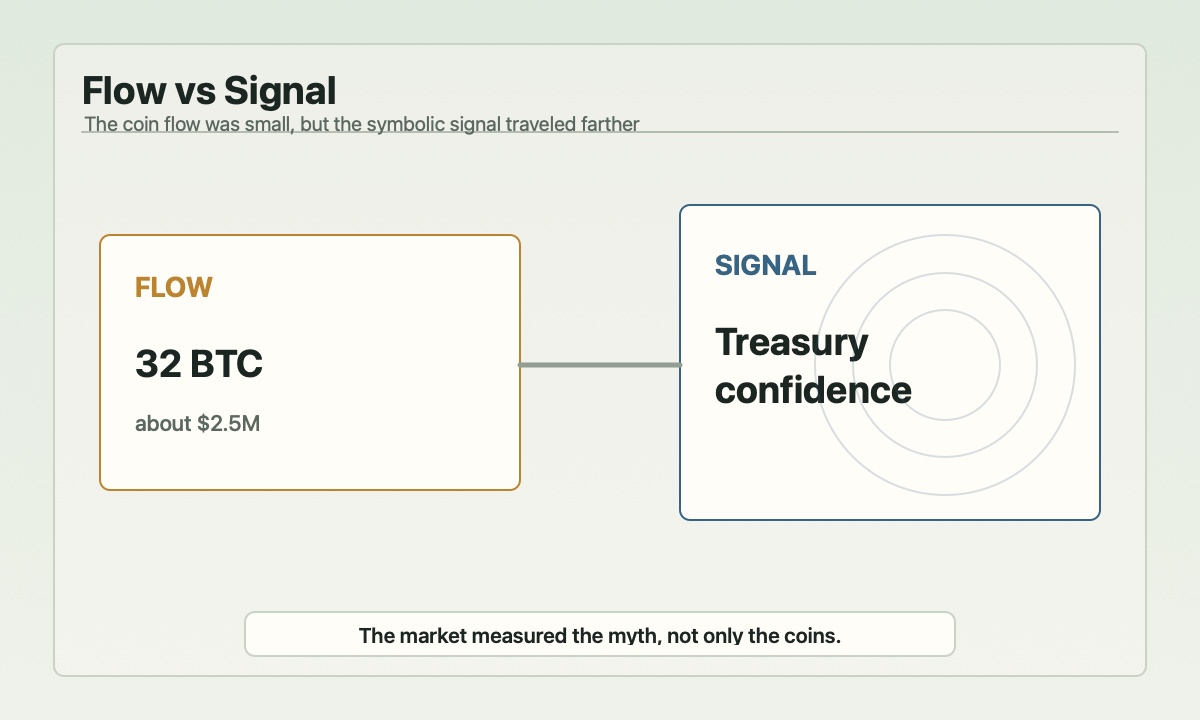
So the market is not saying, "Strategy sold 32 BTC, therefore Bitcoin is doomed." That would be silly. The market is saying, "If the biggest corporate Bitcoin symbol can sell, maybe the treasury trade deserves a more skeptical discount."
That is a subtler thought. And subtler thoughts can move prices when everyone is already nervous.
Historical Parallel: Tesla's 2022 Bitcoin Sale
The closest historical parallel is Tesla's 2022 Bitcoin sale. In its second-quarter 2022 update, Tesla said it had converted roughly 75% of its Bitcoin purchases into fiat currency, adding cash to its balance sheet during a difficult macro and liquidity environment. That was a much larger sale than Strategy's 32 BTC transaction, and it happened in a very different market: 2022 was already a broad crypto bear market, with risk assets under pressure and liquidity drying up.
What made the Tesla sale important was not just the number of coins. It was the psychological reversal. Tesla had helped make corporate Bitcoin ownership feel mainstream in 2021. When it later sold most of that position, the market had to admit a less exciting truth: public-company Bitcoin demand is not always ideological. Sometimes it is treasury management. Sometimes it is liquidity. Sometimes the corporate balance sheet has priorities that are not designed to make Bitcoin holders feel spiritually affirmed.
The Strategy case rhymes with that, but it is not the same song. Tesla was never the pure Bitcoin treasury vehicle that Strategy became. Tesla's Bitcoin position was a side allocation inside a giant operating business. Strategy, by contrast, is widely treated as the public-market avatar of corporate BTC accumulation. That makes a small sale from Strategy more symbolically sensitive than a small sale from an ordinary company would be.
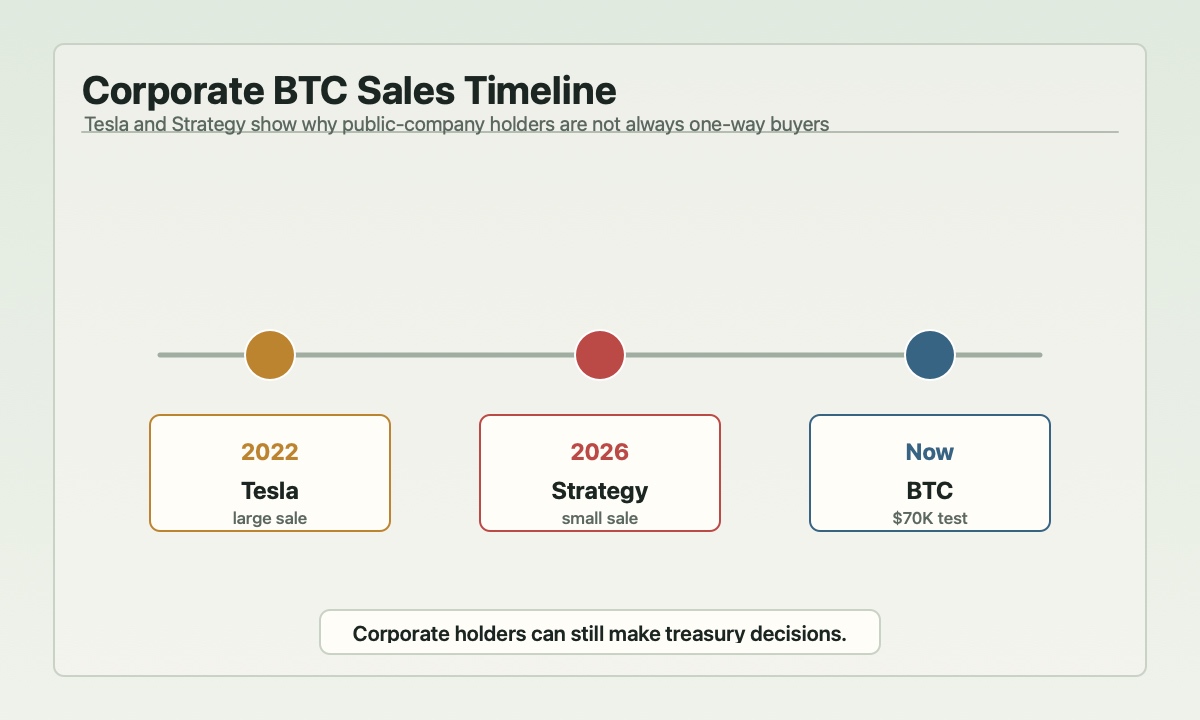
The lesson for current BTC is conditional. Corporate sales do not automatically end a cycle. Tesla's 2022 sale did not permanently invalidate Bitcoin. But they can mark a moment when investors stop assuming corporate holders are one-way buyers. For BTC now, the key is whether the market treats Strategy's sale as a footnote or as the first crack in a balance-sheet narrative. The chart around $70,000 will help answer that question before the essays do.
Bitcoin Price Reaction and K-Line Analysis
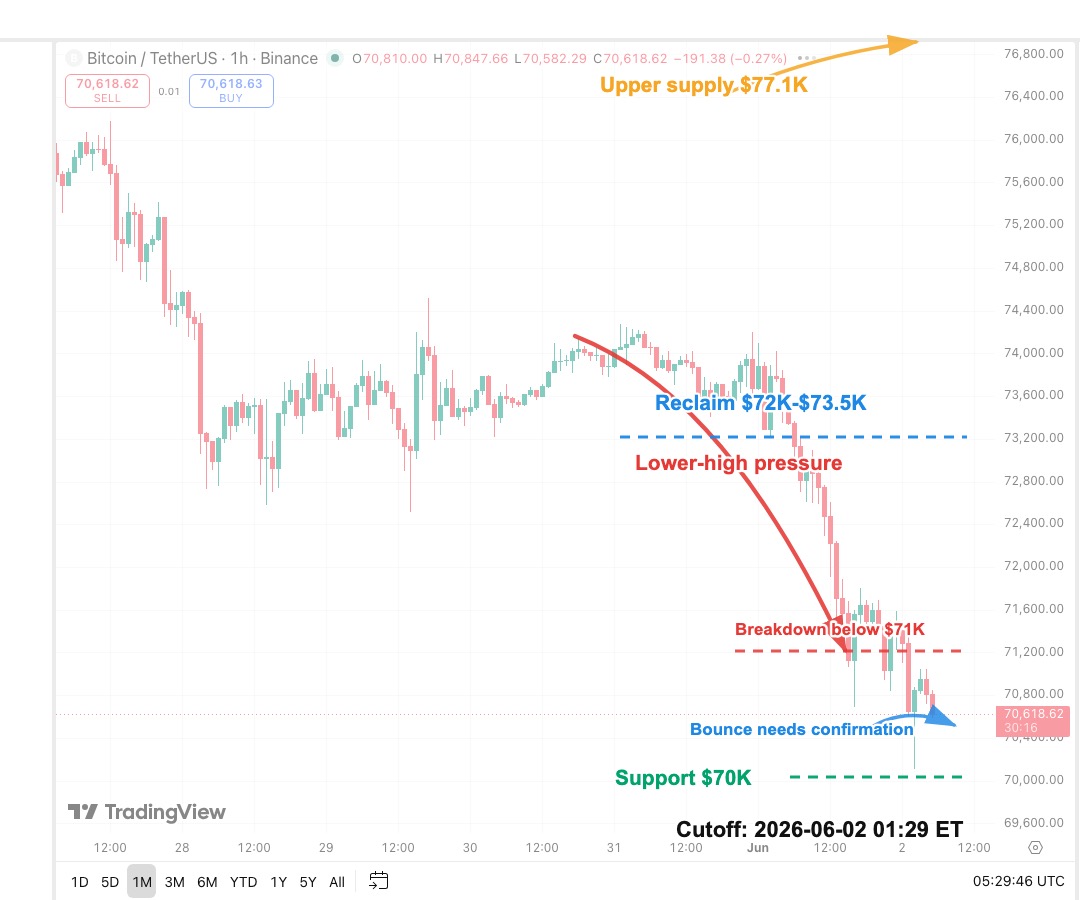
The BTCUSDT 1-hour chart is blunt.
Bitcoin came into the window above $75,000, failed to hold the mid-$73,000 area, then accelerated lower into the $70,000 zone. The move was not a dramatic vertical crash, but it had the more annoying quality of a steady breakdown: lower highs, failed rebounds, and a price that kept finding new ways to disappoint anyone buying too early.
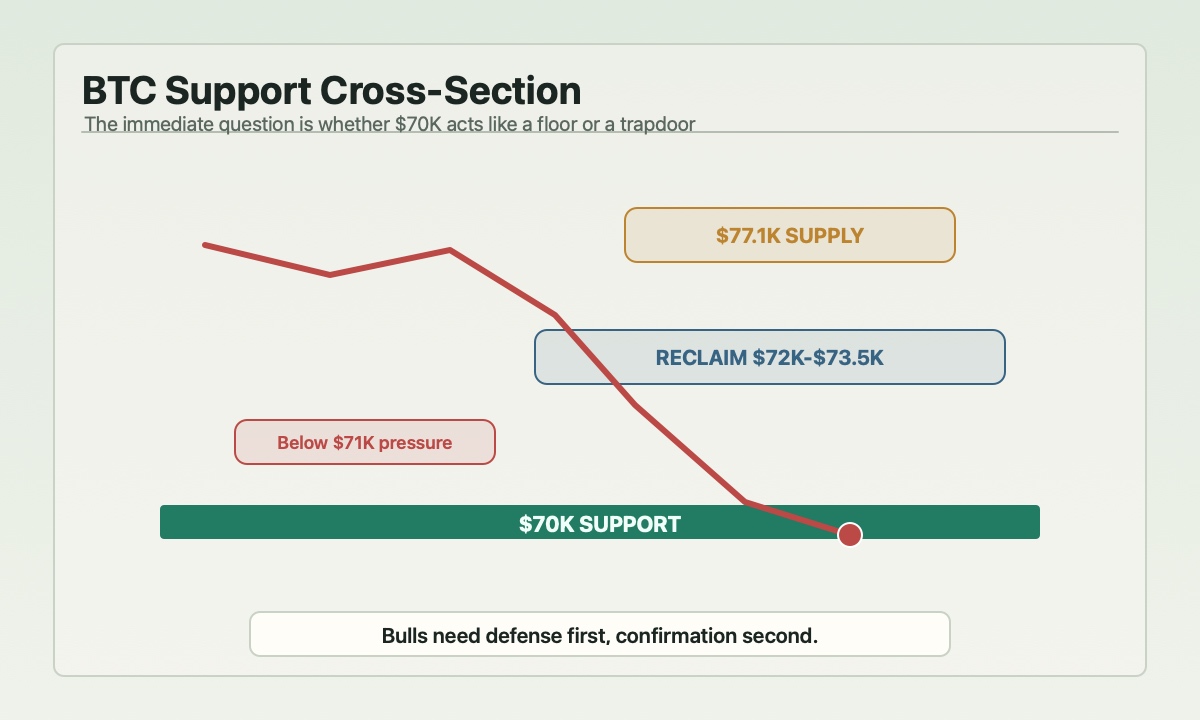
The first level is $70,000. This is the immediate support zone. CoinDesk's reported 24-hour low near $70,120 sits almost exactly there, which makes it the obvious psychological line. If BTC holds this area, traders can start looking for a relief bounce. If it breaks cleanly, the market will likely start searching for lower liquidity and support levels.
The second level is $72,000-$73,500. This is the reclaim zone. A bounce that cannot recover that range is just price breathing after a fall. Useful, maybe. Convincing, no.
The third level is $77,100. This matters because Strategy's disclosed average sale price was $77,135. On the chart, that area sits above the visible pressure zone and now functions as upper supply in the broader short-term structure. BTC does not need to reclaim it immediately, but as long as price remains far below it, the market will keep reading the sale as well-timed relative to the current slide.
The K-line message is simple: BTC is not broken forever, but it is below the levels that would make the bull case easy. Buyers need to show up at $70,000 and then prove they can reclaim $72,000-$73,500. Until then, this is a market trying to stabilize, not a market already stabilized.
Key Levels to Watch
- Immediate support: $70,000
- Breakdown pressure: below $71,000
- Reclaim zone: $72,000-$73,500
- Upper supply: $77,100
- Bullish confirmation: sustained move back above $73,500
- Bearish invalidation: clean breakdown below $70,000 with weak rebound volume
Conditional Forecast
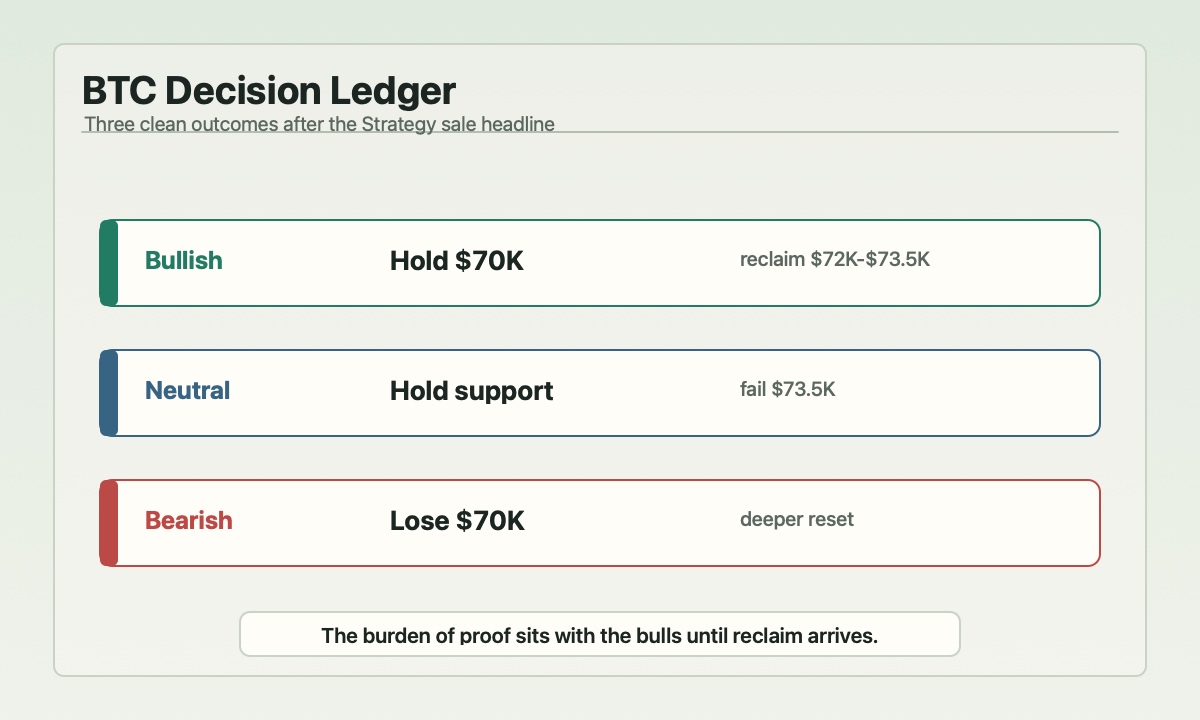
The bullish case starts with defense, not heroics. If BTC holds $70,000 and reclaims $72,000-$73,500, the Strategy sale can fade into the background as an overinterpreted treasury-management detail. In that case, price could work back toward the mid-$70,000s.
The neutral case is chop. BTC holds $70,000 but cannot reclaim $73,500. That would keep the market stuck in a nervous holding pattern, where every bounce looks tradable but none looks trustworthy. A very Bitcoin way to waste everyone's week.
The bearish case is a clean loss of $70,000. If that happens while ETF flows remain negative and risk assets continue to cool, the market will likely stop debating the symbolism of 32 BTC and start focusing on lower support. The story would shift from "Strategy sale shock" to "BTC trend reset."
My base case is cautious stabilization. The sale itself is too small to justify panic, but the chart is weak enough that buyers need to prove the damage is contained. Until $72,000-$73,500 is reclaimed, the burden of proof sits with the bulls.
Investment Takeaway
The Strategy sale is not a reason to declare the Bitcoin treasury thesis dead. That would be a lot of drama for 32 BTC.
But it is a reason to stop treating corporate treasury buyers as cartoonishly permanent. Public companies have obligations, capital structures, preferred distributions, investors and liquidity needs. Sometimes the balance sheet does boring balance-sheet things. The market may dislike it, but the spreadsheet does not apologize.
For investors, the useful takeaway is this: do not confuse a symbolic sell signal with a full structural collapse, and do not ignore the symbol just because the sale size is small.
Bitcoin now needs price confirmation. Hold $70,000. Reclaim $72,000-$73,500. Then the market can start treating the Strategy sale as a strange footnote rather than a new regime.
Until that happens, the chart is still clearing its throat.
Sources
- CoinDesk: Bitcoin slide to $70,000 as stocks pause and Strategy's BTC sale weighs on crypto
- TradingView: BINANCE:BTCUSDT chart
- Tesla Investor Relations: Q2 2022 update, including Bitcoin conversion disclosure
- Tesla SEC filing: 2022 Form 10-Q discussion of digital assets
|
DISCLAIMER:
1. All content on this website (including but not limited to articles, data, charts, and analyses) is for general informational purposes only and does not constitute any form of investment advice, trading recommendation, or financial guidance. 2. Cryptocurrencies and digital assets are subject to extreme price volatility and high investment risk; you may lose part or all of your principal. Past performance does not predict future results. 3. The information on this website is based on sources we believe to be reliable, but we do not guarantee its accuracy, completeness, or timeliness. Any investment decisions made based on this website’s information are at your own risk. 4. We strongly recommend that you conduct your own thorough research and consult an independent, licensed financial advisor before making any investment decisions. |
Recommended reading
Latest News