
Key Takeaways
- Sui deployed a major upgrade after three outages caused more than 15 hours of downtime across two days.
- The upgrade fixes known bugs, but the market is still pricing a reliability discount into SUI.
- SUI needs to reclaim $0.88-$0.90 before the chart looks less damaged.
- The key downside level is $0.80; a clean break would suggest the network-recovery story is not yet convincing buyers.
What Happened
The Sui Foundation said it deployed a major upgrade to fix bugs that caused three recent outages on the Sui Network. According to Cointelegraph, the first outage on Thursday lasted nearly six hours. Two more outages followed on Friday, lasting eight hours and 25 minutes and 43 minutes, bringing total downtime to more than 15 hours across two days.
That is the headline. The actual mechanism is more interesting, and also more awkward.
Sui said the first two outages came from crash bugs introduced in the network's 1.72 software release. One bug involved gas charging: the network charged funds before canceling transactions for insufficient balances, creating negative balances that crashed the system. Then an interim fix meant to restore the chain helped trigger the third outage because it carried a known low-probability halt risk.
There is a very human software lesson in there: sometimes the patch is not the end of the incident. Sometimes the patch is Act Two.
The Sui Foundation said validators have now addressed the known gas-charging and randomness-state issues, network activity has resumed, user funds were not at risk, and committed transactions were not reverted. That matters. A chain outage is bad; a chain outage plus fund loss or transaction rollback is a much darker species of problem.
Still, the market did not shrug. Cointelegraph reported that SUI traded near $0.99 before the first outage and later fell roughly 11% to about $0.88. By the June 3 chart capture, SUI had slipped closer to $0.81 on TradingView.
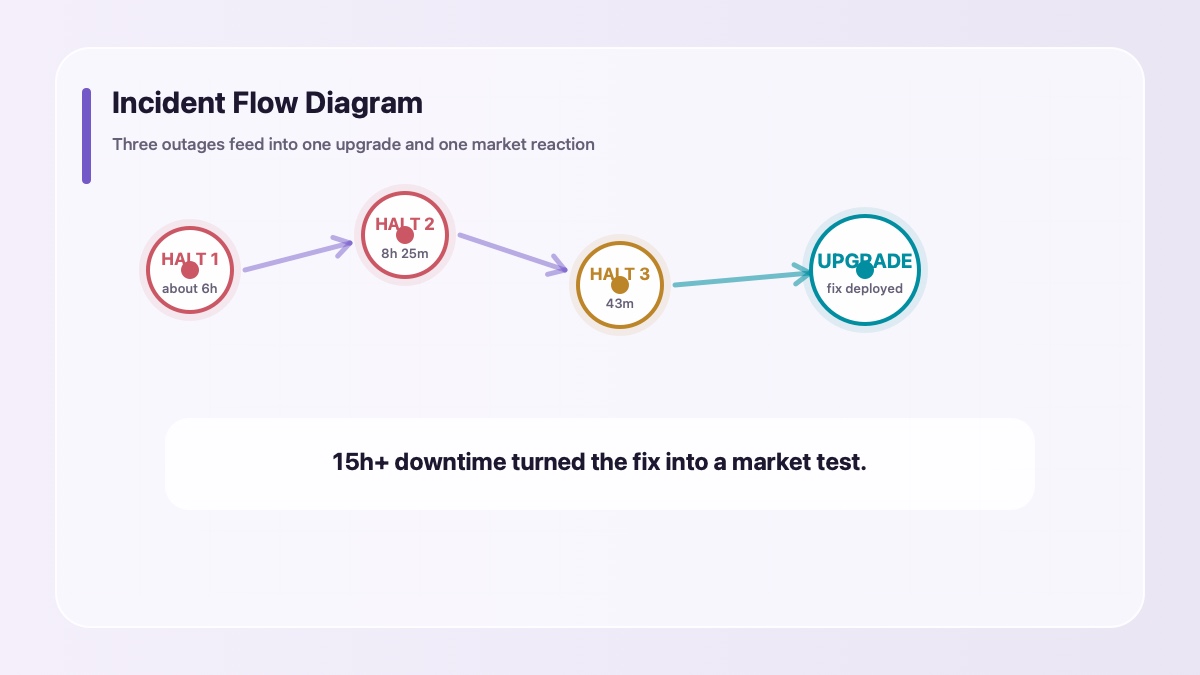
The upgrade fixed the known bug. The chart is asking a different question: how much confidence was lost?
Why This Matters for Sui and Crypto Markets
Sui's problem is not that software bugs exist. Software bugs exist everywhere. If you run complex distributed systems and claim otherwise, congratulations, you have discovered marketing.
The problem is that Sui's investment case depends heavily on performance and institutional-grade reliability. Sui launched with the ambition of being fast, scalable and capable of supporting mainstream financial use cases. That is a big promise. It means the network is not only selling blockspace. It is selling confidence.
When a high-performance blockchain halts three times in two days, the market does not merely ask whether the bug is fixed. It asks whether the reliability model is mature enough for the chain's ambition.
That is the reliability discount.
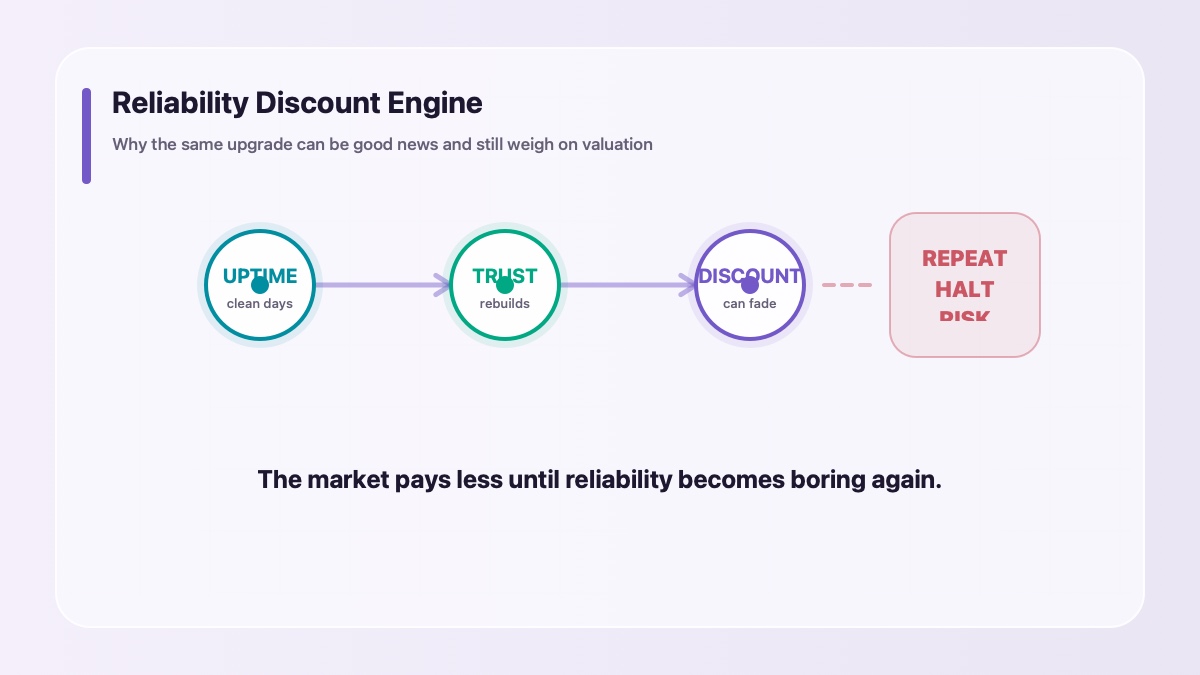
Think of it as the gap between what the network wants to be valued as and what investors are willing to pay after the system reminds them that it can stop. If the upgrade works, uptime remains clean and developers keep building, the discount can fade. If outages repeat, the discount becomes part of the token's valuation furniture, and nobody wants that furniture in the living room.
This matters beyond Sui because every newer Layer 1 is making some version of the same pitch: faster settlement, lower fees, better developer experience and enough reliability for real applications. Outages do not kill that pitch immediately, but they force the market to inspect it with less romance.
For SUI, the next few weeks are less about slogans and more about operational proof. The network needs boring uptime. Boring is underrated. In infrastructure, boring is often the product.
Historical Parallel: Solana's 2021 Network Outage
The cleanest historical parallel is Solana's September 2021 outage, when the network was offline for roughly 17 hours after heavy transaction load and resource exhaustion overwhelmed validators. Solana eventually restarted and continued growing, but the event became a lasting reference point in every later debate about high-throughput chains and reliability.
The similarity is obvious. Both Sui and Solana were built around the promise of speed and scalability. Both networks attracted attention partly because they offered something that felt more usable than slow, expensive base-layer settlement. And in both cases, an outage attacked the strongest part of the story. When a chain sells performance, downtime is not just a technical blemish. It is the market poking the product right where it claims to be strongest.
But the differences matter. Solana's 2021 incident was driven by extreme activity and validator resource exhaustion. Sui's recent outages, based on the Sui Foundation's explanation, came from bugs introduced in a software update and then an interim fix with its own halt risk. One is a stress-capacity problem. The other is a release-quality and failure-containment problem. They both end with the same unpleasant user experience, but they reveal different engineering weaknesses.
The lesson for SUI is not that Sui is doomed because Solana had outages. That would be lazy pattern-matching with a tiny hat on. Solana's history shows that a fast L1 can recover from serious reliability incidents if usage, developer activity and capital keep returning. But it also shows that the market remembers. Every later issue gets interpreted through the earlier one.
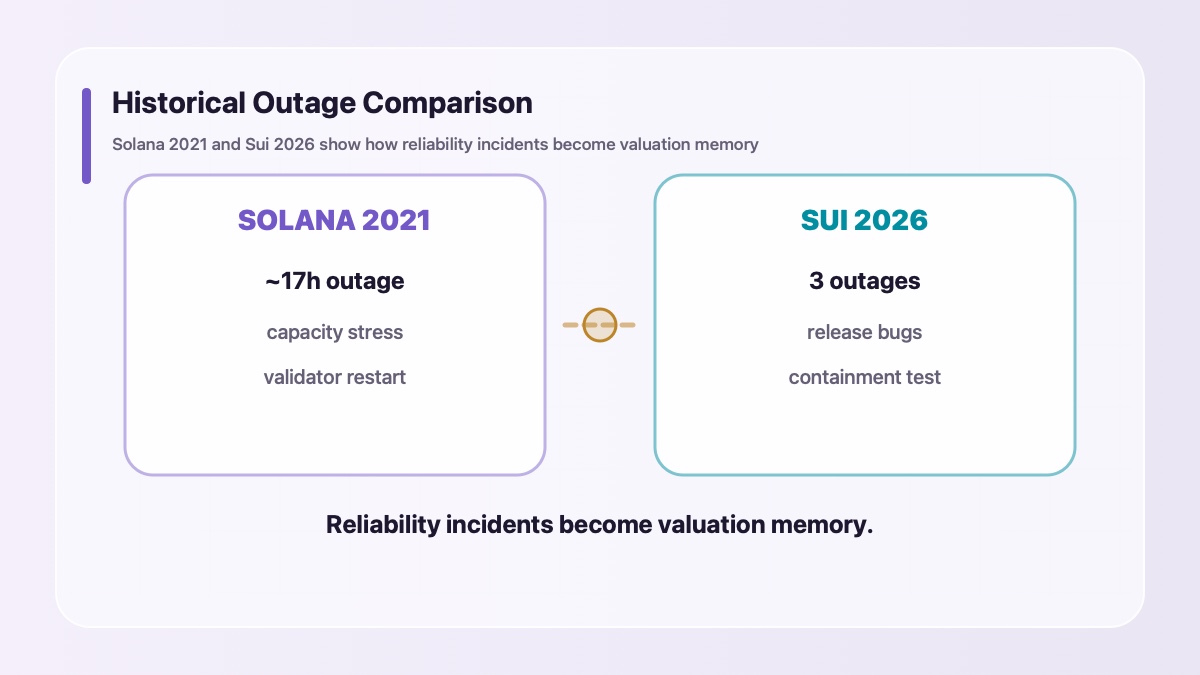
For Sui, the upgrade is only the beginning of the repair. The real repair is time without another halt. Price can bounce before trust fully returns, but durable repricing usually needs proof that the system can be boring again.
SUI Price Reaction and K-Line Analysis
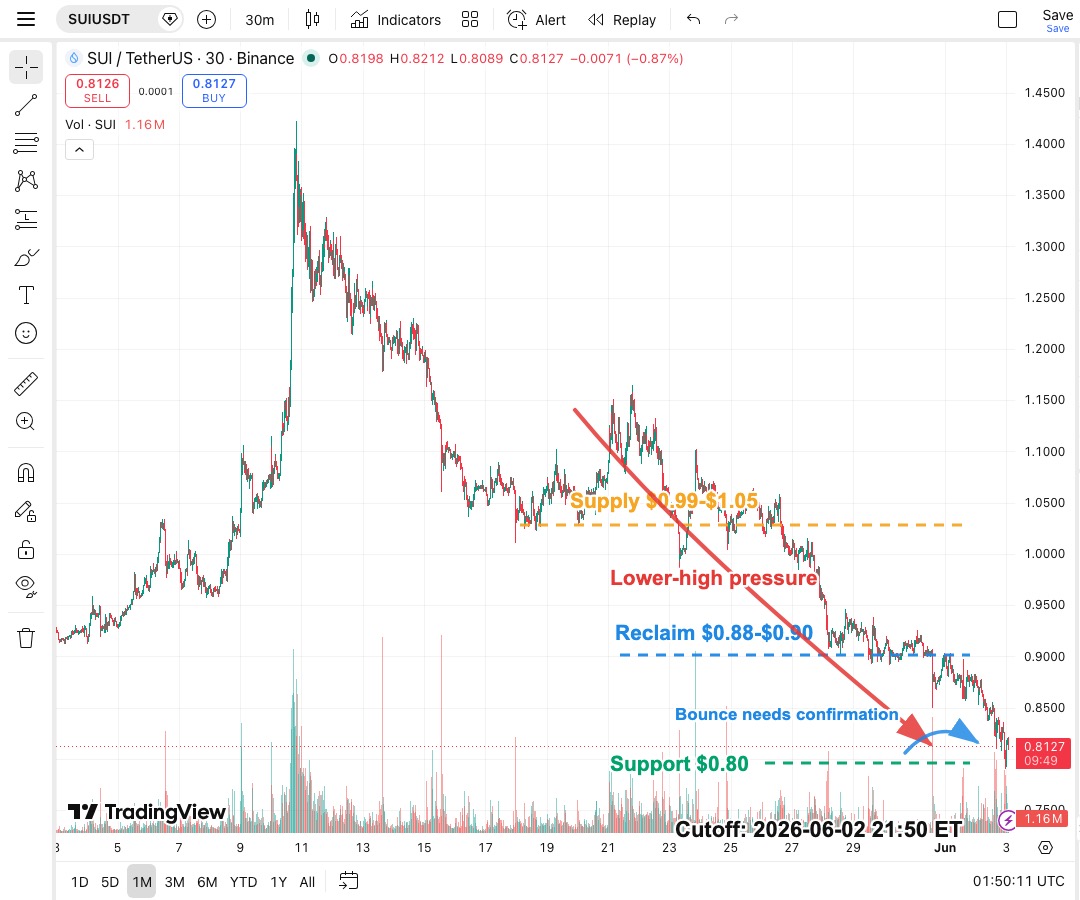
The SUIUSDT 30-minute chart shows a market still punishing the token after the outages.
SUI rallied hard in early May, touching the $1.40 area, then began a long fade. The outage period did not create the entire downtrend by itself, but it gave the decline a sharper narrative. After the network issues, the token failed around the $0.99-$1.05 area, lost the $0.88-$0.90 range and slid toward $0.80.
That gives us three useful zones.
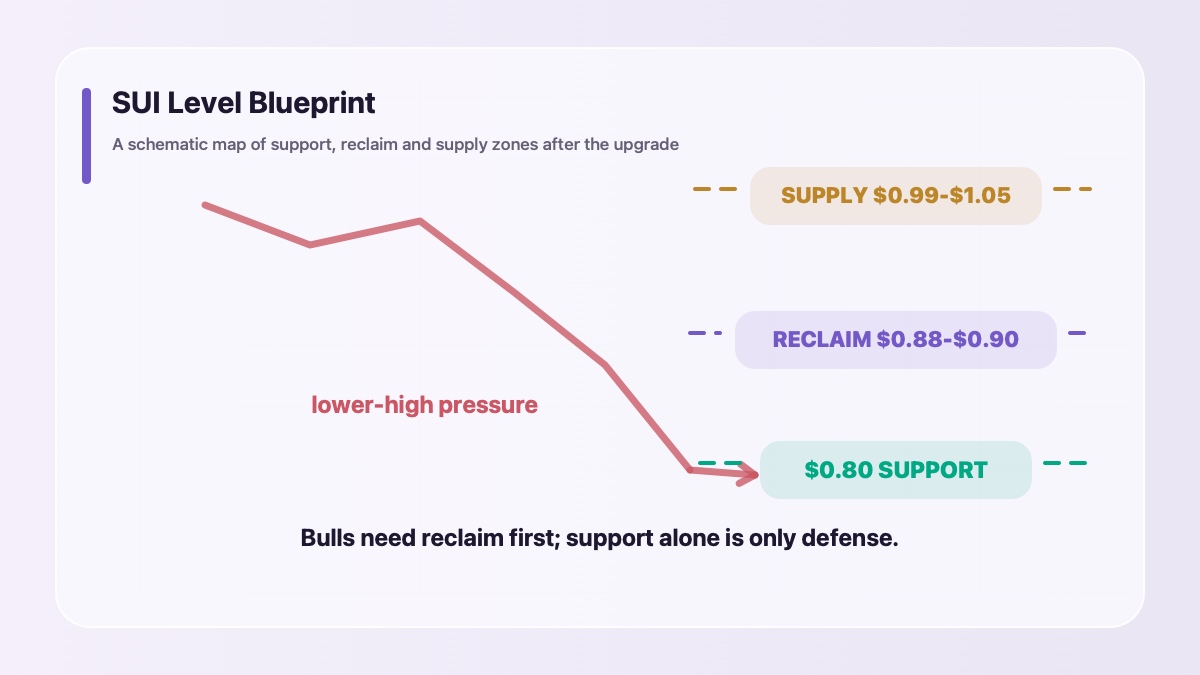
First, $0.80 is the immediate support. It is not a magical number. It is simply where price is currently trying to stop falling. If buyers cannot defend it, the market will likely start searching for lower liquidity.
Second, $0.88-$0.90 is the first reclaim zone. This is where SUI needs to recover before the chart looks less damaged. A bounce that cannot reclaim that level is just a bounce. Useful for traders, perhaps. Not yet evidence that confidence is returning.
Third, $0.99-$1.05 is the supply zone. That area matters because it was where SUI traded before the outage damage became obvious on the chart. If SUI can reclaim that range later, it would suggest the reliability discount is starting to fade.
The line of lower highs is still intact. That is the part the bulls need to deal with. The upgrade is good news, but price has not yet acted like the market is ready to forgive and move on. Forgiveness, in charts, usually looks like reclaimed levels.
Key Levels to Watch
- Immediate support: $0.80
- First reclaim zone: $0.88-$0.90
- Main supply zone: $0.99-$1.05
- Bullish confirmation: sustained recovery above $0.90, then a push toward $1.00
- Bearish invalidation: clean breakdown below $0.80 with weak rebound volume
Conditional Forecast
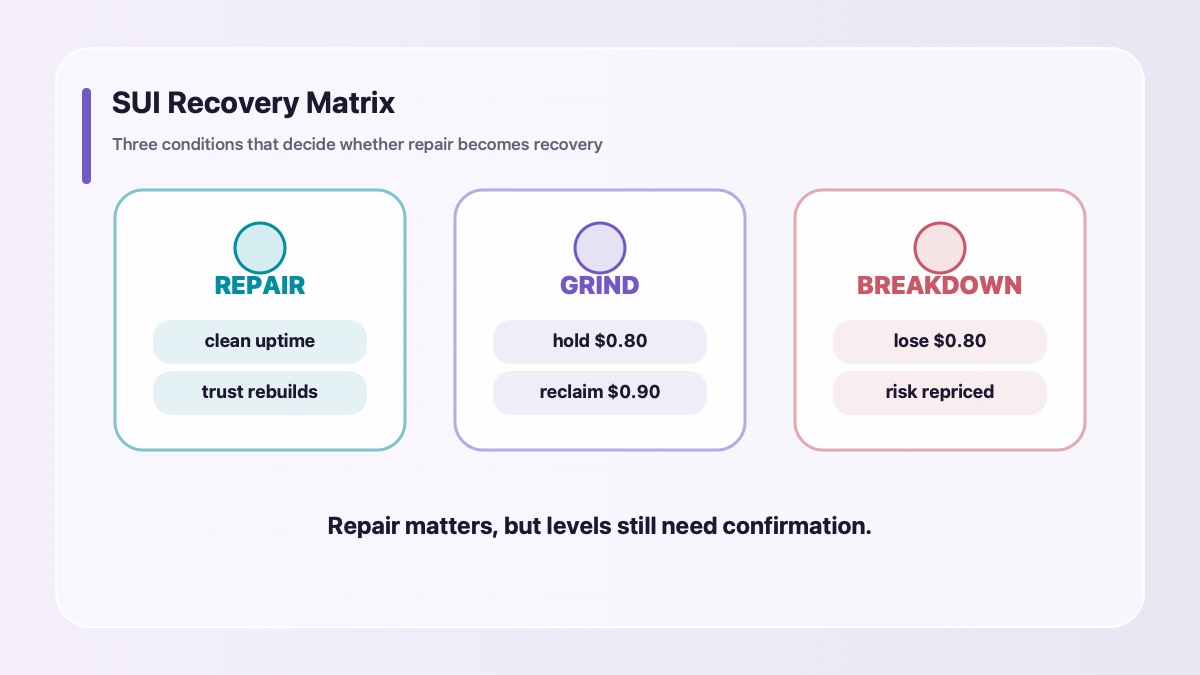
The bullish case starts with boring success. If Sui stays operational, avoids another halt and SUI reclaims $0.88-$0.90, the market can start treating the upgrade as the beginning of a repair cycle. A later move back into $0.99-$1.05 would be the stronger signal that the reliability discount is easing.
The neutral case is a support grind. SUI holds $0.80 but cannot reclaim $0.90. That would mean sellers are no longer accelerating, but buyers are not confident enough to reverse the structure. In plain English: the chain may be fixed, but the chart is still sulking.
The bearish case is a clean loss of $0.80. If that happens, the upgrade has not been enough to stop the market from repricing operational risk. In that scenario, traders may start focusing less on the official fix and more on whether another support zone has to absorb the damage.
My base case is cautious repair, not instant recovery. Sui has done the necessary first step by addressing the known bugs. Now it needs the dullest thing in crypto: time passing without drama.
Investment Takeaway
Sui's upgrade matters because it addresses the technical cause of the outages. But investors should separate "the bug is fixed" from "the market has restored trust."
Those are different things.
The bug can be fixed in code. Trust gets fixed in public, one uneventful day at a time. That is annoying because uneventful days do not make exciting headlines. They just quietly rebuild the thing the headline damaged.
For SUI, the chart is the scoreboard. Hold $0.80, reclaim $0.88-$0.90, then challenge $0.99-$1.05. If those steps happen while the network remains stable, the market can start treating the upgrade as a real recovery signal.
If they do not happen, the upgrade may be technically successful but financially insufficient. The network can be back online while the token is still trying to earn back belief.
Sources
- Cointelegraph: Sui Foundation says major upgrade fixed bugs behind three outages
- Sui Blog: Sui Network outage and upgrade updates
- TradingView: BINANCE:SUIUSDT chart
- DefiLlama API: Sui chain TVL data
- Solana Foundation: Solana network outage and restart overview
|
DISCLAIMER:
1. All content on this website (including but not limited to articles, data, charts, and analyses) is for general informational purposes only and does not constitute any form of investment advice, trading recommendation, or financial guidance. 2. Cryptocurrencies and digital assets are subject to extreme price volatility and high investment risk; you may lose part or all of your principal. Past performance does not predict future results. 3. The information on this website is based on sources we believe to be reliable, but we do not guarantee its accuracy, completeness, or timeliness. Any investment decisions made based on this website’s information are at your own risk. 4. We strongly recommend that you conduct your own thorough research and consult an independent, licensed financial advisor before making any investment decisions. |
Recommended reading
Latest News

