
Key Takeaways
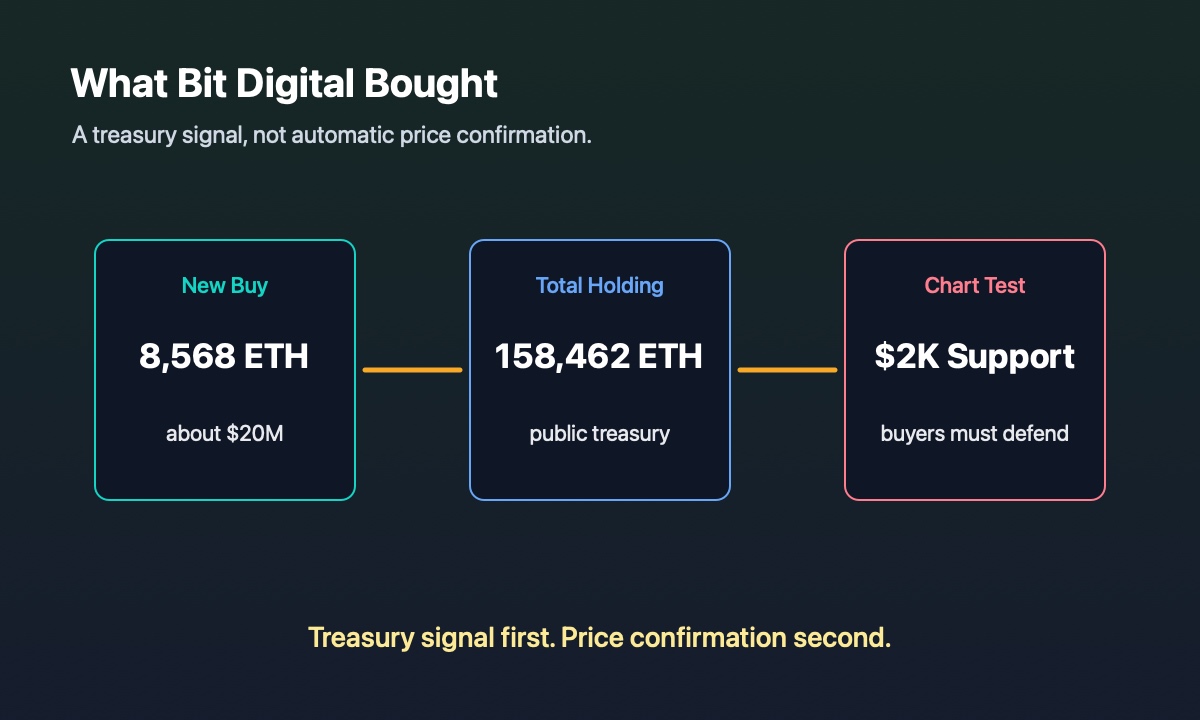
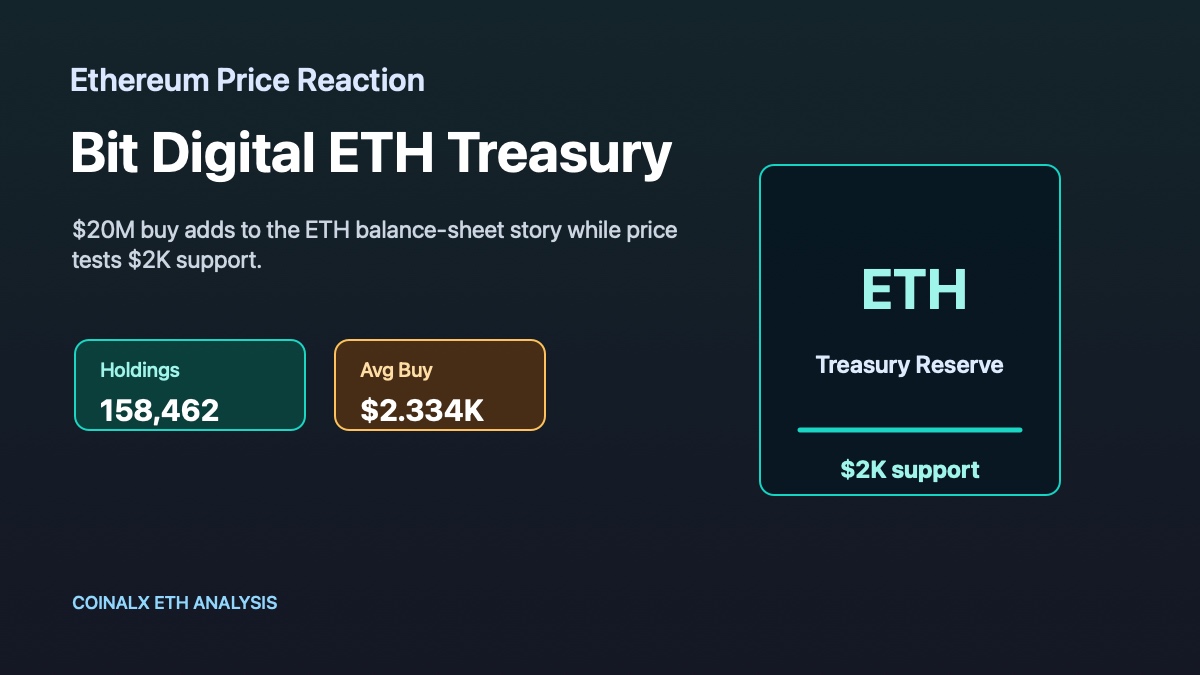
- Bit Digital bought 8,568 ETH for about $20 million, lifting its total holdings to roughly 158,462 ETH.
- The purchase strengthens the public-company ETH treasury narrative, but it does not automatically fix Ethereum's weak price structure.
- ETH still needs to reclaim the $2,130-$2,150 area before the chart looks meaningfully constructive again.
- The key downside line is the $1,970-$2,000 support zone; a clean loss there would make the treasury story feel more like background noise than a catalyst.
What Happened
Bit Digital said it bought 8,568 ETH on May 11 at an average price of $2,334.25 per token, spending about $20 million. After the purchase, the Nasdaq-listed company said its Ethereum holdings rose to roughly 158,462 ETH.
That is the surface-level fact. The more interesting part is where it places Bit Digital in the public-company ETH treasury race.
According to the Cointelegraph report, CoinGecko data showed Bit Digital's previous holdings at about 140,008 ETH, behind Coinbase Global's roughly 151,175 ETH. The new purchase would push Bit Digital above Coinbase and make it the fourth-largest public corporate holder of Ether.
This is not a tiny symbolic buy made for a press-release sugar rush. It is also not large enough, by itself, to bulldoze the ETH market. The correct read sits in the middle: Bit Digital is adding one more brick to the Ethereum treasury narrative, while the price chart is still asking whether buyers have enough muscle to defend the zone around $2,000.
The company's CEO, Sam Tabar, framed the purchase as part of a strategy to grow net asset value per share through Ethereum accumulation, AI infrastructure and acquisitions. That wording matters. Bit Digital is not presenting ETH as a short-term trade. It is presenting ETH as part of the corporate balance-sheet machine.
That is where the market should pay attention.
Why This Matters for Ethereum and Crypto Markets
The Bit Digital purchase matters because Ethereum's current problem is not a lack of stories. Ethereum has plenty of them: stablecoins, tokenization, layer-2 settlement, staking yield, institutional infrastructure, and now corporate treasury accumulation.
The problem is that stories have to survive contact with price.
ETH was trading near $2,013 at the time of the Cointelegraph article, down sharply year-to-date and far below its 2025 high near $4,946. That is an awkward setup. The network can have real usage, institutions can talk warmly about tokenization, and public companies can keep buying ETH, while the token itself still behaves like a chart under distribution.
That is not contradiction. That is markets being annoying in their usual professional way.
The treasury angle does improve the demand map. If more public companies hold ETH as a balance-sheet asset, the market gets a new class of slower-moving buyers. These buyers are different from leveraged traders. They are not necessarily chasing every candle. They can make the float feel tighter over time, especially if they stake or hold through drawdowns.
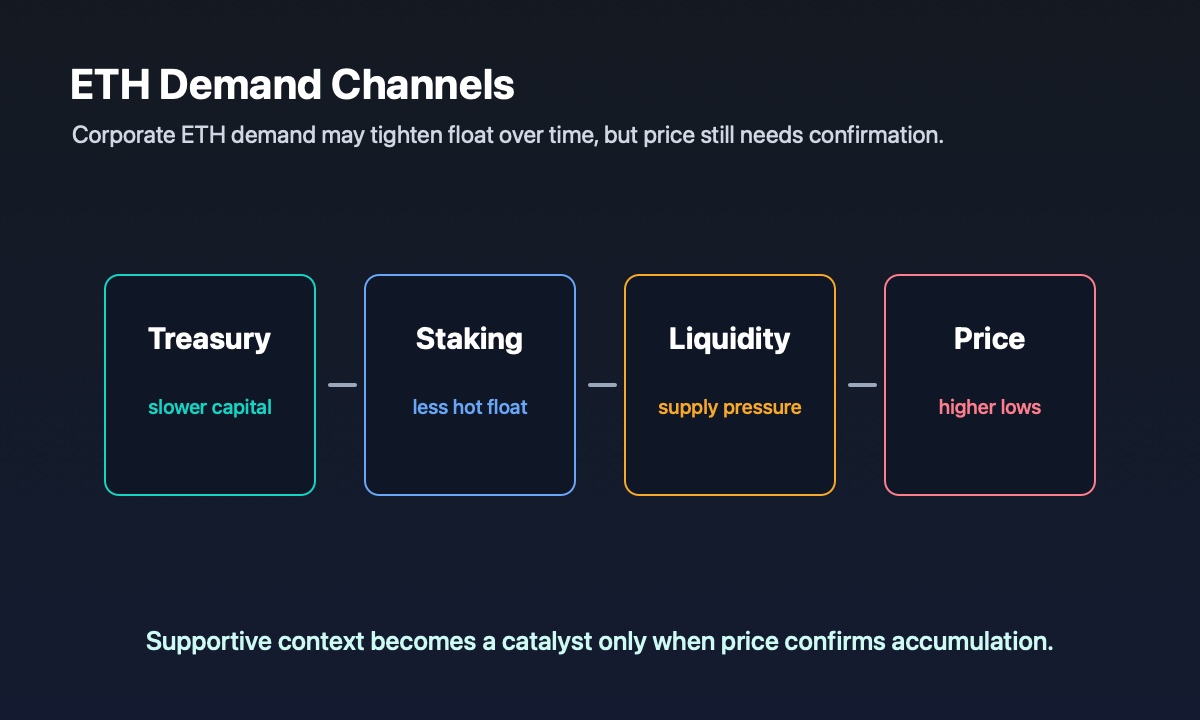
But the key phrase is "over time."
For the next trading window, Bit Digital's buy is supportive context, not proof of reversal. ETH needs confirmation from price: higher lows, stronger closes, and a reclaim of nearby resistance. Until then, the market is basically saying: nice treasury narrative, now show me demand that can actually hold a line.
Historical Parallel: MicroStrategy's First Bitcoin Treasury Buy
The cleanest historical parallel is MicroStrategy's first Bitcoin treasury purchase in August 2020. On August 11, 2020, MicroStrategy announced that it had bought 21,454 BTC for an aggregate purchase price of $250 million, framing Bitcoin as its primary treasury reserve asset. That was one of the moments when corporate crypto exposure moved from "interesting side bet" to "boardroom balance-sheet strategy."
What happened then was simple but powerful. A public company took a large cash position, converted it into a crypto asset, and gave investors a new way to talk about that asset. Bitcoin was no longer only a macro hedge for individuals or a trading instrument for crypto-native funds. It became something a listed company could hold, explain, finance around, and repeatedly accumulate.
Bit Digital's ETH purchase rhymes with that event. The similarity is the balance-sheet signal. In both cases, a public company is telling the market that a crypto asset can sit inside corporate capital allocation, not just inside exchange wallets and speculative portfolios. That matters because treasury buyers can help create a more durable demand narrative than retail excitement alone.
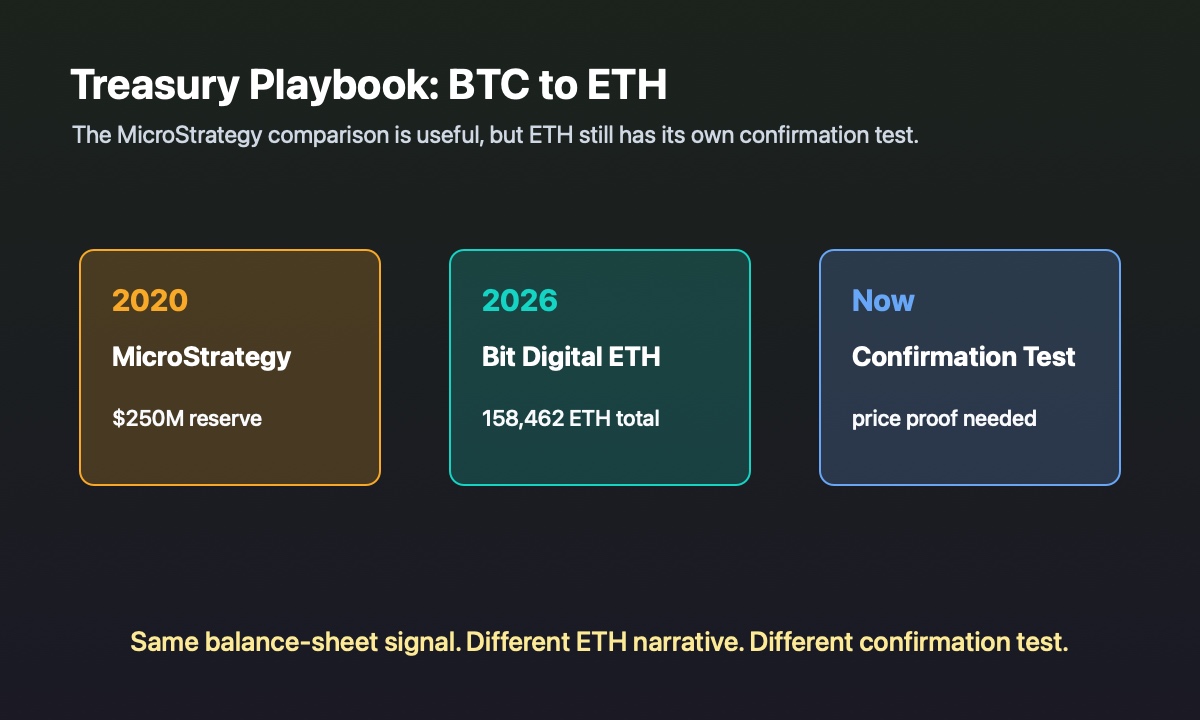
But the differences are just as important. MicroStrategy's 2020 move was larger, earlier, and cleaner as a market signal. It arrived when Bitcoin's corporate-treasury narrative was still new. Bit Digital is operating in a more crowded and more complicated Ethereum landscape. ETH is not just a "digital reserve" pitch. It is also a network-usage, staking, tokenization and layer-2 value-accrual debate. That gives ETH more fundamental angles, but also more places for investors to argue with each other.
The lesson for current ETH is therefore conditional. Corporate treasury accumulation can become a real tailwind if it keeps expanding and if price starts confirming accumulation. But one purchase does not turn a downtrend into a bull market by magic. The market still needs to reclaim resistance and defend support. Otherwise, the story stays impressive on paper and tired on the chart.
Ethereum Price Reaction and K-Line Analysis
ETH did not respond like a market suddenly repricing a major new catalyst. That is the first thing to notice.
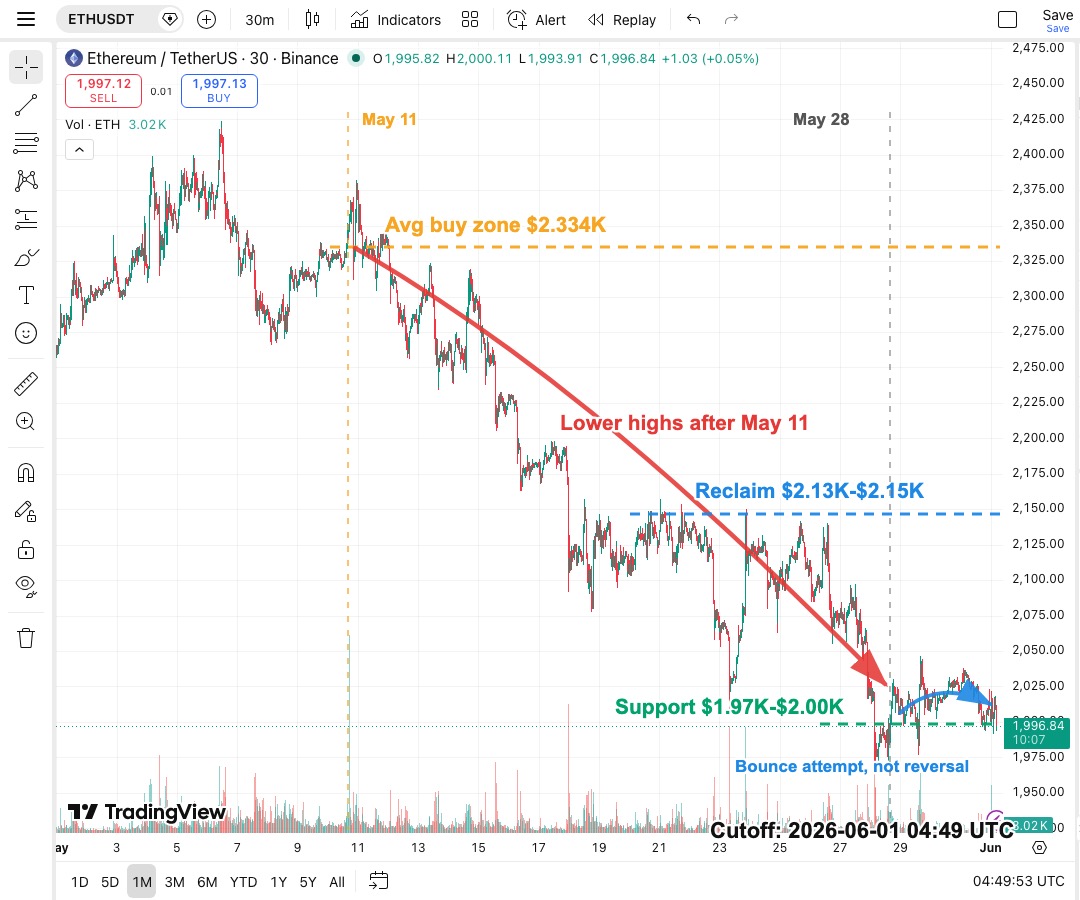
Bit Digital bought near an average price of $2,334.25 on May 11. After that, ETH failed to hold the higher range and slid toward the $2,000 area by the end of May. By the June 1 chart cutoff, ETH was hovering near $1,997 on TradingView's Binance ETHUSDT 30-minute chart.
That tells us the treasury buy was not enough to stop the short-term downtrend.
The chart has three useful zones.
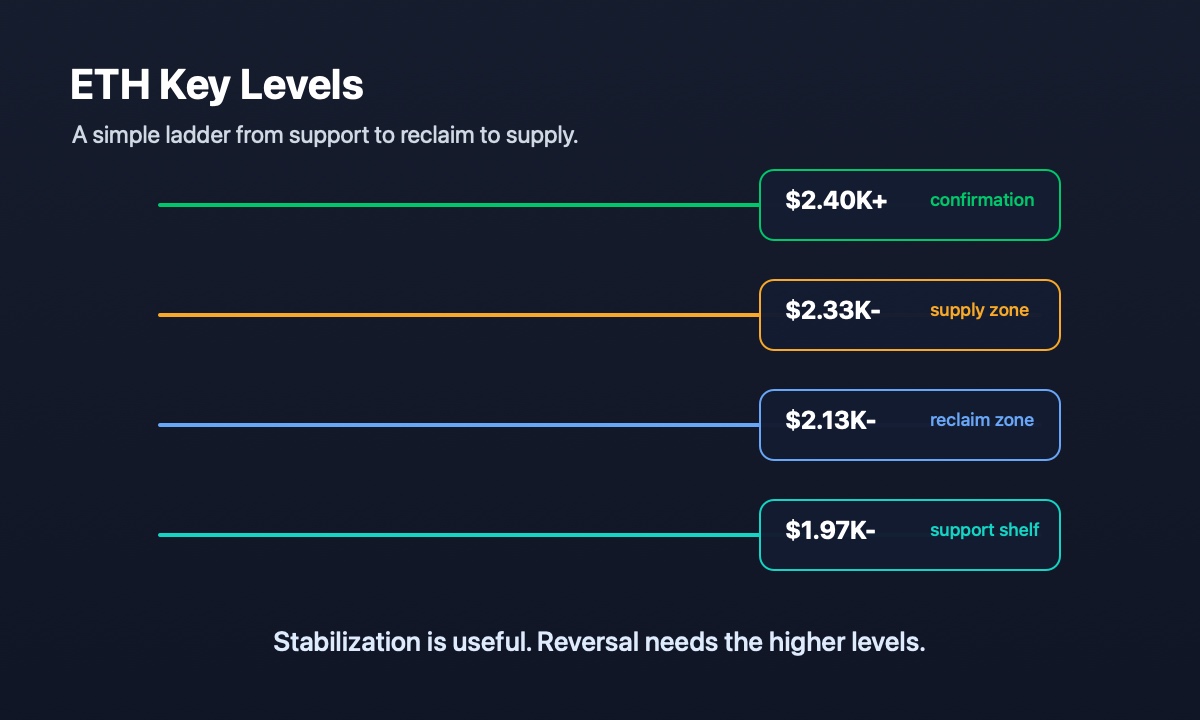
First, the $2,330-$2,400 area is now the heavy supply zone. It is where the Bit Digital purchase price sits, and it is also where ETH repeatedly failed in May. If ETH can reclaim that band later, the treasury story starts to look much better. Until then, that zone is where trapped buyers and sellers may both show up.
Second, $2,130-$2,150 is the first reclaim area. This is the level ETH needs to recover before traders can even talk seriously about a stronger rebound. Below it, rallies are still suspect.
Third, $1,970-$2,000 is the immediate support shelf. ETH has bounced around this area, but not with the kind of authority that says sellers are finished. If this level breaks cleanly, the market will likely start focusing on lower support rather than the corporate treasury narrative.
So the chart message is not bearish panic. It is more restrained than that. ETH is trying to stabilize near $2,000, but stabilization is not the same thing as reversal. The difference is confirmation.
Key Levels to Watch
- Immediate support: $1,970-$2,000
- First reclaim zone: $2,130-$2,150
- Main supply zone: $2,330-$2,400
- Bullish confirmation area: daily closes back above $2,400 with stronger volume
- Bearish invalidation: a clean daily breakdown below $1,970
Conditional Forecast
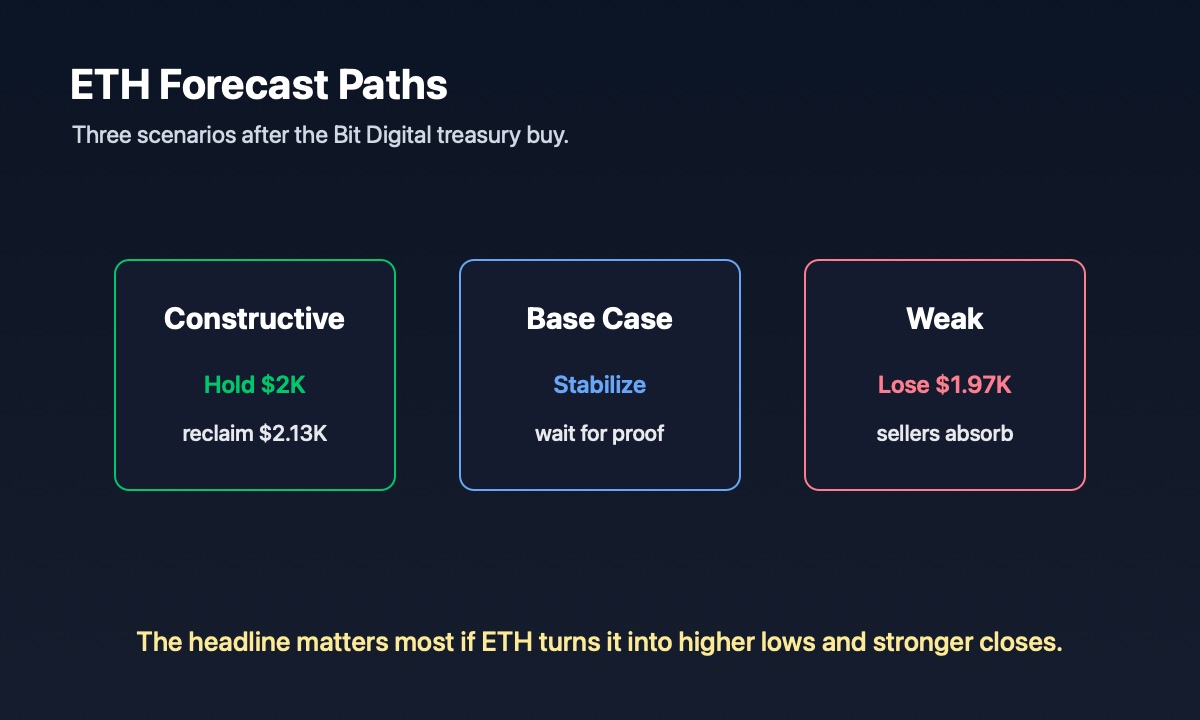
The constructive case is straightforward. If ETH holds $1,970-$2,000 and reclaims $2,130-$2,150, the market can start treating the Bit Digital purchase as part of a broader accumulation story. A later push through $2,330-$2,400 would be the point where the treasury narrative begins to line up with price action.
The weak case is also straightforward, and less fun at parties. If ETH fails to recover $2,130 and loses $1,970, the market is telling us that corporate buying is being absorbed by stronger selling pressure. In that scenario, the Bit Digital headline remains important for long-term adoption, but it becomes less useful as a near-term trading catalyst.
My base case is conditional stabilization. ETH has enough narrative support to avoid being dismissed, but not enough price confirmation to deserve blind optimism. The market is still asking for proof.
Investment Takeaway
Bit Digital's purchase is good for the Ethereum treasury narrative. It shows that some public companies are willing to hold ETH as a strategic asset, not just touch it through products, custody or trading revenue.
But investors should separate narrative quality from entry quality.
The better ETH setup is not "a company bought, therefore price goes up." That is not analysis; that is a wish wearing a blazer.
The better setup is: ETH holds the $2,000 zone, reclaims $2,130-$2,150, then challenges the $2,330-$2,400 supply area where the May treasury-buy range sits. If those steps happen, Bit Digital's purchase becomes part of a stronger accumulation thesis.
If they do not happen, the story is still worth tracking, but the chart remains in charge.
Sources
- Cointelegraph: Bit Digital buys $20M worth of Ethereum, expands treasury to 158K ETH
- TradingView: BINANCE:ETHUSDT 30-minute chart
- CryptoCurrencyChart: Ethereum/TetherUS on Binance market data
- Strategy/MicroStrategy Form 8-K: August 11, 2020 Bitcoin treasury reserve disclosure
|
DISCLAIMER:
1. All content on this website (including but not limited to articles, data, charts, and analyses) is for general informational purposes only and does not constitute any form of investment advice, trading recommendation, or financial guidance. 2. Cryptocurrencies and digital assets are subject to extreme price volatility and high investment risk; you may lose part or all of your principal. Past performance does not predict future results. 3. The information on this website is based on sources we believe to be reliable, but we do not guarantee its accuracy, completeness, or timeliness. Any investment decisions made based on this website’s information are at your own risk. 4. We strongly recommend that you conduct your own thorough research and consult an independent, licensed financial advisor before making any investment decisions. |
Recommended reading
Latest News

