
Key Takeaways
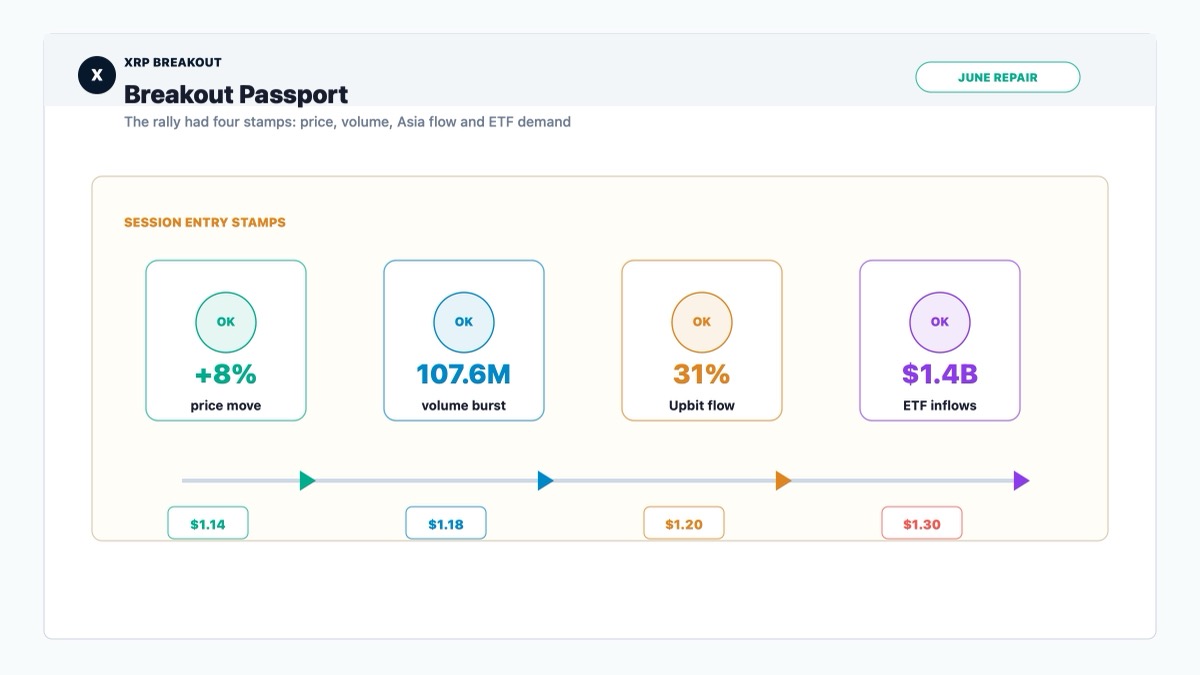
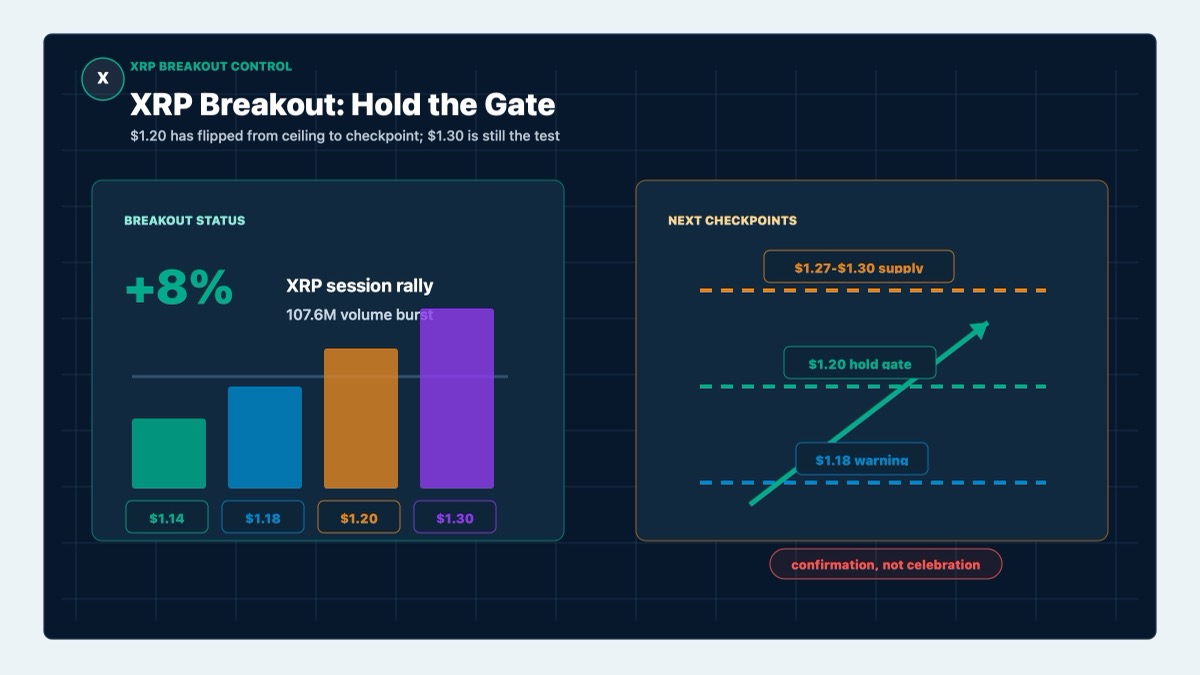
- XRP climbed roughly 8% from $1.1425 to $1.2307, reclaiming $1.14, $1.18 and $1.20 on the strongest volume since the early-June selloff.
- The move is backed by XRP-specific demand signals, including stronger activity from South Korea's Upbit and about $1.4 billion in cumulative XRP ETF inflows.
- The breakout stays constructive above $1.20, but a drop back below $1.18 would make traders question whether this was just another oversold bounce.
What Happened
XRP spent the past two weeks doing the least glamorous job in markets: trying to stop falling.
Now it is trying to do the more interesting job.
According to CoinDesk, XRP jumped from $1.1425 to $1.2307 during the session, gaining roughly 8% in its first major breakout since the June selloff. The token did not just drift higher. It pushed through $1.14, then $1.18, then $1.20, with volume surging during the June 14 21:00 UTC session to 107.6 million XRP.
That matters because markets have two very different kinds of bounces.
There is the sad kind, where price rises because sellers pause for lunch.
And there is the more serious kind, where buyers show up with enough force to break the levels that had been trapping every recovery attempt.
This XRP move belongs closer to the second category.
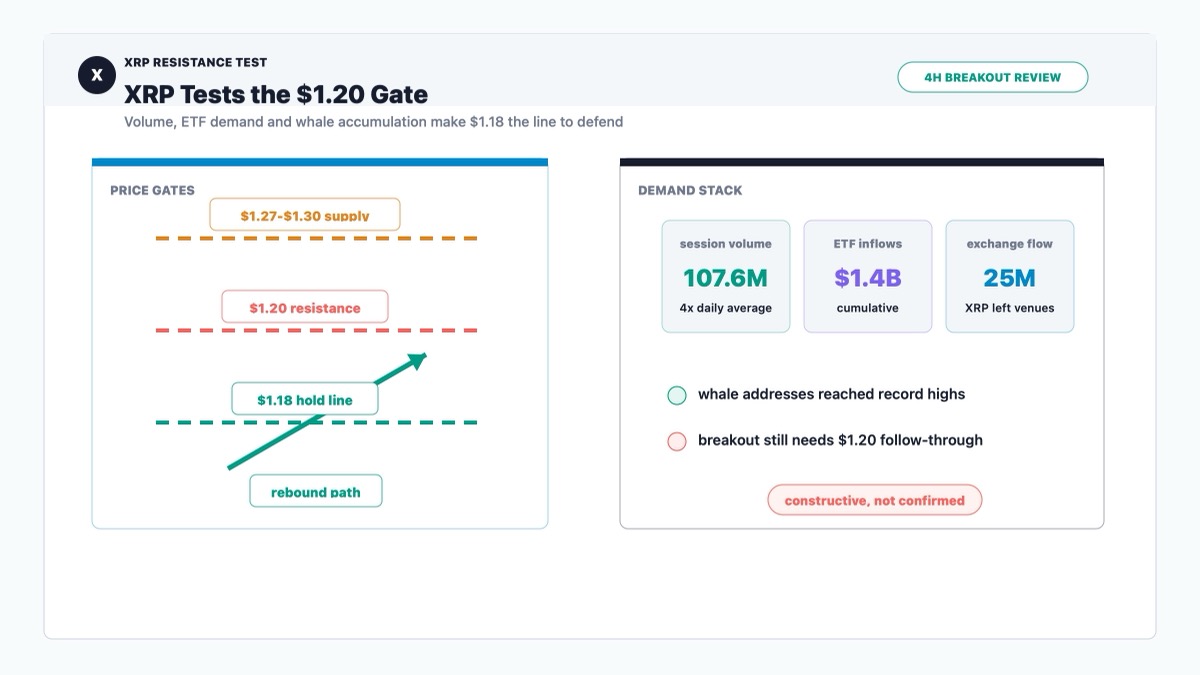
The news also has a demand layer. CoinDesk reported that South Korea's Upbit accounted for 31% of XRP wallet-flow dominance by June 14, up from 13% a week earlier. XRP ETF products have also continued to attract capital, with cumulative net investment around $1.4 billion since launch.
So the rally is not just a candle on a chart. It is a candle with a story underneath it: Asia-led flow, institutional access through ETFs and a market that had been leaning too hard toward further weakness.
But the story still has to survive the chart.
$1.20 is now the first line bulls need to defend. Above it, the breakout can keep building. Below $1.18, the market may decide this was not a trend change.
Just a better-looking bounce.
Why This Matters for Bitcoin and Crypto Markets
XRP is not the whole crypto market.
But large-cap altcoins often tell us when crypto risk appetite is changing shape.
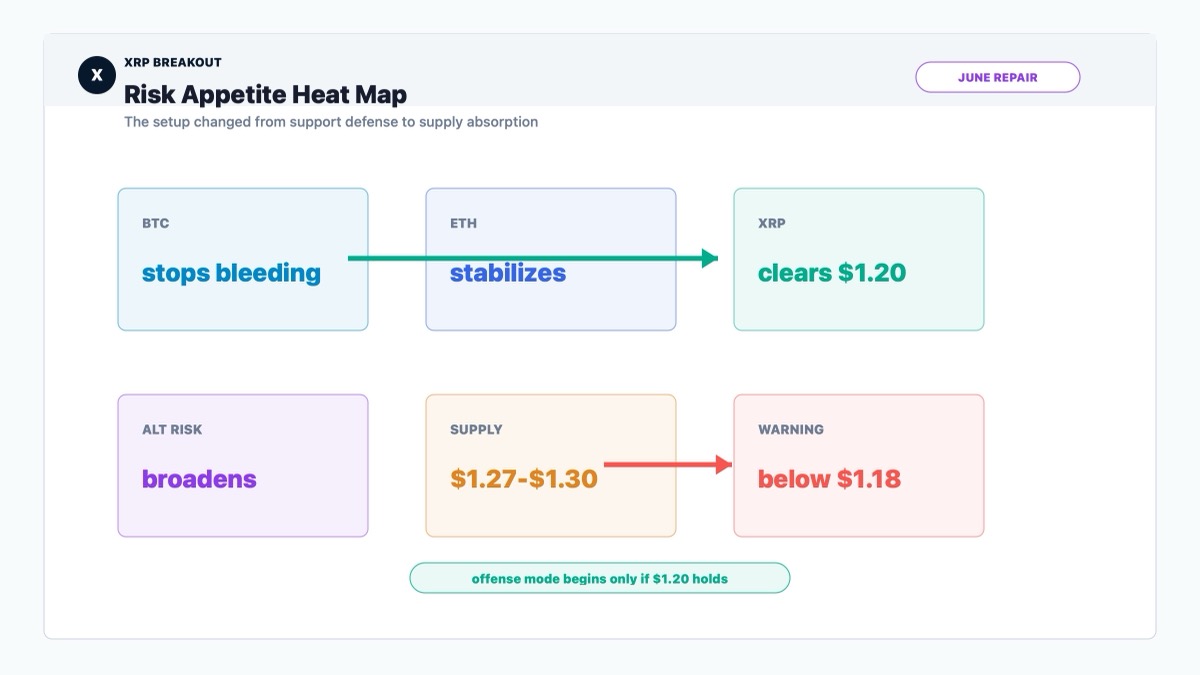
Bitcoin can bounce because macro conditions improve. Ethereum can stabilize because liquidity comes back. But when XRP starts breaking resistance on heavy volume, the message is more specific: traders are no longer only hiding in the safest crypto names. They are willing to buy a narrative-heavy, high-liquidity altcoin after a painful correction.
That is a different mood.
The important thing is not simply that XRP rose. Coins rise all the time. Crypto is very good at producing dramatic green candles that later turn out to be elaborate traps with nice lighting.
The important thing is where XRP rose from and what it reclaimed.
Before this move, XRP's chart was defensive. The market was asking whether $1.05-$1.09 could hold. Buyers were not trying to win. They were trying not to lose.
After the breakout, the question changed. Now traders are asking whether XRP can hold $1.20 and pressure $1.27-$1.30. That is the difference between a market defending support and a market testing supply.
This matters for the broader market because altcoin rotation usually needs proof. It needs liquidity. It needs volume. It needs a story that is not just "number went up." XRP now has a cleaner version of that setup than it had a week ago.
Still, this is not a victory lap.
The broader downtrend has not vanished because one session got loud. The $1.27-$1.30 zone is where old supply may show up again. If XRP fails there, the market can quickly return to suspicion.
So this is a useful signal.
Not a permission slip to turn your brain off.
Historical Parallel
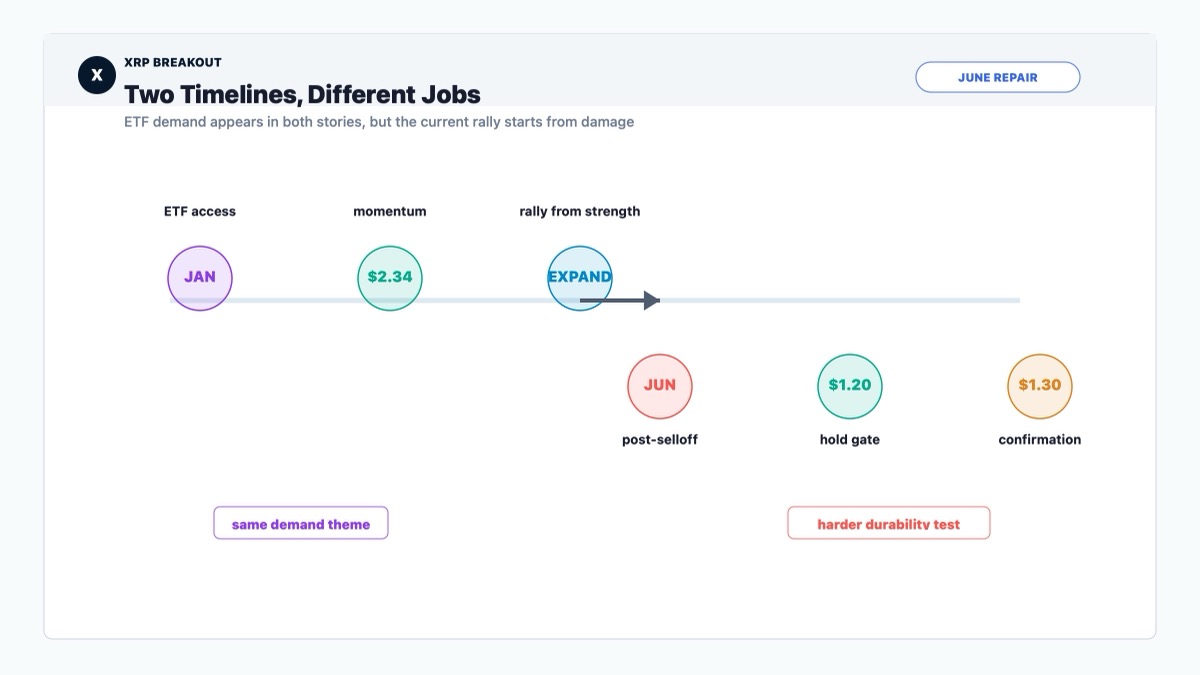
A useful historical parallel is XRP's early-2026 ETF-driven rally, when the token surged as investors treated spot XRP exchange-traded products as a new demand channel rather than just another headline. Barron's reported in January 2026 that XRP jumped more than 9% to around $2.34, with spot XRP ETF inflows cited as a major driver after the products launched in late 2025.
The similarity is the demand mechanism. In both cases, XRP's price action was not only about chart traders discovering a green candle and getting emotionally attached to it. The move was tied to the idea that a new pool of buyers had become more active. In January, that pool was framed around spot ETF access. In the current move, CoinDesk points to roughly $1.4 billion in cumulative XRP ETF inflows, plus stronger Upbit-linked activity and improving momentum after the $1.05-$1.09 support zone held.
The difference is the starting point. The January rally came from a stronger market structure, when ETF demand helped extend an already active momentum story. This breakout is more of a repair job. XRP had just spent weeks under pressure, with traders watching whether the June selloff would keep grinding lower. That means the current rally has less room for laziness. It has to hold reclaimed levels quickly, because failed recoveries after sharp selloffs tend to invite fast skepticism.
The lesson is simple: demand stories can start a move, but structure decides whether the move becomes durable. ETF inflows and Asia-led activity explain why buyers had a reason to step in. The $1.20 level will help show whether those buyers are willing to stay.
January was about expansion.
This is about confirmation.
XRP Price Reaction and K-Line Analysis
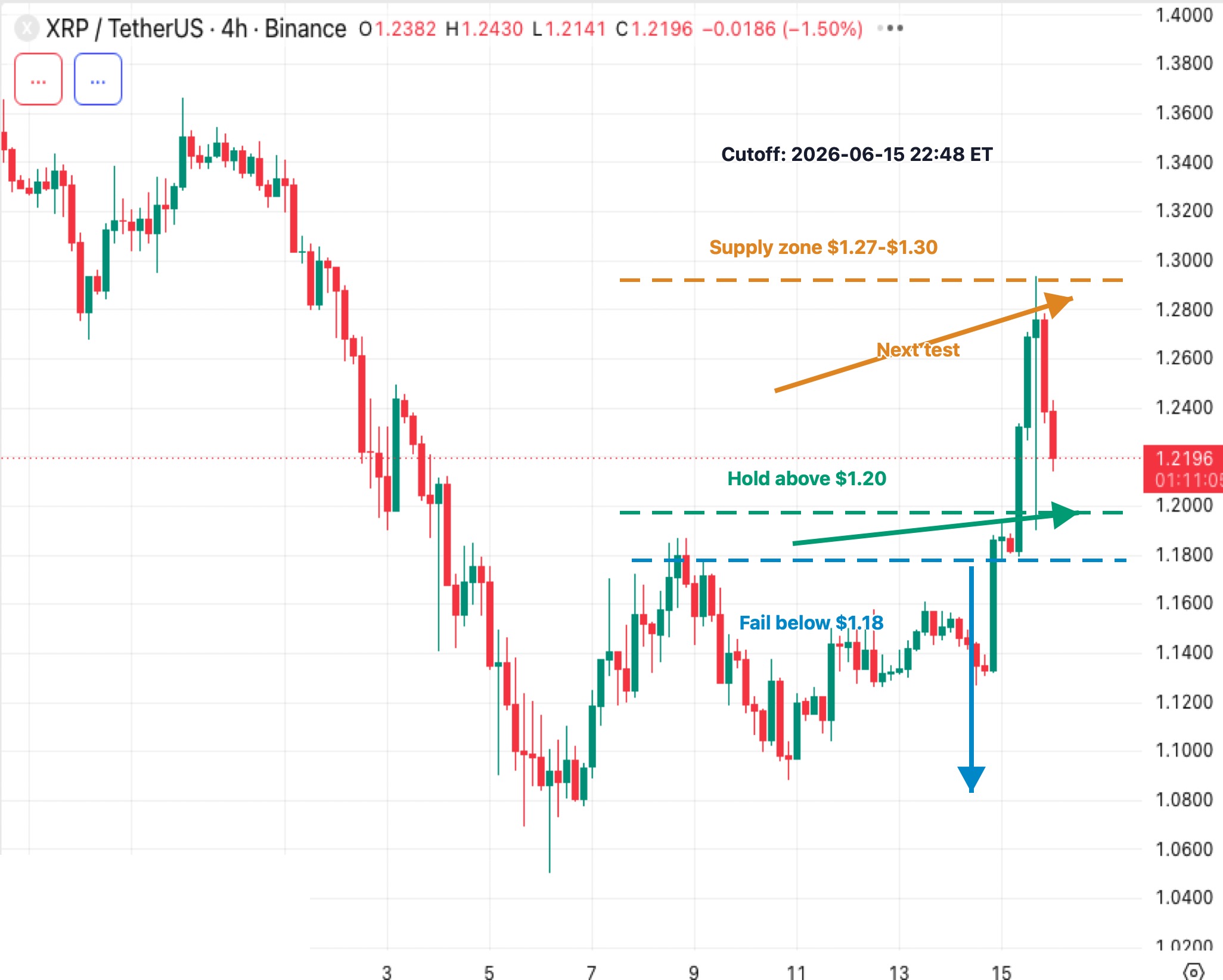
The XRPUSDT 4H chart shows the market changing personality.
On the left side of the chart, XRP is still living inside the June selloff: lower highs, heavy red candles and repeated failure to hold the $1.20 area. That section is the reason this breakout matters. The market was not starting from calm. It was starting from damage.
Then XRP built a base near the $1.05-$1.09 support region, recovered through $1.14, pushed through $1.18 and finally reclaimed $1.20. That sequence is important because it shows layered repair. One level is noise. Three reclaimed levels start to look like intent.
The first job now is simple: hold above $1.20.
If XRP can stay above that level, the breakout becomes cleaner. It would show that the market is not just reacting to a fast volume spike, but accepting a higher trading range.
The next test is the $1.27-$1.30 supply zone. That area matters because it sits above the breakout candle and near prior resistance. It is where traders who bought lower may take profit and where trapped buyers from the earlier decline may try to exit.
The downside line is $1.18. A dip into that area would not automatically ruin the chart, but a fast loss of $1.18 would change the tone. It would tell traders the market could not defend the breakout structure after the first burst of buying.
In other words, XRP has done the impressive part.
Now it has to do the boring part.
Hold the level.
Key Levels to Watch
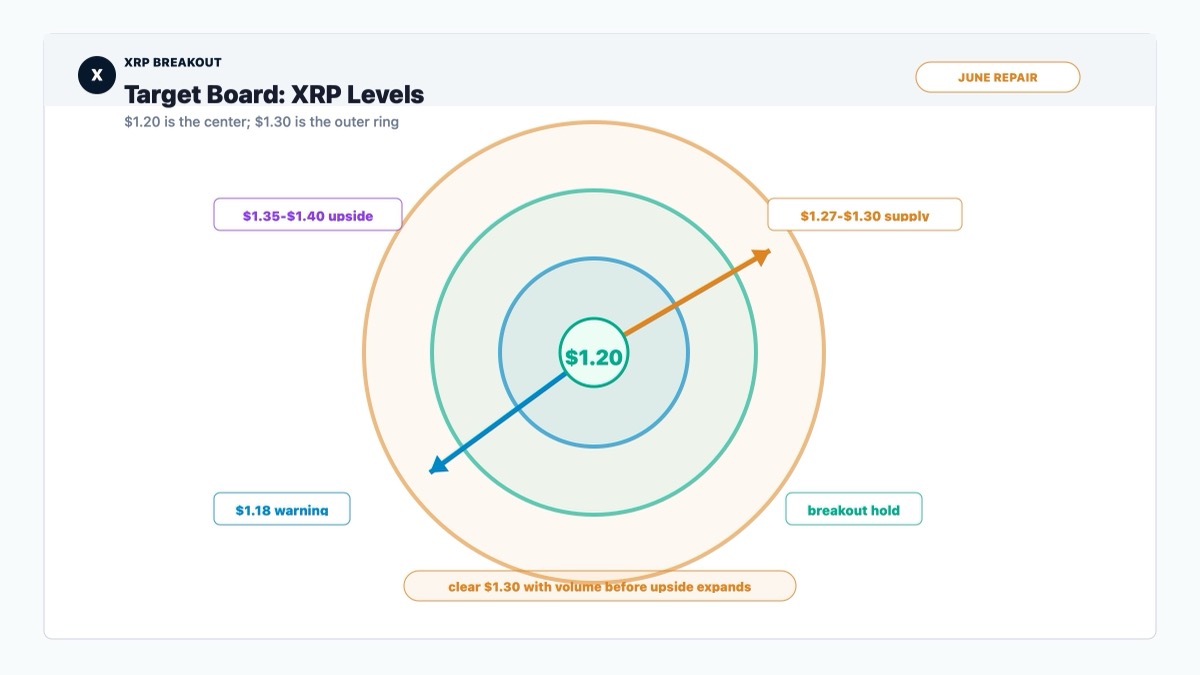
- $1.20: The breakout hold level. Staying above it keeps the rally constructive.
- $1.18: The first warning line. Losing it would make the breakout look less convincing.
- $1.27-$1.30: The next major supply zone and the real test of follow-through.
- $1.35-$1.40: The next upside discussion if XRP clears $1.30 with volume.
Conditional Forecast
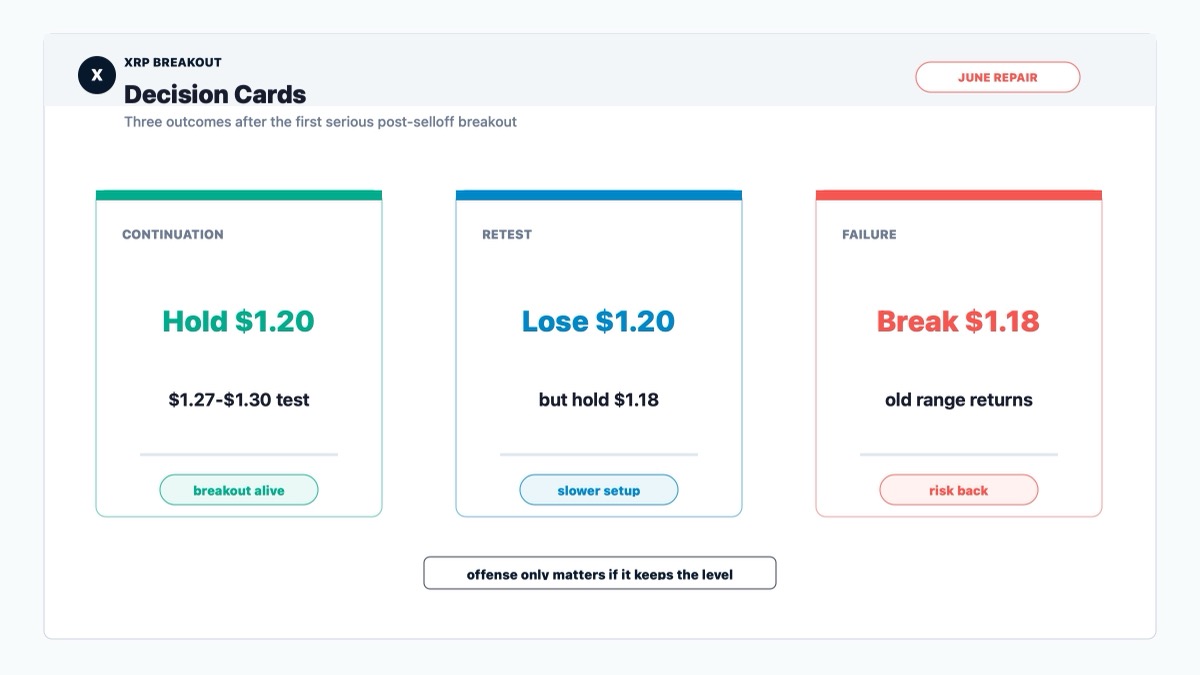
If XRP holds above $1.20, the market has a clean path to test $1.27-$1.30. A strong break through that zone would make traders reconsider whether the June selloff has already exhausted itself.
If XRP slips below $1.20 but holds $1.18, the setup becomes slower but still alive. That would look less like a failed breakout and more like a retest of the reclaimed range.
If XRP drops below $1.18 quickly, the tone changes. Traders would likely treat the move as another oversold bounce, especially if volume fades and price falls back into the old range.
The cleanest read is this: XRP has shifted from defense to offense, but offense only matters if it can keep the ball.
Investment Takeaway
XRP's breakout is meaningful because it combines three things that traders actually care about: reclaimed levels, heavy volume and a demand story.
That is a real improvement.
But it is not the same thing as a finished reversal. The move above $1.20 puts XRP back on the map. The move through $1.27-$1.30, if it happens, would change the map.
For investors, the practical version is simple. Above $1.20, XRP deserves attention. Above $1.30, the recovery becomes much harder to dismiss. Below $1.18, caution comes back quickly.
This is the first serious breakout since the selloff.
Now the market gets to decide whether serious means sustainable.
Sources
|
DISCLAIMER:
1. All content on this website (including but not limited to articles, data, charts, and analyses) is for general informational purposes only and does not constitute any form of investment advice, trading recommendation, or financial guidance. 2. Cryptocurrencies and digital assets are subject to extreme price volatility and high investment risk; you may lose part or all of your principal. Past performance does not predict future results. 3. The information on this website is based on sources we believe to be reliable, but we do not guarantee its accuracy, completeness, or timeliness. Any investment decisions made based on this website’s information are at your own risk. 4. We strongly recommend that you conduct your own thorough research and consult an independent, licensed financial advisor before making any investment decisions. |
Recommended reading
Latest News

