Bitcoin Price Prediction: BTC Risks February Low Retest as AI Trade Drains Capital
Key Takeaways
- Bitcoin lost the $67,000 level on June 2, turning a normal pullback into a more serious test of market structure.
- The move was not just spot selling: CoinDesk reported more than $1.3 billion in long liquidations across crypto derivatives, with BTC accounting for over $700 million.
- K33 warned that capital is favoring AI stocks and expected AI-linked IPOs over crypto, while spot Bitcoin ETF outflows have weakened institutional demand.
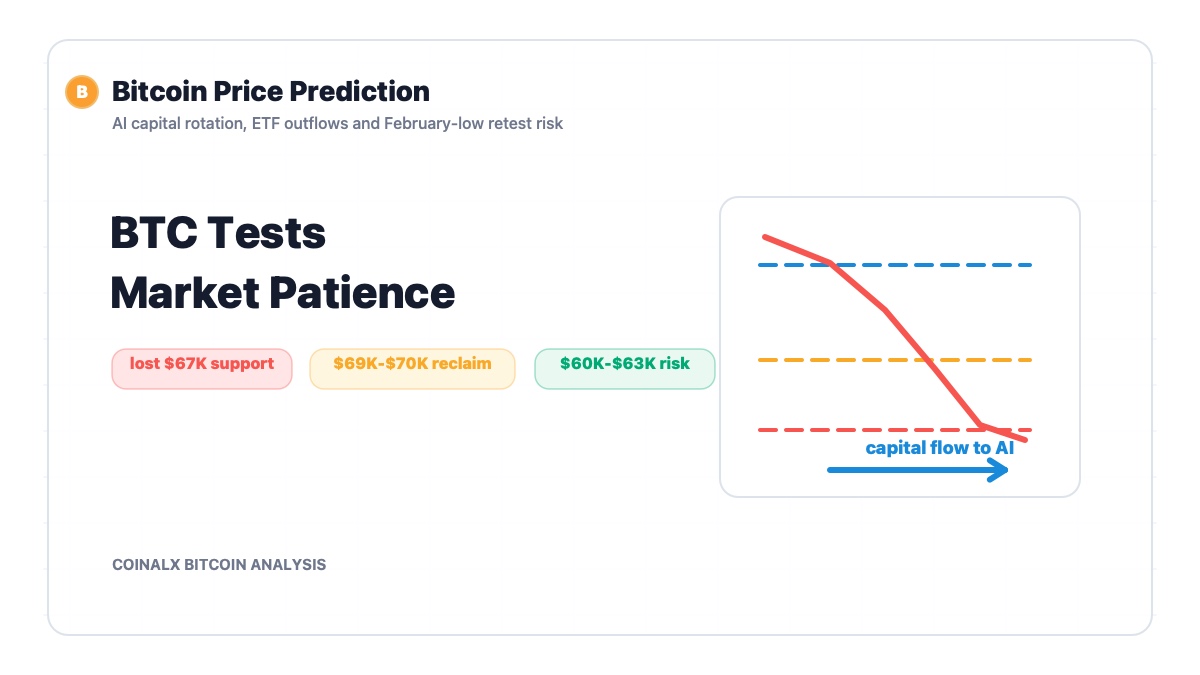
- BTC now needs to reclaim the $69,000-$70,000 area quickly; otherwise, the $60,000-$63,000 February retest zone becomes the market's next uncomfortable conversation.
What Happened
Bitcoin's latest drop was sharp enough to change the tone of the market.
According to CoinDesk's June 2 live market coverage, BTC fell below $67,000 during the U.S. session and traded as low as roughly $66,300. At one point, Bitcoin was down about 6% on the day, while major crypto assets such as Ether, XRP and Solana also weakened. That part is the easy headline.
The harder part is what sat underneath it.
CoinDesk reported that crypto derivatives saw their largest liquidation event since February, with more than $1.3 billion in long positions wiped out over 24 hours. Bitcoin alone accounted for more than $700 million of those forced closures. In plain English: this was not only people deciding to sell. It was also leverage being dragged out of the room by the collar.
The timing matters. U.S. equity indexes were relatively steady, and AI-linked assets continued to attract capital. The same CoinDesk coverage noted Google's planned $80 billion stock sale to fund AI infrastructure, including $10 billion tied to Berkshire Hathaway, while attention around future AI and technology IPOs remained intense.
That contrast is the point. Bitcoin was not falling in a market where everything was on fire. It was falling while another trade was still being fed.
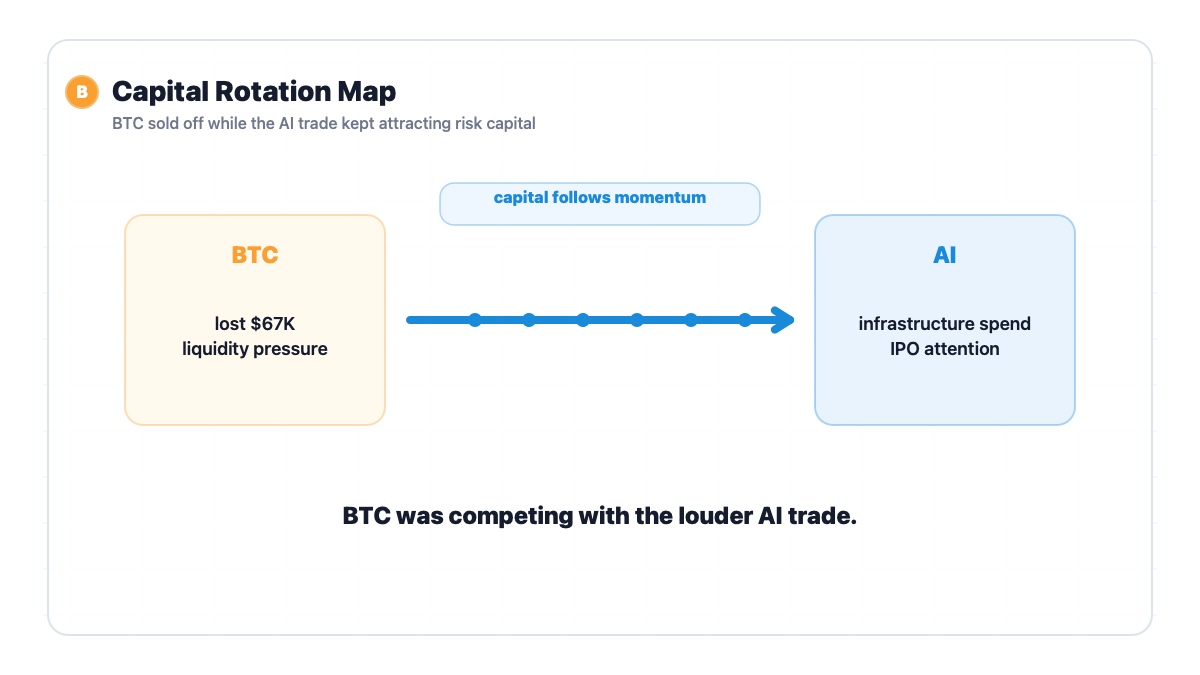
K33's Vetle Lunde framed the pressure as more than weak price action. Investors, in that reading, are comparing Bitcoin with the AI trade and choosing the asset class that still feels hotter, more institutional, and less emotionally exhausting. Bitcoin, for all its grand monetary mythology, still has to compete for marginal capital. It does not get a free throne just because the logo is orange.
Why This Matters for Bitcoin and Crypto Markets
This matters because Bitcoin's problem is no longer only price. It is attention, liquidity and patience.
When BTC fails to reclaim a major moving average, ETF flows turn negative, and leverage builds into a thin market, the structure gets brittle. A single red candle can become a liquidation chain. A liquidation chain can become a narrative. And once the narrative changes from "healthy dip" to "retest the lows," traders start treating every bounce with suspicion.
The ETF flow detail is especially important. CoinDesk cited K33's estimate that spot Bitcoin ETFs had seen nearly 63,000 BTC of outflows over the prior three weeks, the second-largest outflow streak on record. That does not mean institutions have abandoned Bitcoin forever. It does mean the passive demand cushion looks thinner right now.
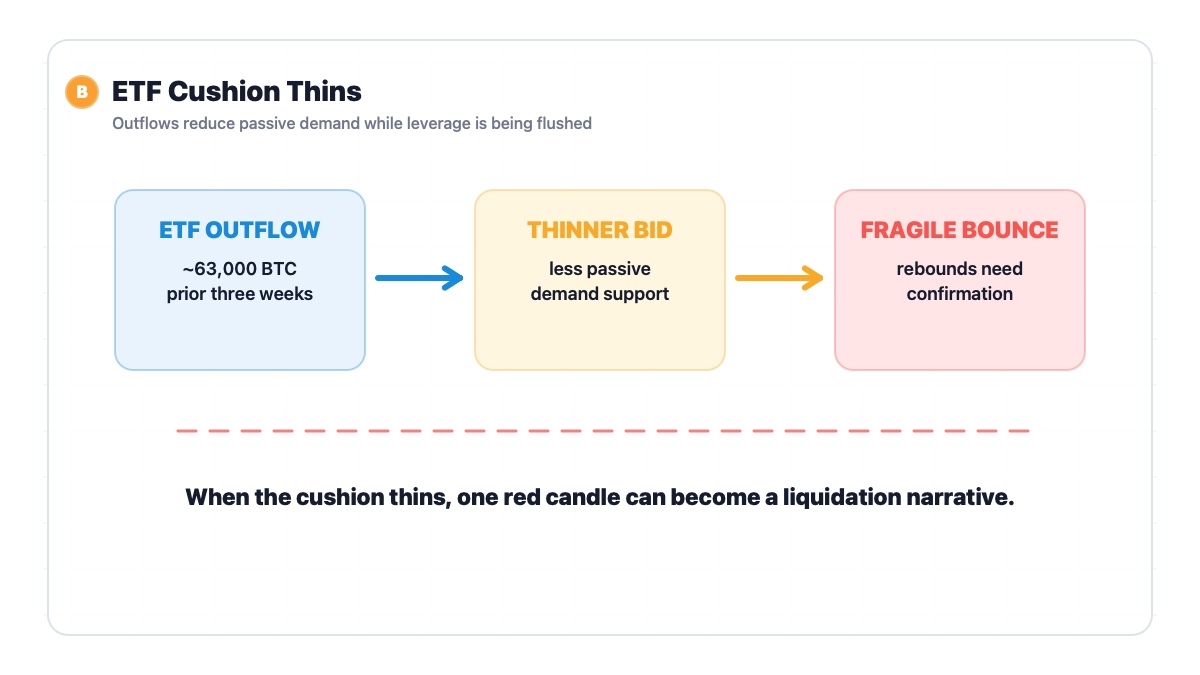
This is where the AI rotation becomes more dangerous. A bearish Bitcoin market can recover when investors still want crypto exposure. A bearish Bitcoin market struggles more when investors are busy elsewhere. AI stocks, AI infrastructure spending, and expected mega-IPOs create a powerful opportunity-cost argument: why sit through Bitcoin chop if the market is rewarding another theme immediately?
That does not make Bitcoin broken. It makes it accountable.
For crypto markets, the message is simple: BTC is still the liquidity anchor. If Bitcoin stabilizes above the mid-$60,000s and recovers $70,000, altcoins can breathe. If it loses that area and the market starts pricing a real February-low retest, risk appetite across crypto can compress quickly. In that scenario, even good altcoin stories may trade like passengers on someone else's bus.
Historical Parallel: February 2026's Liquidation Flush
The closest historical parallel is Bitcoin's February 2026 liquidation flush, the same episode CoinDesk referenced when describing the June 2 derivatives wipeout as the largest since February.
In that earlier move, BTC briefly pushed toward the $60,000 area during a winter panic, while leverage was forced out of the market at speed. CoinDesk's June 2 coverage specifically pointed back to that February decline and noted that February's low was essentially the bottom of that panic. The structure was familiar: crowded long exposure, falling spot price, forced selling, and then a market forced to decide whether the flush was a bottoming event or the start of a deeper trend.
The similarity is the liquidation engine. In both cases, BTC did not simply drift lower because buyers were lazy. Leverage accelerated the move. Once important levels broke, forced exits added mechanical pressure, which made the chart look worse and sentiment feel worse. Markets love to pretend they are philosophical debates. During liquidation events, they become plumbing.
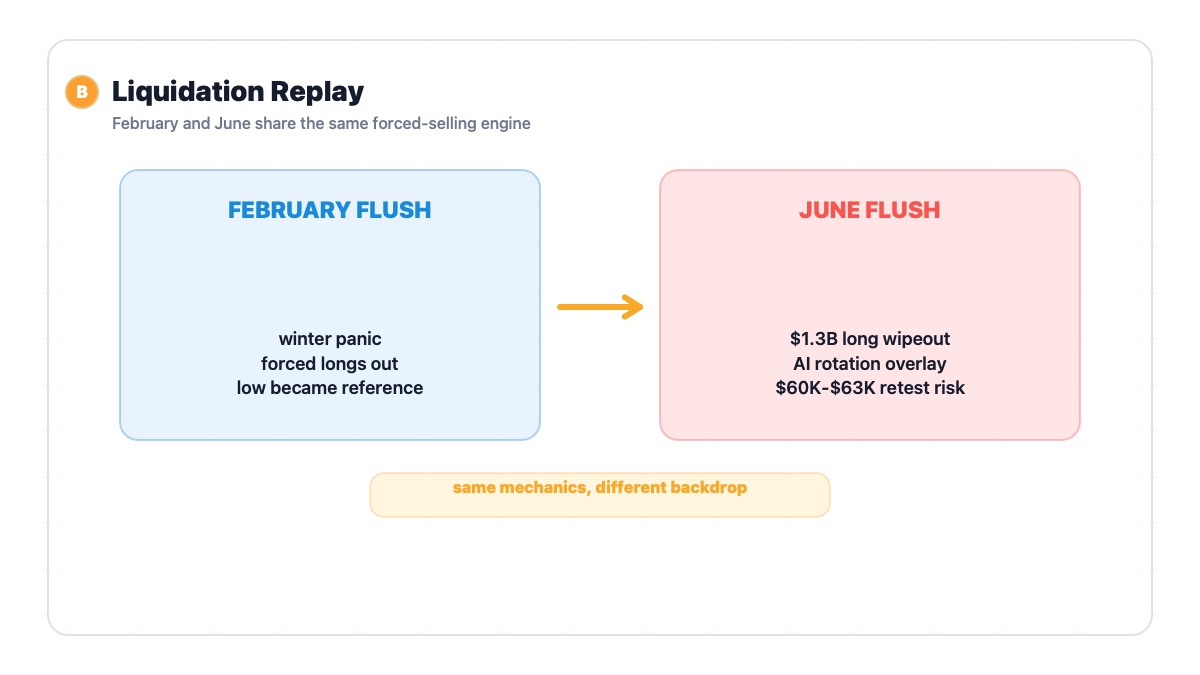
The difference is the macro backdrop. February's selloff looked more like a direct crypto panic. The current June move is more complicated because capital is being pulled toward a competing growth story: AI. K33's warning about investors rotating into AI stocks and away from crypto changes the interpretation. If Bitcoin rebounds quickly, this can still look like another leverage reset. If ETF outflows continue and AI keeps absorbing risk capital, the market may not get the same easy recovery pattern.
The lesson for current BTC price action is conditional. A fast reclaim of $69,000-$70,000 would suggest the June flush is being absorbed. Failure there keeps the $60,000-$63,000 zone alive as a realistic retest area, not a dramatic bear-posting fantasy.
Bitcoin Price Reaction and K-Line Analysis
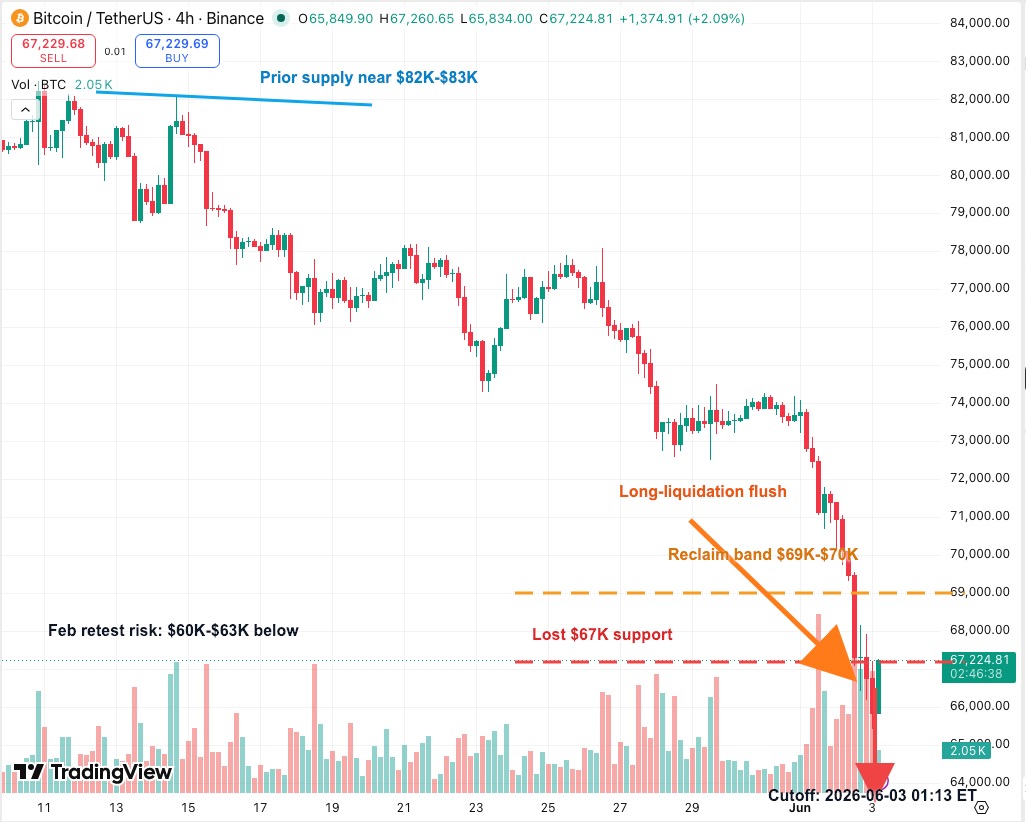
The 4-hour BTCUSDT chart shows why the market's tone changed so quickly.
Bitcoin had already been leaking from the $82,000-$83,000 supply area before the June 2 break. That earlier failure matters because it tells us the market was not strong before the liquidation wave arrived. The drop below $70,000 then turned into a fast slide through the $67,000 area, with volume expanding into the decline.
That is not a graceful pullback. It is a momentum break.
The first level to watch is the $69,000-$70,000 reclaim band. If BTC can recover that zone and hold it, the market can start arguing that the liquidation event has been absorbed. It would not erase the ETF outflow issue or the AI capital rotation problem, but it would at least stop the chart from looking like a staircase with missing steps.
The second level is $67,000. BTC was hovering near that area at the chart cutoff, and the market was attempting to stabilize. The key word is attempting. A few green candles after a forced selloff are not automatically strength; sometimes they are just the market catching its breath before deciding whether it has a spine.
Below that, the $60,000-$63,000 area is the real danger zone. That is where the February-low retest discussion becomes practical. A move into that area would not require a new disaster. It would only require weak ETF demand, failed rebounds, and continued preference for AI-linked risk assets.
Key Levels to Watch
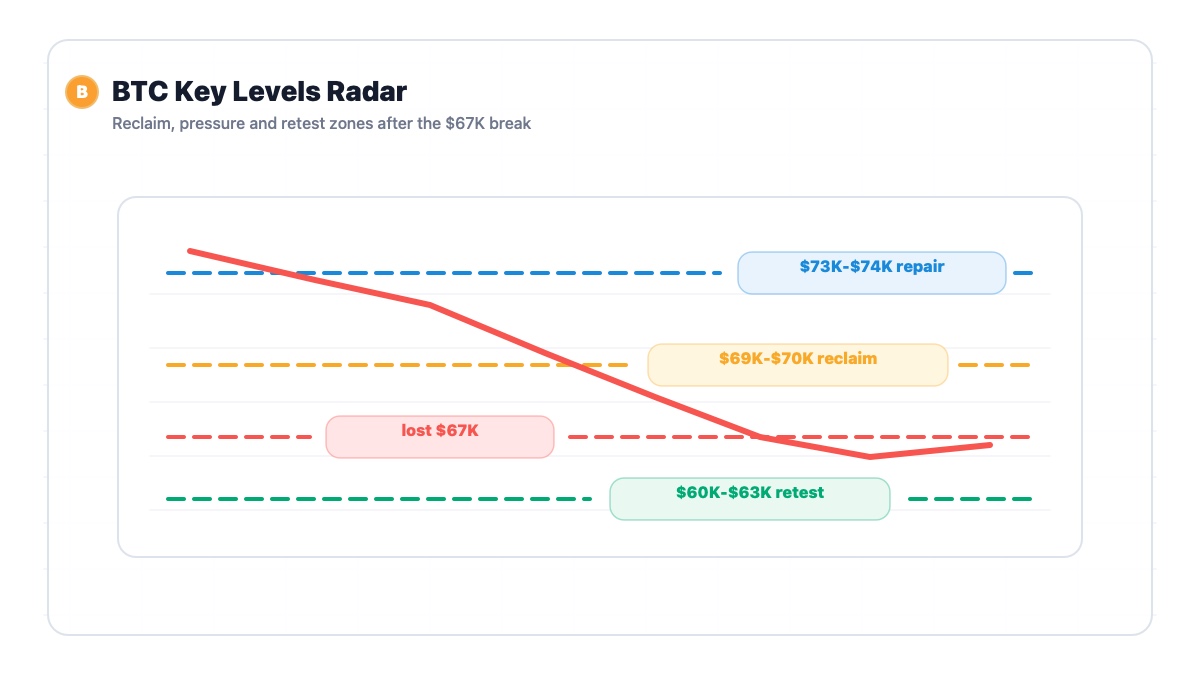
The immediate reclaim zone is $69,000-$70,000. BTC needs to get back above this range to weaken the bearish setup.
The short-term pressure line is $67,000. Holding near this level keeps stabilization possible; losing it cleanly keeps sellers in control.
The deeper retest zone is $60,000-$63,000. That is the area traders will watch if the market starts replaying February's liquidation psychology.
The upside repair zone sits around $73,000-$74,000. A recovery into that range would show that buyers are doing more than defending a broken level.
Conditional Forecast
If BTC reclaims $69,000-$70,000 quickly, the June 2 selloff can be treated as a leverage flush inside a broader corrective phase. In that case, the market may chop sideways while ETF flows and macro risk appetite decide the next leg.
If BTC fails at that reclaim zone, the bearish case becomes cleaner. The market would then have lower highs, a broken $67,000 support area, weak institutional flow, and a competing AI trade absorbing capital. That combination points toward a possible $60,000-$63,000 retest.
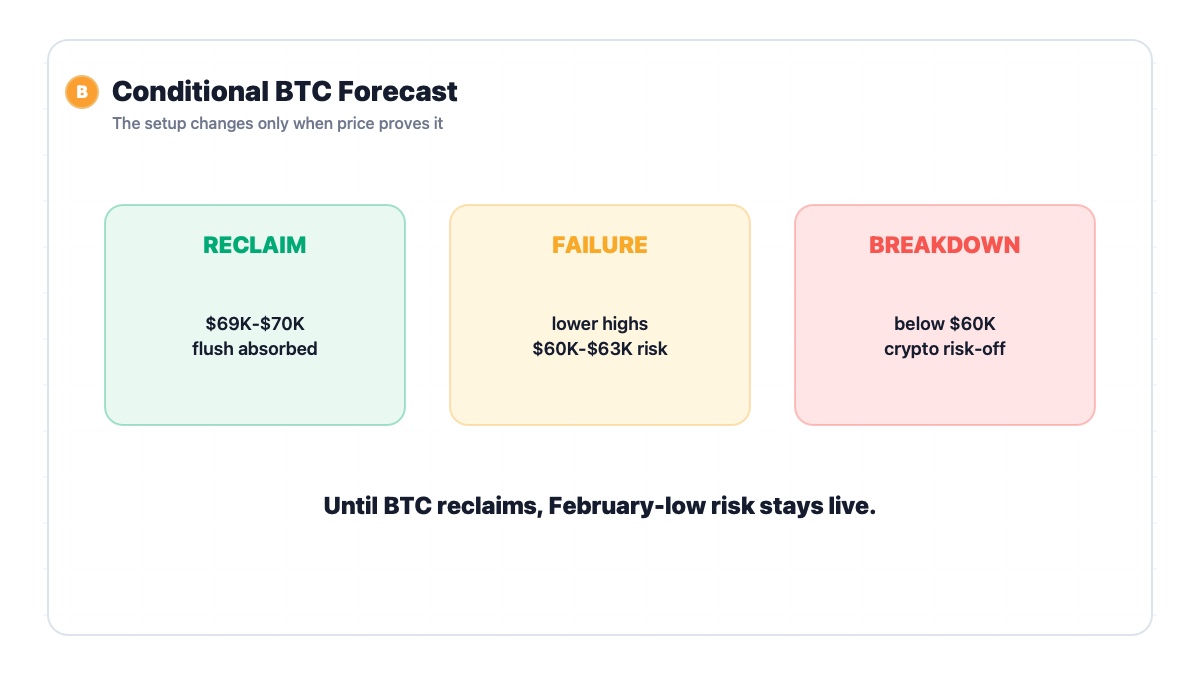
If BTC breaks below $60,000 with volume, the conversation changes again. At that point, this is no longer a tidy retest of February's lows. It becomes a broader risk-off event for crypto, and altcoins would likely feel the pressure first and louder.
Investment Takeaway
The smarter Bitcoin view here is not "bullish" or "bearish." It is conditional.
BTC is still a structurally important asset, but this setup asks for humility. ETF demand has softened, leverage has been punished, and the AI trade is offering investors a shinier place to park capital. Bitcoin can recover from that, but it has to prove it on the chart.
For long-term investors, the $60,000-$63,000 zone may become strategically important if it arrives with exhaustion rather than panic expansion. For traders, the cleaner signal is higher up: BTC needs to reclaim $69,000-$70,000 before the market deserves the benefit of the doubt.
Until then, Bitcoin is not dead. It is being repriced by a market that has found a louder party across the street.
Sources
- CoinDesk: Live markets: bitcoin loses $67,000 level in Tuesday plunge, putting February's lows back in play
- TradingView: BTCUSDT chart, Binance
- CoinGlass: Crypto liquidation data
|
DISCLAIMER:
1. All content on this website (including but not limited to articles, data, charts, and analyses) is for general informational purposes only and does not constitute any form of investment advice, trading recommendation, or financial guidance. 2. Cryptocurrencies and digital assets are subject to extreme price volatility and high investment risk; you may lose part or all of your principal. Past performance does not predict future results. 3. The information on this website is based on sources we believe to be reliable, but we do not guarantee its accuracy, completeness, or timeliness. Any investment decisions made based on this website’s information are at your own risk. 4. We strongly recommend that you conduct your own thorough research and consult an independent, licensed financial advisor before making any investment decisions. |