Key Takeaways
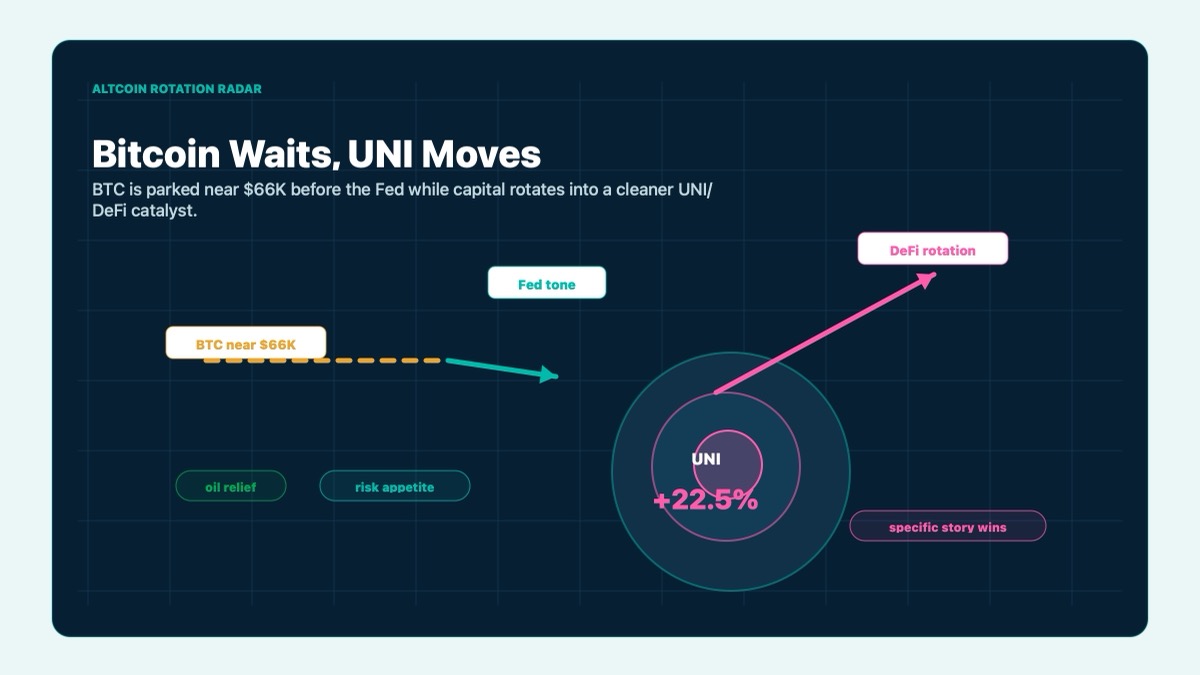
- Bitcoin held near $65,800-$66,000 before the Fed decision, even as it stayed up 7.4% on the week.
- Capital rotated into altcoins, led by Uniswap's UNI jumping 22.5% after Standard Chartered set a $100 long-term target.
- Lower oil and stronger risk appetite help the setup, but the Fed's tone still decides whether this becomes durable altcoin rotation or just a fast thematic chase.
What Happened
Bitcoin did not really move.
That sounds boring until you look at what moved instead.
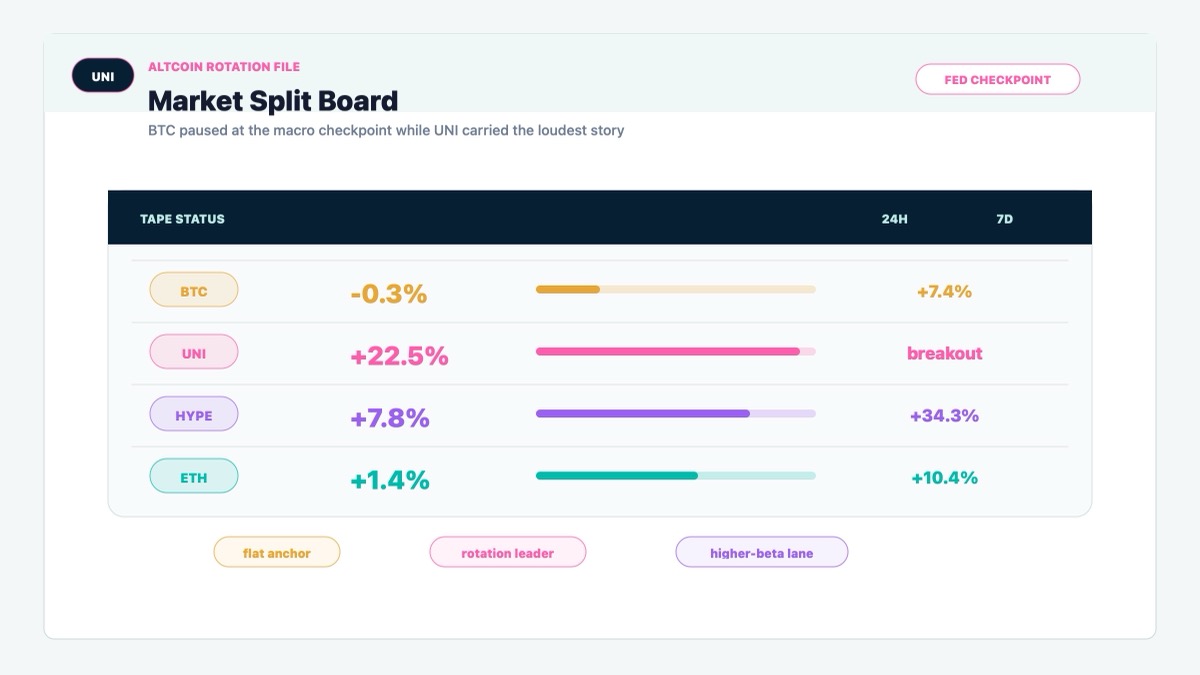
According to CoinDesk, BTC traded around $65,800 on Wednesday, down 0.3% over 24 hours but still up 7.4% for the week. The market was waiting for the Federal Reserve's first rate decision under new Chair Kevin Warsh, which made Bitcoin look like a large asset standing very still in the middle of a noisy room.
The noise was in altcoins.
Uniswap's UNI jumped 22.5% to $3.53 after Standard Chartered initiated coverage with a $100 price target by 2030. Geoffrey Kendrick, the bank's head of digital assets research, framed Uniswap as a foundational layer of the onchain economy. Crypto Briefing and other market outlets also reported the same $100 target, linking the call to tokenized assets, DeFi expansion and Uniswap's potential fee revenue.
UNI was not alone. Hyperliquid's HYPE rose 7.8% on the day and 34.3% on the week. Solana was flat on Wednesday but up 14.7% over seven days. Ether gained 1.4% to $1,793 and was up 10.4% on the week. XRP slipped 0.9% to $1.22.
So the market was not asleep.
It was rotating.
The macro backdrop helped. Brent crude fell below $79 a barrel, its lowest level in more than three months, as traders priced in a prospective US-Iran deal tied to the reopening of the Strait of Hormuz. Lower oil reduces inflation pressure. Lower inflation pressure gives risk assets a little more oxygen. A bond rally added to that relief.
But Bitcoin did not run.
That is the interesting part.
The market had a better macro backdrop and still chose to express excitement through altcoins rather than BTC. That tells us traders were not simply buying "crypto" as one giant blob. They were choosing specific stories.
And for one day, UNI had the loudest story.
Why This Matters for Bitcoin and Crypto Markets
There are two ways to misread this kind of market.
The first is to say Bitcoin was flat, so nothing happened.
The second is to say UNI was up 22%, so everything is bullish.
Both are too lazy.
What actually happened is more useful: Bitcoin paused at the macro checkpoint, while money moved into higher-beta crypto stories. That is what capital rotation looks like before it becomes obvious enough for everyone to name it.
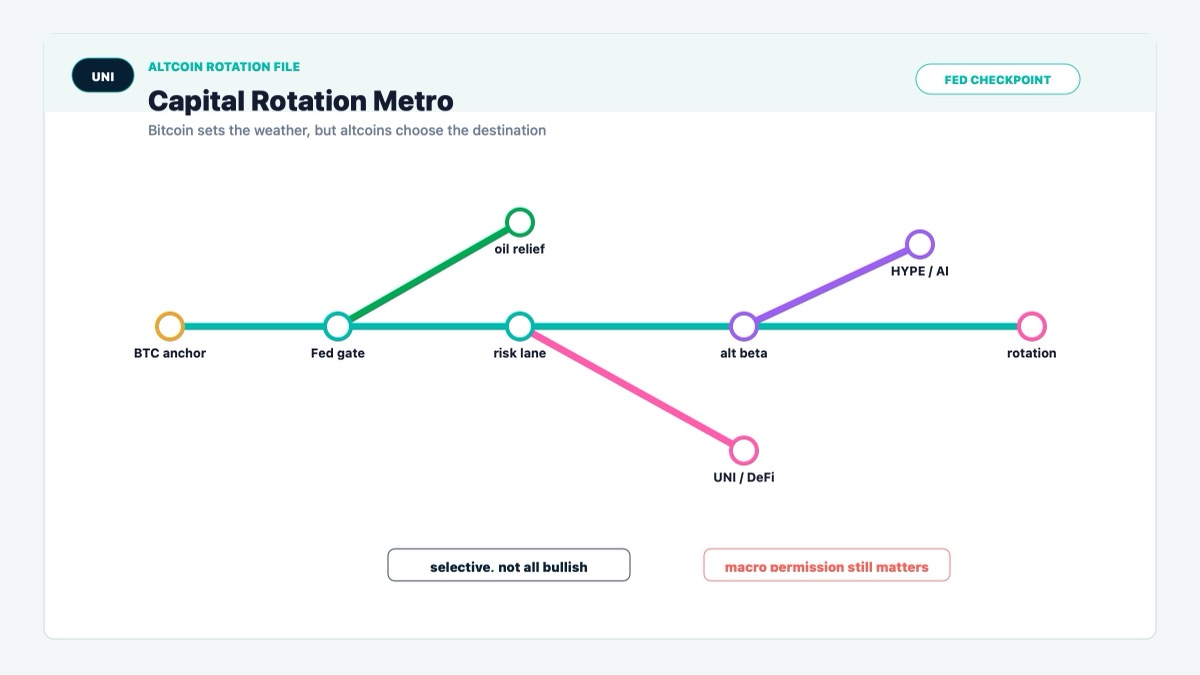
Bitcoin is still the anchor. When traders are waiting for the Fed, BTC often becomes the asset that asks the biggest question first: are rates, yields and liquidity going to help or hurt risk appetite? That question matters even more when oil has just fallen hard, because cheaper energy can soften inflation expectations and give the Fed a little more room.
But altcoins do not always wait politely for Bitcoin to finish thinking.
Sometimes they move first because the story is more specific. UNI had a clean catalyst: a major bank saying Uniswap could be worth dramatically more by 2030 if tokenized assets and DeFi volume scale. That is not the same kind of catalyst as "macro looks better." It is narrower, easier to trade and easier to tell.
That is why this matters.
The crypto market may be entering a phase where Bitcoin still sets the weather, but altcoins choose the outfits.
If the Fed sounds friendly enough, the rotation can broaden. BTC may hold its weekly gains while traders chase DeFi, AI-linked tokens and high-beta layer-1s. If the Fed sounds restrictive, the move can unwind quickly, because speculative rotation is usually the first part of the market to lose its balance.
So this is not just a UNI story.
It is a test of whether crypto risk appetite is becoming more selective.
Historical Parallel
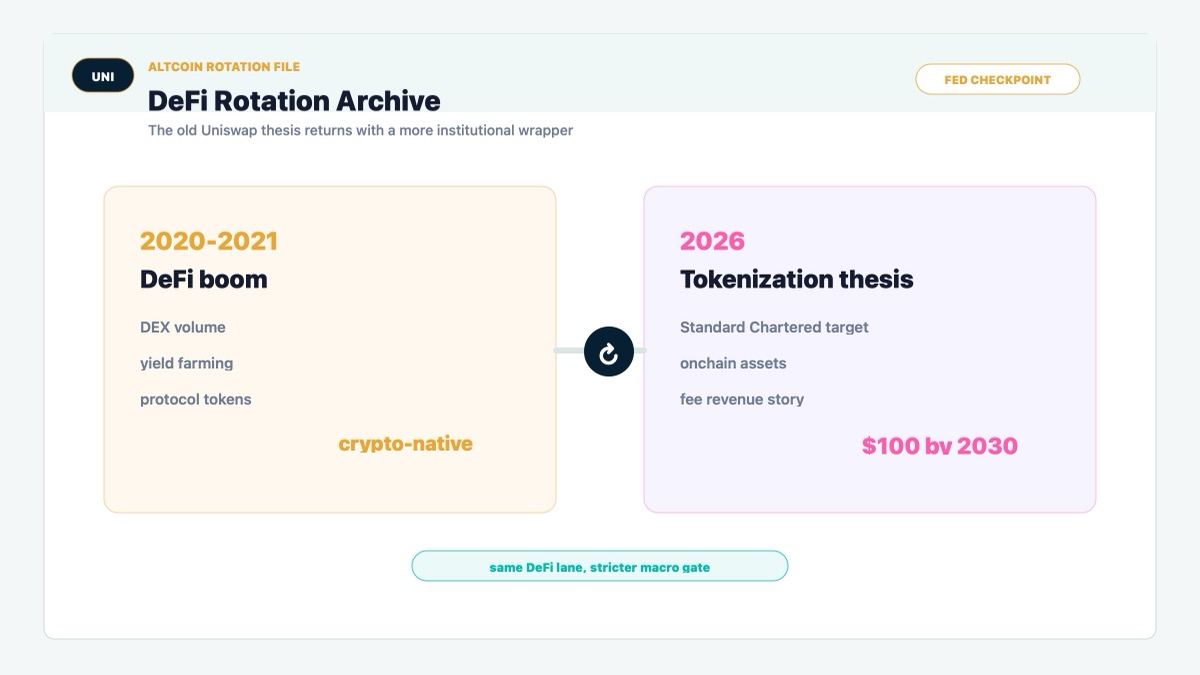
A useful historical parallel is the 2020-2021 DeFi rotation, when Bitcoin was no longer the only place traders looked for crypto upside and protocol tokens began trading like claims on new financial infrastructure. During that period, Uniswap became one of the clearest symbols of the decentralized exchange boom, and UNI often moved with the broader idea that DeFi could become a parallel market structure rather than a niche experiment.
The similarity is the rotation mechanism. In both cases, the market was not simply saying "crypto up." It was choosing a more specific thesis: decentralized exchanges, onchain liquidity and protocol-level fee opportunities. The current Standard Chartered call gives that old thesis a more institutional wrapper. Instead of a purely crypto-native story about yield farming and trading volume, the 2026 version is about tokenized assets, Wall Street adoption and whether Uniswap can become neutral infrastructure for assets that move onchain.
That similarity matters because altcoin rotations need stories that feel larger than the daily candle. UNI's 22.5% jump was not just a random green bar. It was attached to the idea that DeFi infrastructure may matter again if tokenization becomes a real institutional flow.
The difference is the macro setting. The 2020-2021 DeFi cycle unfolded in a much looser liquidity environment. Today, the market is still waiting on the Fed, oil prices are moving because of geopolitical developments, and Bitcoin remains close to the center of the risk-asset conversation. That makes this rotation more fragile. It can work, but it has less room for sloppy confirmation.
The lesson is simple: DeFi rotations can move fast when the story is clean, but they need macro permission to last. UNI has the narrative spark.
Now the Fed has to not pour water on it.
UNI Price Reaction and K-Line Analysis
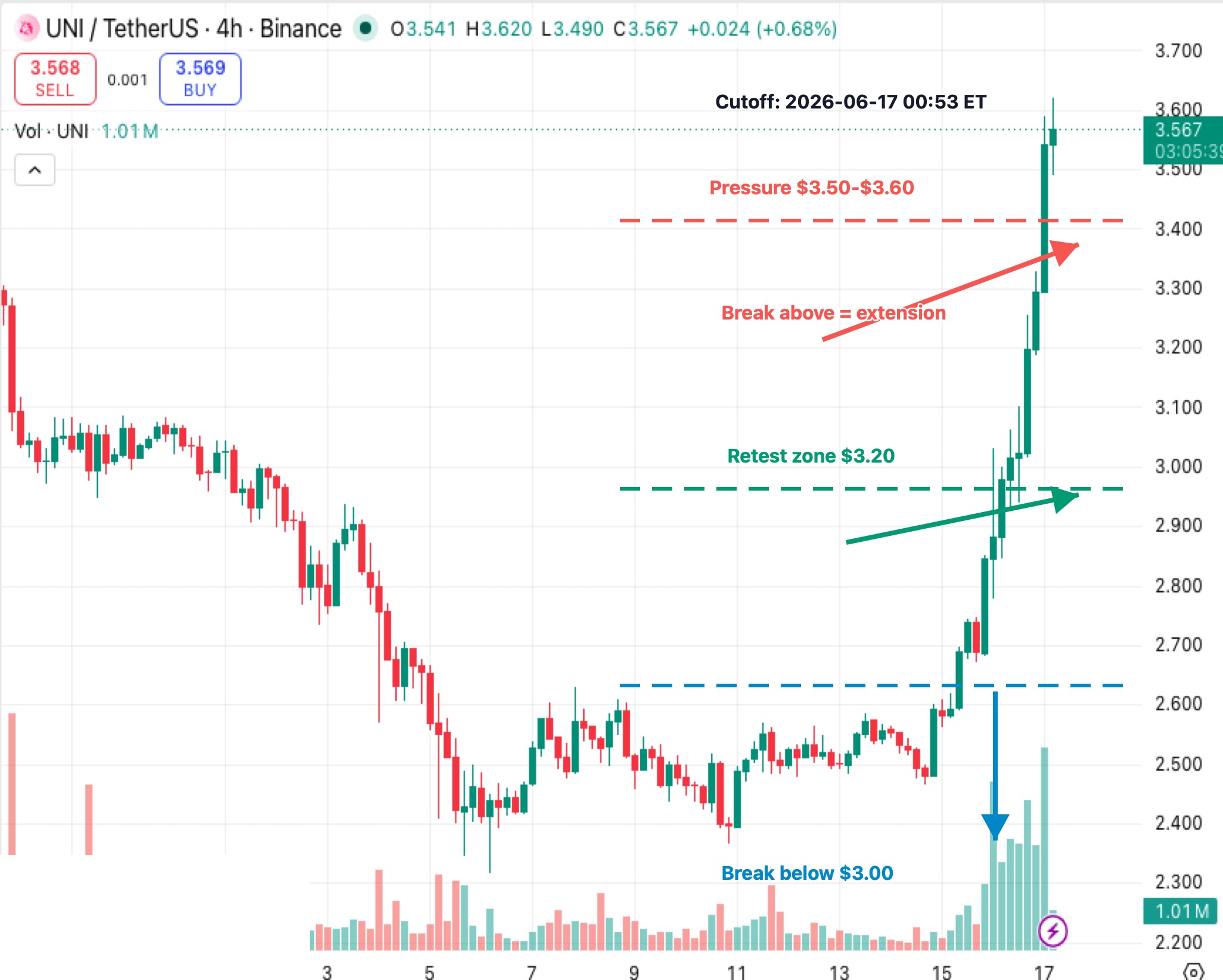
The UNIUSDT 4H chart shows what a sharp rotation looks like when it finally hits the candles.
For most of the visible window, UNI was not exciting. It had been sliding, then grinding sideways in the $2.40-$2.60 region. That kind of structure is where trader interest usually goes to sleep. Price stops collapsing, but it also fails to prove that anyone urgently wants it.
Then the market changed its mind.
UNI broke out with a vertical move through $3.00 and pushed into the $3.50-$3.60 area, with volume expanding as the move accelerated. That is exactly the kind of price action you expect when a dormant token gets a fresh narrative and traders rush to reprice it quickly.
The first issue now is pressure near $3.50-$3.60. UNI is already trading in that zone, which means the breakout has delivered the easy part. The harder part is either holding near the highs or building a controlled retest.
$3.20 is the cleaner retest zone. If UNI pulls back and holds that area, the breakout can stay constructive. It would suggest buyers are willing to defend a higher range rather than just chase the first candle.
$3.00 is the line that matters for risk.
If UNI falls back below $3.00, the move starts looking more like a news spike than a durable breakout. That does not erase the long-term Standard Chartered thesis, but it would weaken the short-term chart.
So the chart is simple.
The story got UNI moving.
Now $3.20 and $3.00 decide whether the move gets to breathe.
Key Levels to Watch
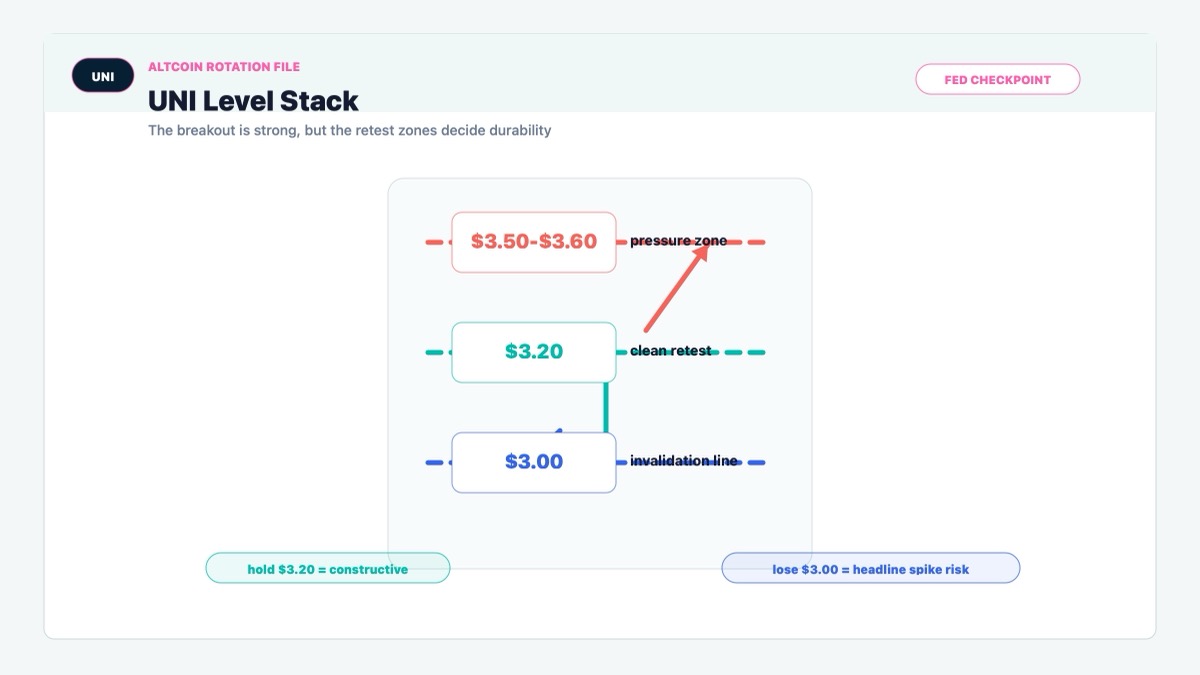
- $3.50-$3.60: Current pressure zone after the sharp breakout.
- $3.20: Retest zone. Holding it would keep the breakout structure healthier.
- $3.00: Main invalidation line. Losing it would make the rally look much more fragile.
- Above $3.60: Extension zone if momentum continues and broader altcoin appetite stays strong.
Conditional Forecast
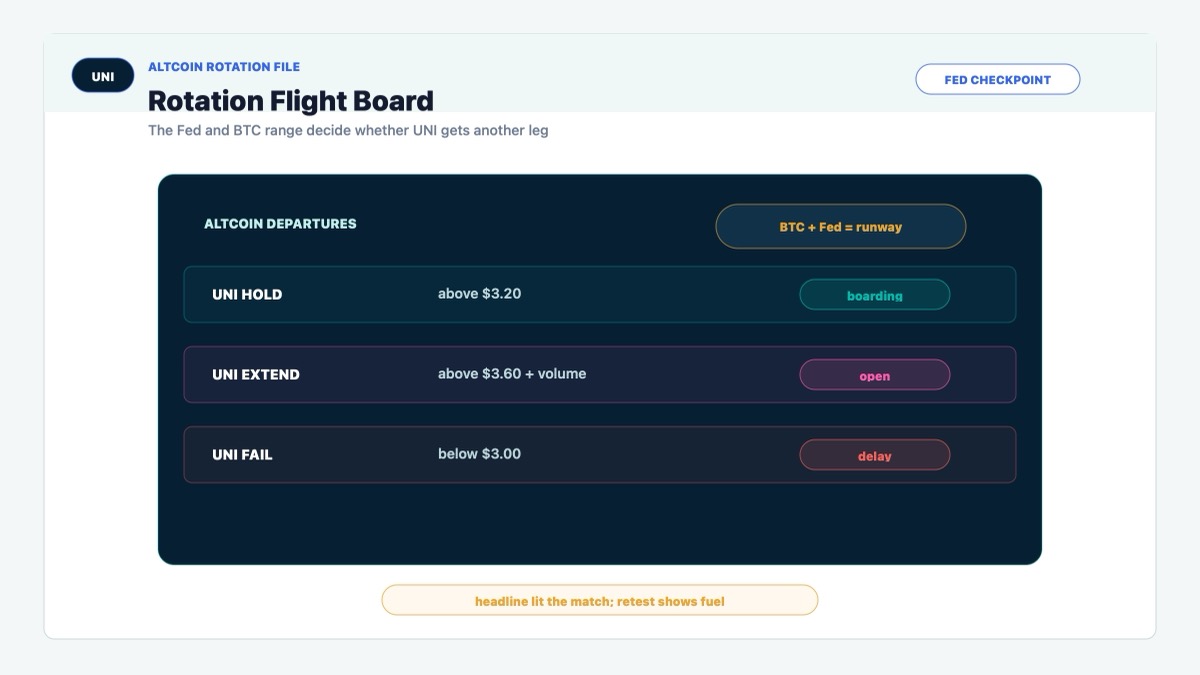
If UNI holds above $3.20, the breakout remains constructive. That would show traders are not only chasing the Standard Chartered headline, but also defending the repriced range.
If UNI breaks above $3.60 with volume, the next phase becomes extension. In that case, the chart would support the idea that UNI is leading a genuine DeFi rotation rather than just reacting to one report.
If UNI loses $3.20 and then drops below $3.00, caution comes back quickly. The market would likely treat the move as an overextended headline spike, especially if Bitcoin stays flat and the Fed delivers a restrictive tone.
Bitcoin still matters here.
If BTC holds near $66K and the Fed does not damage risk appetite, altcoins have room to keep moving. If BTC rolls over, UNI's breakout has to fight gravity and macro at the same time.
That is a much harder job.
Investment Takeaway
This market is not quiet.
It is selective.
Bitcoin is waiting for the Fed near $66K, while traders are willing to take more risk in specific altcoin stories. UNI's 22.5% jump shows what happens when a clean catalyst lands in a market already looking for something with more torque than BTC.
For investors, the useful read is not "buy every altcoin." That is how people turn rotation into regret.
The useful read is this: if Bitcoin holds its range and the Fed does not tighten the mood, DeFi and high-beta altcoins can keep attracting capital. But UNI now has to prove that the move can hold above $3.20 and stay out of the old range below $3.00.
The headline lit the match.
The retest tells us whether there is fuel.
Sources
- CoinDesk: Uniswap jumps 22% and altcoins rip while bitcoin stalls before the Fed
- Crypto Briefing: Standard Chartered sets $100 price target for Uniswap by 2030
- The Defiant: Standard Chartered Sets UNI 2030 Price Target at 40x Current Levels
- Trading Economics: Brent crude oil price
- TradingView: UNIUSDT chart
|
DISCLAIMER:
1. All content on this website (including but not limited to articles, data, charts, and analyses) is for general informational purposes only and does not constitute any form of investment advice, trading recommendation, or financial guidance. 2. Cryptocurrencies and digital assets are subject to extreme price volatility and high investment risk; you may lose part or all of your principal. Past performance does not predict future results. 3. The information on this website is based on sources we believe to be reliable, but we do not guarantee its accuracy, completeness, or timeliness. Any investment decisions made based on this website’s information are at your own risk. 4. We strongly recommend that you conduct your own thorough research and consult an independent, licensed financial advisor before making any investment decisions. |
Recommended reading
Latest News