Key Takeaways
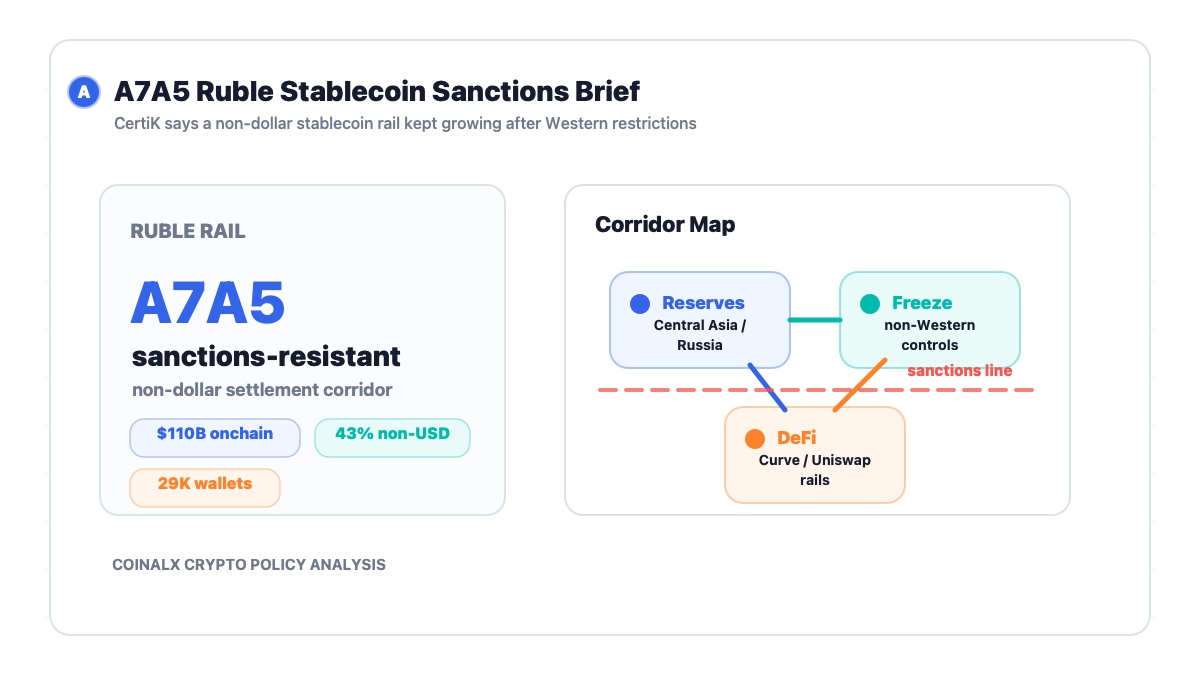
CertiK says the ruble-backed A7A5 stablecoin processed more than $110 billion in cumulative onchain transactions despite Western sanctions.
A7A5 reportedly captured about 43% of the non-US dollar stablecoin market, while wallet count rose from 13,000 to 29,000 between February 2025 and May 2026.
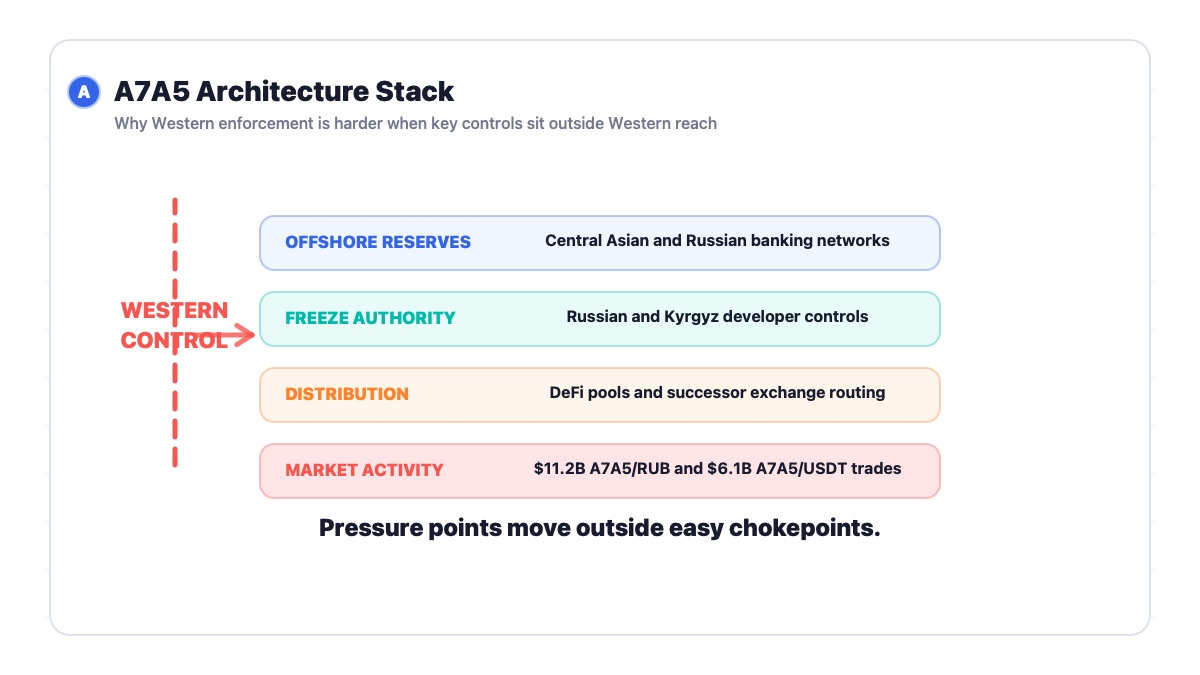
The case matters because A7A5 appears designed around three pressure points: offshore reserves, non-Western freezing authority, and DeFi-based distribution.
The market risk is not that A7A5 is large enough to move Bitcoin by itself; it is that sanctions-resistant stablecoin rails may become a repeatable model.
What Happened
CertiK says a Russian ruble-backed stablecoin kept growing even after Western sanctions tried to cut it off.
According to Cointelegraph, A7A5 processed more than $110 billion in cumulative onchain transactions. CertiK also said the token captured about 43% of the global non-US dollar stablecoin market, while its holder count increased from 13,000 wallets in February 2025 to 29,000 wallets by May 2026.
That is the simple version. The less simple version is more interesting, and much less comforting.
A7A5 was issued in January 2025 by Old Vector LLC, a Kyrgyz entity acting on behalf of the Russian cross-border settlement firm A7 LLC. Cointelegraph reported that A7 LLC is co-owned by Moldovan-Russian oligarch Ilan Shor and Russian state-owned defense sector lender Promsvyazbank. Russian authorities later recognized A7A5 under the country's digital financial asset framework.
The token's trading activity reportedly included $11.2 billion across A7A5/RUB and $6.1 billion in A7A5/USDT trades, primarily through Grinex. That matters because Grinex is described as the successor to Garantex, the platform previously tied to laundering activity and illicit flows.
The sanctions angle is the core of the story. The European Union's 19th sanctions package, adopted on Oct. 23, 2025, prohibited transactions involving A7A5 from Nov. 12. But CertiK argues that the design of A7A5 makes Western enforcement difficult. The reserves sit largely in Central Asian and Russian banking networks. The freeze controls are handled by Russian and Kyrgyz developers. Distribution also leans on DeFi liquidity pools such as Curve and Uniswap.
In other words, this is not only a stablecoin. It is a payment system built like a jurisdictional escape room.
Why This Matters for Bitcoin and Crypto Markets
This matters because stablecoins are no longer just crypto's cash drawer.
For years, the basic stablecoin story was simple: traders used dollar tokens to move between risk assets without leaving crypto rails. That story still exists. But A7A5 points to a darker and more strategic version of stablecoin infrastructure: tokens used for cross-border settlement when the traditional banking system becomes hostile or unavailable.
That does not make every non-dollar stablecoin suspicious. It does mean the category now has a sharper regulatory edge. If a ruble-backed token can keep moving value after sanctions, regulators will not treat stablecoins as harmless plumbing. They will treat them as programmable financial corridors. Some corridors carry legitimate commerce. Some carry sanctioned flows. The chain itself does not blush.
For Bitcoin and broader crypto markets, the direct price impact is probably limited in the short term. A7A5 is not a BTC ETF. It is not a Federal Reserve rate decision. It is not the kind of headline that automatically turns candles green or red.
But the second-order impact is important. If regulators see stablecoins as sanctions infrastructure, enforcement pressure can expand toward exchanges, liquidity pools, wallets, bridges and stablecoin issuers. That creates compliance risk across the market. The more crypto rails are used to bypass sovereign controls, the more governments will try to pull those rails into their own control systems.
This is the uncomfortable model: stablecoins are becoming geopolitical tools. Not metaphorically. Operationally.
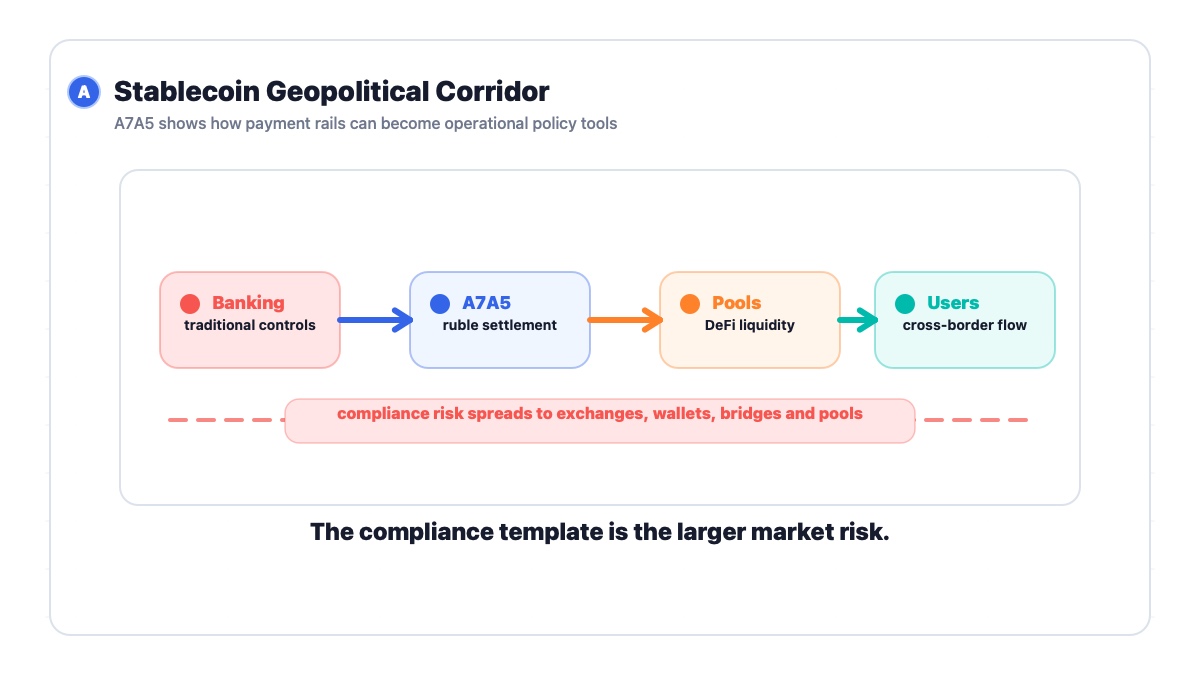
The market should watch whether A7A5 remains an isolated case or becomes a template. If it is isolated, the story stays mostly in the sanctions and compliance lane. If it becomes a template for other sanctioned or semi-isolated economies, stablecoin regulation may get much more aggressive, especially around non-dollar tokens and DeFi liquidity.
Historical Parallel: Garantex, USDT Freezes and the Migration Problem
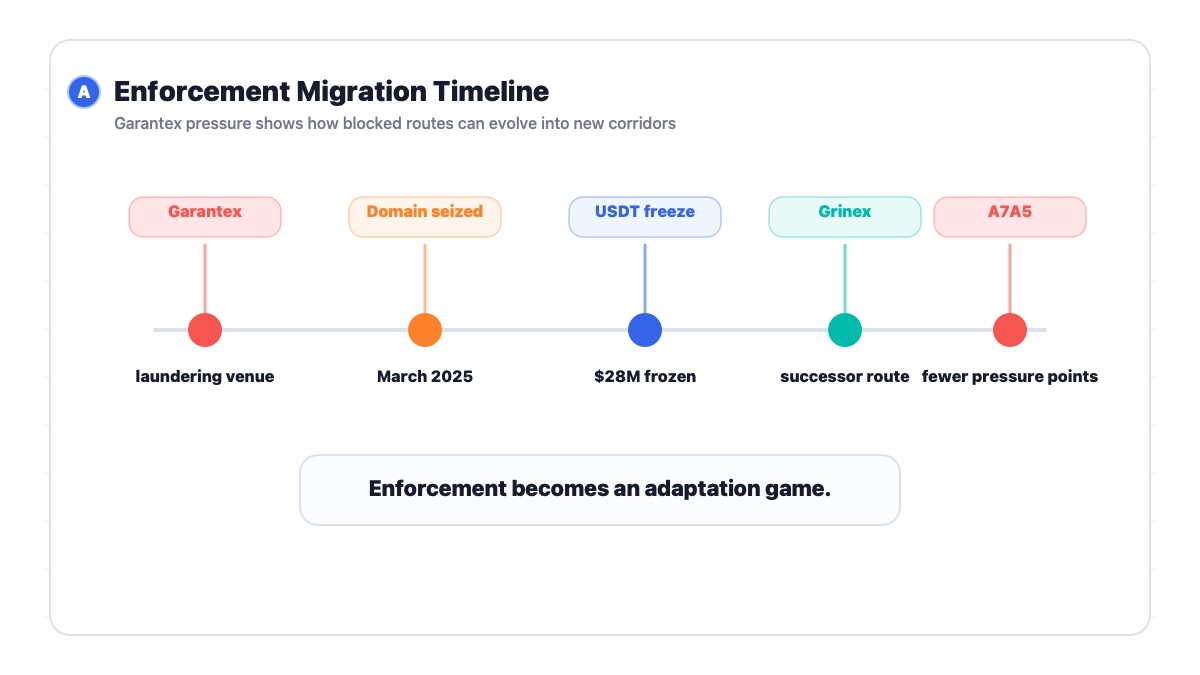
The clearest historical parallel is the earlier enforcement pressure around Garantex and USDT-linked illicit flows. Cointelegraph noted that Grinex, where much of A7A5's activity reportedly took place, is the successor to Garantex. That matters because Garantex had previously functioned as a laundering venue for ransomware-linked groups and illicit funds, including funds attributed to North Korean-linked actors.
In March 2025, the US Secret Service seized the Garantex domain, while Tether froze about $28 million in USDT held by Garantex-controlled wallets. On paper, that looks like the system working. A centralized issuer had a freeze button. Law enforcement had a domain to seize. The bad venue lost access to important infrastructure.
But the A7A5 story shows the other side of that victory. When one route is blocked, the next route may be designed specifically to avoid the same weakness. CertiK's framing is that A7A5 was built with reserves outside direct Western reach, freeze authority outside Western-controlled infrastructure, and DeFi distribution that is harder to shut down through centralized exchanges.
The similarity is the use of stablecoin rails for sanctioned or illicit-adjacent settlement. Both cases involve crypto infrastructure stepping into the space where banking controls are supposed to work. The difference is architectural. Garantex and USDT still exposed centralized pressure points. A7A5 appears to have learned from that and moved the sensitive parts into friendlier jurisdictions and more decentralized liquidity venues.
The lesson for the current market is not that sanctions are useless. It is that enforcement can become an adaptation game. Regulators close one door; sophisticated actors study the door, the hinge, the lock, and the person holding the key. Then they build a hallway with fewer doors.
That is why A7A5 matters beyond its own transaction volume.
CoinGecko Price Chart and Market Context
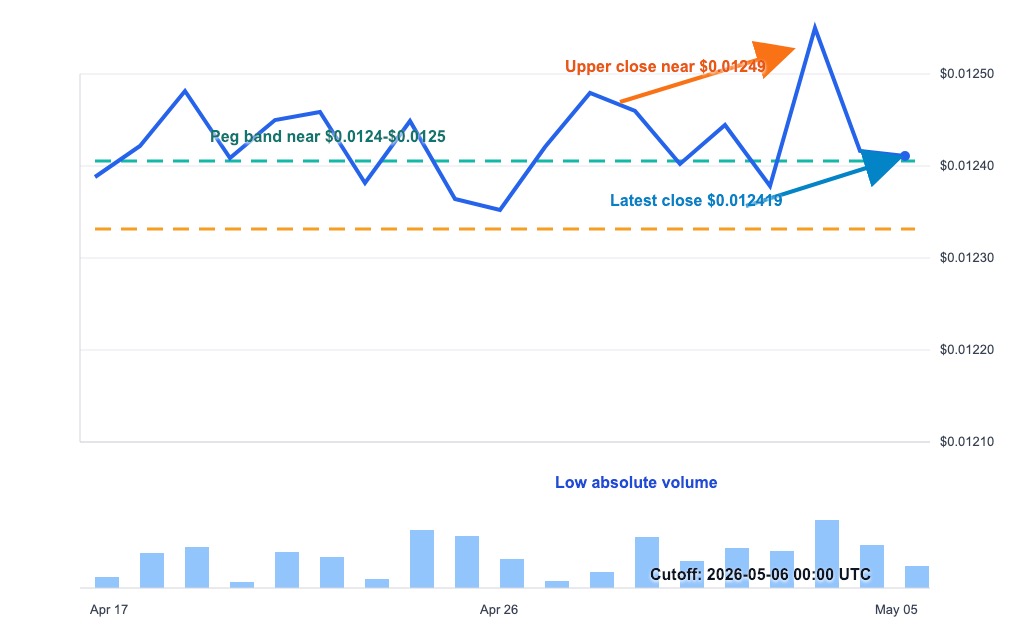
CoinGecko provides A7A5 historical price, market cap and volume data, but not a full OHLC candle set in the accessible historical view. So the chart above uses CoinGecko's A7A5 daily close and volume data rather than inventing fake candlesticks. That is less dramatic, but much cleaner. The market has enough problems without us manufacturing wicks for decoration.
The A7A5 price line shows a tight range around the $0.0124-$0.0125 area. That is what a stablecoin-like instrument is supposed to do: avoid looking exciting. In this case, the lack of price drama is actually part of the point. CertiK's concern is not that A7A5 is whipping around like a speculative altcoin. It is that a relatively stable settlement token can keep moving value even after sanctions try to block the channel.
The most recent CoinGecko close in the plotted window sits near $0.012419, close to the middle of the observed peg band. The upper close in this short data window sits near $0.01249. That is a narrow band, but narrow does not mean irrelevant. For a sanctions-focused stablecoin, the real signal is not explosive upside. It is persistence.
Volume remains low in absolute terms on the plotted CoinGecko history, which matters because it limits how much we should infer from short-term price wiggles. A7A5's larger importance comes from reported cumulative onchain settlement and wallet growth, not from a clean exchange-chart breakout.
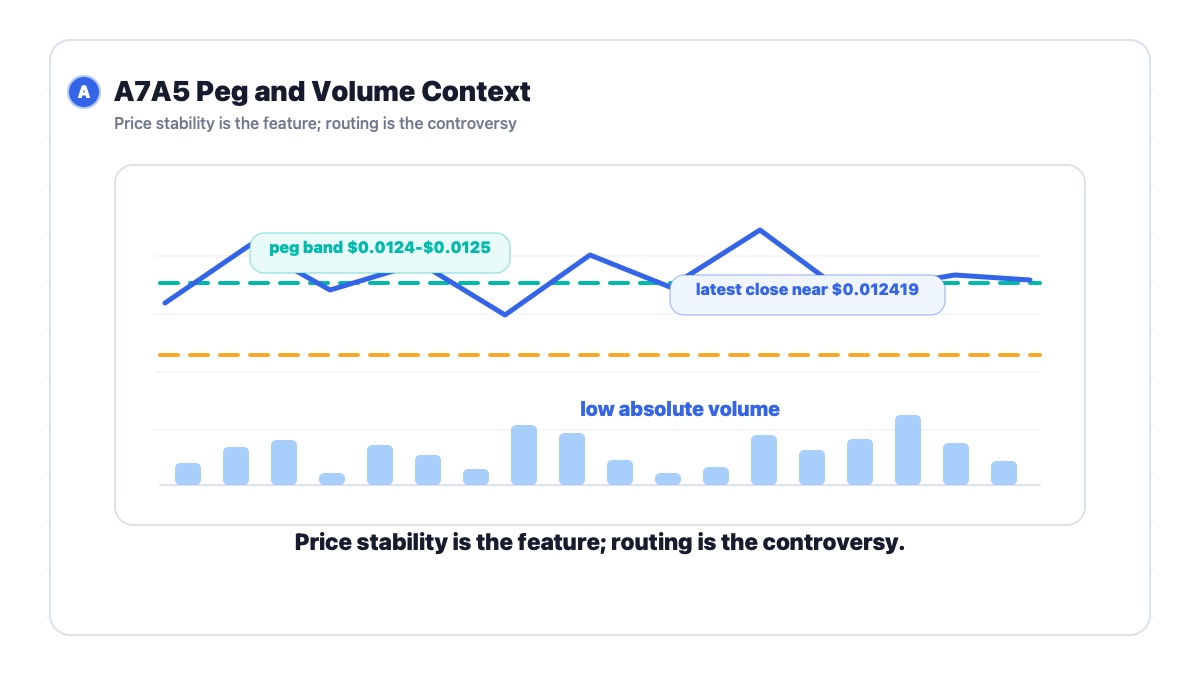
For the A7A5 story, the chart's message is direct: price stability is the feature, while transaction routing is the controversy. The token does not need to pump to matter. It only needs to function.
Key Levels to Watch
The first A7A5 chart level is the $0.0124-$0.0125 peg band. Holding this area keeps the token behaving like a stable settlement instrument rather than a volatile microcap.
The upper close in the plotted CoinGecko window is near $0.01249. A sustained move above that area would matter less as a bullish signal and more as a sign that liquidity or quote conditions are changing.
The latest plotted close is near $0.012419. Staying near that area supports the view that A7A5's importance is operational, not speculative.
For the A7A5 ecosystem itself, the key non-price levels are wallet growth, DeFi liquidity depth, and whether centralized exchanges or stablecoin issuers cut off related pathways.
Conditional Forecast
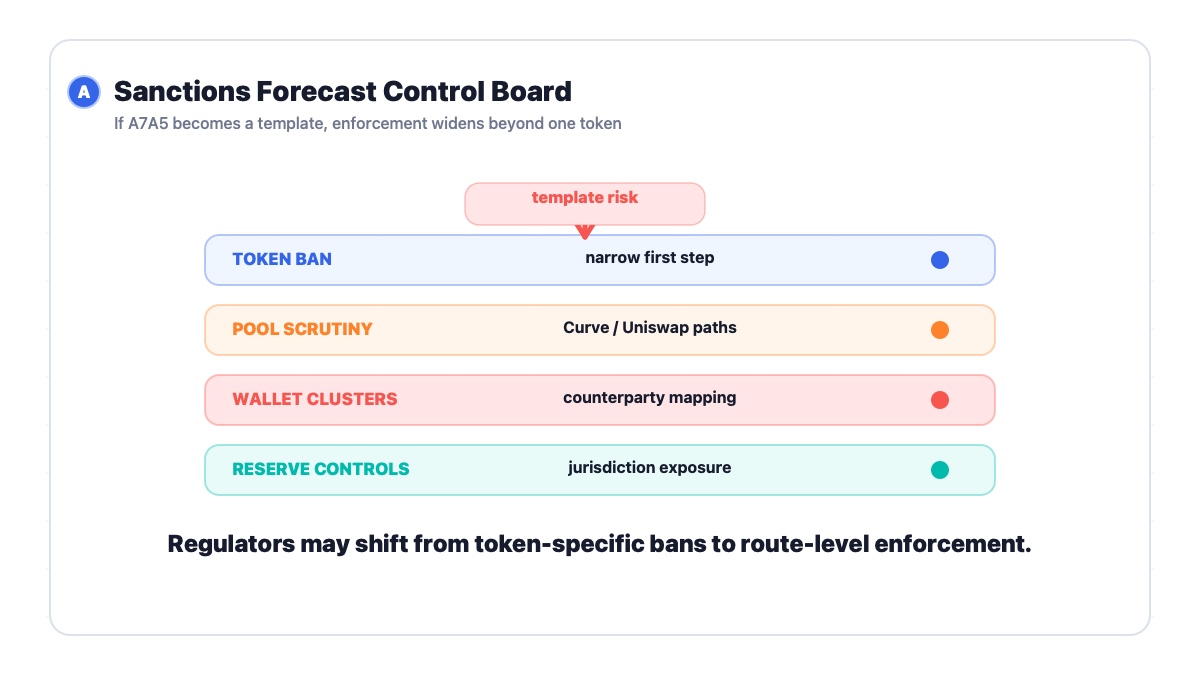
If A7A5 activity continues growing despite sanctions, regulators are likely to move beyond token-specific bans and focus more on liquidity pools, exchange access, wallet clusters and counterparties. That would make the enforcement map wider and messier.
If DeFi liquidity dries up or major routing paths become harder to use, A7A5 may remain active but become less efficient. A sanctions-resistant system can still be inconvenient. Friction matters.
If other non-dollar stablecoins copy the A7A5 model, the market should expect more aggressive scrutiny of stablecoin reserves, governance, freeze controls and jurisdictional exposure. That would affect not only sanctioned actors but also legitimate issuers trying to build non-dollar payment tokens.
Investment Takeaway
The investment takeaway is not "buy this token" or "short that token." That would be the wrong lesson and, frankly, a strange hobby.
The real takeaway is that stablecoin infrastructure is becoming a geopolitical battleground. Investors should watch issuers, exchanges and DeFi protocols with exposure to sanctioned flows because enforcement risk can spread faster than price narratives.
For crypto markets, A7A5 is a reminder that liquidity rails matter as much as speculative assets. Bitcoin gets the headlines, altcoins get the dopamine, but stablecoins often decide how money actually moves. When that movement crosses sanctions lines, the regulatory temperature rises.
The market may not price this immediately. But it will remember it later, probably at the least convenient time.
Sources
Cointelegraph: Russian ruble stablecoin A7A5 grows despite Western sanctions: CertiK
CoinGecko: A7A5 price page
CoinGecko: A7A5 historical data
U.S. Department of the Treasury: Garantex sanctions background
|
DISCLAIMER:
1. All content on this website (including but not limited to articles, data, charts, and analyses) is for general informational purposes only and does not constitute any form of investment advice, trading recommendation, or financial guidance. 2. Cryptocurrencies and digital assets are subject to extreme price volatility and high investment risk; you may lose part or all of your principal. Past performance does not predict future results. 3. The information on this website is based on sources we believe to be reliable, but we do not guarantee its accuracy, completeness, or timeliness. Any investment decisions made based on this website’s information are at your own risk. 4. We strongly recommend that you conduct your own thorough research and consult an independent, licensed financial advisor before making any investment decisions. |