Key Takeaways
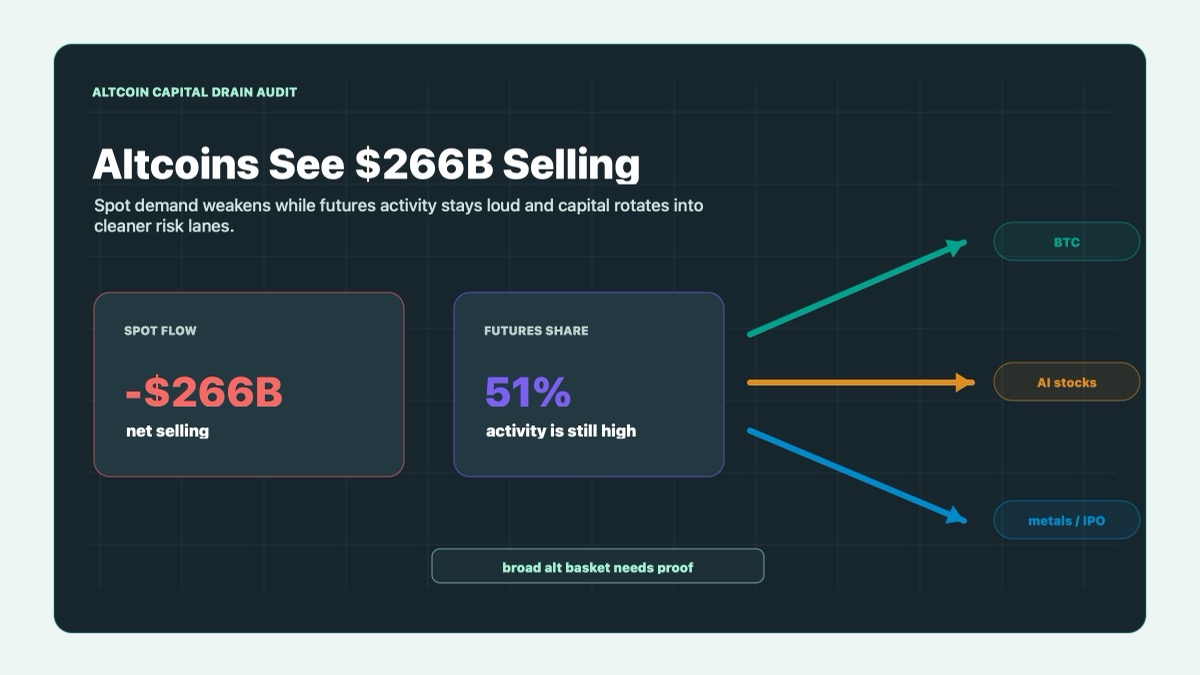
- Altcoin spot demand excluding Bitcoin and Ether has fallen to its weakest level in years, with one CryptoQuant-linked measure showing $266B in net selling.
- The strange part is that altcoins are not quiet. They still made up 51% of Binance futures volume on June 16, which means traders are active but spot buyers are missing.
- TOTAL3 needs to reclaim the $700B-$710B zone to make the rebound feel credible; failure there keeps the market vulnerable to another test of $660B-$670B.
What Happened
The altcoin market just produced one of those data points that sounds dramatic because it is dramatic, but also slightly confusing because the surface of the market still looks busy.
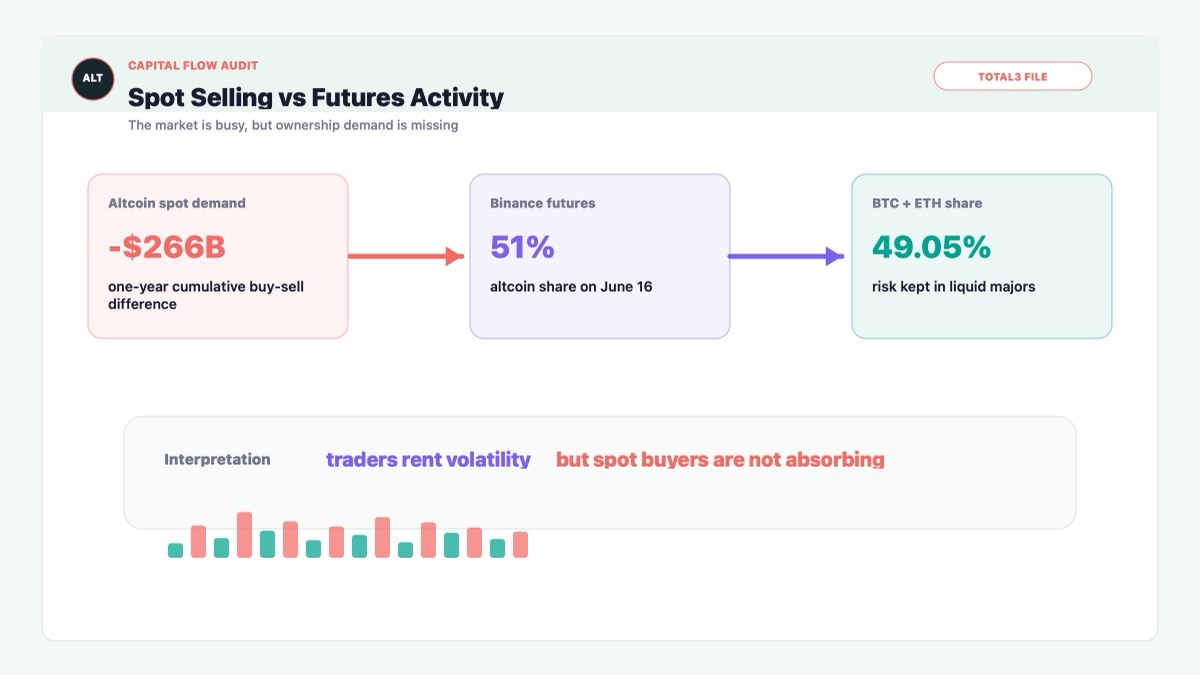
According to the Cointelegraph report, altcoin markets excluding Ether recently saw $266 billion in net selling volume on centralized exchanges. The figure came from the one-year cumulative buy-sell difference for altcoins excluding Bitcoin and Ether, which dropped to -$266 billion on June 16.
That is the clean version. The less clean version is the more important one.
Altcoins are being sold heavily in spot markets, but they are still being traded aggressively in derivatives markets. On June 16, altcoins accounted for 51% of Binance futures trading volume, compared with 28.85% for Bitcoin and 20.20% for Ether. So this is not a dead market. It is a market where people are still pressing buttons, taking leverage, rotating between narratives and trying to catch short bursts of motion.
The missing ingredient is simpler: fresh spot demand.
Stablecoin balances also add a useful clue. ERC-20 stablecoin exchange supply ratios have reportedly stayed between 0.40 and 0.46 for more than a year, meaning liquidity is still sitting on exchanges. Binance alone held between 25% and 30% of total stablecoin supply, according to the report. The money did not vanish into the floor. It became pickier.
And that is where the story gets uncomfortable for altcoins. Some of the capital that might once have chased the broad altcoin basket is now being pulled toward Bitcoin, AI and tech stocks, metals futures, oil, equities and pre-IPO perpetual products offered through crypto exchanges.
Altseason is not necessarily extinct. But the old, lazy version of altseason, where liquidity lifts almost everything with a ticker and a dream, is having a very hard year.
Why This Matters for Bitcoin and Crypto Markets
Crypto markets often confuse activity with demand. They are related, but they are not the same animal.
Activity is volume. It is futures traders opening and closing positions. It is leverage moving from one hot chart to the next. It is the market looking alive because every few hours something is up 18% and something else is down 23%.
Demand is different. Demand is when capital decides to own the asset, not just rent its volatility for an afternoon.
The $266B selling figure matters because it suggests that, across the broad altcoin complex, the ownership impulse is weak. Traders may still want exposure to altcoin volatility, but buyers are not showing the same willingness to absorb supply in spot markets.
For Bitcoin, this can be a mixed signal. On one hand, capital rotation away from weaker altcoins can reinforce Bitcoin dominance. In a nervous market, Bitcoin becomes the cleaner expression of crypto exposure: more liquid, more institutionally legible and less dependent on small-narrative enthusiasm.
On the other hand, if altcoin selling reflects a broader reduction in crypto risk appetite, Bitcoin is not immune. It may outperform the rest of the market and still trade poorly in absolute terms. That is one of the annoying truths of bear-phase crypto: relative strength can look impressive while everyone is still losing money, just at different speeds.
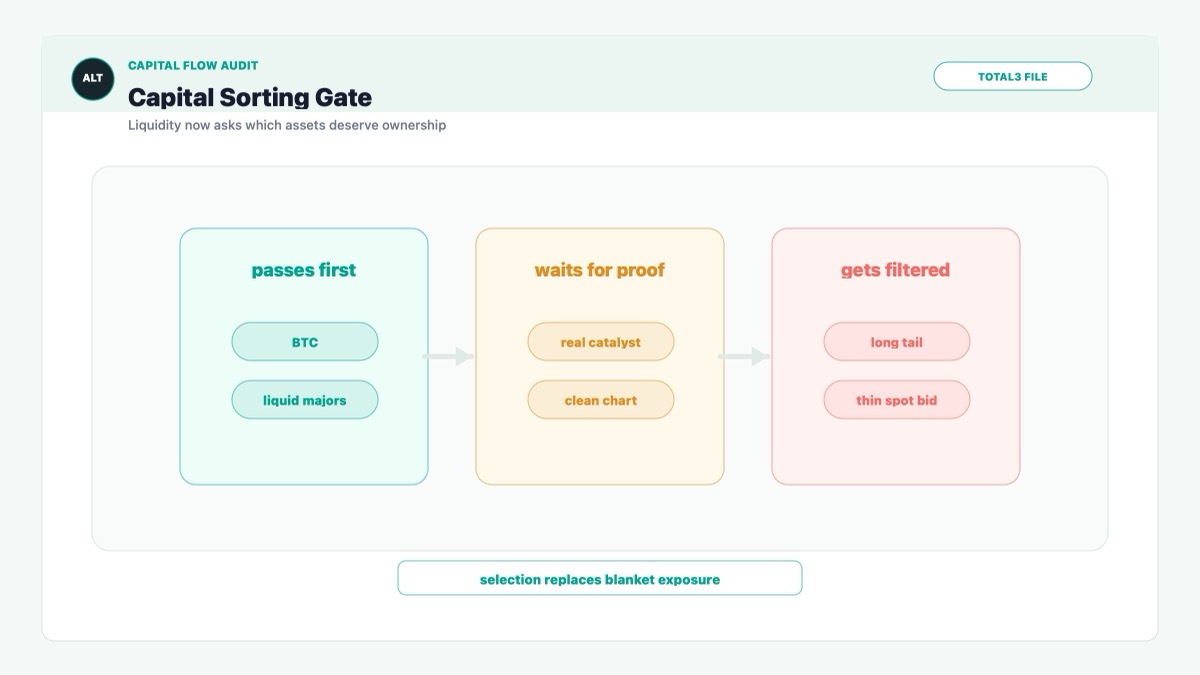
The bigger point is that liquidity is no longer behaving like a rising tide. It is behaving like a bouncer with a clipboard. Bitcoin may get in. A handful of highly liquid majors may get in. Some exchange-native synthetic products may get in. But the long tail of altcoins is being asked to prove why it deserves capital.
That changes the altcoin playbook. Broad exposure becomes harder to justify. Narrative chasing becomes more dangerous. The market stops rewarding participation and starts rewarding selection.
Historical Parallel
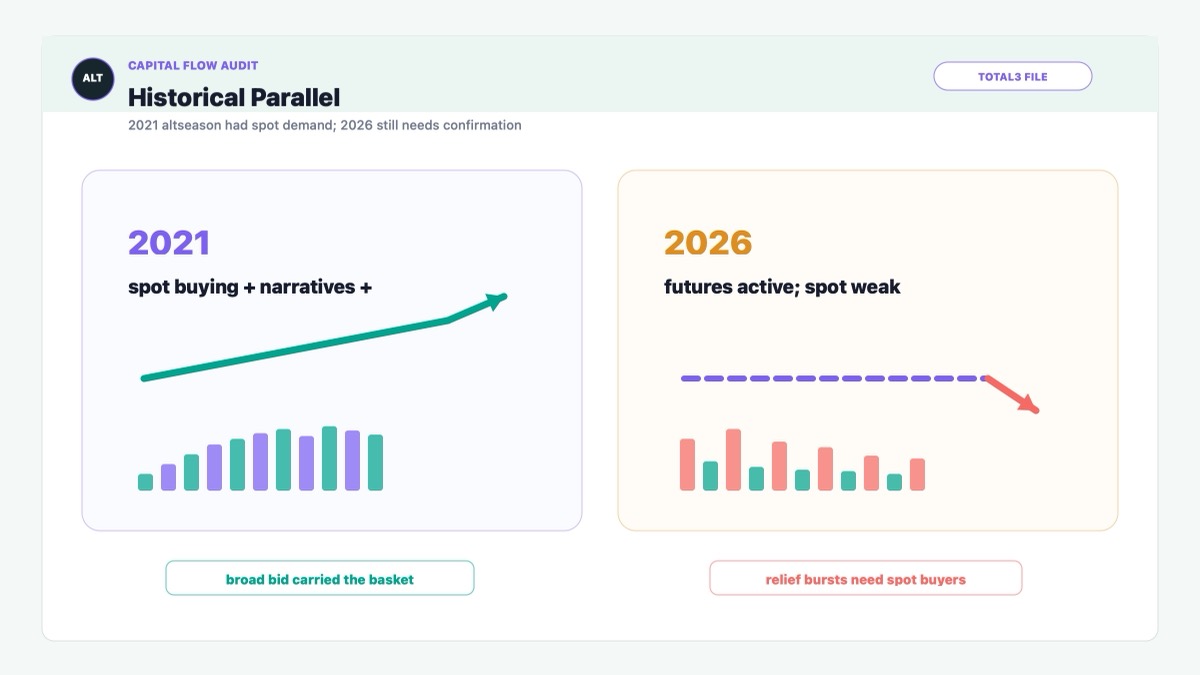
The closest useful parallel is not a single crash day. It is the 2021 altseason structure, especially the period when risk appetite moved across DeFi tokens, layer-1 networks, gaming names and meme assets in a way that made almost every corner of crypto feel temporarily magnetic.
Back then, the important feature was not just that altcoins went up. Markets go up all the time and then pretend it was philosophy. The important feature was that spot demand, narrative excitement and liquidity expansion were all moving in roughly the same direction. Retail flows were strong, stablecoins were actively deployed, and traders were not only using altcoins as leveraged instruments. They were buying them as future stories.
That is the similarity with today: the market is still narrative-hungry. Traders still want volatility. Exchanges are still where a lot of risk-taking happens. Altcoins still dominate pockets of trading activity when the right catalyst appears.
But the difference is the whole point.
In 2021, spot buying and speculative trading often reinforced each other. Today, according to the data cited in this report, they are separating. Futures activity remains high, but spot demand is deeply negative. Stablecoins are present, but they are not rushing into the broad altcoin basket. Capital is rotating with more suspicion, and it now has more places to go: Bitcoin, AI-linked equities, metals, oil, pre-IPO perpetuals and other exchange-listed products.
The lesson for the current BTC and crypto setup is that a real altseason probably needs more than loud futures volume. It needs spot buyers to return, and it needs TOTAL3 to show that the broad market can hold higher levels after rebounds. Until that happens, altcoin rallies may behave less like new cycles and more like tradable relief bursts inside a selective, capital-starved market.
Altcoin Price Reaction and K-Line Analysis
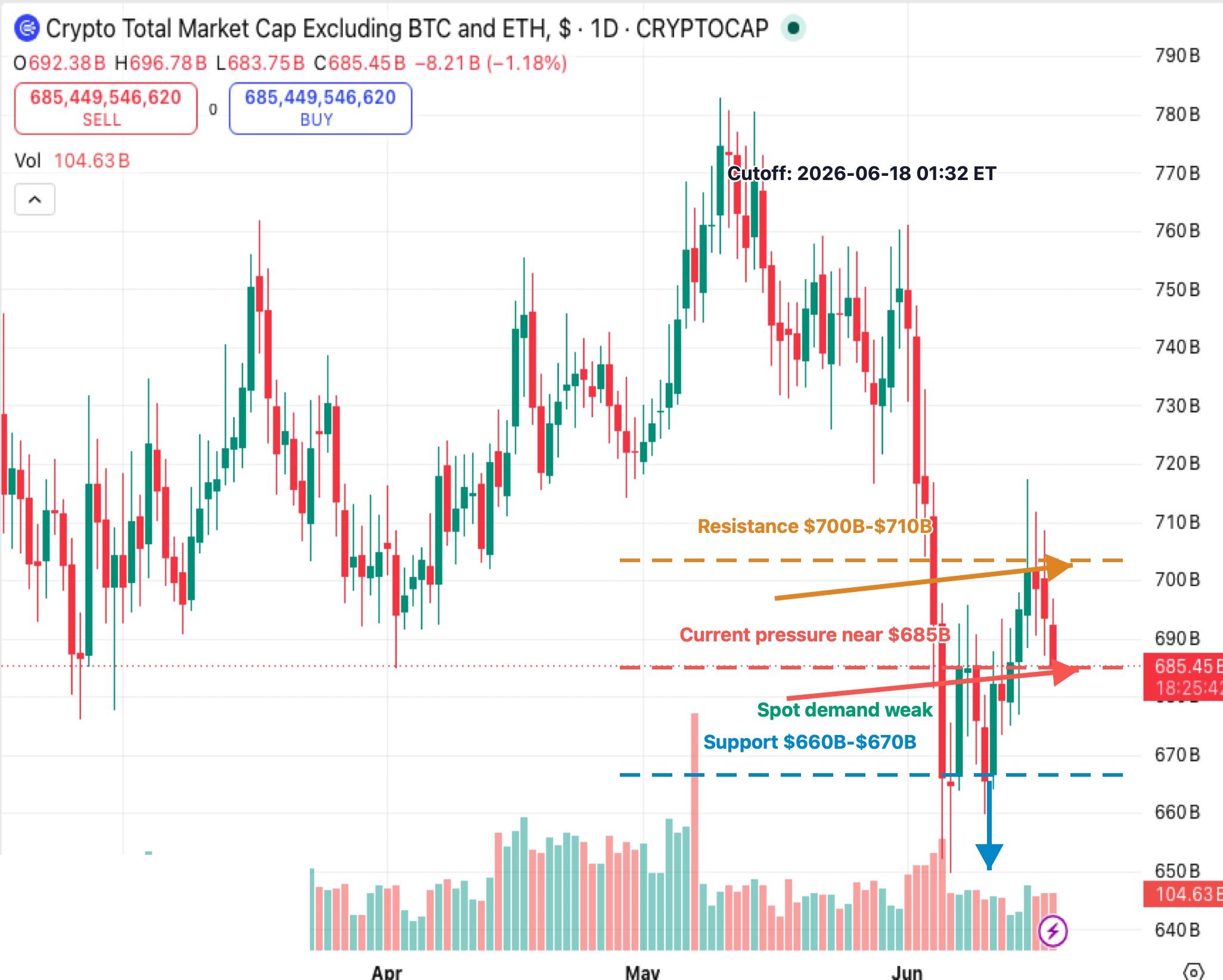
The cleanest chart for this story is TOTAL3, the total crypto market capitalization excluding Bitcoin and Ether. A single altcoin pair would make the story smaller than it is. This news is about the broad altcoin basket, so the broad altcoin basket deserves the chart.
TOTAL3 is trying to recover after a sharp June breakdown, but the rebound is still stuck in the awkward middle zone. The market bounced from the $660B-$670B area and pushed back toward the high-$600B range, but it has not yet reclaimed the $700B-$710B zone that would make the recovery look healthier.
That matters because $700B-$710B is not just a random round-number ceiling. It is the area where a failed rebound would tell us sellers still control the structure. If TOTAL3 cannot get back above that zone and stay there, the market may be showing exactly what the spot-demand data says: traders can create rallies, but buyers are not yet strong enough to change the trend.
The current pressure area near $685B is the shorter-term battlefield. Holding above it keeps the rebound alive. Losing it would shift attention back toward $660B-$670B, where the last support reaction started.
The chart is not screaming collapse. It is also not celebrating a new altseason. It is doing something more annoying and more honest: asking for proof.
Key Levels to Watch
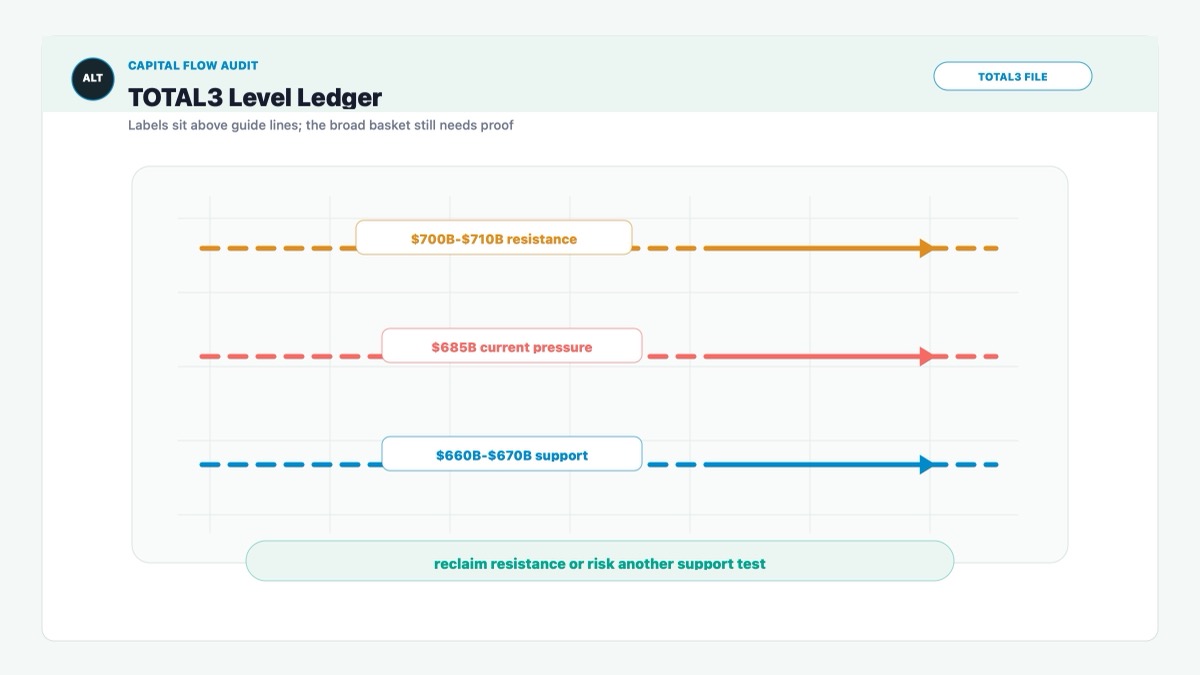
$700B-$710B resistance: This is the first major zone TOTAL3 needs to reclaim. A daily close above it would suggest the rebound has more than just relief-rally energy behind it.
$685B current pressure area: This is where the market is now negotiating whether the bounce can stabilize or fade. Losing this area would weaken the short-term recovery structure.
$660B-$670B support: This is the zone that recently absorbed the selloff. If it breaks, the market would likely read it as confirmation that weak spot demand is translating into weaker structure.
Conditional Forecast
If TOTAL3 reclaims $700B-$710B and holds that area on daily closes, the altcoin market can start building a better argument. It would not prove that altseason is back, but it would show that the broad basket can absorb selling pressure and recover lost ground.
If TOTAL3 fails below $700B and rolls back through $685B, the rebound becomes more fragile. In that case, the $660B-$670B support zone becomes the main test. A clean break below it would strengthen the case that altcoin rallies are still being sold into, not accumulated.
If Bitcoin stays firm while TOTAL3 struggles, the market may continue favoring Bitcoin and a small group of liquid majors over the wider altcoin universe. That would be a Bitcoin-dominance environment, not a classic altseason environment.
If stablecoins begin moving into spot altcoin markets again, the picture changes. The market does not need a magical mood swing. It needs evidence that capital is moving from waiting mode into buying mode.
Investment Takeaway
The takeaway is not that altcoins are uninvestable. That is too simple, and markets enjoy punishing simple ideas.
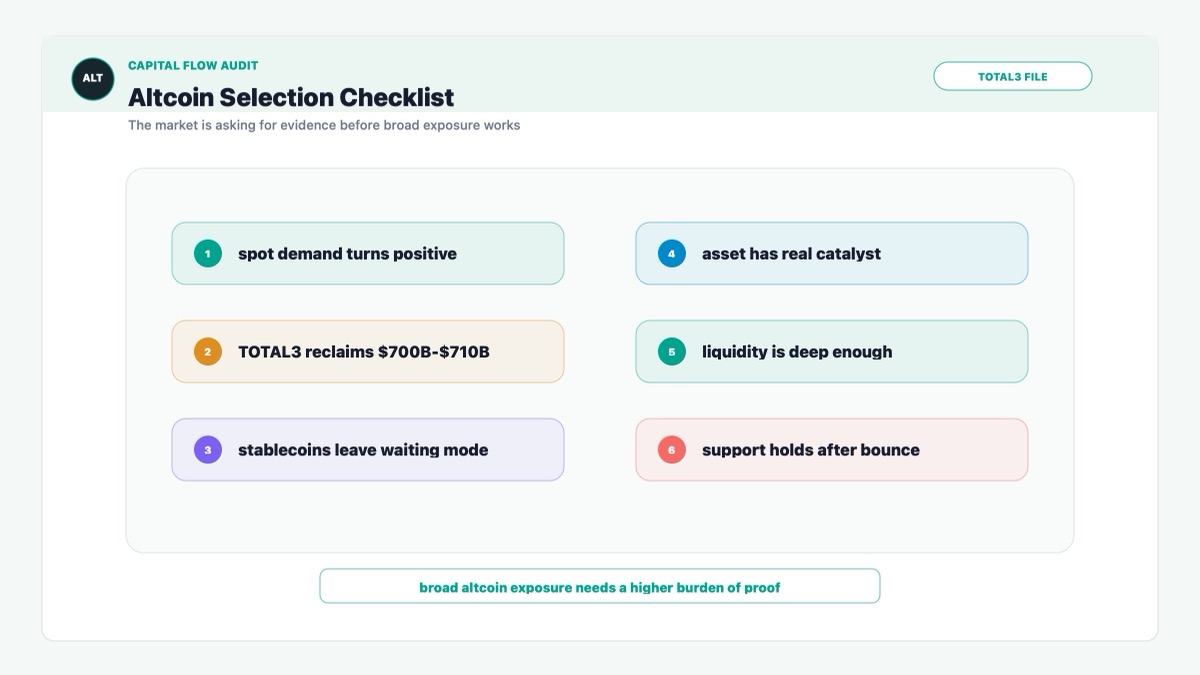
The better takeaway is that broad altcoin exposure now needs a higher burden of proof. Futures volume alone is not enough. A coin can be heavily traded and still be structurally weak if spot demand is negative and liquidity is rotating elsewhere.
For investors, this argues for selectivity over blanket exposure. Bitcoin may remain the cleaner crypto risk asset if capital keeps rotating toward liquidity and institutional comfort. Altcoins can still offer sharp upside, but the setup favors assets with real catalysts, strong liquidity and charts that can reclaim lost levels instead of merely bouncing from oversold conditions.
In other words, the market is not saying “never buy altcoins.” It is saying, “stop assuming the tide will do your research for you.”
Sources
- Cointelegraph: Altcoin selling tops $266B as capital rotates out of crypto: Is altseason extinct?
- CryptoQuant data cited by Cointelegraph, including altcoin cumulative buy-sell volume, futures volume share and exchange stablecoin supply ratios.
- TradingView: CRYPTOCAP:TOTAL3 daily chart
|
DISCLAIMER:
1. All content on this website (including but not limited to articles, data, charts, and analyses) is for general informational purposes only and does not constitute any form of investment advice, trading recommendation, or financial guidance. 2. Cryptocurrencies and digital assets are subject to extreme price volatility and high investment risk; you may lose part or all of your principal. Past performance does not predict future results. 3. The information on this website is based on sources we believe to be reliable, but we do not guarantee its accuracy, completeness, or timeliness. Any investment decisions made based on this website’s information are at your own risk. 4. We strongly recommend that you conduct your own thorough research and consult an independent, licensed financial advisor before making any investment decisions. |
Recommended reading
Latest News