Key Takeaways
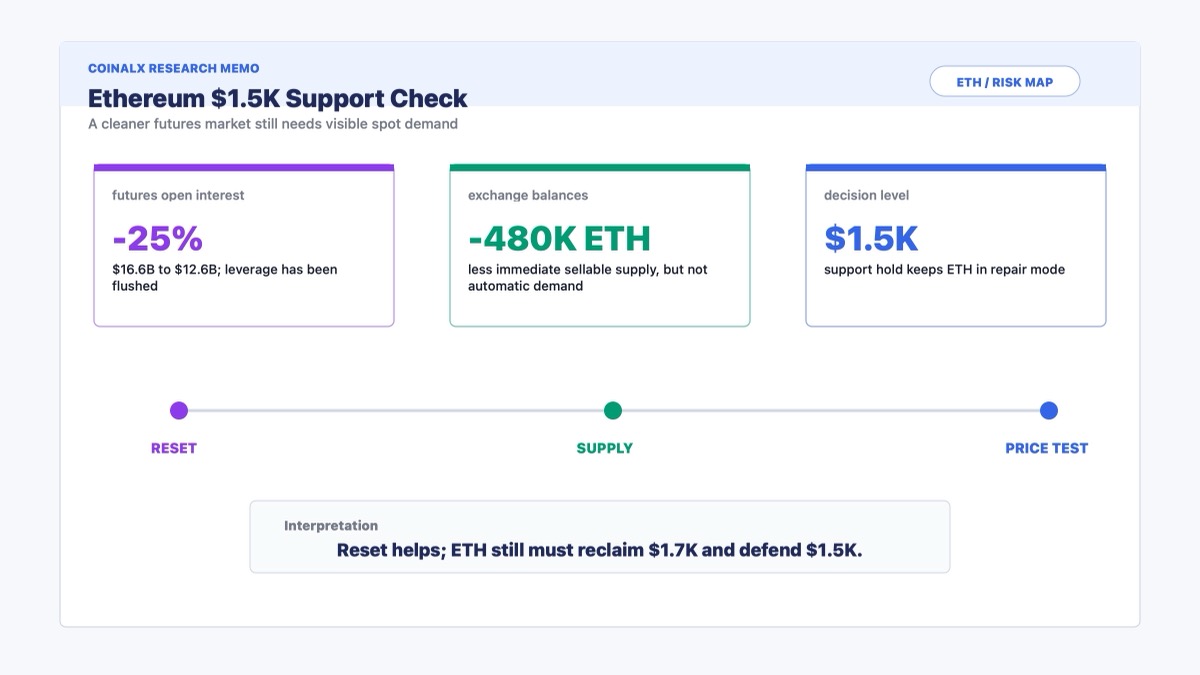
- ETH futures open interest has dropped about 25%, showing that a large part of the leveraged market has already been flushed out.
- The $1,500 zone is now the line that matters most: holding it keeps ETH in repair mode, while losing it reopens the $1,000 risk debate.
- Exchange balances falling by roughly 480,000 ETH may reduce ready supply, but that only becomes bullish if demand actually returns.
What Happened
Ether is sitting in one of those uncomfortable market zones where two opposite things can be true at the same time.
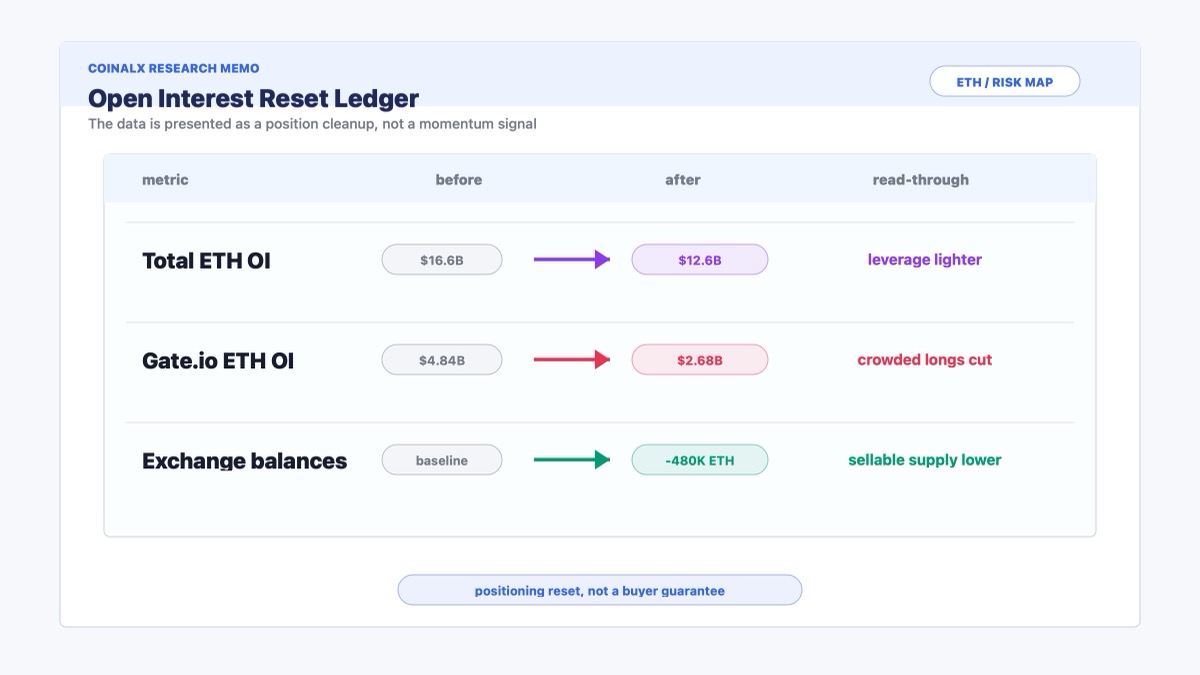
The first thing: the derivatives market has been cleaned out. According to the Cointelegraph article, total ETH futures open interest across exchanges fell 25%, dropping from $16.6 billion in May to $12.6 billion. Gate.io saw the sharpest move, with ETH open interest falling from $4.84 billion on May 7 to $2.68 billion on Tuesday, a decline of about 45%.
That is not a small adjustment. That is the market taking a lot of borrowed conviction and quietly removing it from the room.
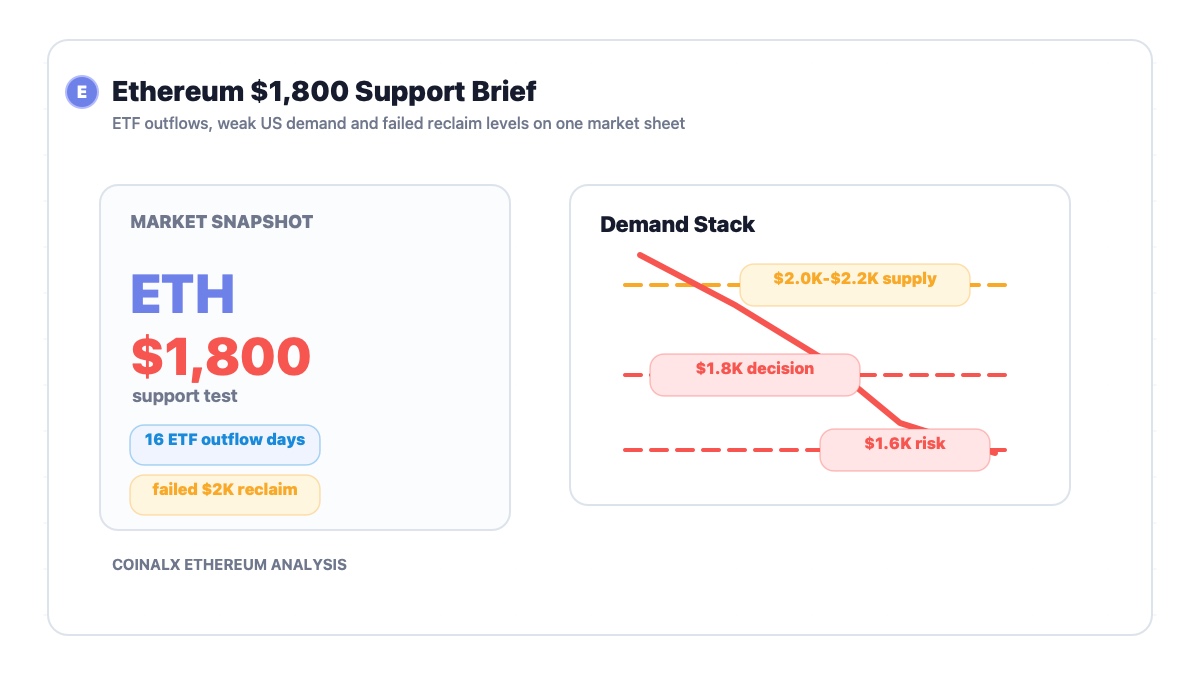
The second thing: ETH is still technically fragile. The article points to the $1,500 support zone as the level traders are watching. If ETH can stay above it, the market can argue that the leverage reset is helping price stabilize. If it loses that level, attention shifts toward the next major downside area near $1,000.
There is also a supply wrinkle. Around 480,000 ETH reportedly left Binance, OKX, Gemini and Bitfinex over the past few days. Lower exchange balances can matter because they reduce the amount of ETH immediately available for sale. But this is where people often get too excited too quickly. Lower supply on exchanges is useful only if demand shows up.
Without demand, it is just a smaller shelf in a quiet store.
Why This Matters for Ethereum and Crypto Markets
Open interest is one of those numbers that sounds boring until it starts breaking things.
In simple terms, open interest tells us how much futures positioning is still open. When it rises during a price decline, the market can become more explosive because leverage is building into weakness. When it falls sharply, the market is usually going through a reset. Positions are closed, liquidated, or abandoned. The fight gets smaller.
That can be healthy. A market with less leverage is less likely to suffer a violent cascade from every small move. It can breathe.
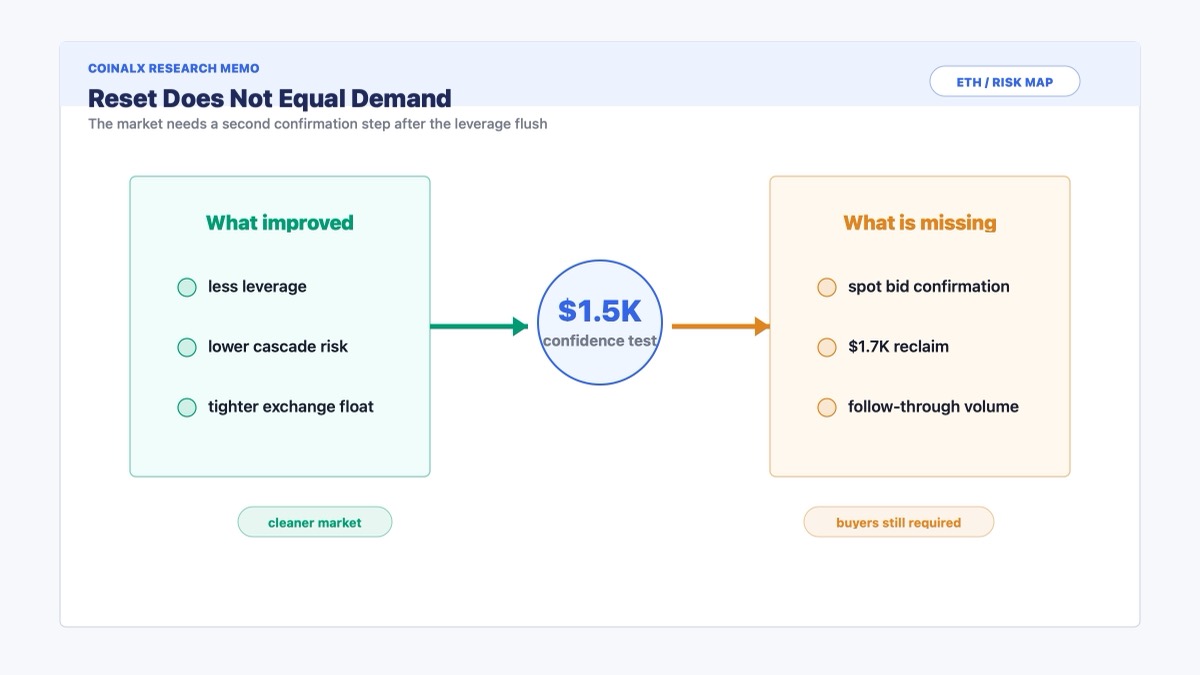
But less leverage is not the same thing as more demand. This is the trap.
ETH bulls want to see the open-interest decline as a cleansing event. Bears want to see it as confirmation that traders are leaving the market. Both readings have some truth. A cleaner market can form a bottom, but only if spot buyers, long-term holders, ETF flows, or ecosystem demand step in. Otherwise, the reset simply tells us that fewer people are willing to fight the downtrend with size.
The exchange reserve decline adds another layer. If hundreds of thousands of ETH are leaving centralized exchanges, the immediate sellable supply may be tightening. That can support a rebound if buyers return. But if the broader market remains risk-off, lower exchange balances can sit there quietly while price still struggles under technical pressure.
So the real question is not "Is the open-interest reset bullish or bearish?"
The better question is: after the reset, who is left to buy?
That is why $1,500 matters. It is not just a number on a chart. It is the place where the derivatives reset, the exchange outflows, and the broader ETH confidence test all meet.
Historical Parallel
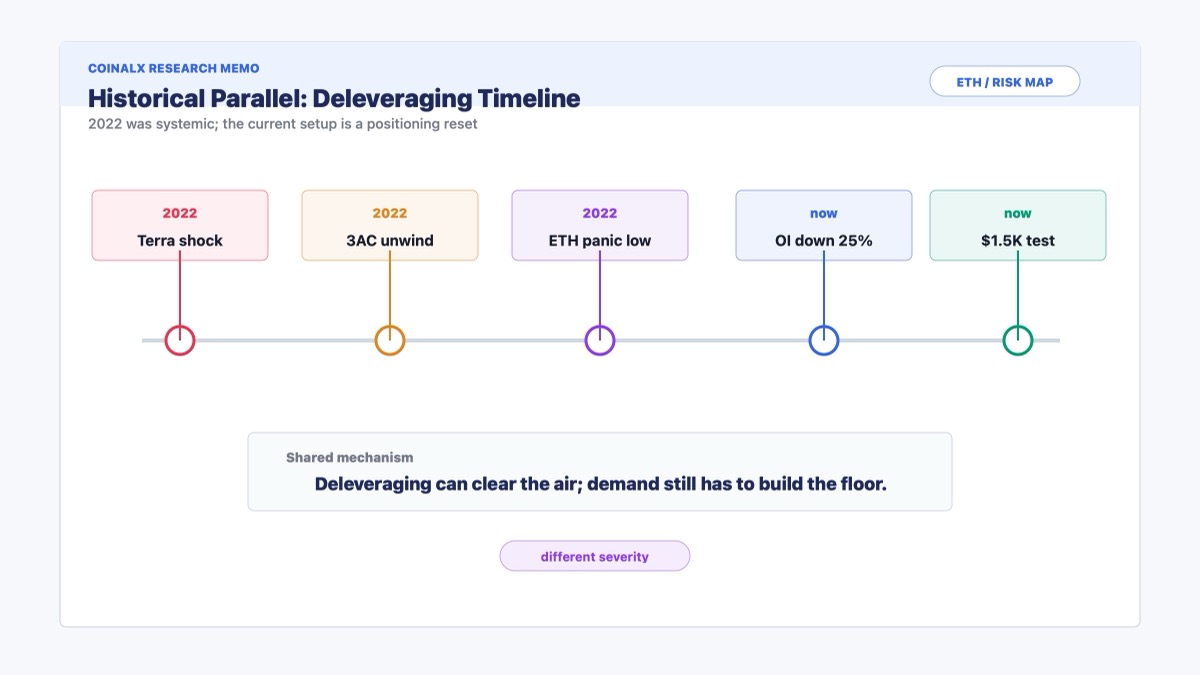
A useful historical parallel is Ethereum's 2022 bear-market deleveraging after the Terra collapse, the Three Arrows Capital crisis, and the broader crypto credit unwind. ETH fell from its 2021 cycle high near $4,800 to the high-$800 area in June 2022, while leverage and risk appetite were stripped out of the market in a way that felt less like a normal correction and more like a forced balance-sheet cleanup.
The similarity is the mechanism. In both cases, Ethereum was not just dealing with a price decline. It was dealing with a positioning problem. When too much leverage piles into a market, the chart can start behaving like a crowded staircase during a fire drill. People are not calmly repricing fundamentals. They are trying to get out of the same narrow door. Open interest falling sharply tells us that some of that crowd has already left.
That is why the current 25% decline in ETH futures open interest matters. It suggests that the market has moved from "leveraged stress building" to "leverage already being removed." Historically, that transition can help a bottoming process because the next move becomes less dependent on forced liquidations and more dependent on whether real buyers appear.
The difference is that 2022 was a systemic credit crisis. The Ethereum market was absorbing bankruptcies, contagion risk, and a collapse in trust across major crypto lenders and funds. The current setup, at least based on the article, looks more like a market-structure reset around futures positioning, exchange reserves, and a key technical support level. That is serious, but it is not automatically the same kind of industry-wide solvency shock.
The lesson is uncomfortable but useful: deleveraging can clear the air, but it does not guarantee a floor. In 2022, ETH eventually stabilized only after both leverage and panic had been exhausted. Today, the $1,500 zone is where traders find out whether the current reset is enough, or whether price still needs to search lower for real demand.
Ethereum Price Reaction and K-Line Analysis
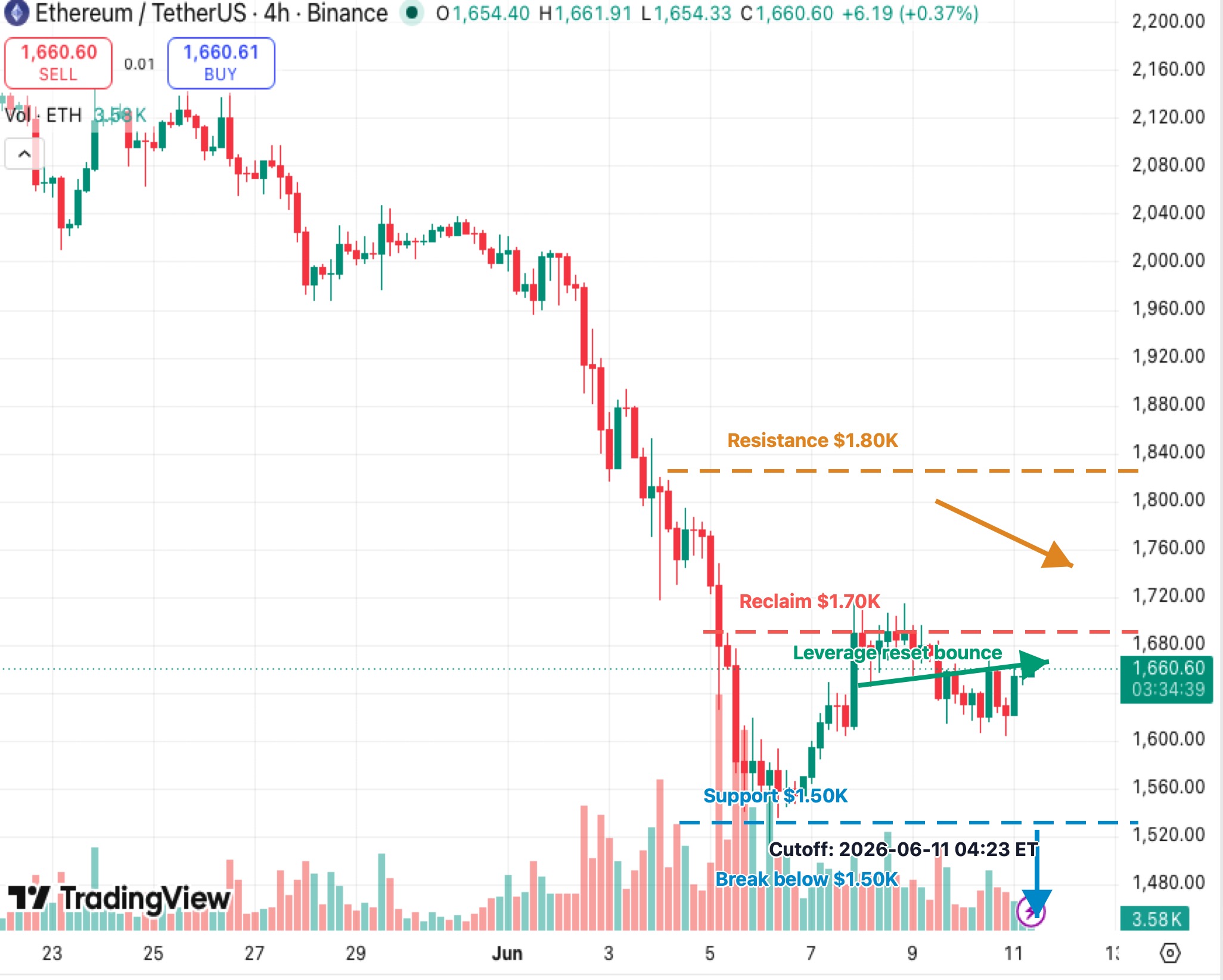
The ETHUSDT 4H chart shows a market that has stopped collapsing for the moment, but has not repaired itself yet.
The downtrend from above $2,100 was clean and heavy. ETH lost multiple short-term shelves, broke below $1,800, and then flushed toward the $1,500 area. That is why the current bounce needs to be treated carefully. It is coming after a real breakdown, not after a mild dip.
The first important level is $1,700. ETH is trying to rebuild near the mid-$1,600s, but the chart still needs a clean reclaim of $1,700 before the rebound looks healthier. Until that happens, the move can still be read as a weak bounce inside a damaged trend.
Above that, $1,800 is the next resistance zone. A push into that area would suggest buyers are not merely defending the lows; they are forcing sellers to retreat from the prior breakdown area.
The downside is simpler. The $1,500 zone is the support that keeps the structure from becoming much darker. If ETH breaks below it with momentum, the article's $1,000 risk scenario becomes more than a dramatic headline. It becomes the next technical conversation.
Key Levels to Watch
- $1,700: The first reclaim level. ETH needs this zone to turn the bounce into a more credible repair.
- $1,800: The next resistance area, where sellers may reappear after the recent breakdown.
- $1,500: The key support level. Holding it keeps ETH above the line traders are watching.
- Below $1,500: The danger zone. A decisive break would shift focus toward the $1,000 downside risk area.
Conditional Forecast
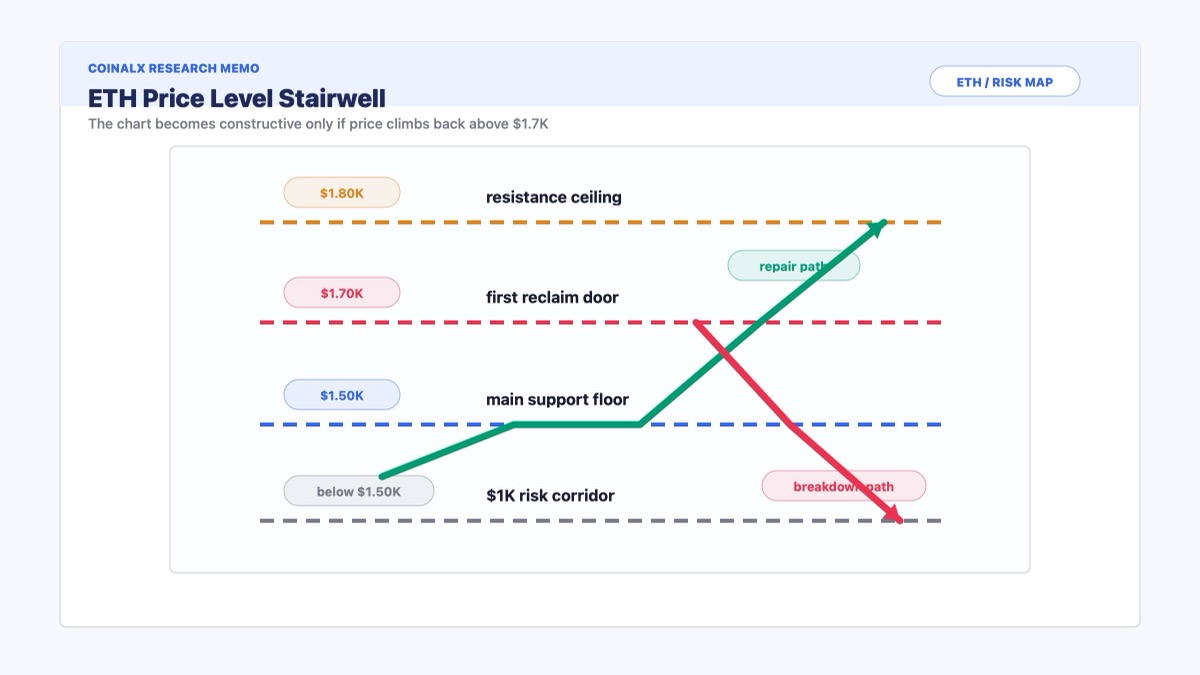
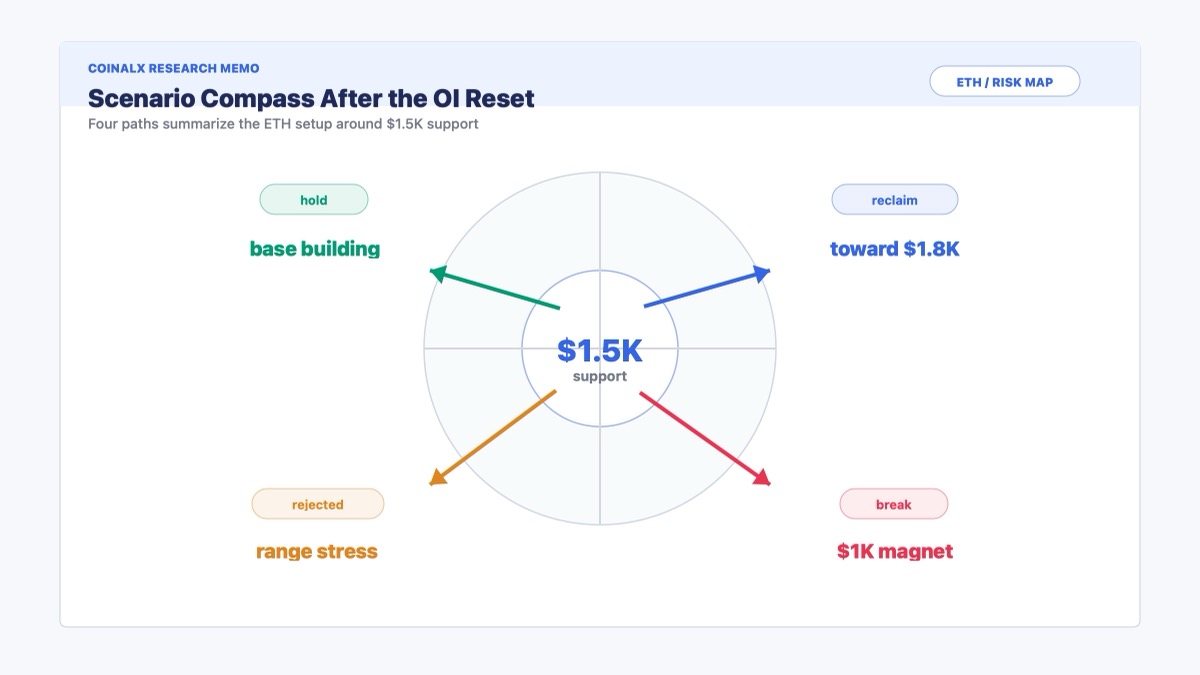
If ETH holds $1,500 and reclaims $1,700, the leverage reset can start to look constructive. In that scenario, lower open interest would suggest that much of the forced selling pressure has already passed, and ETH could attempt a recovery toward $1,800.
If ETH fails at $1,700, the market remains vulnerable. That would tell us the bounce is still being sold, and that traders are not yet willing to treat the open-interest decline as a durable bottom signal.
If ETH breaks below $1,500, the setup changes fast. The market would likely stop focusing on exchange outflows and start focusing on downside liquidity. That is when $1,000 becomes the obvious psychological magnet.
Investment Takeaway
The ETH story here is not simple bullish or simple bearish. It is a cleaner market sitting on a dangerous ledge.
The open-interest reset is helpful because it removes some leveraged pressure. The exchange outflows are potentially helpful because they reduce available sell-side inventory. But neither of those things forces buyers to appear.
Price still has the final vote.
For investors, the practical read is this: ETH above $1,500 is damaged but alive. ETH above $1,700 starts to look like repair. ETH below $1,500 reopens the deeper-stress scenario.
That is the map. The market now has to choose which part of it becomes real.
Sources
- Cointelegraph: Ether risks revisit of $1,000 if this support level breaks amid leverage reset data
- TradingView News: Ethereum open interest drops 25% as $1,500 support comes into focus
- Glassnode Insights: A Bear of Historic Proportions
- CME Group: Ether futures volume and open interest
- TradingView: ETHUSDT chart
|
DISCLAIMER:
1. All content on this website (including but not limited to articles, data, charts, and analyses) is for general informational purposes only and does not constitute any form of investment advice, trading recommendation, or financial guidance. 2. Cryptocurrencies and digital assets are subject to extreme price volatility and high investment risk; you may lose part or all of your principal. Past performance does not predict future results. 3. The information on this website is based on sources we believe to be reliable, but we do not guarantee its accuracy, completeness, or timeliness. Any investment decisions made based on this website’s information are at your own risk. 4. We strongly recommend that you conduct your own thorough research and consult an independent, licensed financial advisor before making any investment decisions. |