Key Takeaways
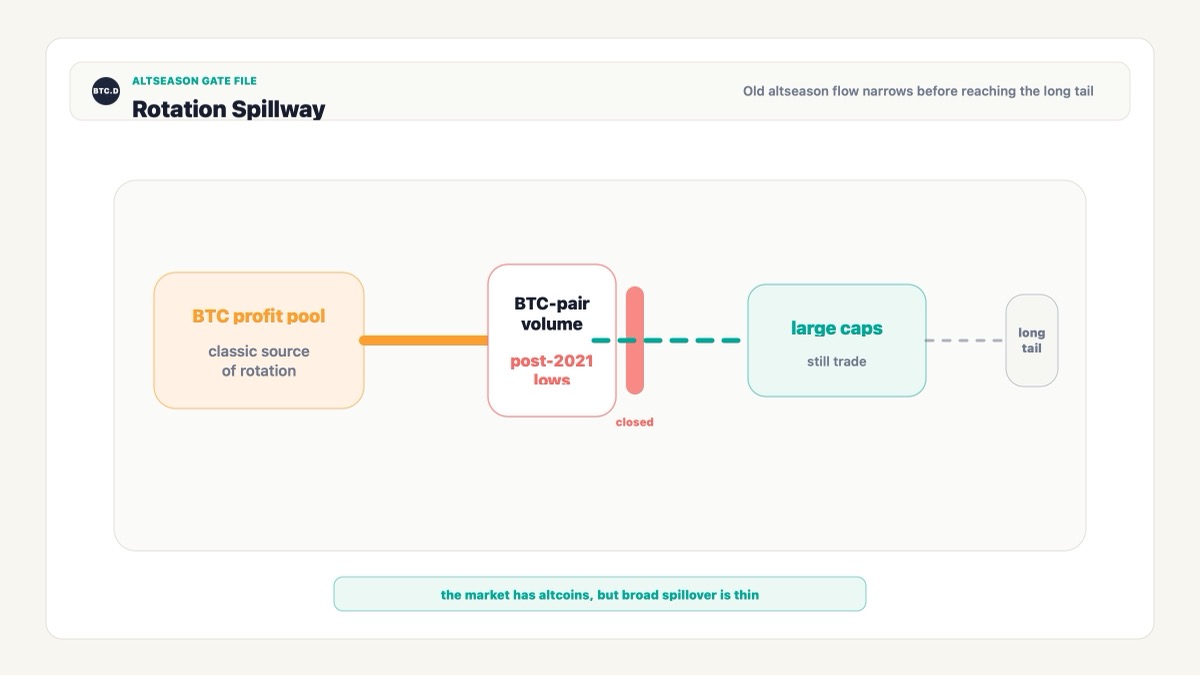
- CryptoQuant CEO Ki Young Ju says the Bitcoin-to-altcoin rotation trend has “basically disappeared,” with BTC-pair altcoin volume near its weakest level since 2021.
- Altcoin capital is becoming more concentrated: the top 10 non-stablecoin altcoins account for roughly 80.5% of the non-BTC, non-stablecoin market.
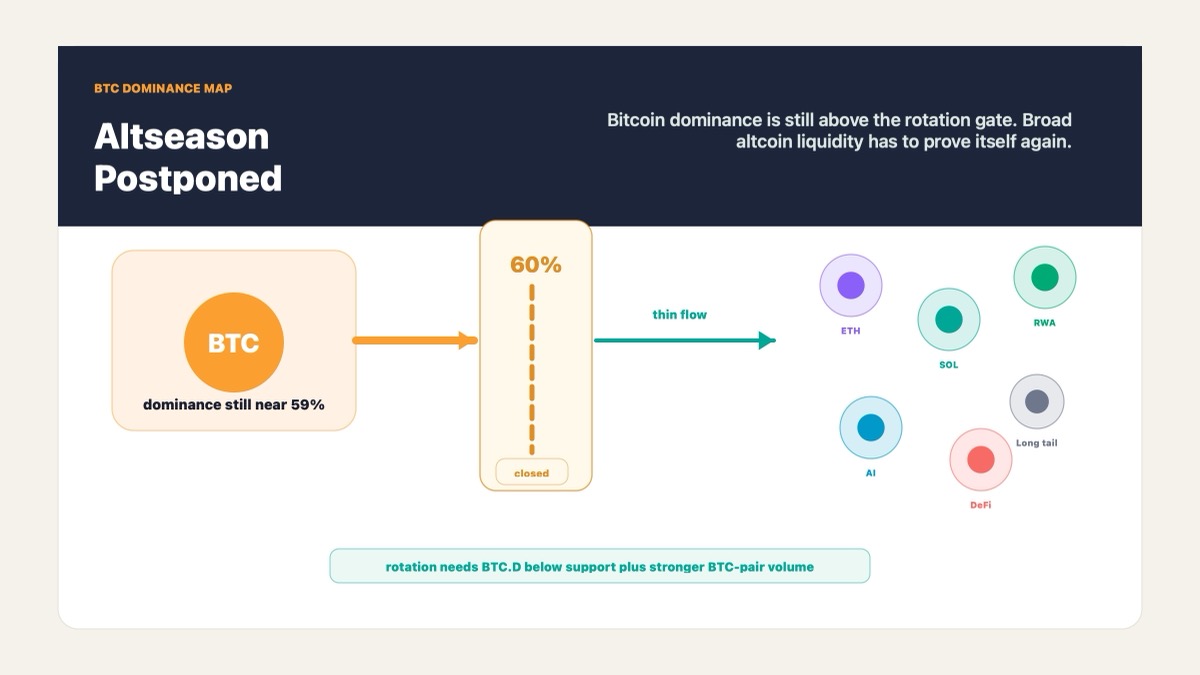
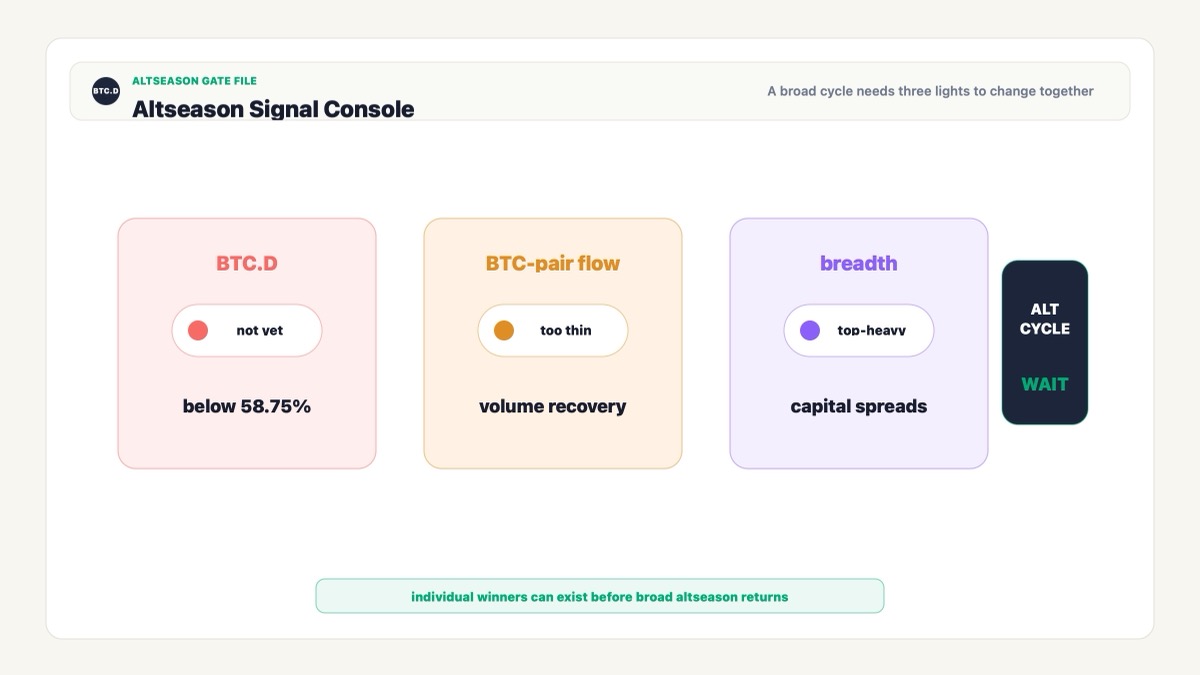
- BTC dominance holding above 58.75% keeps pressure on broad altseason hopes; a push toward 60% would likely delay altcoin rotation further.
What Happened
The old altseason script used to be simple enough to fit on a napkin.
Bitcoin runs first. Traders make money. Some of that Bitcoin-denominated profit rotates into altcoins. Then the market gets weird, fast and expensive. Smaller coins start moving not because every project has become brilliant overnight, but because liquidity is spilling downhill and everyone is suddenly a genius.
That script is not working the same way now.
According to Cointelegraph, CryptoQuant CEO Ki Young Ju said the Bitcoin-to-altcoin rotation trend has “basically disappeared.” He cited CryptoQuant data showing that BTC-pair altcoin trading volume has collapsed to its weakest level since 2021.
This metric matters because it does not simply ask whether altcoins are trading. It asks a more specific question: are traders using Bitcoin itself to buy smaller altcoins? In 2017 and 2021, that kind of flow helped fuel broad altseason rallies. In the current market, the flow looks thin.
The concentration data tells the same story from a different angle. Cointelegraph reported that the non-BTC, non-stablecoin crypto market was worth roughly $600 billion as of Saturday, while the top 10 non-stablecoin altcoins accounted for about $483 billion of that total. That is roughly 80.5%.
The long tail is getting thinner.
The number of altcoins with market valuations above $1 billion has also fallen sharply. In 2021, about 106 altcoins were above that threshold, according to a CoinMarketCap historical snapshot cited in the report. By June 2026, the number had dropped to around 50.
So the market has not run out of altcoins. Crypto is very good at producing more things with tickers. The problem is that capital is no longer spreading across them the way it used to.
Meanwhile, Bitcoin dominance is holding above key support. BTC.D bounced from the 100-week EMA and the lower trend line of an ascending channel near 58.75%. If that bounce continues toward 60%, Bitcoin would keep absorbing market share and make broad altseason harder to start.
Why This Matters for Bitcoin and Crypto Markets
This matters because “altseason” is not just a vibe. It is a liquidity process.
The lazy version of the story says altseason happens when Bitcoin goes up and traders get bored. The better version is that altseason needs capital to rotate out along the risk curve. Bitcoin has to stop monopolizing attention. Stablecoin liquidity has to move. Traders have to believe that smaller assets can outperform enough to justify the extra risk.
Right now, that mechanism looks damaged.
If BTC-pair altcoin volume is weak, then one of the classic engines of altseason is missing. Traders may still buy altcoins with stablecoins. They may still chase Solana, AI tokens, DeFi revenue names or whatever the narrative machine is currently chewing on. But the old broad rotation from Bitcoin profits into a wide basket of smaller coins is not showing the same force.
That changes the market’s shape.
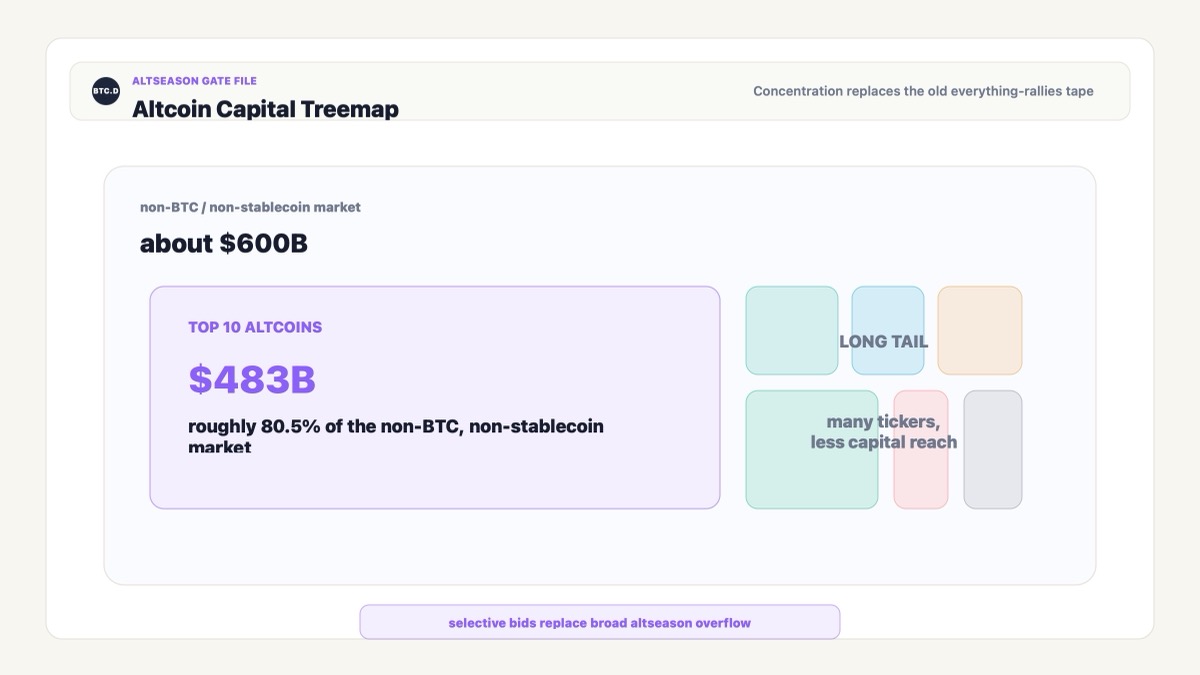
Instead of a tide lifting almost everything, the market becomes a security checkpoint. The largest altcoins get most of the capital. Tokens with revenue, users, real business models or strong exchange liquidity may still attract bids. Narrative-only projects have a harder time pretending that attention is the same thing as demand.
For Bitcoin, this is supportive in relative terms. If capital is not rotating aggressively into smaller altcoins, BTC can keep holding dominance even when its own price action is not spectacular. Bitcoin does not have to be exciting. It just has to be the cleanest, deepest pool in a market that has become more selective.
For altcoins, the message is harsher. A broad altseason may not be impossible, but it likely needs a new trigger. The old “BTC pumped, therefore everything else follows” chain is weaker now.
That is not death. It is maturation. Less fun, maybe. But more honest.
Historical Parallel
The obvious historical parallel is the 2017 and 2021 altseason pattern, when Bitcoin strength eventually became fuel for the rest of the crypto market.
In those cycles, Bitcoin often acted like the first rocket stage. It attracted attention, pulled in liquidity and created paper profits. Then, once traders felt richer and Bitcoin momentum cooled, capital rotated into Ether, large-cap altcoins, mid-caps and eventually the long tail. The process did not require every project to have deep fundamentals. Liquidity itself became the argument. If enough capital was rotating, weaker assets could still rise because the whole market was expanding.
That is the similarity with the current discussion: traders are again looking for the moment when Bitcoin stops absorbing attention and altcoins begin outperforming. The dream is familiar. The market memory is powerful. Everyone remembers how fast a real altseason can make a portfolio look smarter than its owner.
But the difference is the whole point.
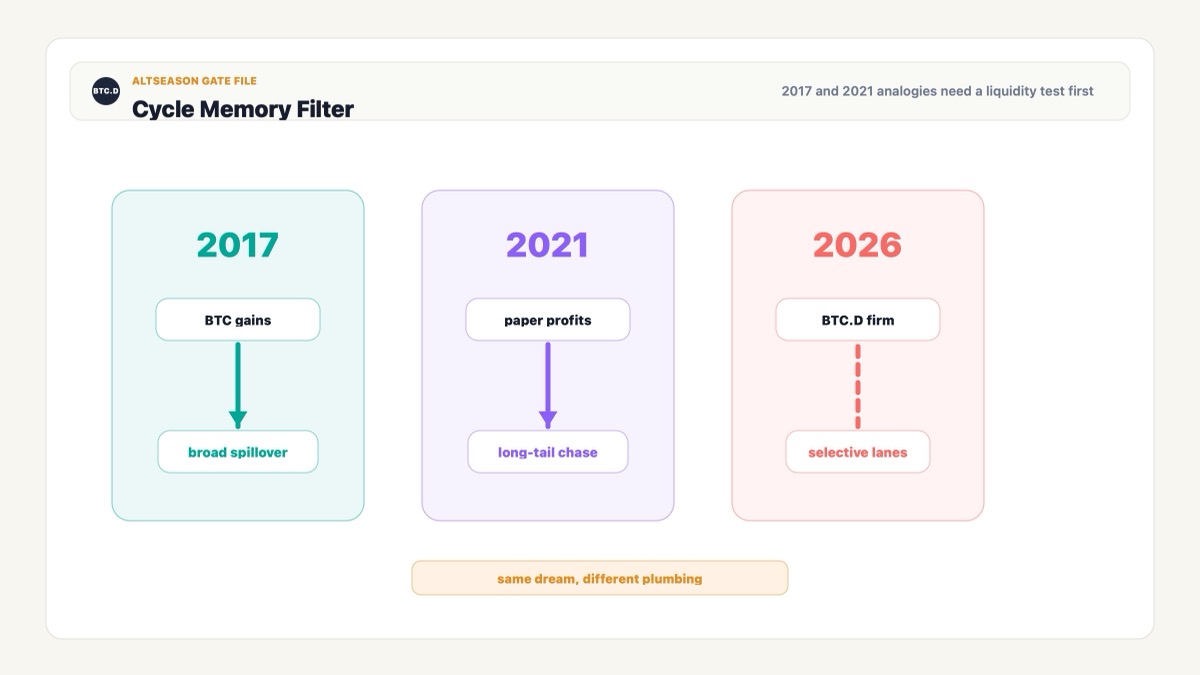
In 2017 and 2021, BTC-denominated rotation into smaller altcoins was visibly active. According to the current CryptoQuant-linked analysis, that flow has collapsed to post-2021 lows. Meanwhile, altcoin capital is much more concentrated, and the number of billion-dollar altcoins has fallen sharply from the last cycle.
The lesson for today is that historical altseason analogies need a filter. You cannot just say “Bitcoin ran, so altcoins are next.” The old cycle logic depended on broad liquidity spillover. If that spillover is missing, the next altcoin phase may be narrower, slower and more selective.
In other words, altseason may not have disappeared. But the easy version of it may have.
Bitcoin Dominance Reaction and K-Line Analysis
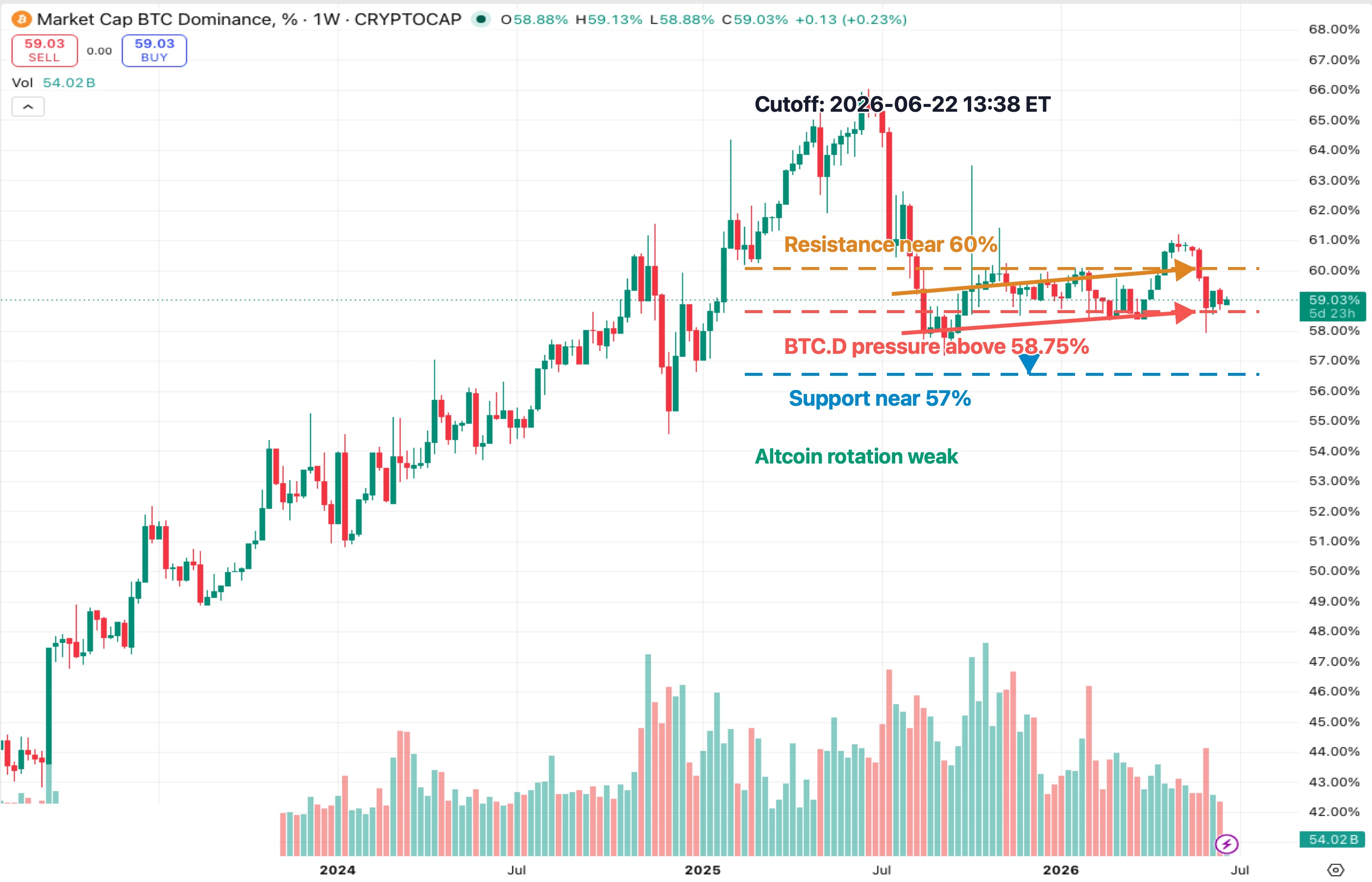
The BTC dominance chart is the cleanest visual for this story because the news is not really about one altcoin. It is about whether capital is moving from Bitcoin into the broader altcoin market.
Right now, BTC.D is holding around 59%, above the 58.75% area highlighted in the report. That matters because dominance staying above support means Bitcoin is still defending its share of total crypto market capitalization.
The first upside level is near 60%. If BTC.D pushes toward that zone and holds there, it would signal that Bitcoin is still absorbing capital relative to the rest of crypto. That would likely postpone a broad altseason because altcoins need dominance to fall, not stabilize near resistance.
The important lower level is near 57%. If BTC.D loses the 58.75% area and starts moving toward the 200-week EMA region around 57%, the setup becomes more favorable for altcoins. That would suggest Bitcoin’s dominance bounce is fading and capital may have room to rotate outward.
The chart is not saying altseason is impossible. It is saying the door is not open yet.
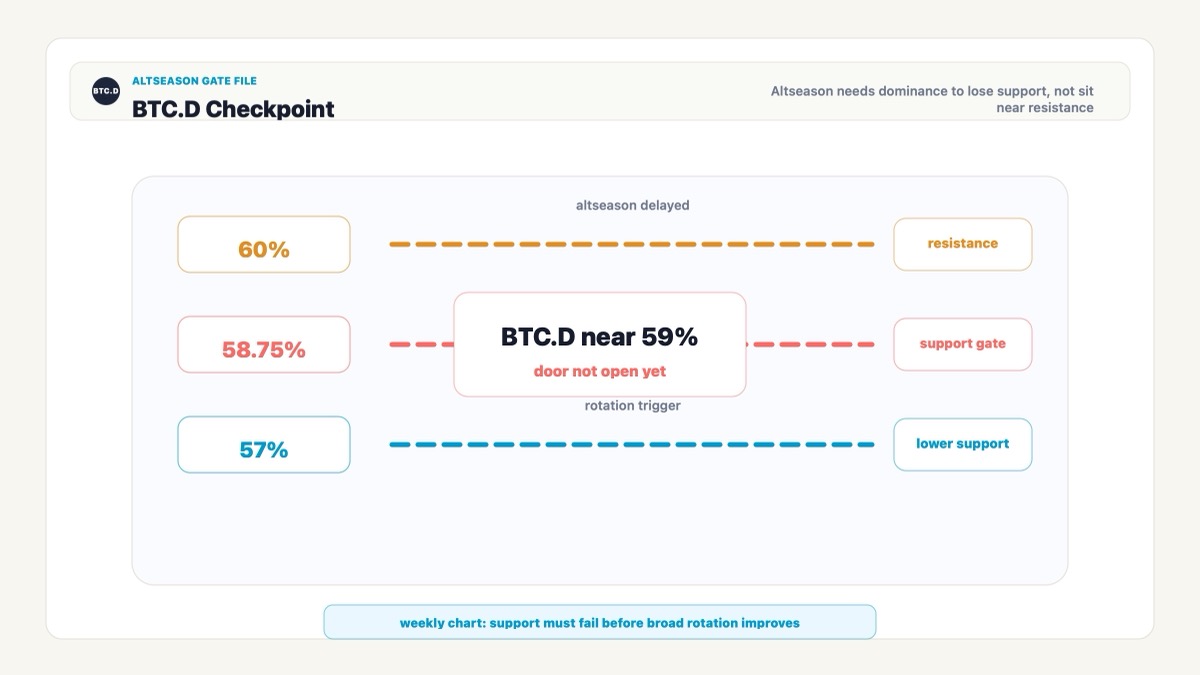
And that distinction matters. A market can have individual altcoin winners while still failing to produce a broad altseason. That is exactly the kind of environment this chart describes: selective opportunity, weak rotation, and Bitcoin still sitting in the middle of the room taking up oxygen.
Key Levels to Watch
60% BTC dominance resistance: A move toward this zone would likely delay broad altseason momentum and keep capital concentrated around Bitcoin.
58.75% dominance support: This is the key area from the report. Holding above it supports the “altseason postponed” argument.
57% lower support: A move toward this area would suggest BTC dominance is losing strength and altcoin rotation may have more room to develop.
BTC-pair altcoin volume: This is the hidden engine to watch. Without stronger BTC-denominated rotation, broad altseason remains harder to justify.
Conditional Forecast
If BTC dominance moves toward 60% and holds above 58.75%, the broad altcoin market likely remains under pressure. In that scenario, individual winners can still emerge, but the old full-market altseason structure stays postponed.
If BTC.D loses 58.75% and trends toward 57%, the market gets more interesting for altcoins. That would suggest Bitcoin is no longer absorbing capital as strongly, giving altcoins more room to outperform.
If BTC-pair altcoin volume begins recovering from post-2021 lows, the rotation thesis becomes stronger. That would be one of the clearest signs that traders are again using Bitcoin profits to reach for smaller assets.
If capital remains concentrated in the top 10 altcoins, the next “altseason” may not look like 2017 or 2021. It may be a narrower cycle built around revenue, liquidity, stablecoins, real-world assets, AI agents and working applications rather than broad speculative overflow.
Investment Takeaway
The investment takeaway is not that altcoins are dead. That is too dramatic, and crypto has a long history of making dramatic obituaries age badly.
The better takeaway is that broad altcoin exposure now needs more proof. A real altseason requires more than Bitcoin strength. It needs rotation, liquidity expansion and falling Bitcoin dominance.
For traders, BTC dominance around 58.75%-60% is the key battlefield. For investors, the bigger question is whether an altcoin has a reason to attract capital without depending on the whole market becoming generous.
The market is not saying “never buy altcoins.” It is saying the free-money phase of altcoin selection is not here yet.
Sources
- Cointelegraph: Bitcoin rotations into altcoins collapse: Have altseasons disappeared?
- CryptoQuant data cited by Cointelegraph, including BTC-pair altcoin trading volume analysis from Ki Young Ju.
- CoinMarketCap historical snapshot data cited by Cointelegraph on the number of $1B+ altcoins in 2021 versus June 2026.
- TradingView: CRYPTOCAP:BTC.D weekly chart
|
DISCLAIMER:
1. All content on this website (including but not limited to articles, data, charts, and analyses) is for general informational purposes only and does not constitute any form of investment advice, trading recommendation, or financial guidance. 2. Cryptocurrencies and digital assets are subject to extreme price volatility and high investment risk; you may lose part or all of your principal. Past performance does not predict future results. 3. The information on this website is based on sources we believe to be reliable, but we do not guarantee its accuracy, completeness, or timeliness. Any investment decisions made based on this website’s information are at your own risk. 4. We strongly recommend that you conduct your own thorough research and consult an independent, licensed financial advisor before making any investment decisions. |
Recommended reading
Latest News