Key Takeaways
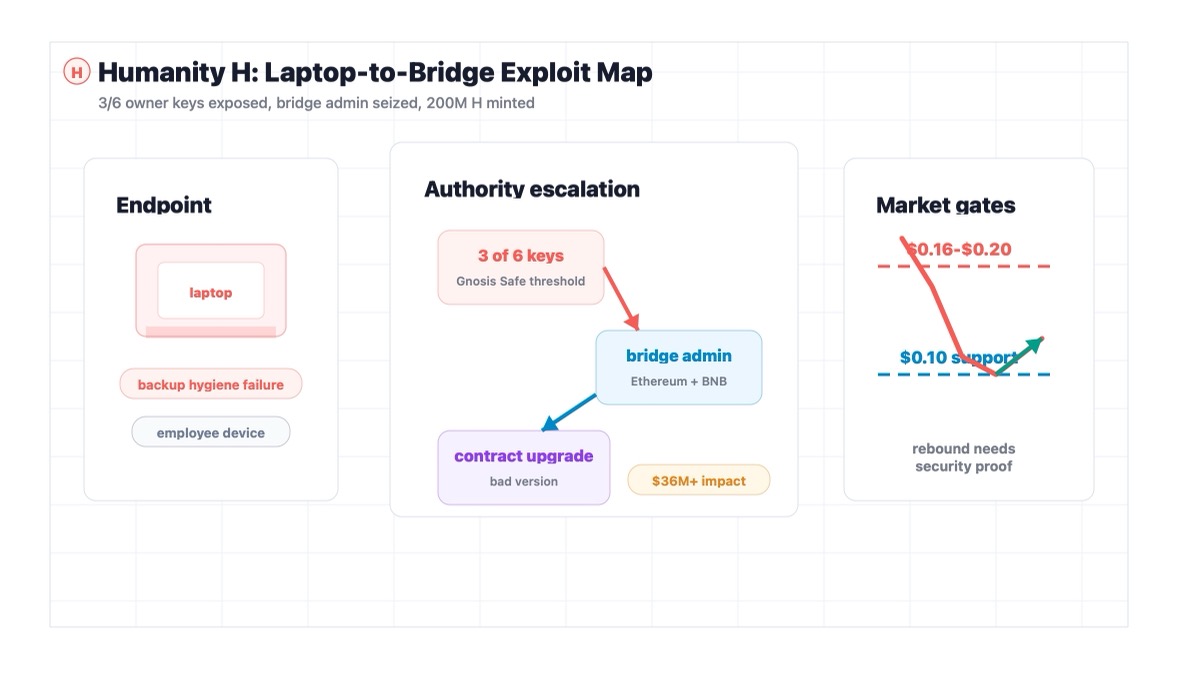
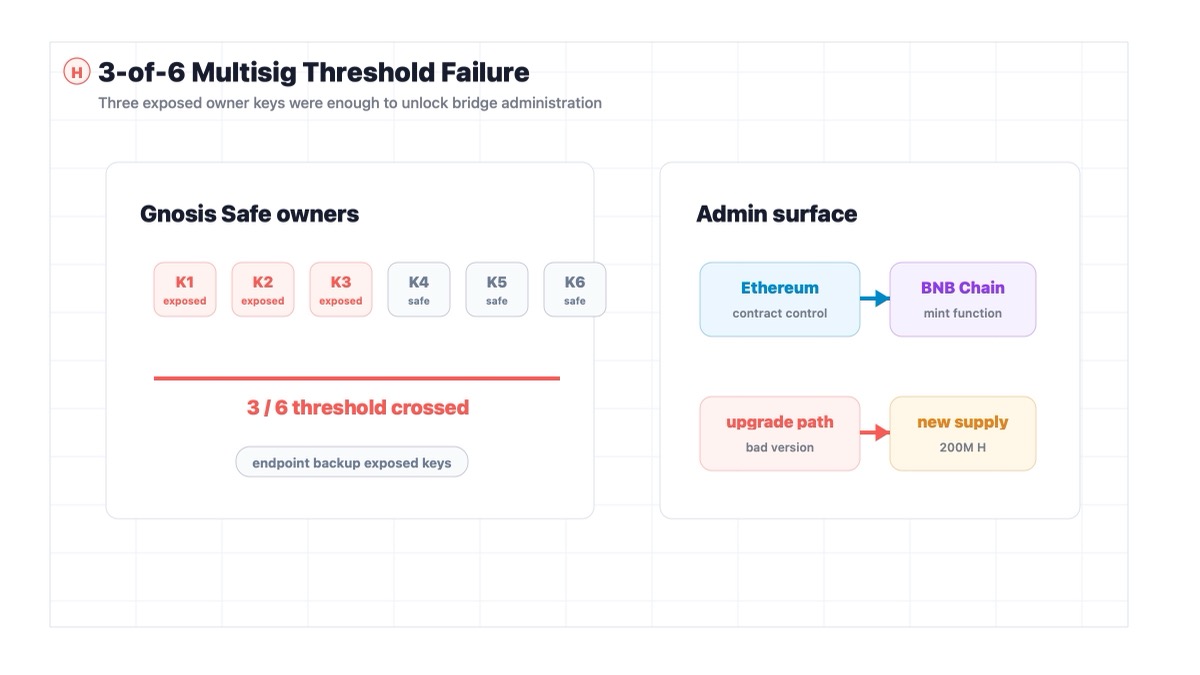
- Humanity says a compromised employee laptop exposed three of six Gnosis Safe owner keys.
- Attackers allegedly seized bridge administration on Ethereum and BNB Chain, upgraded contracts and created fresh H supply.
- H has rebounded near $0.16, but remains down roughly 74% over seven days, according to CoinGecko.
- The token needs to hold $0.10 and reclaim $0.16-$0.20 before the chart can show real repair.
What Happened
Humanity Protocol has now offered a more specific explanation for the H token disaster.
The short version sounds almost too small for the damage it caused: a laptop was compromised.
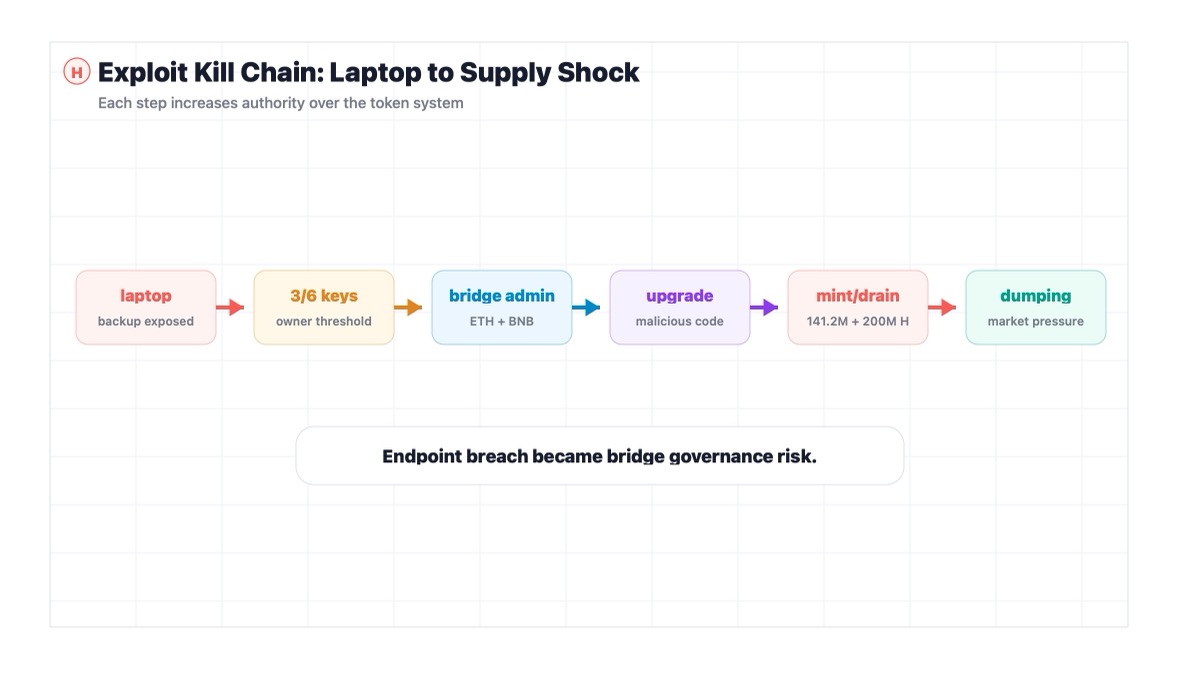
The longer version is where things get uncomfortable. According to Cointelegraph, Humanity founder Terence Kwok said some multisig keys may have been accidentally backed up to a compromised device during setup. Humanity said three of six Gnosis Safe owner keys were compromised, which allowed attackers to take control of bridge administration on both Ethereum and BNB Chain.
Once attackers had that control, the incident stopped being a normal wallet-drain story. Humanity said the attackers changed bridge contracts into malicious versions. On Ethereum, they drained around 141.2 million H tokens. On BNB Chain, they added a function that let them create unlimited tokens, then minted 200 million H directly to their own wallet.
That is how an endpoint compromise becomes a protocol-level crisis.
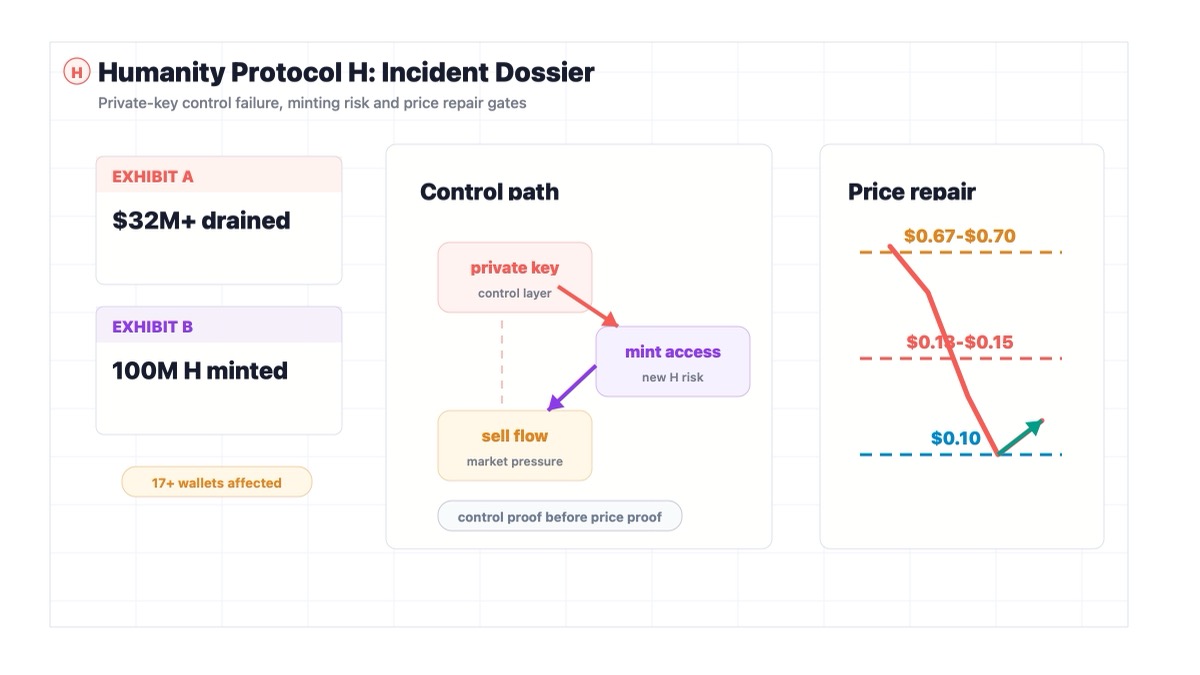
The reported damage rose to more than $36 million, higher than the first wave of reports around $32 million. H had already collapsed more than 80% after the private-key compromise became public. CoinGecko data now shows H around $0.16, up sharply over 24 hours but still down roughly 74% over seven days.
Humanity said it halted deposits and withdrawals to the affected bridges and is working with exchanges and related parties to reduce damage and explore recovery options.
Security researchers were not fully satisfied with the explanation. Cyvers' Hakan Unal told Cointelegraph that when an attacker holds legitimate admin rights, the onchain pattern can look similar whether the event is a genuine compromise or something more coordinated. Allium Labs researcher Elton Shehdula said wallet funding weeks ahead of the attack, minting authority being warmed up before the exploit and simultaneous dumping across chains suggested a planned operation.
So the market is left with two questions.
Was this contained?
And why did one compromised endpoint have a path to this much authority?
Why This Matters for Bitcoin and Crypto Markets
Crypto likes to talk about decentralization in grand language.
Then an event like this comes along and asks a smaller, nastier question: where were the keys?
That is the whole problem. A bridge can have impressive branding, a serious team, a biometric identity narrative and smart cryptographic language around it. But if enough privileged keys are exposed through a laptop backup, all of that sophistication gets pulled back to a very human failure point.
This is why the Humanity update matters beyond H token holders. It shows how three layers can stack into one crisis.
First, endpoint security fails. A device is compromised or backup hygiene breaks down. Second, key custody fails. Sensitive owner keys are exposed in a way the system clearly did not survive. Third, bridge governance fails. The attacker can upgrade contracts, alter bridge behavior and create supply on another chain.
That is not one bug. That is a chain of authority.
The market reaction makes sense through that lens. H did not fall simply because tokens were sold. It fell because investors had to reprice the trust model. If a project says three of six multisig keys could be compromised through a laptop setup mistake, traders are not only asking how many tokens were dumped. They are asking whether the remaining system is truly contained.
This also explains why the rebound is tricky. H can bounce from oversold levels, and it has. But price repair is not the same thing as trust repair. A token can move from $0.06 to $0.16 because short-term sellers are exhausted or speculators smell volatility. That does not answer the deeper question of whether bridge controls, minting permissions and exchange coordination are now safe enough for serious capital.
In security-driven crashes, the chart is only the surface. The control system underneath is the story.
Historical Parallel: Ronin Bridge and the Fragility of Privileged Keys
The closest historical parallel remains the Ronin Bridge exploit in March 2022.
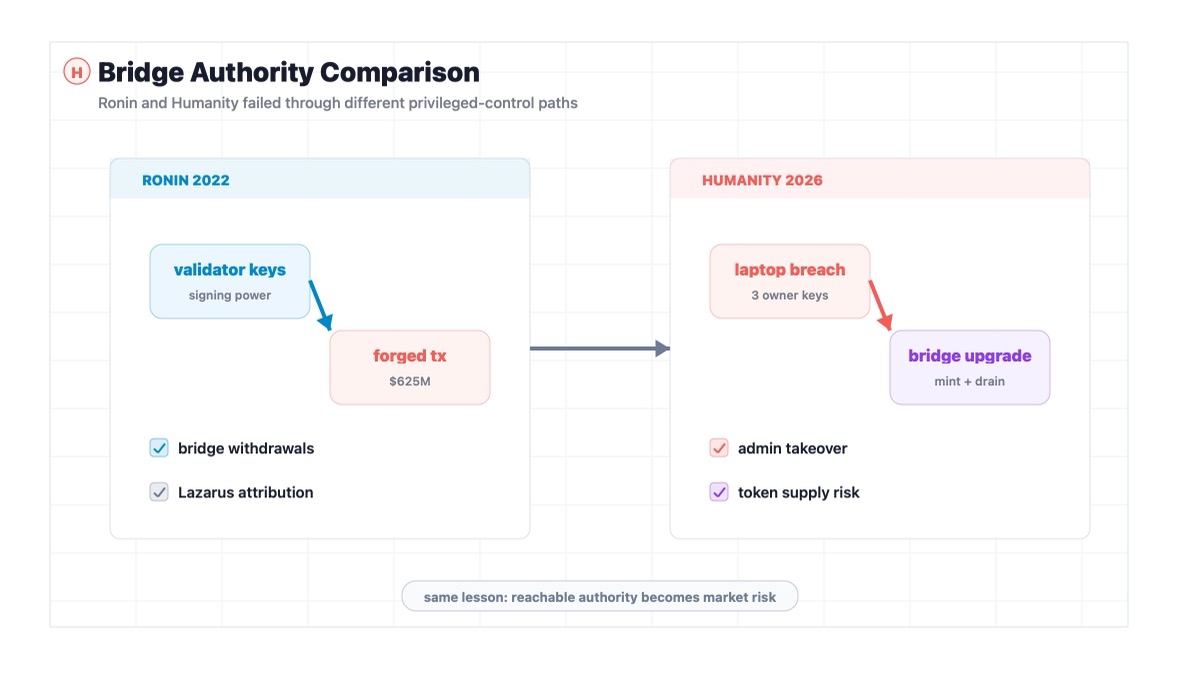
Ronin was a bridge attached to the Axie Infinity ecosystem, and the attack became one of crypto's largest. CoinDesk reported that attackers used hacked private keys to forge withdrawals from the Ronin bridge, draining roughly $625 million in ETH and USDC. The U.S. Treasury later attributed the hack to North Korea-linked Lazarus Group. Technically, the core issue was not that a public market suddenly disliked Axie. It was that attackers gained enough validator signing power to make fraudulent withdrawals look legitimate to the bridge.
The similarity to Humanity is the control layer. In both cases, the damage came from privileged authority being captured. Ronin's attackers controlled enough validator keys. Humanity says its attackers compromised three of six Gnosis Safe owner keys, then seized bridge administration, upgraded contracts and minted new H supply on BNB Chain. Different systems, same ugly lesson: if the authority threshold is reachable by an attacker, the bridge can become a machine for moving value in the wrong direction.
The differences matter too. Ronin was a larger infrastructure loss and centered on validator approvals for withdrawals. Humanity's incident, based on its current explanation, appears to involve a compromised employee laptop, accidentally backed-up keys, admin control over bridge contracts and token minting authority. Ronin was primarily a massive bridge-drain event. Humanity is also a token-supply confidence event.
The lesson for H is direct. Recovery cannot be based only on saying the hack is over. The market needs proof that compromised keys are dead, upgrade paths are secured, minting authority is contained and bridge flows are no longer exposed. Without that, every rebound has a ceiling made of doubt.
The Ronin precedent shows that bridges can recover operationally. But it also shows that key failures leave a scar the market remembers.
H Token Price Reaction and K-Line Analysis
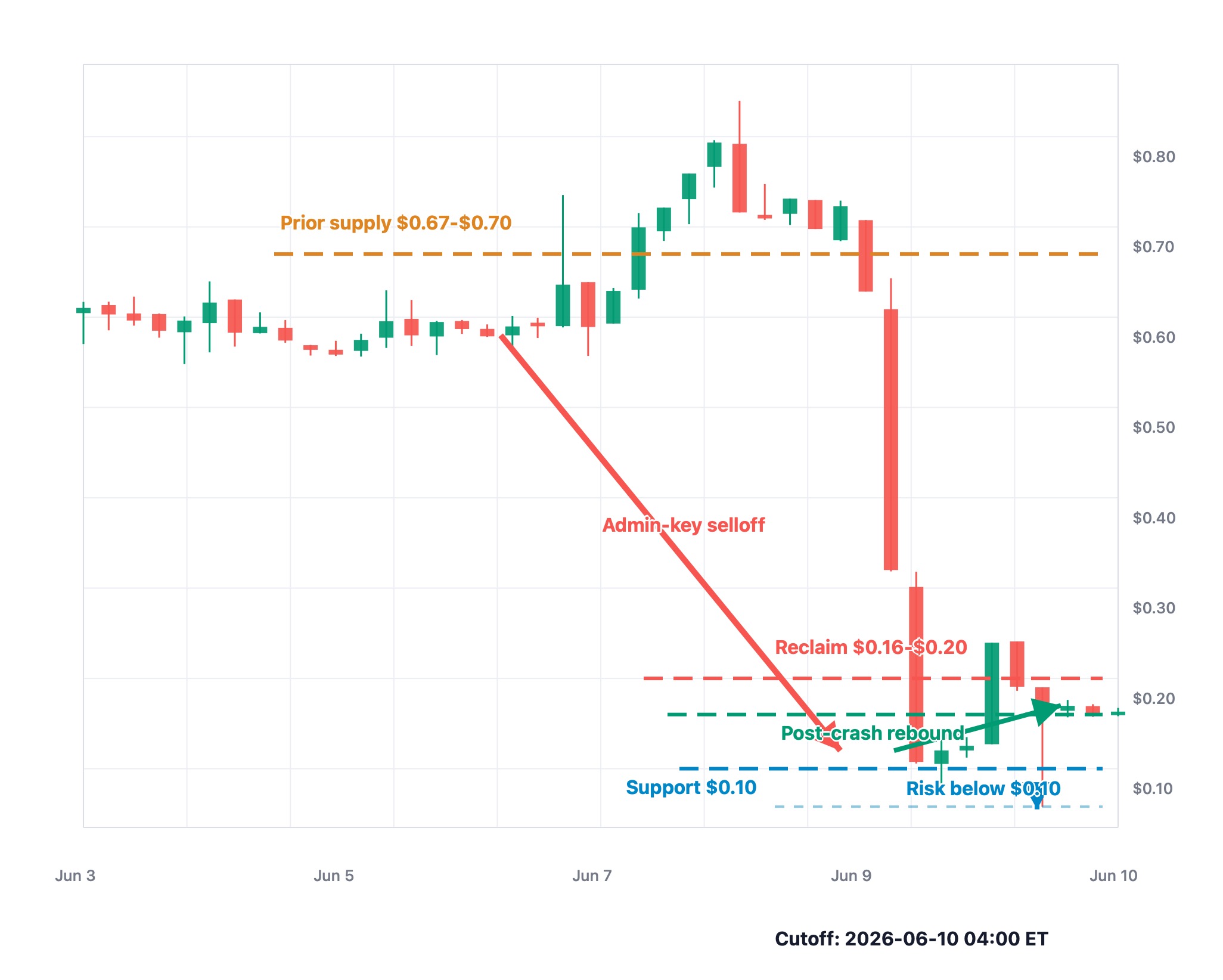
The H/USD seven-day K-line structure shows three different markets in one chart.
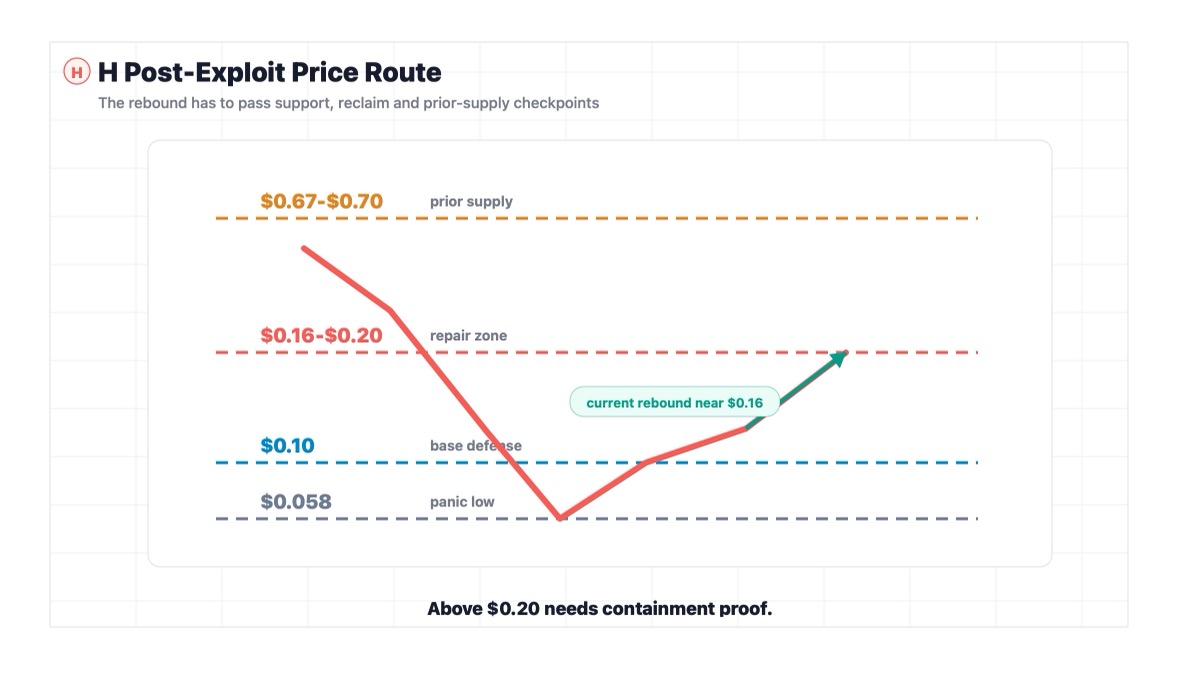
The first market was the pre-crash supply zone around $0.67-$0.70, where H traded before the exploit narrative fully hit. That area now matters mostly as overhead supply. It is where trapped holders, market makers and risk reducers may become sellers into any large recovery.
The second market was the collapse. The chart moved from a high near $0.84 to a low near $0.058 on CoinGecko's seven-day OHLC data. That is not normal volatility. That is a control-risk repricing.
The third market is the current rebound. H is trying to stabilize near $0.16, with a visible repair zone between $0.16 and $0.20. This is the first area that matters now. A clean hold above it would suggest buyers are willing to price in the laptop-breach explanation and containment efforts. Failure there would suggest the bounce is mostly mechanical.
The $0.10 area remains the key downside line. If H holds above $0.10, the token can continue trying to form a post-crash base. If it loses $0.10, the chart starts pointing back toward the panic-low region instead of toward repair.
The important thing is not whether H can bounce. It already has. The important thing is whether the bounce can survive the next wave of security details.
Key Levels to Watch
The first level is $0.16-$0.20. This is the immediate repair zone and the place where the rebound has to prove it is more than a short-term reaction.
The second level is $0.10. A break below it would tell the market that trust remains too damaged for the current base to hold.
The third level is $0.058. This is the panic low from CoinGecko's seven-day OHLC window.
The fourth zone is $0.67-$0.70. This is prior supply, not a near-term target. It matters because any major rally into that area would face heavy memory from the collapse.
Conditional Forecast
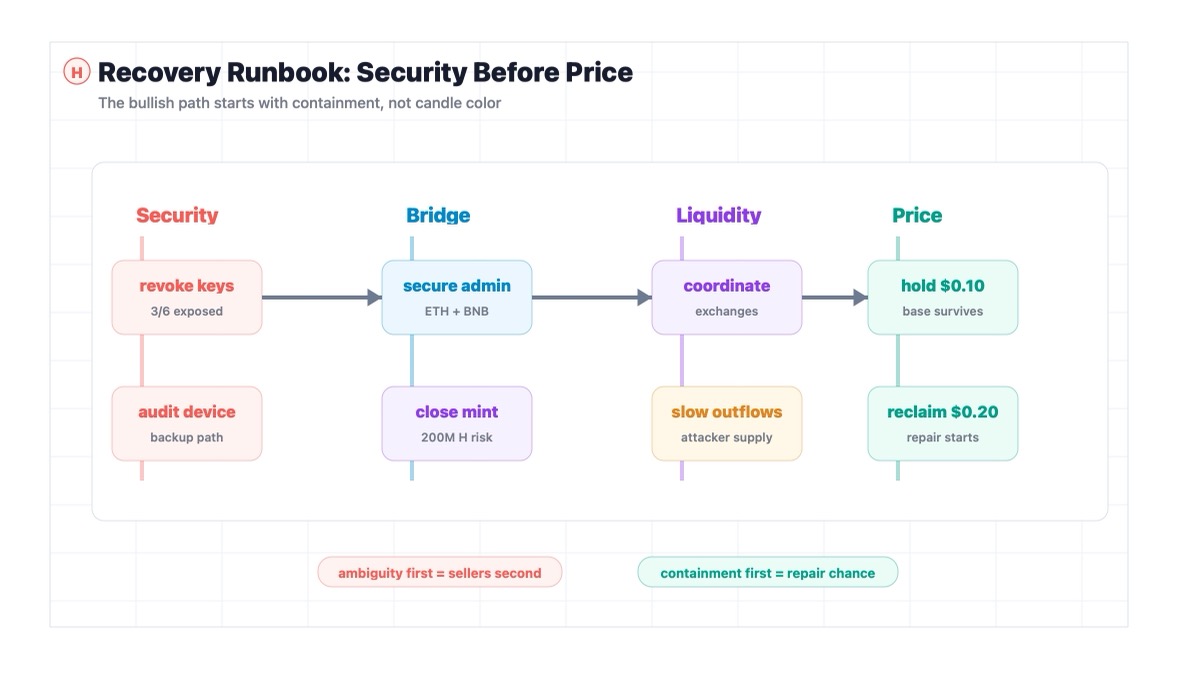
If Humanity can show that compromised keys have been revoked, bridge contracts are secured, minting paths are closed and exchange coordination is working, H can continue stabilizing above $0.10 and attempt to hold the $0.16-$0.20 zone. That would not erase the damage. It would mean the market is beginning to price containment.
If the update trail remains incomplete, or if security researchers keep finding signs of advance preparation and unresolved authority risk, H may struggle to stay above $0.16. In that case, the rebound becomes a liquidity event rather than a confidence event.
If H loses $0.10, the chart probably reopens the panic-low discussion. A token that has just suffered an admin-control exploit does not need much additional bad news to retest its weakest level.
The bullish path is containment first, price repair second. The bearish path is ambiguity first, sellers second, support failure third.
That order matters.
Investment Takeaway
The Humanity update makes the incident clearer, but not necessarily cleaner.
"A compromised laptop" is an explanation. It is not, by itself, a recovery plan. The market now needs to know how three of six owner keys became reachable, why bridge administration could be captured across two chains, how minting authority is being locked down and whether any related wallets or permissions remain exposed.
For investors, this is not the kind of chart where "down a lot" is enough. H may be oversold. H may also be cheap for a reason that is still unfolding.
The practical read is conditional caution. Above $0.16-$0.20, with credible containment evidence, H can begin rebuilding. Above $0.10 but below that reclaim zone, it is still damaged and undecided. Below $0.10, the market is saying the security story has not earned trust back.
In a normal selloff, price asks where buyers are.
In this one, price asks whether the keys are finally safe.
Sources
- Cointelegraph: Humanity says compromised laptop led to $36M bridge attack
- CoinGecko: Humanity price and market data
- CoinMarketCap: Humanity market data
- Crypto.news: Humanity says laptop hack caused $36M bridge attack
- CoinDesk: Axie Infinity's Ronin Network Suffers $625M Exploit
- U.S. Treasury: Treasury Sanctions North Korean State-Sponsored Malicious Cyber Groups
|
DISCLAIMER:
1. All content on this website (including but not limited to articles, data, charts, and analyses) is for general informational purposes only and does not constitute any form of investment advice, trading recommendation, or financial guidance. 2. Cryptocurrencies and digital assets are subject to extreme price volatility and high investment risk; you may lose part or all of your principal. Past performance does not predict future results. 3. The information on this website is based on sources we believe to be reliable, but we do not guarantee its accuracy, completeness, or timeliness. Any investment decisions made based on this website’s information are at your own risk. 4. We strongly recommend that you conduct your own thorough research and consult an independent, licensed financial advisor before making any investment decisions. |