
Key Takeaways
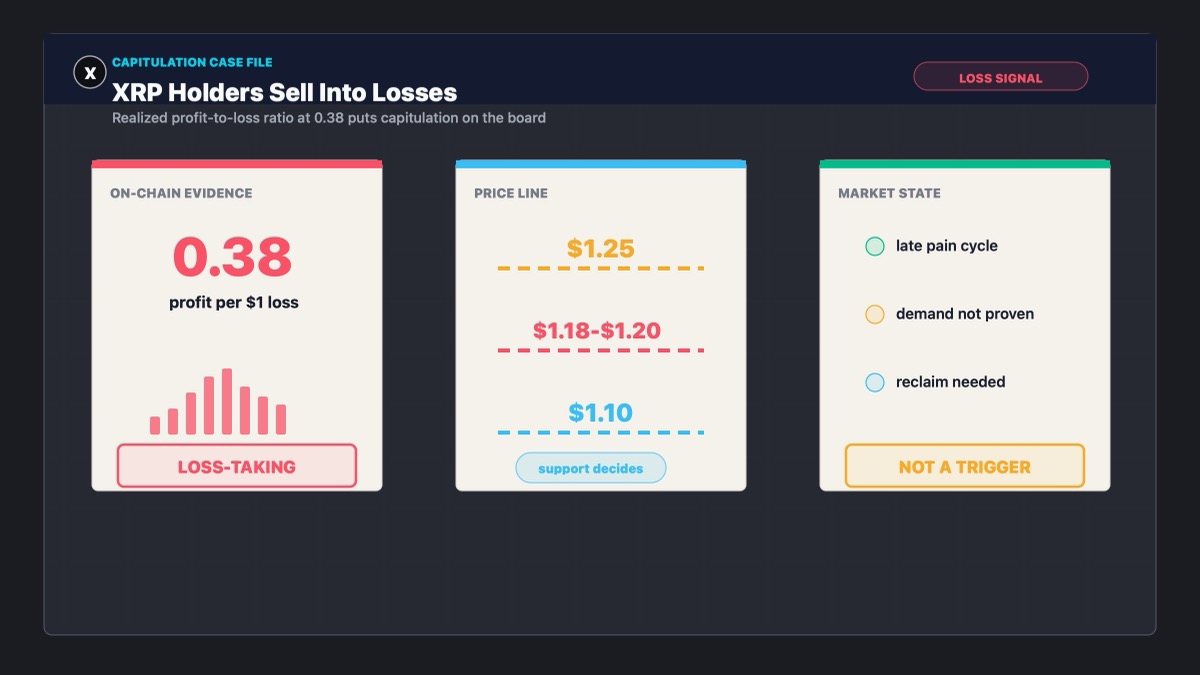
- XRP's 90-day realized profit-to-loss ratio has fallen to 0.38, showing that loss-taking now dominates on-chain activity.
- Capitulation can appear near late-stage downtrends, but it does not automatically mark the exact bottom.
- XRP needs to hold the $1.10 area and reclaim $1.18-$1.20 before the bounce looks like more than exhausted selling.
What Happened
XRP holders are doing the thing markets usually do when patience runs out: they are selling into pain.
According to CoinDesk, citing Glassnode data, XRP's 90-day moving average realized profit-to-loss ratio has dropped to 0.38. That means investors are realizing only $0.38 in profit for every $1 of realized losses. In plain English, the coins moving on-chain are mostly underwater.
That is a very different market from the one XRP had near its 2025 peak. The article notes that the same ratio reached 50 at the top, meaning profit-takers overwhelmed loss-sellers by 50 to 1. Back then, the market was in distribution mode. Holders were taking wins. Now, it is closer to surrender mode. Holders are accepting losses.
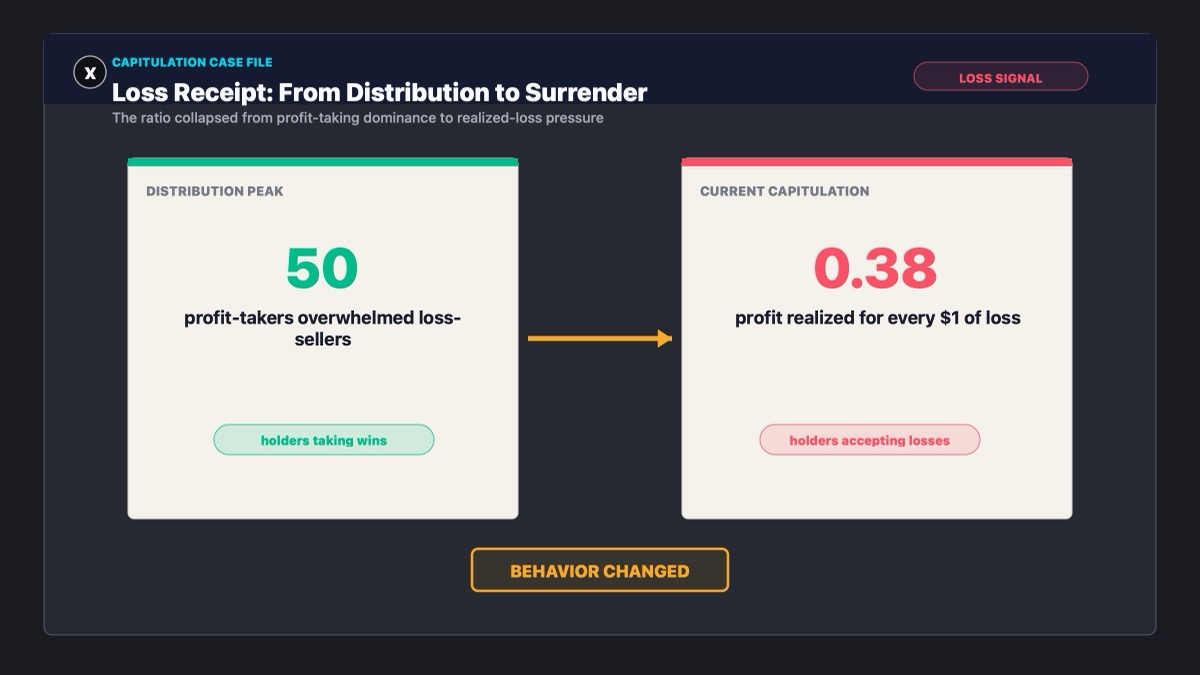
XRP was trading around $1.11 in the original article, down nearly 40% for the year and far below its July peak above $3.60. The current TradingView chart used below shows XRP near the mid-$1.10s after a sharp slide and a weak rebound attempt.
So the news is not simply "XRP is down." Everyone can see that.
The more interesting point is that the character of selling has changed. It is no longer just traders taking profits after a big run. It is holders realizing losses after a long decline. That is what makes the word capitulation relevant.
Why This Matters for XRP and Crypto Markets
Capitulation is one of those market words that sounds dramatic because it is dramatic. But it is also often misunderstood.
It does not mean a bottom has definitely arrived. It means the market has entered a phase where exhausted holders are finally giving up. Some are forced out. Some are emotionally done. Some waited through the decline, watched the bounce fail, and then decided they could no longer keep pretending they were calm.
This matters because markets need sellers to run out before durable bottoms can form. A downtrend does not usually end when everyone is still confidently waiting for higher prices. It ends when enough weak hands, late buyers, and over-optimistic holders have been cleared out that the next dollar of selling has less impact.
That is the bullish side of the XRP signal.
The bearish side is that capitulation can continue. A realized profit-to-loss ratio below 1 tells us losses dominate. It does not tell us that buyers are strong enough to absorb those losses. A falling market can look cheap, painful, and oversold for longer than holders want to admit. The data says pain is visible. It does not say demand has won.
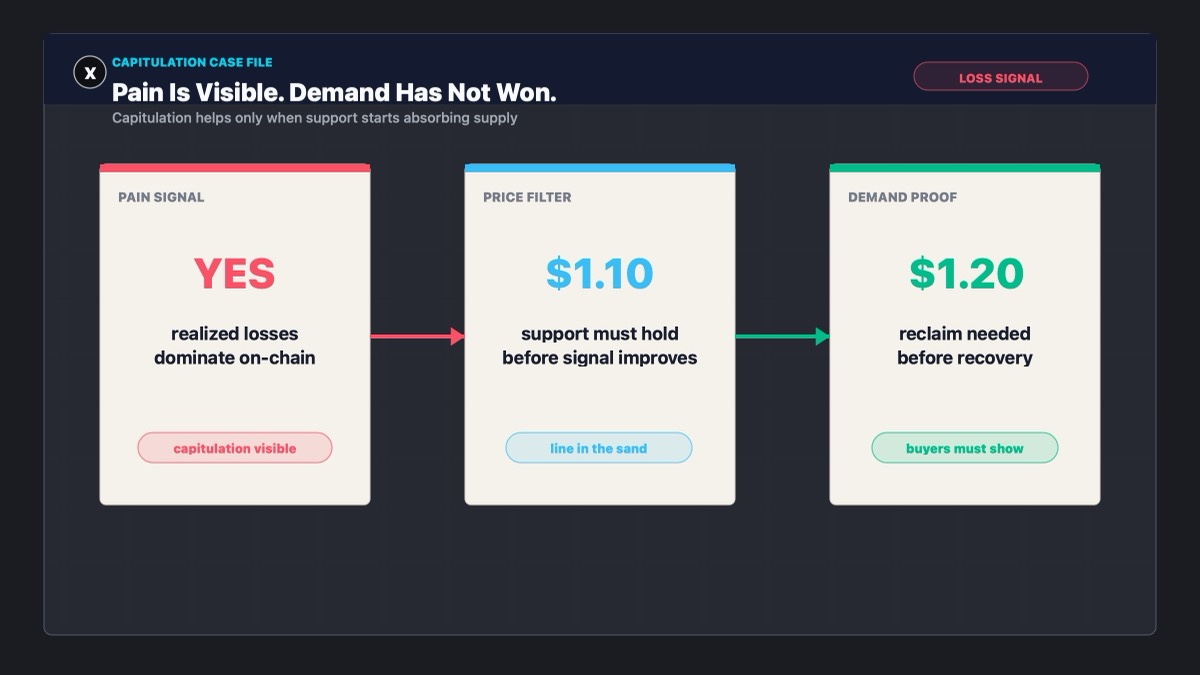
This is why price confirmation matters. XRP needs the chart to agree with the on-chain signal. If XRP holds the $1.10 area and reclaims $1.18-$1.20, the capitulation story becomes more constructive. It would suggest sellers are tiring and buyers are beginning to defend the wound.
If XRP loses $1.10, the market may decide the pain signal was not the bottom. It was just another stage of the decline.
Not great. But useful to know.
Historical Parallel
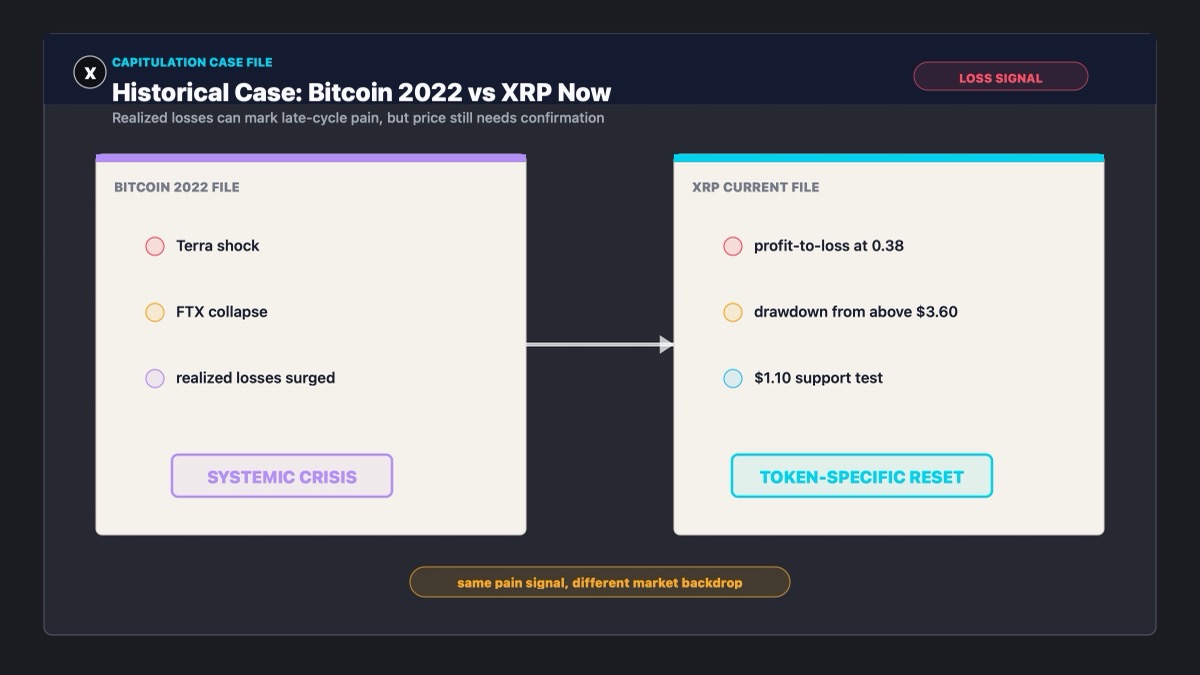
A useful historical parallel is Bitcoin's 2022 capitulation phase, especially around the Terra collapse in May-June and the FTX collapse in November. During that year, on-chain data repeatedly showed large realized losses as investors who had held through the bull market finally sold into weakness. The emotional structure was familiar: first denial, then hope, then a long uncomfortable silence, then the moment when holders decide they would rather take the loss than keep living inside the drawdown.
The similarity to XRP now is the realized-loss dynamic. In both cases, the important signal was not just that price had fallen. Price can fall for many reasons. The more revealing signal was that coins were moving at a loss, which tells us the decline had reached actual holder behavior. The pain had become transactional. It had left the chart and entered wallets.
That is why capitulation can be useful. It shows that the market is flushing out stale conviction. A holder who sells at a loss is often someone who has stopped defending the old story. Once enough of those sellers are gone, a market can become lighter. It can start forming a base.
But the difference is just as important. Bitcoin's 2022 capitulation happened inside a market-wide credit and solvency crisis. XRP's current signal, based on the CoinDesk and Glassnode data, is more specific: a holder-profitability reset after XRP's own major drawdown from above $3.60 to around $1.11. That makes it serious, but not identical.
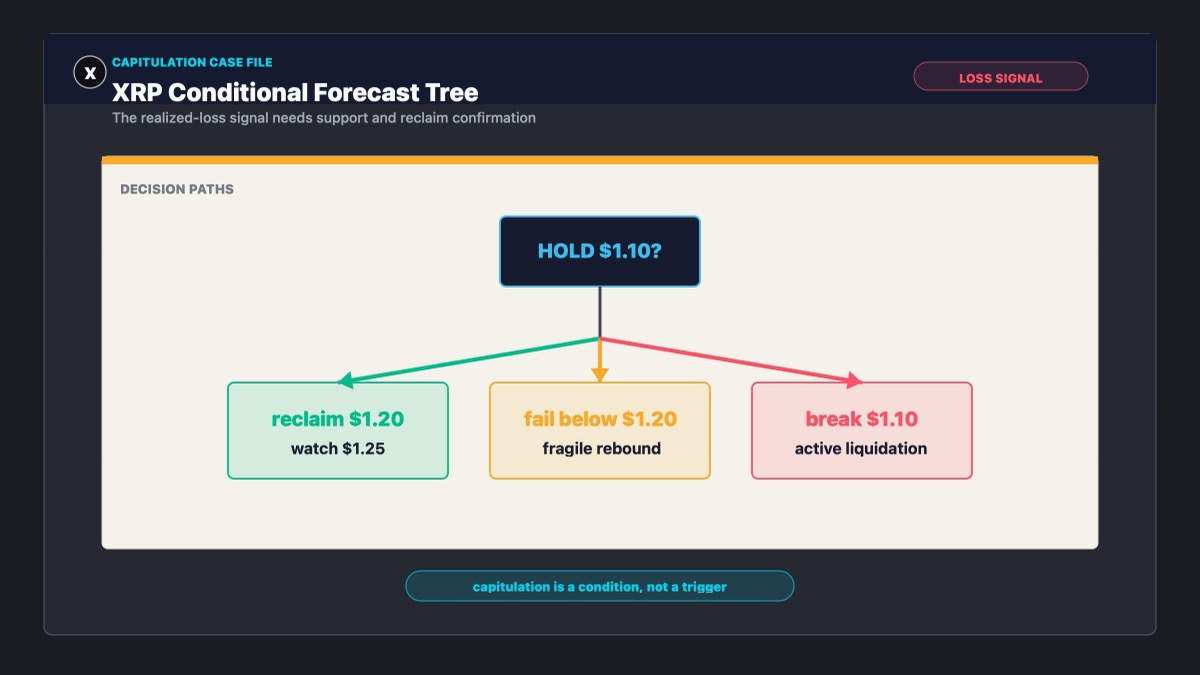
The lesson is simple and slightly annoying, which means it is probably useful: capitulation is a condition, not a trigger. It tells us the market may be late in the pain cycle. It does not tell us the exact candle where the bottom appears. For XRP, the on-chain signal becomes more powerful only if price starts holding support and reclaiming lost levels.
XRP Price Reaction and K-Line Analysis
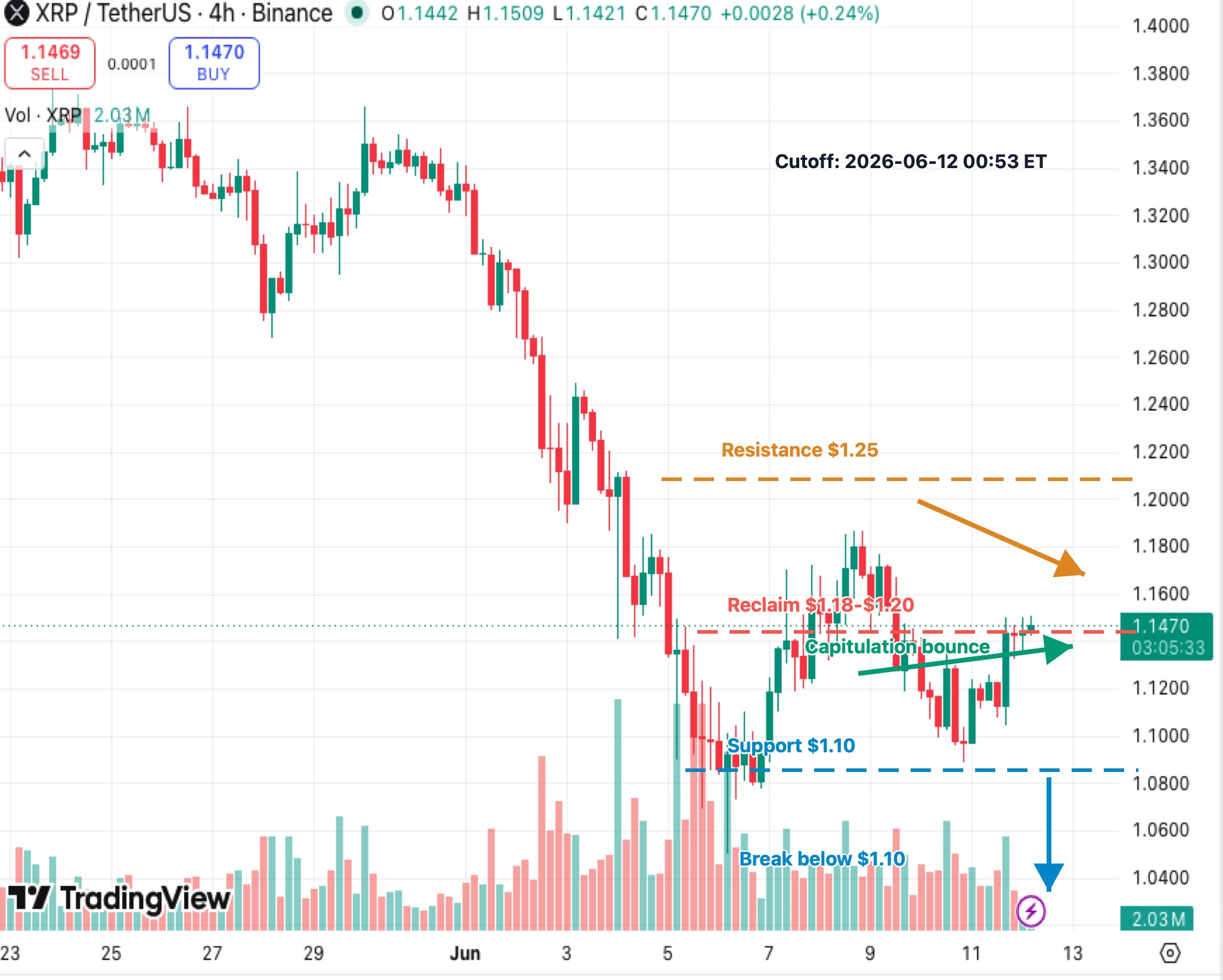
The XRPUSDT 4H chart shows a market trying to repair after a fast breakdown.
The structure is straightforward. XRP fell from the mid-$1.30s into the $1.08-$1.10 area, then bounced into the $1.14-$1.18 region. That bounce matters because it came after the capitulation signal, but it is not yet enough to call the move repaired.
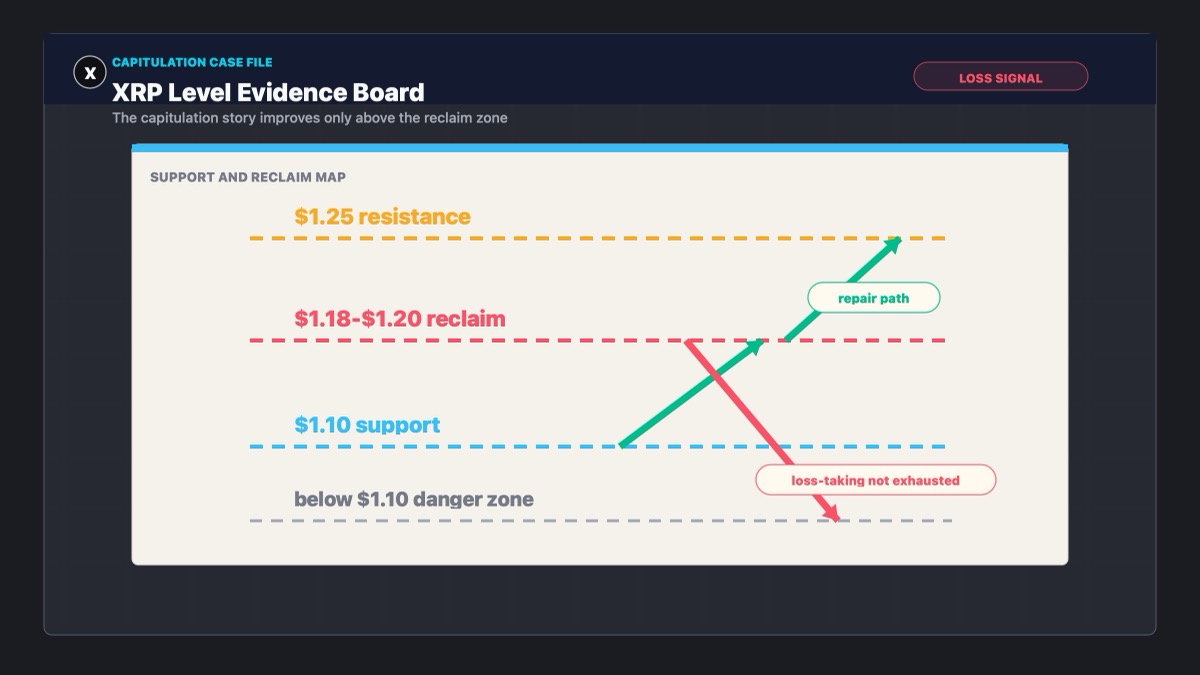
The first key area is $1.10. That is the support zone where buyers have recently appeared. If XRP keeps holding above it, the market can argue that loss-taking is becoming exhaustion rather than acceleration.
The next test is $1.18-$1.20. This is the reclaim zone. XRP needs to get back above it and stay there before the chart starts looking healthier. Until then, rallies can still be sold as lower-high attempts inside a damaged trend.
Above that, $1.25 is the next resistance area. A move there would suggest the capitulation bounce is gaining structure. It would not erase the larger drawdown from above $3.60, but it would show that buyers are no longer only defending the floor.
The downside is cleaner. If XRP breaks below $1.10 with momentum, the capitulation story becomes more dangerous. The market would likely stop asking whether a bottom is near and start asking where the next forced selling zone sits.
Key Levels to Watch
- $1.18-$1.20: The first reclaim zone. XRP needs this area to make the rebound more credible.
- $1.25: The next resistance level, where sellers may test the strength of the recovery.
- $1.10: The key support area. Holding it keeps the capitulation-bottom argument alive.
- Below $1.10: The danger zone. A breakdown would suggest loss-taking has not yet been exhausted.
Conditional Forecast
If XRP holds $1.10 and reclaims $1.18-$1.20, the market can start treating the capitulation signal as constructive. In that scenario, the next upside test sits near $1.25, where sellers may try to defend the prior breakdown zone.
If XRP fails below $1.18-$1.20, the rebound remains fragile. That would mean the market has pain, but not yet enough demand. Pain alone is not a trading plan.
If XRP breaks below $1.10, the setup weakens quickly. The realized-loss signal would still matter, but it would look less like final exhaustion and more like an active liquidation phase that has not finished clearing.
Investment Takeaway
The XRP capitulation signal is important because it tells us the market is no longer casually correcting. Holders are realizing losses. The emotional temperature has changed.
But investors should be careful with the word capitulation. It is not a magic button. It does not turn a downtrend into an uptrend by itself.
The cleaner read is this: XRP may be moving into a late-stage bear phase, but the chart still needs to confirm it. Above $1.20, the recovery starts to earn respect. Above $1.25, it becomes more interesting. Below $1.10, the market is still in damage-control mode.
So the signal is worth watching.
It is not yet worth worshipping.
Sources
- CoinDesk: XRP market shows signs of capitulation as holders sell at loss
- Glassnode Studio: XRP Realized Profit and Loss
- Glassnode Insights: The Week Onchain: Bitcoin Capitulation and Realized Losses
- TradingView: XRPUSDT chart
- CoinDesk data reference: CoinDesk Markets
|
DISCLAIMER:
1. All content on this website (including but not limited to articles, data, charts, and analyses) is for general informational purposes only and does not constitute any form of investment advice, trading recommendation, or financial guidance. 2. Cryptocurrencies and digital assets are subject to extreme price volatility and high investment risk; you may lose part or all of your principal. Past performance does not predict future results. 3. The information on this website is based on sources we believe to be reliable, but we do not guarantee its accuracy, completeness, or timeliness. Any investment decisions made based on this website’s information are at your own risk. 4. We strongly recommend that you conduct your own thorough research and consult an independent, licensed financial advisor before making any investment decisions. |
Recommended reading
Latest News

