Key Takeaways
- Humanity Protocol's H token fell more than 80% after attackers compromised private keys tied to the project.
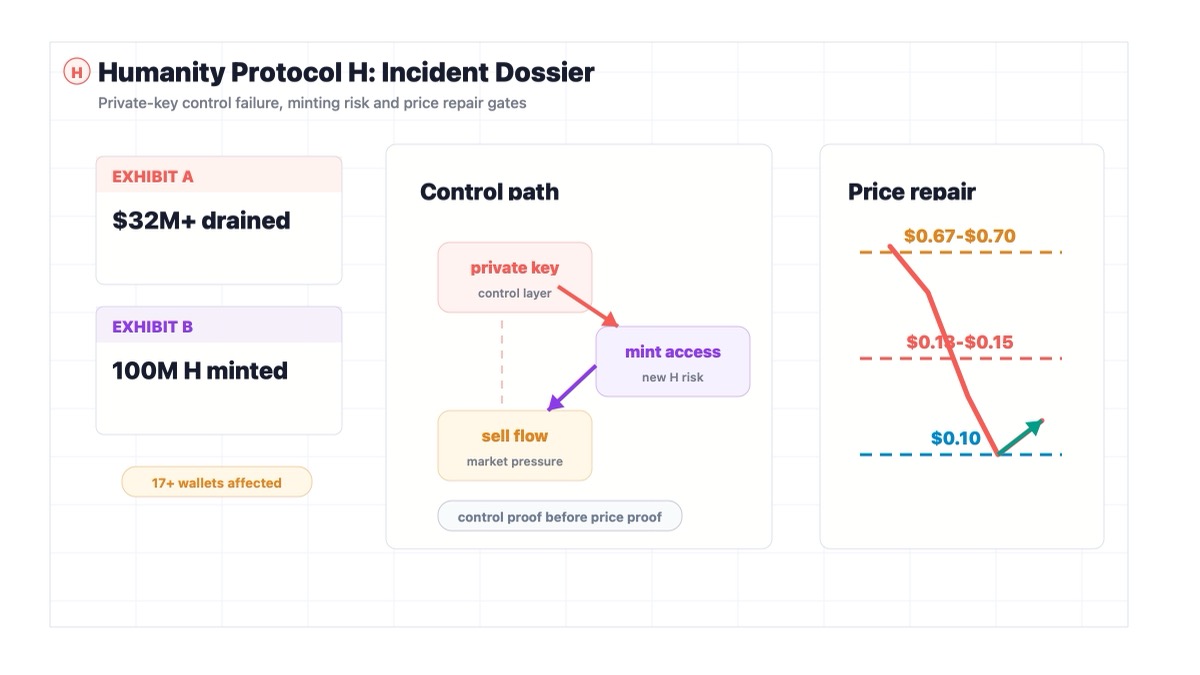
- At least 17 wallets were drained, with losses above $32 million and additional H minted on BNB Chain.
- The market is reacting to control-risk, not just a normal token selloff.
- H needs to reclaim $0.13-$0.15 and hold $0.10 before any rebound looks technically serious.
What Happened
Humanity Protocol had the kind of day that turns a token chart into an incident report.
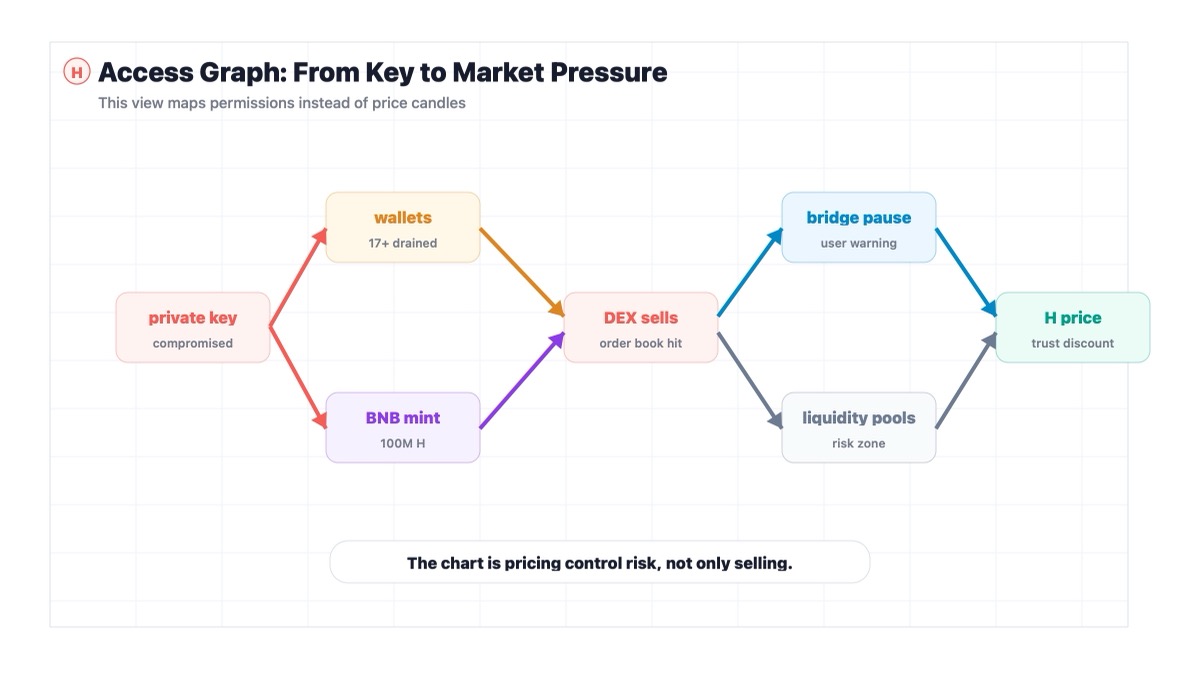
The project's H token crashed more than 80% after attackers allegedly compromised private keys connected to a Humanity Foundation member. According to the CoinDesk report, more than $32 million was drained from at least 17 wallets, and the attacker has been selling stolen H for ether.
That would already be bad. Then came the extra ugly part.
Blockchain data cited in the report showed the attacker also minted another 100 million H on BNB Chain, worth roughly $11 million at the time. That matters because a theft is one problem, but a theft plus fresh token supply is a different animal in market terms. One hits confidence. The other can hit the order book.
H fell from around $0.67 to near $0.13 and briefly touched $0.05, marking an intraday collapse of roughly 90% from peak to trough. Cointelegraph also reported an 85% drop from around $0.70 to $0.08 during the move, while The Block cited CoinGecko data showing the token down 89% over 24 hours.
Humanity Protocol confirmed the breach. Founder Terence Kwok said attackers had compromised private keys, and the project urged users to stop using its bridge and liquidity pools while it works with security firms and exchange partners.
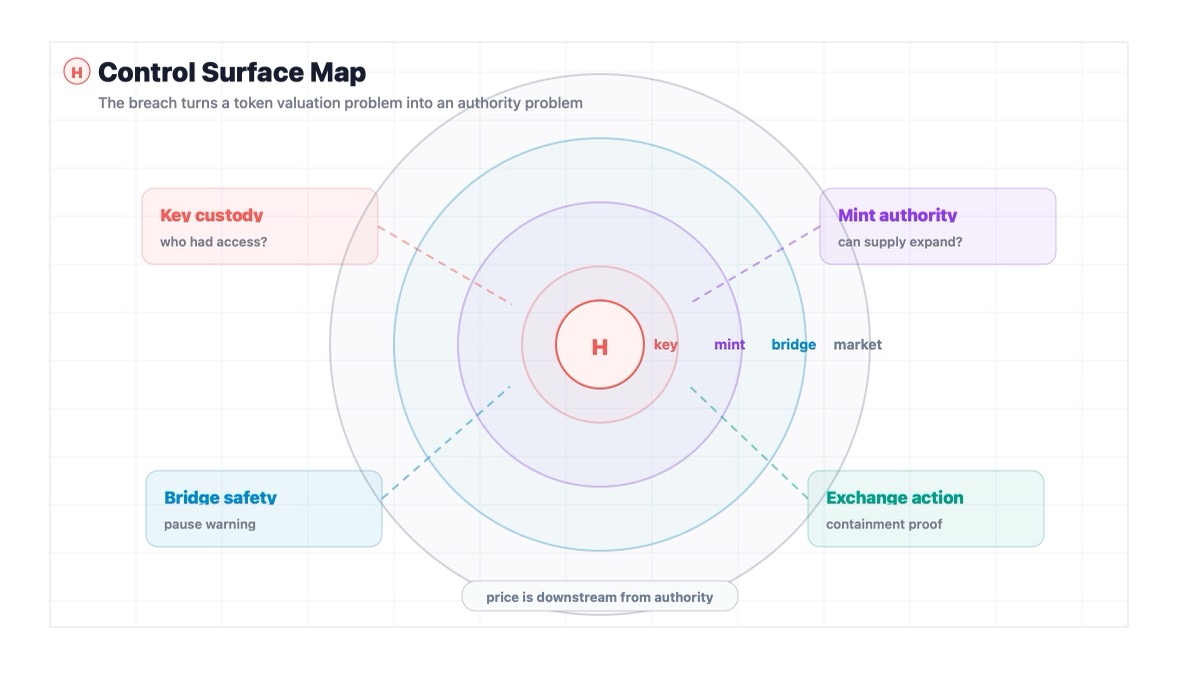
That warning is the center of the story. In a normal token dump, the question is whether sellers are exhausted. In a private-key compromise, the first question is more basic: who still controls what?
Until the market has a cleaner answer, every bounce has to carry a bag of suspicion.
Why This Matters for Bitcoin and Crypto Markets
This is not just another small-cap token crash.
Crypto has many kinds of failure. Some are code failures. A smart contract does exactly the wrong thing because a bug lets someone push it into a corner. Some are market failures. Leverage gets too high, liquidity disappears, and price falls through the floor. Some are governance failures. A team says one thing, wallets reveal another, and trust evaporates.
This one sits in a harsher category: key failure.
Private keys are the boring little objects that quietly hold the whole system together. They are not flashy. They do not get the marketing deck treatment. But if the wrong person gets them, the protocol can move from "decentralized identity infrastructure" to "someone else is pressing the buttons" very quickly.
That is why the H token reaction was so violent. The market was not simply pricing a loss amount. It was pricing uncertainty over control, circulating supply, bridge safety, liquidity-pool exposure and whether additional selling pressure could still emerge. Once the project itself tells users to avoid the bridge and liquidity pools, the trade stops being a clean price bet and becomes a containment bet.
The broader crypto market should care because this fits a familiar 2026 pattern: attackers are increasingly going after keys rather than only code. Code audits can help when the danger is a contract bug. They are less comforting when the danger is operational custody, internal access, admin permissions or cross-chain minting authority.
For Humanity Protocol specifically, the damage is also narrative damage. The project sells a human-proof identity story built around biometrics and zero-knowledge cryptography. That is a big, futuristic promise. But markets have a rude habit of reducing big promises to small questions during a crisis.
Who had the key?
What could that key do?
Can it happen again?
Until those questions are answered with more than reassurance, the chart will probably treat good news as temporary and bad news as structural.
Historical Parallel: Ronin Bridge and the Cost of Key Compromise
The clearest historical parallel is the Ronin Bridge exploit in March 2022.
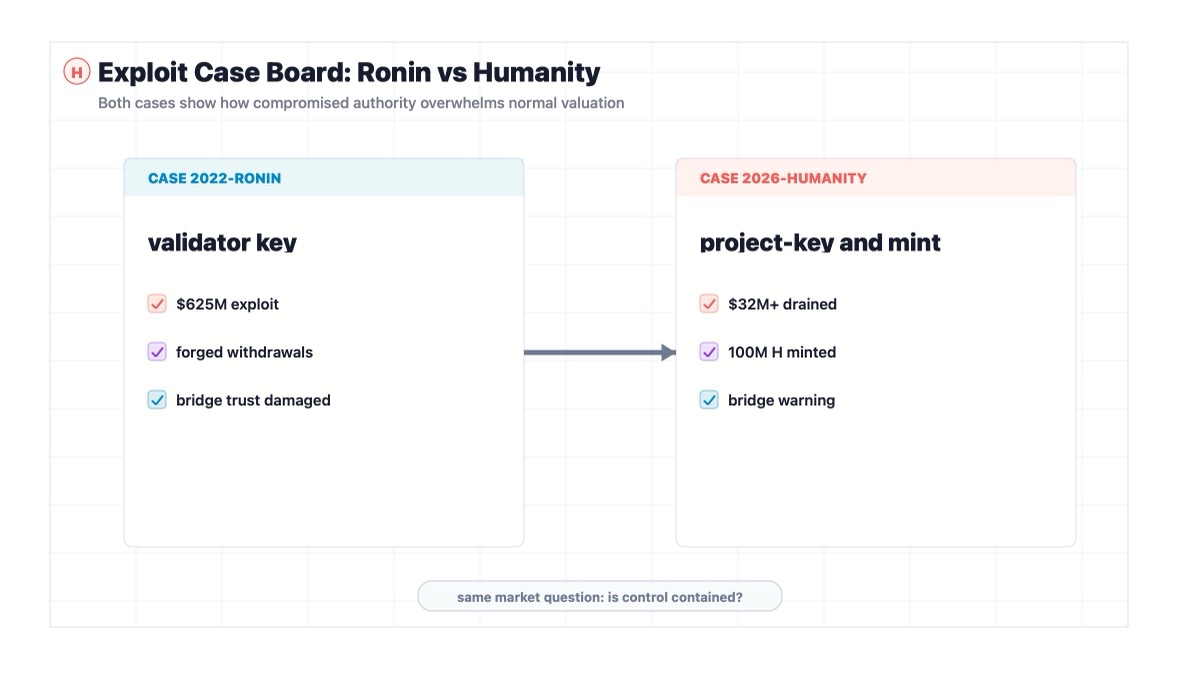
Ronin was not mainly a story about a clever trader bending a pricing formula. It was a story about control. According to CoinDesk's report at the time, attackers used hacked private keys to forge withdrawals from the Ronin bridge. The exploit hit validator nodes connected to Sky Mavis and Axie DAO and drained roughly $625 million in ETH and USDC. Later analyses described the attack as a validator-key compromise, where attackers obtained enough signing power to authorize fraudulent withdrawals.
The similarity to Humanity Protocol is the uncomfortable part: when keys are compromised, the system can look normal from the outside until the attacker uses the authority those keys provide. That is why these events are so damaging. A bridge, wallet or minting setup can appear operational, audited and branded as secure, but if the control layer is weak, the whole structure is only as safe as the key custody behind it.
There are also important differences. Ronin was a bridge-scale infrastructure failure involving hundreds of millions of dollars and a major gaming ecosystem. Humanity Protocol's reported loss is smaller, around $32 million, and the immediate market damage is concentrated in H token supply, bridge warnings and liquidity confidence. Ronin's lesson was about validator threshold design and delegated signing authority. Humanity's lesson appears more focused on project-linked private keys, wallet draining and the ability to mint additional H on BNB Chain.
The takeaway for current H is blunt: recovery depends on proof of containment. In key-based attacks, price cannot repair itself with a nice green candle alone. The market needs to know that compromised authority has been revoked, minting risk is closed, exchange coordination is working, and users are no longer standing near a live wire.
Until then, the chart is not asking "is H cheap?" It is asking "is H safe enough to price?"
H Token Price Reaction and K-Line Analysis
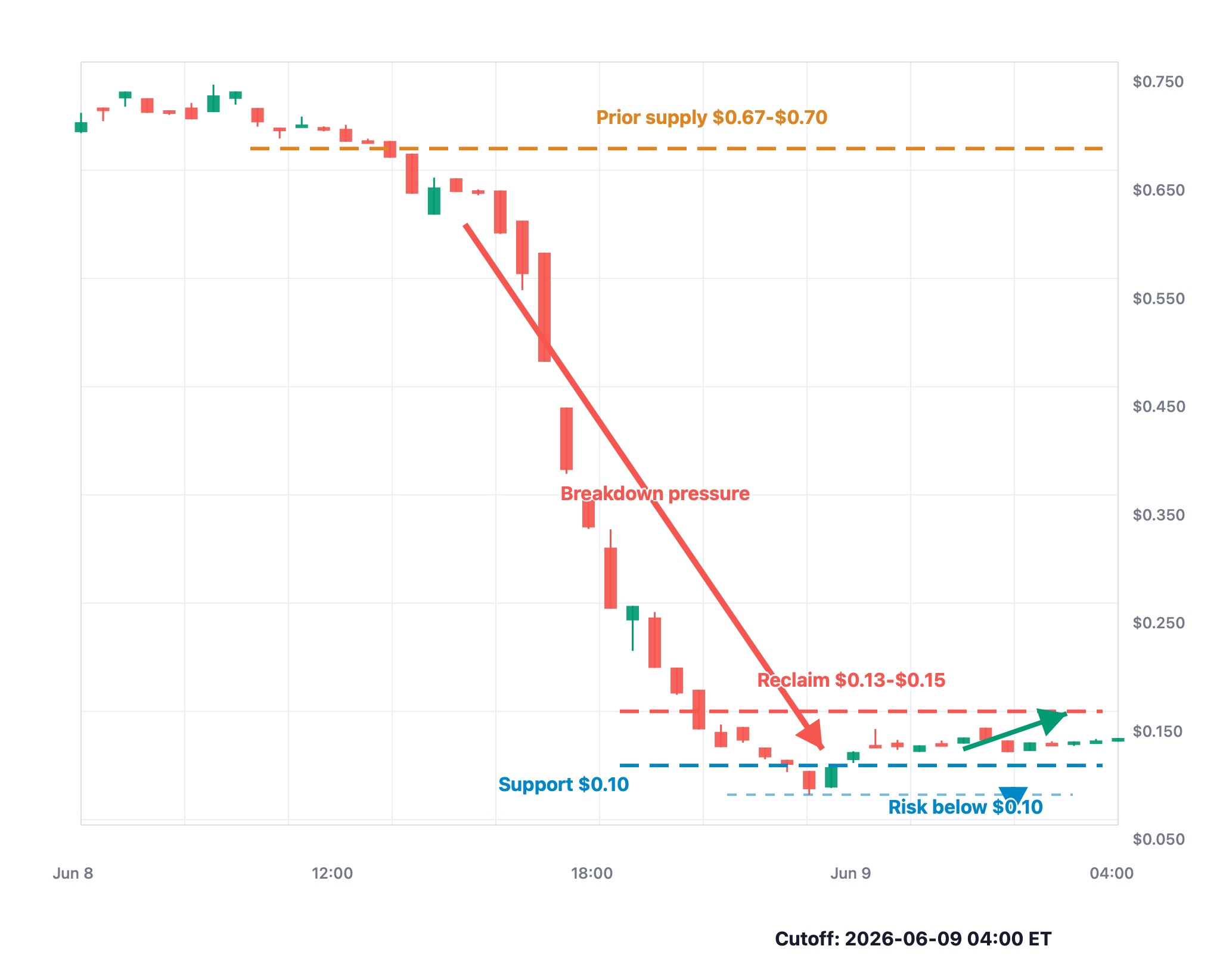
The H/USD chart is a collapse first and a rebound second.
Before the breakdown, H was trading around the $0.67-$0.70 supply area. Then the structure failed in a nearly vertical move. That matters because vertical crashes usually leave very little real support behind them. They do not build a healthy base. They just reveal where buyers finally stop stepping away.
The panic low on the CoinGecko OHLC data sits near $0.073, while the latest candles are trying to stabilize around the $0.12-$0.13 area. That is an improvement from the low, but it is not enough to call the chart repaired.
The first technical test is $0.13-$0.15. If H cannot reclaim and hold that zone, the rebound is mostly a reflex after forced selling. A clean hold above that band would at least show that buyers are willing to accept post-hack risk at higher prices.
The second level is $0.10. This is the psychological floor that now separates "damaged but stabilizing" from "still leaking confidence." A break back below $0.10 would put the market's attention back on the panic-low area and would probably invite another round of defensive selling.
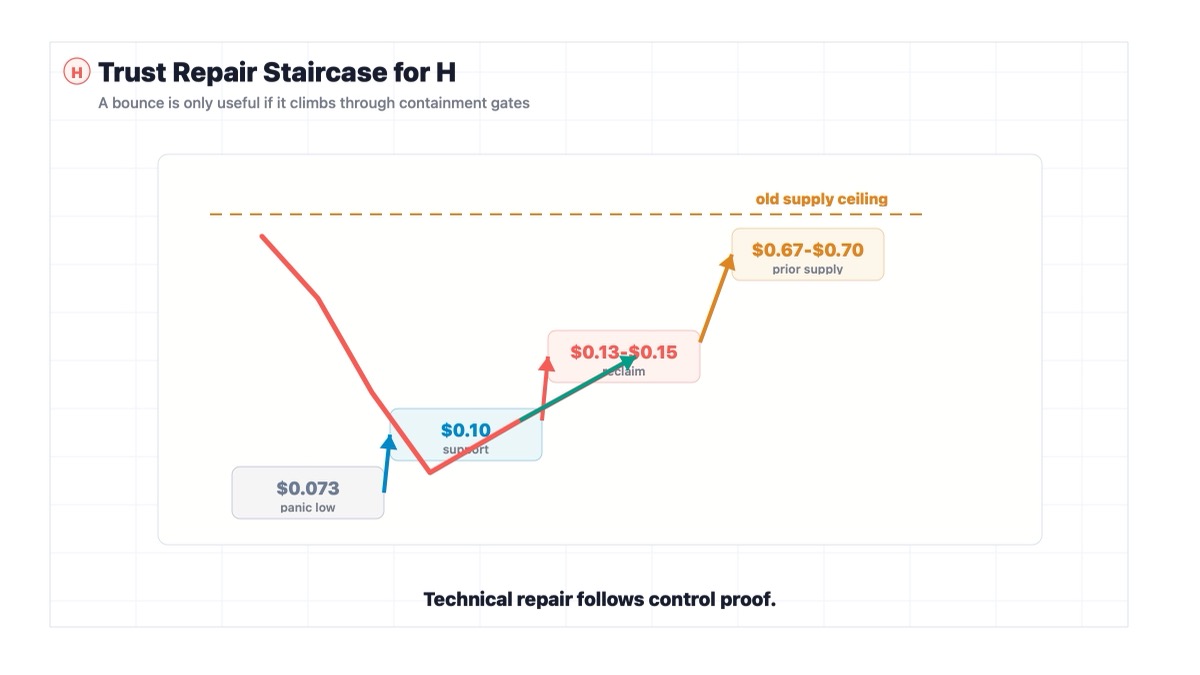
The old $0.67-$0.70 zone is not a realistic near-term target. It is prior supply now. The chart has to rebuild trust layer by layer before it can think about the level where the collapse began.
Key Levels to Watch
The first level is $0.13-$0.15. This is the immediate reclaim zone and the place where H has to prove the bounce is more than panic cleanup.
The second level is $0.10. Losing it would suggest that the market still sees unresolved risk.
The third level is $0.073. That panic low is the last visible line from the crash window.
The fourth zone is $0.67-$0.70. This is prior supply, not a near-term bullish target. It matters because trapped holders and post-hack sellers may use any large rebound to exit.
Conditional Forecast
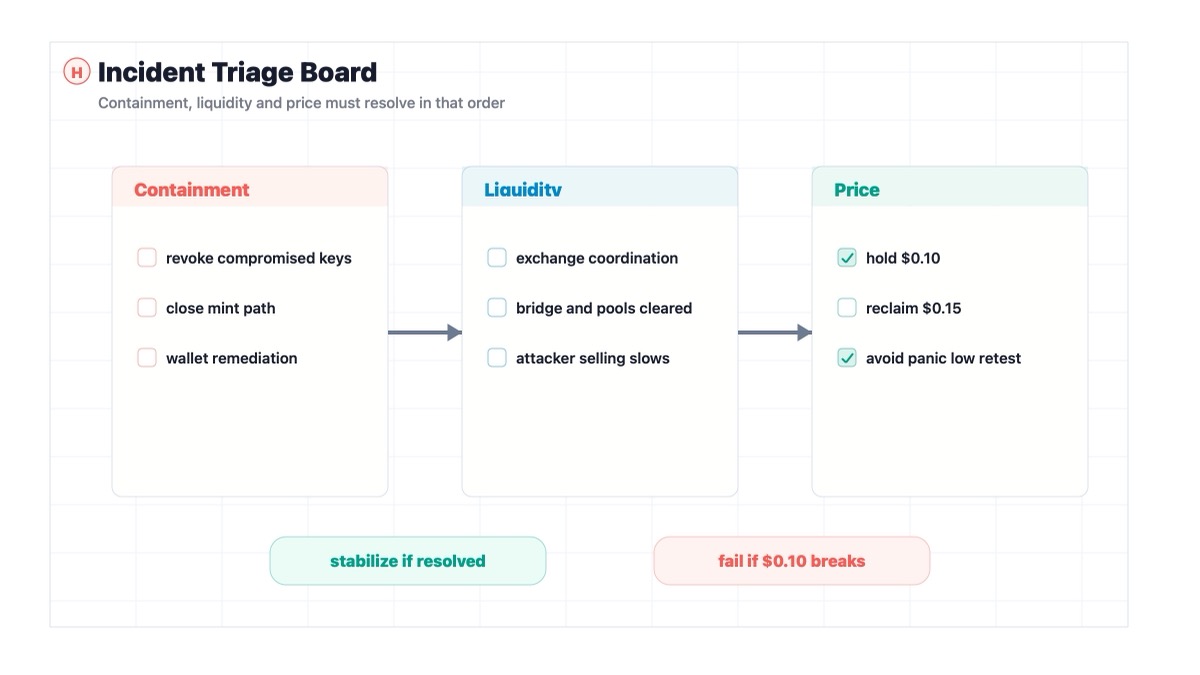
If Humanity Protocol clearly contains the compromised keys, freezes or neutralizes the dangerous minting path, coordinates with exchanges and provides credible wallet-level remediation, H could stabilize above $0.10 and attempt a reclaim of $0.13-$0.15. That would not make the chart healthy. It would make it less broken.
If the attacker continues selling, if additional minted H reaches liquidity venues, or if bridge and pool warnings remain open-ended, the rebound can fail quickly. In that case, $0.10 becomes the level where weak confidence turns into renewed downside pressure.
If H loses $0.10 and retests the $0.073 panic low, the market will probably stop treating the event as a one-day shock and start treating it as an unresolved supply and custody crisis.
The clean bullish path requires containment first, liquidity second, price third. Reversing that order is how traders get trapped by a bounce that looked brave for five minutes and then remembered why it was falling.
Investment Takeaway
The important thing about this H crash is that price is not the first problem.
Control is.
A token can recover from a bad candle. It can even recover from a hack if the damage is contained, users understand the loss path, and the project proves that the same authority cannot be abused again. But when private keys are compromised and additional supply can be minted, the market does not just discount the token. It discounts the entire control system around the token.
For investors, that means the usual "down 80%, must be cheap" reflex is dangerous here. Cheap relative to yesterday is not the same thing as safe relative to tomorrow.
The practical read is conditional caution. H above $0.13-$0.15 would show the first sign of technical repair. H above that level after credible containment updates would matter more. But H below $0.10 says the market is still voting that the risk is not finished.
In this kind of setup, the chart can bounce before trust returns. The serious question is whether trust follows.
Sources
- CoinDesk: Humanity Protocol token crashes more than 80% after a $32 million private-key hack
- Cointelegraph: Humanity Protocol Hacked, H Token Crashes 85%
- The Block: Wallets linked to Humanity Protocol drained for over $32 million, token plunges 89%
- CoinGecko: Humanity price and market data
- CoinDesk: Axie Infinity's Ronin Network Suffers $625M Exploit
- Halborn: Explained: The Ronin Hack
|
DISCLAIMER:
1. All content on this website (including but not limited to articles, data, charts, and analyses) is for general informational purposes only and does not constitute any form of investment advice, trading recommendation, or financial guidance. 2. Cryptocurrencies and digital assets are subject to extreme price volatility and high investment risk; you may lose part or all of your principal. Past performance does not predict future results. 3. The information on this website is based on sources we believe to be reliable, but we do not guarantee its accuracy, completeness, or timeliness. Any investment decisions made based on this website’s information are at your own risk. 4. We strongly recommend that you conduct your own thorough research and consult an independent, licensed financial advisor before making any investment decisions. |