Key Takeaways
- Arthur Hayes said he sold his HYPE and NEAR holdings after warning that markets may peak before September.
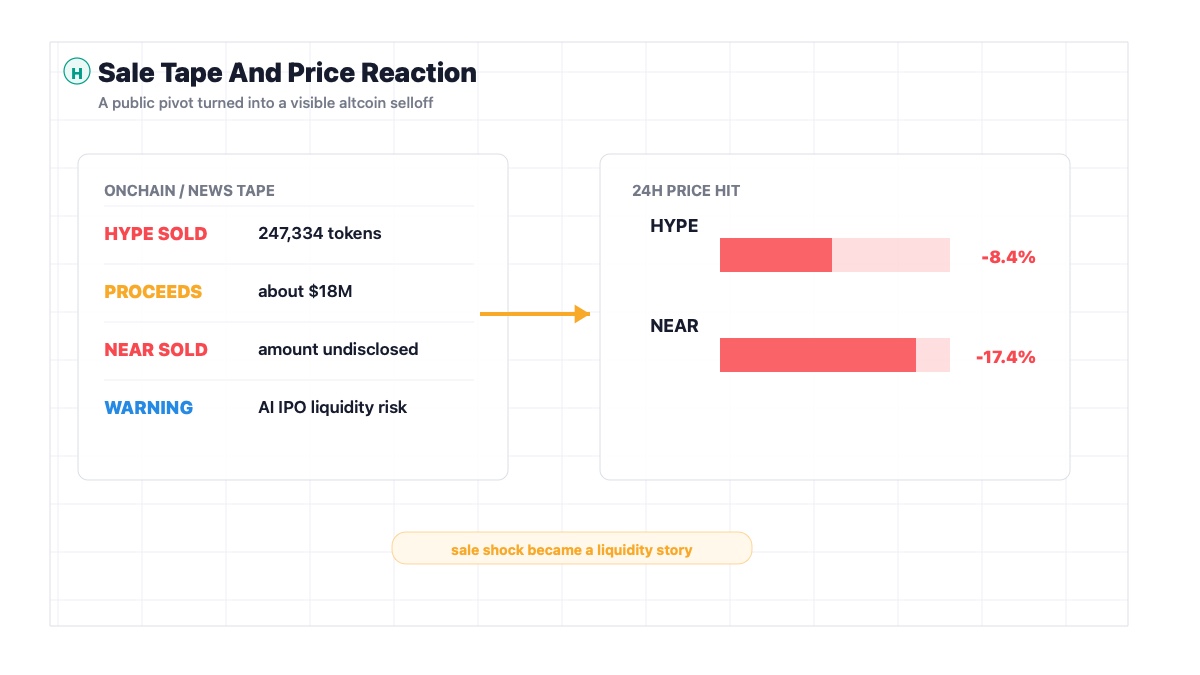
- Onchain Lens said Hayes sold 247,334 HYPE for about $18 million, while Cointelegraph reported he also sold an undisclosed amount of NEAR.
- HYPE fell 8.4% to $65 and NEAR dropped 17.4% to $2.34 in the 24 hours cited by Cointelegraph.
- The bigger concern is liquidity competition: OpenAI, Anthropic and SpaceX IPO expectations may pull capital away from high-beta crypto trades.
What Happened
Arthur Hayes just did the thing markets hate most: he changed his mind in public.
According to Cointelegraph, the BitMEX co-founder said he dumped his Hyperliquid (HYPE) and Near Protocol (NEAR) holdings after warning that markets may peak sometime between now and September. Hayes cited higher energy prices tied to the Middle East conflict, a coming wave of mega AI IPOs, and the possibility that President Donald Trump could turn "anti-AI" ahead of the US midterm elections.
The move is jarring because Hayes had recently been loudly bullish on both assets. He previously projected HYPE could reach $150 by August 2026 and said NEAR could rally 20x by 2027. That is not a small shift. That is the market equivalent of showing up to dinner in a tuxedo and leaving through the kitchen window.
Onchain Lens said Hayes sold 247,334 HYPE for about $18 million, along with an undisclosed amount of NEAR. The sale came shortly after Hayes publicly challenged Multicoin Capital co-founder Kyle Samani to a $100,000 charity bet, arguing that HYPE would outperform every top-10 cryptocurrency by the end of 2026.
Prices reacted quickly. Cointelegraph reported that HYPE fell 8.4% to $65, while NEAR dropped 17.4% to $2.34 over 24 hours. Live market data after the report showed pressure continuing, with HYPE trading closer to the high-$50s and NEAR closer to the low-$1.80s.
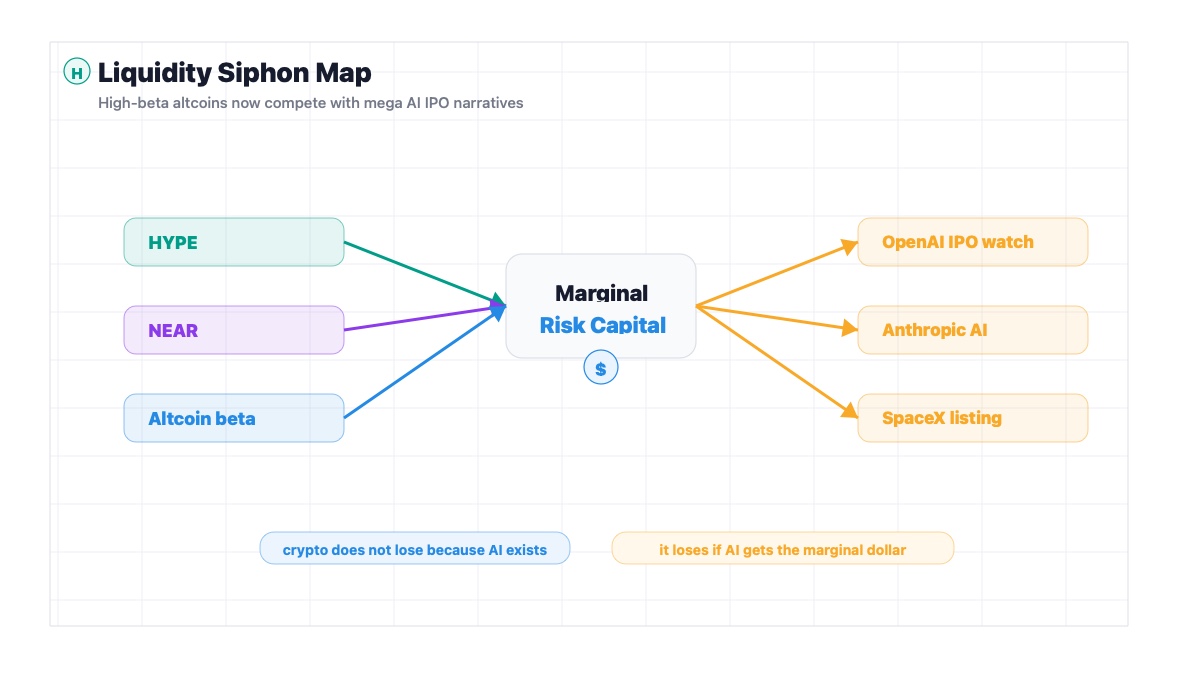
The stated reason was not just token-specific weakness. Hayes framed the sale around a broader capital-allocation problem: mega AI IPOs from OpenAI, Anthropic and SpaceX could drain liquidity from crypto before Q3 2026.
Why This Matters for Altcoins and Crypto Markets
This matters because altcoins are not only competing with each other.
They are competing with every other exciting place capital can go.
When crypto is the main speculative theater, high-beta tokens like HYPE and NEAR can attract aggressive flows. Traders buy the story, the chart confirms the story, and then everyone pretends the story was obvious all along. But when another theme becomes louder, bigger and easier for institutions to justify, crypto has to share the room.
AI IPOs are exactly that kind of competitor. OpenAI, Anthropic and SpaceX are not obscure growth stories. They are giant narrative magnets. If public markets get access to them, some risk capital that might have gone into crypto momentum trades may rotate toward AI listings instead. The money does not have to hate HYPE. It only has to love something else more.
That is the uncomfortable part.
Hayes selling also matters because personality-driven crypto calls have real market gravity. When a prominent bull sells after making aggressive upside targets, it does not automatically invalidate the long-term thesis. But it does force traders to ask a colder question: if the loudest believer is taking profit, who is the next marginal buyer?
For HYPE, the problem is especially sharp because its recent strength had made it one of the standout altcoins. A strong token can survive bad news better than a weak one, but strength also creates a different risk: crowded confidence. When crowded confidence breaks, the exit feels smaller than it looked on the way in.
NEAR faces a similar problem, but with a different personality. The 20x call depends on a multi-year thesis. The current selloff is about whether the market has enough near-term liquidity and patience to keep paying for that thesis before AI IPOs arrive.
Historical Parallel: Coinbase's 2021 Listing and Attention Rotation
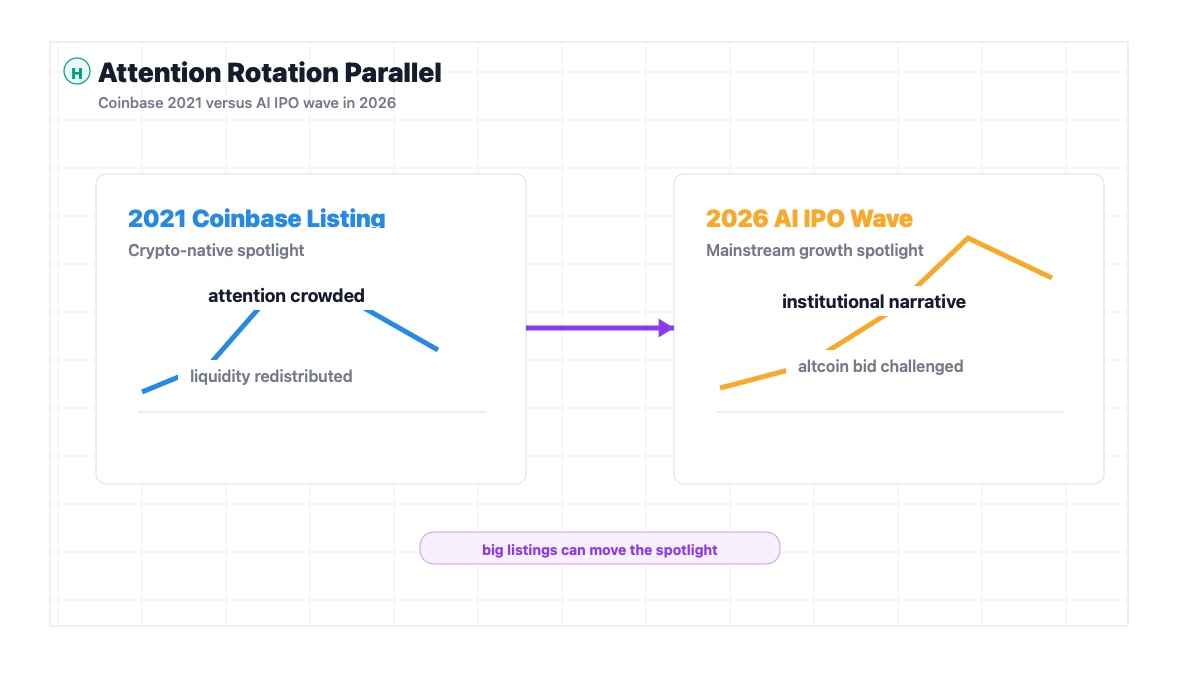
The useful historical parallel is Coinbase's 2021 public listing. It was not an AI IPO, but it was a major public-market event that pulled crypto-native excitement into traditional equity markets. For a moment, the industry had a clean bridge between crypto narrative and public-market capital. Traders treated the listing as both validation and a possible liquidity magnet.
What happened next was more complicated. Coinbase's debut did not kill crypto, and it did not create a straight-line bull market either. It marked a moment when attention, capital and narrative all became crowded around one huge event. Bitcoin and altcoins were already extended, and after the listing window, parts of the market started to lose momentum. The lesson was not "big listings are bearish." The lesson was that when a major capital event arrives after a strong speculative run, it can become a point where liquidity gets redistributed rather than expanded.
The similarity to today's AI IPO concern is attention competition. OpenAI, Anthropic and SpaceX could give public-market investors a direct way to buy the AI story. If that happens while crypto is already fragile, high-beta altcoins may struggle to keep their bid. The market only has so much speculative oxygen before someone starts breathing heavily.
The difference is scale and sector. Coinbase was crypto-native. The coming AI IPOs are outside crypto and may be easier for large institutions to underwrite as mainstream growth exposure. That makes them potentially more dangerous for altcoin liquidity, because they do not need crypto believers to attract capital.
The lesson for HYPE and NEAR is conditional. If crypto liquidity remains strong, AI IPOs may coexist with altcoin rallies. If liquidity tightens, the IPO wave can become a serious competitor for marginal risk dollars.
HYPE Price Reaction and K-Line Analysis
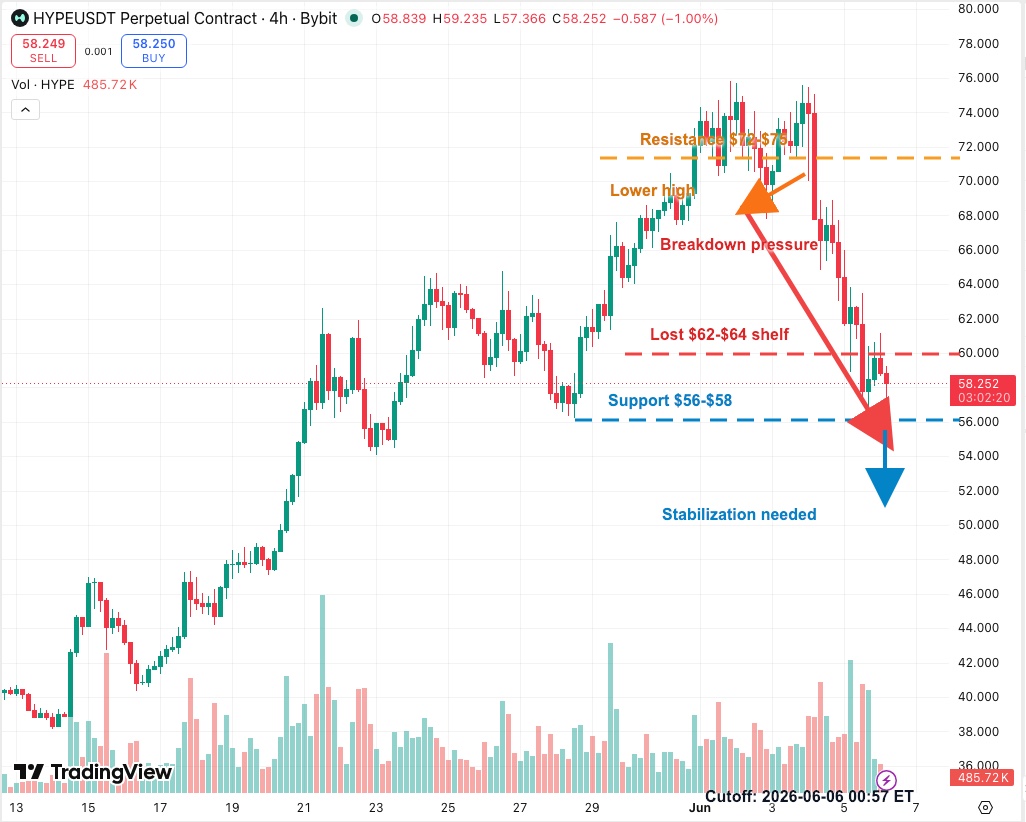
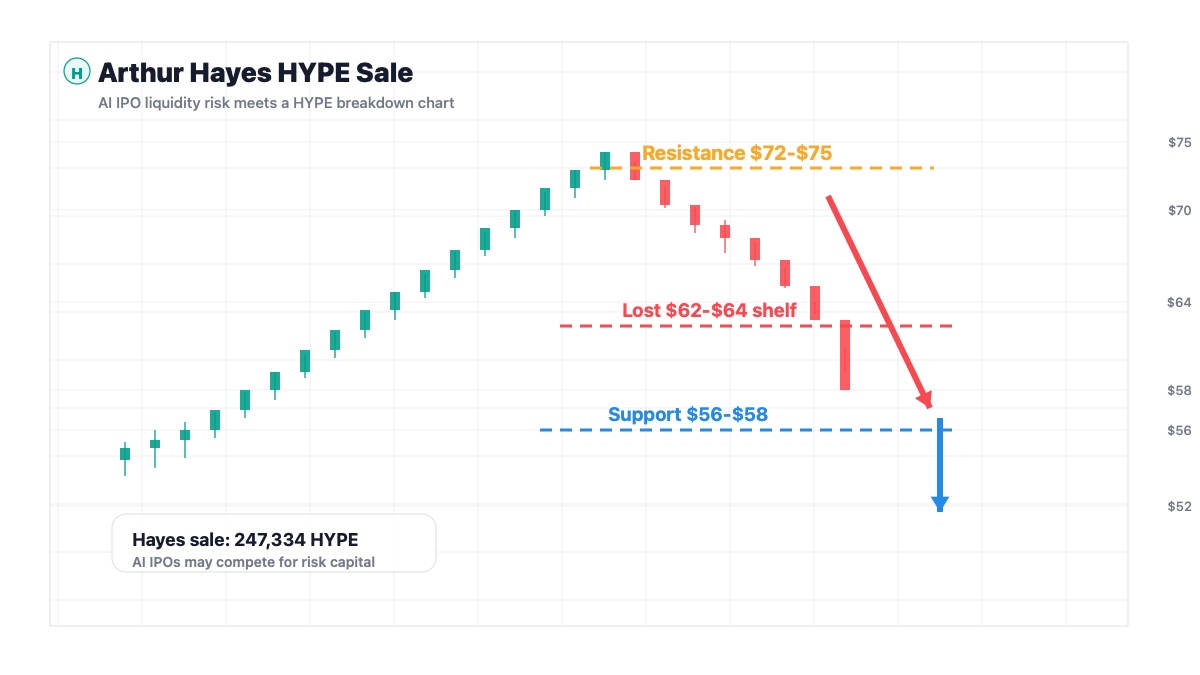
The HYPEUSDT 4-hour chart shows a clean momentum break.
HYPE had rallied aggressively into the $72-$75 area before failing to hold the highs. That zone now acts as resistance. The problem is not only that price fell. The problem is that it fell after a visible lower high, which tells traders the market stopped accepting higher prices before the news fully hit.
The first damaged area is the $62-$64 shelf. Once HYPE lost that zone, the structure shifted from controlled pullback to breakdown pressure. That matters because a token can fall from a high and still look healthy if it holds prior support. HYPE did not hold it cleanly.
The next support zone is $56-$58. That is where price was trying to stabilize on the chart. If buyers defend it, HYPE can attempt a relief bounce back toward $62-$64. If they fail, the market may start treating the move as a deeper unwind rather than a one-day reaction to Hayes.
The chart also explains why the AI IPO story matters. HYPE is a high-beta token with a strong narrative. Those can run hard when liquidity is abundant. But when liquidity starts questioning where it wants to live, high-beta assets get tested first. They are the fun part of the portfolio. In a risk-off moment, fun is usually the first budget line to get cut.
Key Levels to Watch
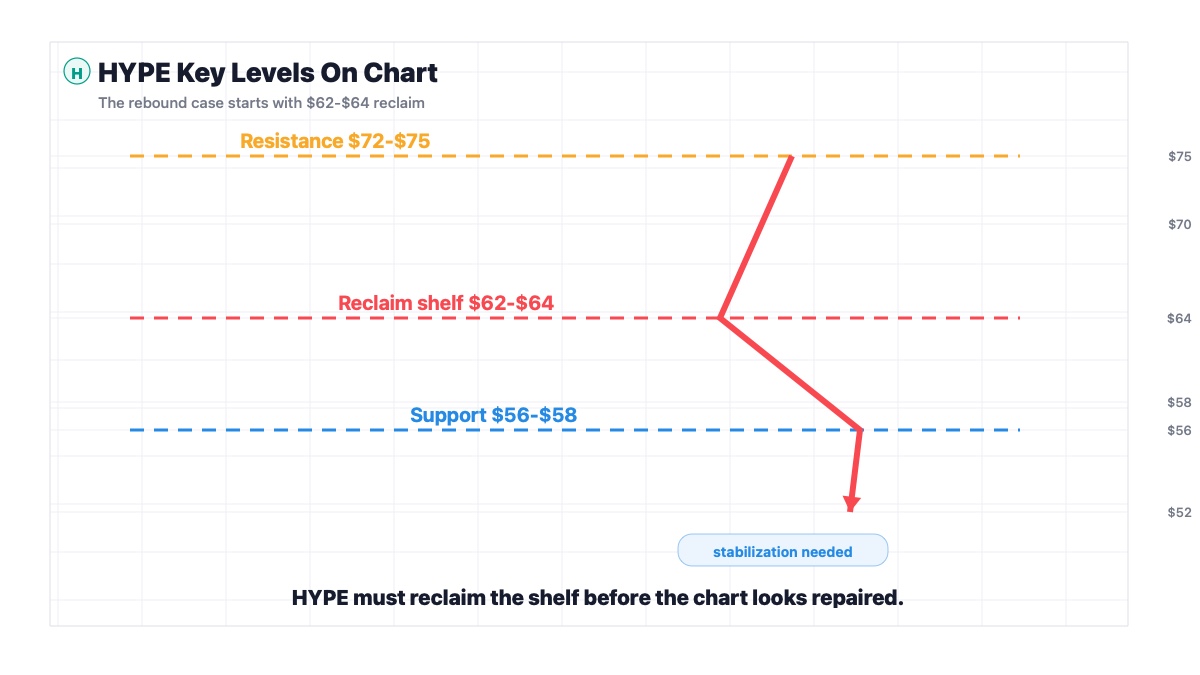
The immediate support zone is $56-$58. Holding this area keeps a short-term stabilization attempt alive.
The first reclaim zone is $62-$64. HYPE needs to recover this shelf before the chart can look less damaged.
The upper resistance zone is $72-$75. A return to that area would suggest the market has absorbed the Hayes sale and broader liquidity concerns.
For NEAR, the key psychological area is $2.00. Trading below it keeps sentiment weak and makes the 20x long-term thesis feel distant rather than active.
The non-price level to watch is AI IPO timing. If OpenAI, Anthropic or SpaceX move closer to public listings, liquidity competition may remain a pressure point for altcoins.
Conditional Forecast
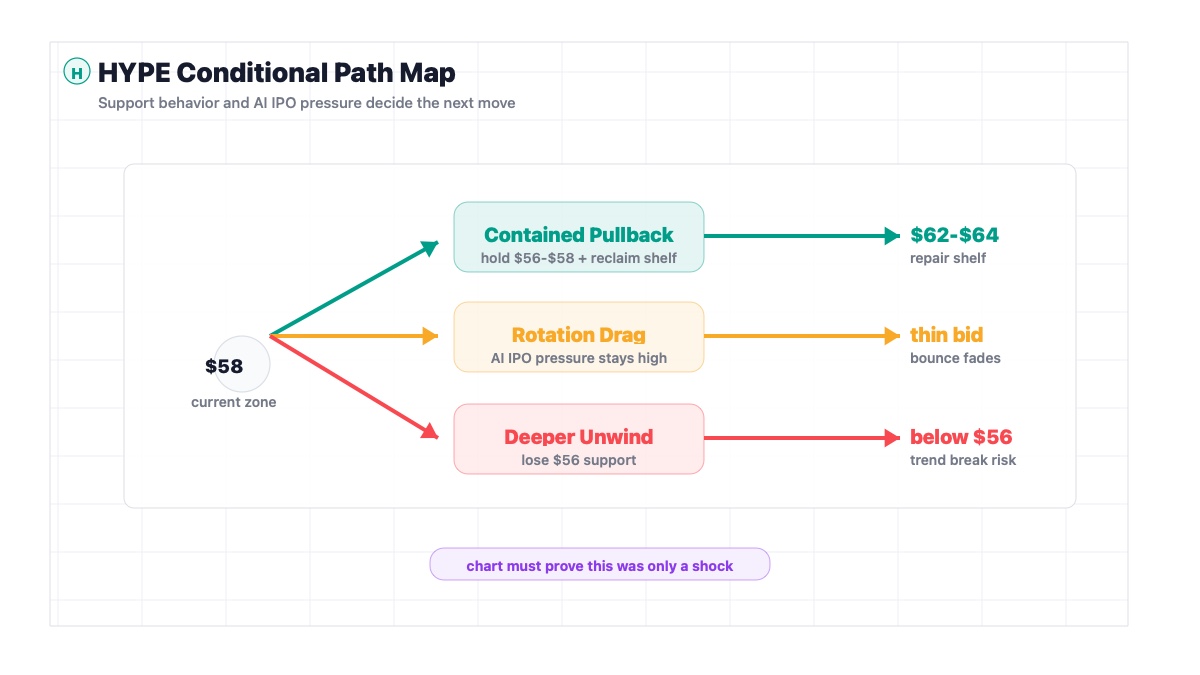
If HYPE holds $56-$58 and reclaims $62-$64, the selloff can be treated as a sharp but potentially contained profit-taking move.
If HYPE loses $56, traders may start pricing a deeper unwind toward lower liquidity zones, especially if NEAR and other high-beta altcoins continue to weaken.
If AI IPO expectations intensify and crypto liquidity remains thin, altcoins may face more rotation pressure even without new token-specific bad news.
If broader crypto risk appetite returns, Hayes's sale may become a temporary narrative shock rather than a lasting trend break. The chart needs to prove that before the article gets too cheerful.
Investment Takeaway
The key takeaway is not that Hayes is always right or that HYPE and NEAR are doomed.
The useful takeaway is that high-beta altcoin trades depend on liquidity staying generous. Hayes's sale is a reminder that even strong narratives can be repriced when capital sees a bigger stage elsewhere.
For traders, HYPE needs to hold $56-$58 and reclaim $62-$64 before the setup improves. For longer-term investors, the question is whether the HYPE and NEAR theses remain strong enough to compete with public-market AI exposure.
Crypto likes to imagine it is the only casino in town. AI IPO season may remind it that the town has more than one very bright sign.
Sources
- Cointelegraph: Arthur Hayes dumps HYPE, NEAR as he warns of AI IPO wave
- TradingView: HYPEUSDT perpetual chart, Bybit
- Onchain Lens: Onchain analytics account
- Polymarket: OpenAI IPO prediction market
|
DISCLAIMER:
1. All content on this website (including but not limited to articles, data, charts, and analyses) is for general informational purposes only and does not constitute any form of investment advice, trading recommendation, or financial guidance. 2. Cryptocurrencies and digital assets are subject to extreme price volatility and high investment risk; you may lose part or all of your principal. Past performance does not predict future results. 3. The information on this website is based on sources we believe to be reliable, but we do not guarantee its accuracy, completeness, or timeliness. Any investment decisions made based on this website’s information are at your own risk. 4. We strongly recommend that you conduct your own thorough research and consult an independent, licensed financial advisor before making any investment decisions. |