Key Takeaways
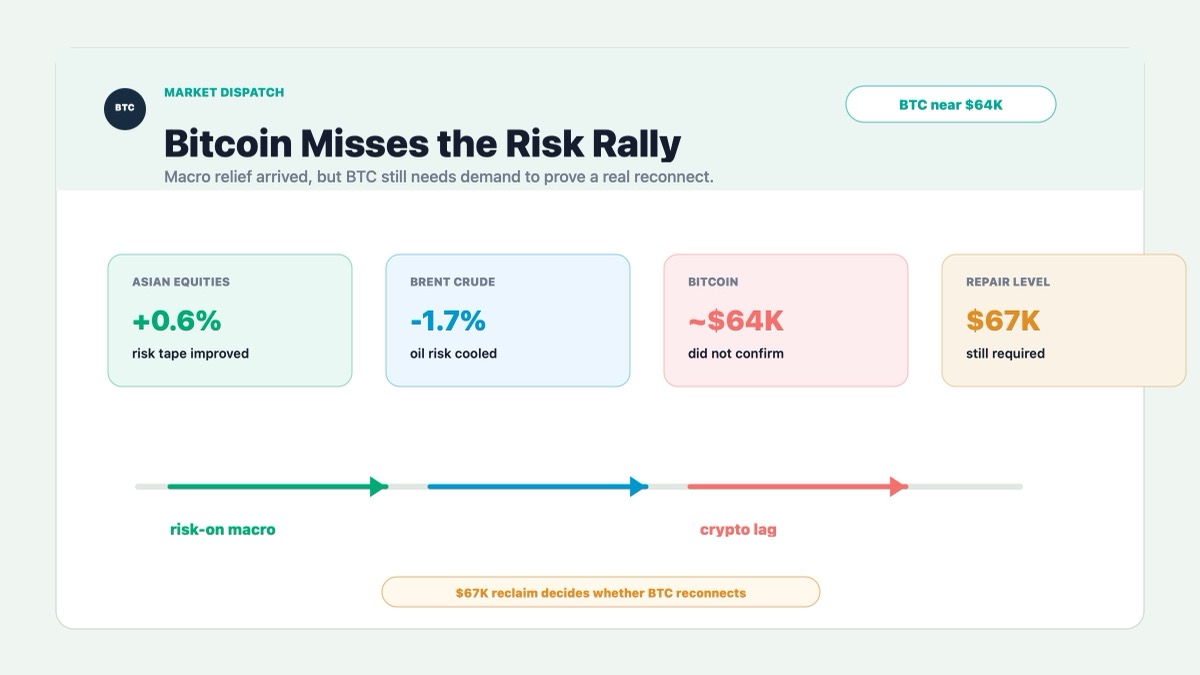
- Bitcoin traded around $64,000 even as Asian equities rose and oil slipped after the US and Iran agreed on a roadmap toward a final peace deal.
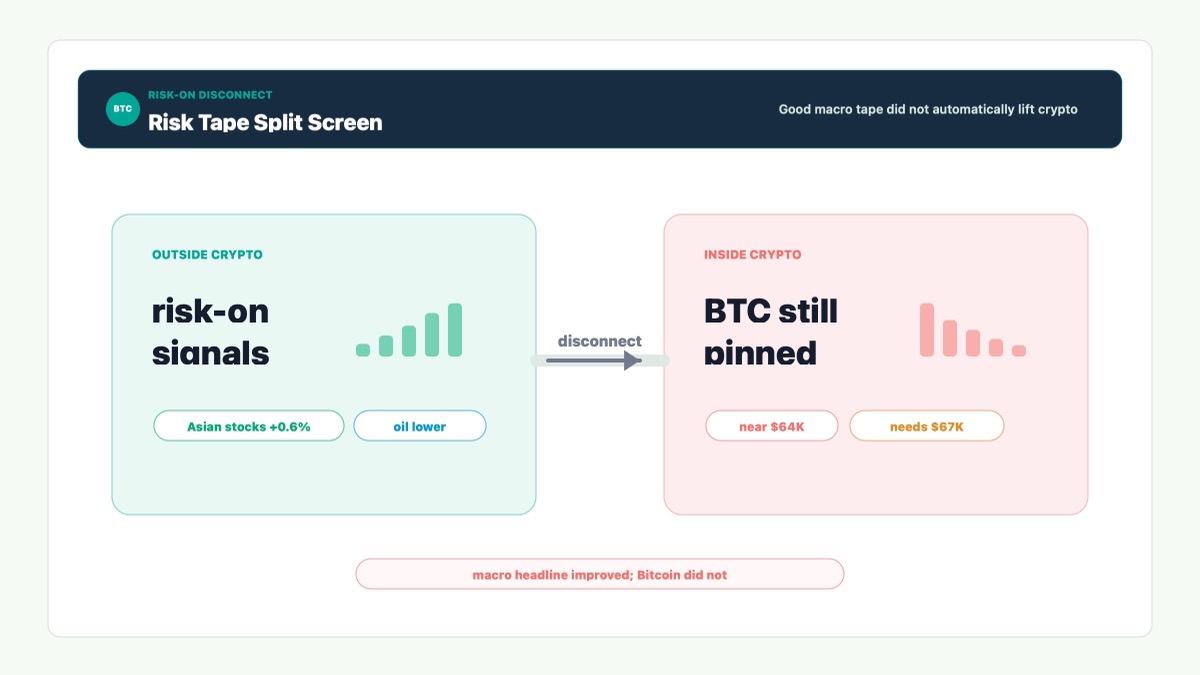
- The important signal is the disconnect: traditional risk assets improved, but crypto stayed soft, with BTC down 2.2% on the week.
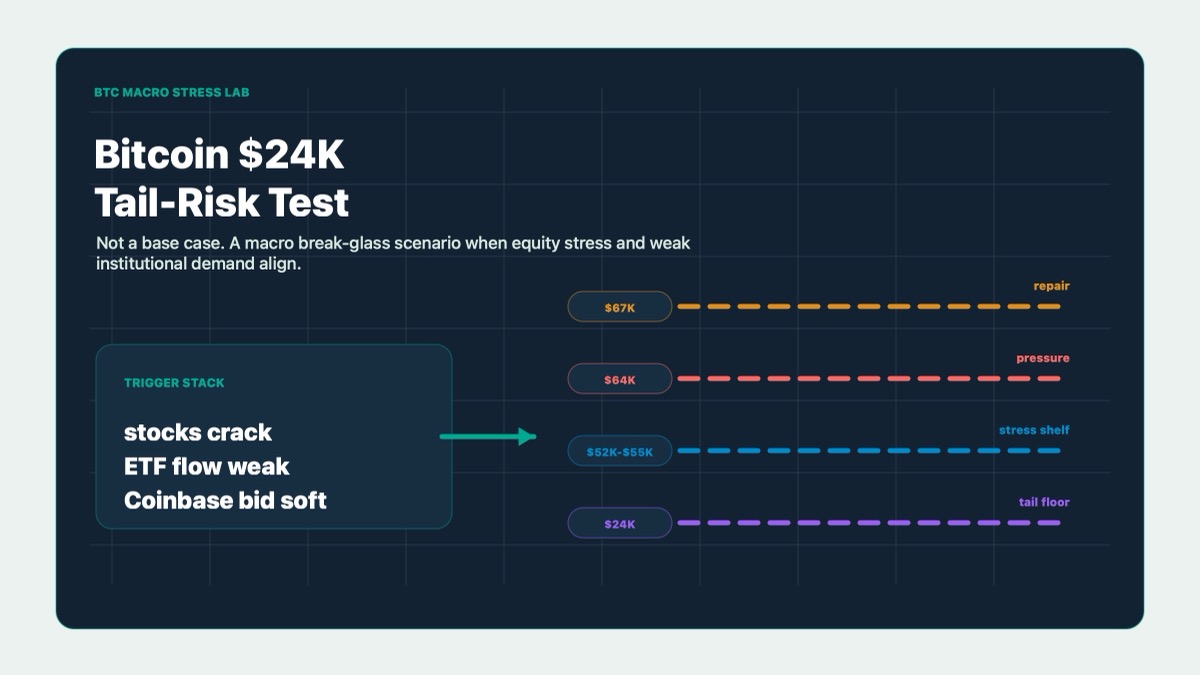
- BTC needs to reclaim $67K to show real repair; failure near $64K keeps $60K-$61.5K as the next major support test.
What Happened
Bitcoin started the week doing something slightly rude: ignoring a risk-on setup that should have helped it.
According to CoinDesk, BTC traded around $63,996 on Monday, down 0.4% over 24 hours and 2.2% on the week. That would be normal enough by itself. Markets drift. Candles get bored. The weird part is the backdrop.
The US and Iran had agreed on a roadmap toward a final peace deal within 60 days. Brent crude fell 1.7% to about $79 a barrel. An MSCI gauge of Asian stocks rose 0.6%, led by a technology rally tied to continued optimism around artificial intelligence.
In other words, several things that normally make risk assets breathe a little easier were happening at the same time.
Crypto did not join the party.
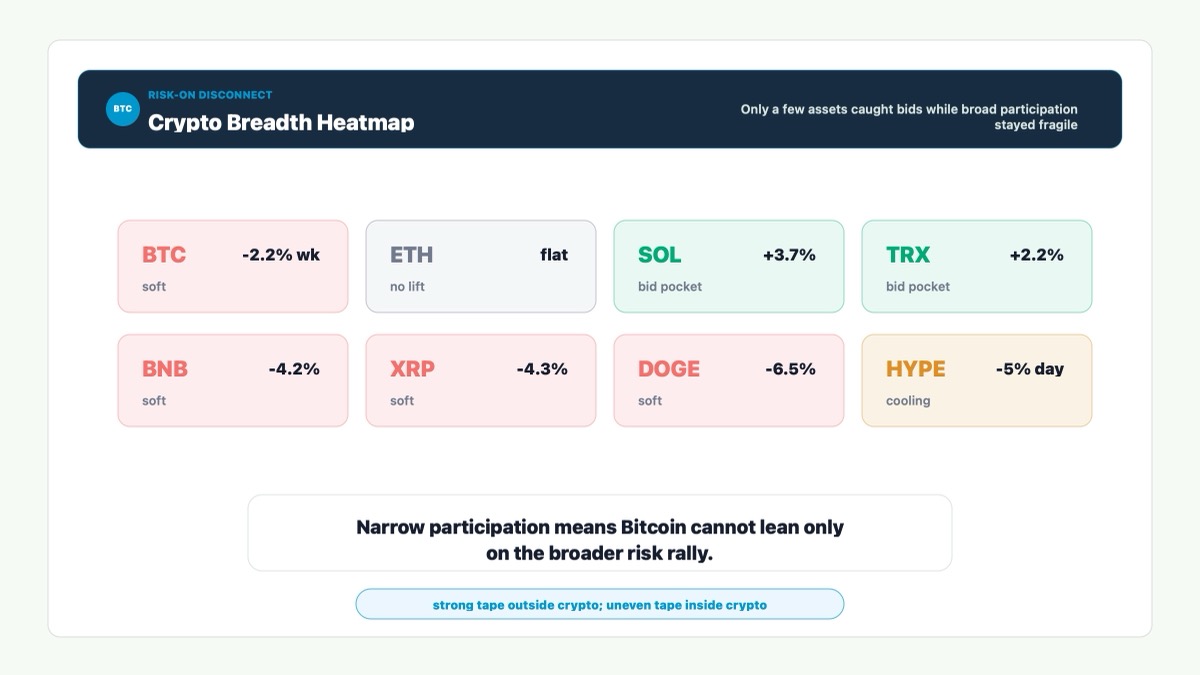
The broader market was mixed. Solana rose 3.7% on the week to $74, while Tron added 2.2%. Ether was roughly flat near $1,733. But losses were deeper elsewhere: BNB fell 4.2% on the week, XRP dropped 4.3% to $1.13, Dogecoin lost 6.5%, and HYPE cooled from its early-June strength, falling 5% on the day while keeping a smaller weekly gain.
The diplomatic progress is also not finished business. CoinDesk noted that talks had a confusing start after Iran briefly halted discussions following renewed threats from President Donald Trump, before both sides agreed to a channel meant to prevent escalation.
So the market is looking at two truths at once.
The macro headline improved. Bitcoin did not.
That is the story.
Why This Matters for Bitcoin and Crypto Markets
Bitcoin often gets described as a macro asset, a liquidity asset, a technology asset, a hedge, a risk asset, or some combination of those depending on what the chart did that morning.
Annoying, but fair.
The reason this particular move matters is that BTC has recently tracked risk assets through the Iran story. If oil spikes, geopolitical anxiety rises, or equities wobble, Bitcoin tends to react. So when the macro backdrop turns friendlier and Bitcoin stays pinned near $64K, the market is telling us something useful: the crypto bid is not strong enough to automatically follow every risk-on cue.
That does not mean Bitcoin is doomed. It means the burden of proof has shifted.
In a healthy risk-on environment, good macro news should help BTC reclaim lost levels. If it cannot, traders start asking whether the weakness is coming from inside crypto itself: softer ETF demand, lower exchange activity, weak altcoin liquidity, institutional caution, or simply a market that has already spent too much energy defending support.
This matters for altcoins even more. Solana’s weekly strength shows that some pockets of crypto can still catch bids. But broad crypto participation looks fragile when BTC is stuck and memecoins are leading the losses. A market where only a few assets move is different from a market where liquidity lifts everything.
There is also a psychological layer. Bitcoin under $64K after a risk-positive headline feels different from Bitcoin under $64K during a panic. During panic, everyone understands why price is weak. During good news, weakness becomes more suspicious.
That is the uncomfortable read here. The market was handed a reason to bounce, and Bitcoin mostly stared at it.
Historical Parallel
A useful historical parallel is the post-2022 recovery phase, especially the periods when macro assets began to stabilize before Bitcoin and the broader crypto market fully trusted the move.
The historical event was not a single dramatic crash. It was the slow, awkward aftermath of one. After the 2022 deleveraging cycle, risk assets eventually found moments of relief as inflation fears cooled, equities bounced, and liquidity expectations improved. But crypto did not always respond cleanly. Sometimes Bitcoin lagged because the internal crypto damage still mattered: failed lenders, broken balance sheets, weak exchange activity and investors who had learned, very recently, that “risk-on” could still be a trap.
That is the similarity with today’s setup. The current news is not a crypto-native disaster. It is actually a macro-positive development: progress toward a US-Iran peace roadmap, lower oil and stronger Asian equities. But Bitcoin’s muted reaction suggests that crypto is not simply taking orders from the broader risk tape. Internal demand still matters.
The difference is that the present market is not emerging from the same kind of systemic crypto collapse. There is no identical lender unwind sitting at the center of this story. The current problem is more subtle: Bitcoin is failing to respond strongly to a headline that should have helped, while several major crypto assets remain soft.
The lesson is that correlation is conditional. Bitcoin can behave like a risk asset when macro stress rises, then fail to behave like one when macro stress eases. That is frustrating, but it is also informative. It tells us that the market is not just asking whether the outside world is improving. It is asking whether crypto has enough internal demand to use that improvement.
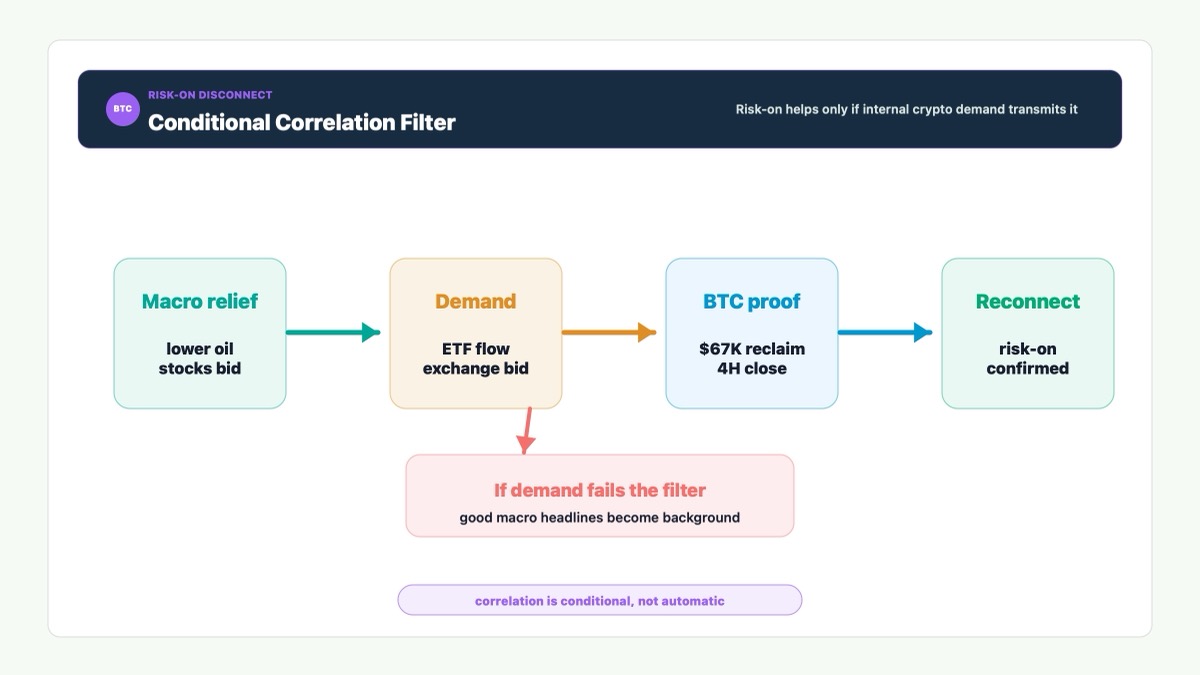
For BTC now, the historical parallel says: do not assume a friendlier macro headline is enough. Wait for price to reclaim levels that prove buyers are actually back.
Bitcoin Price Reaction and K-Line Analysis
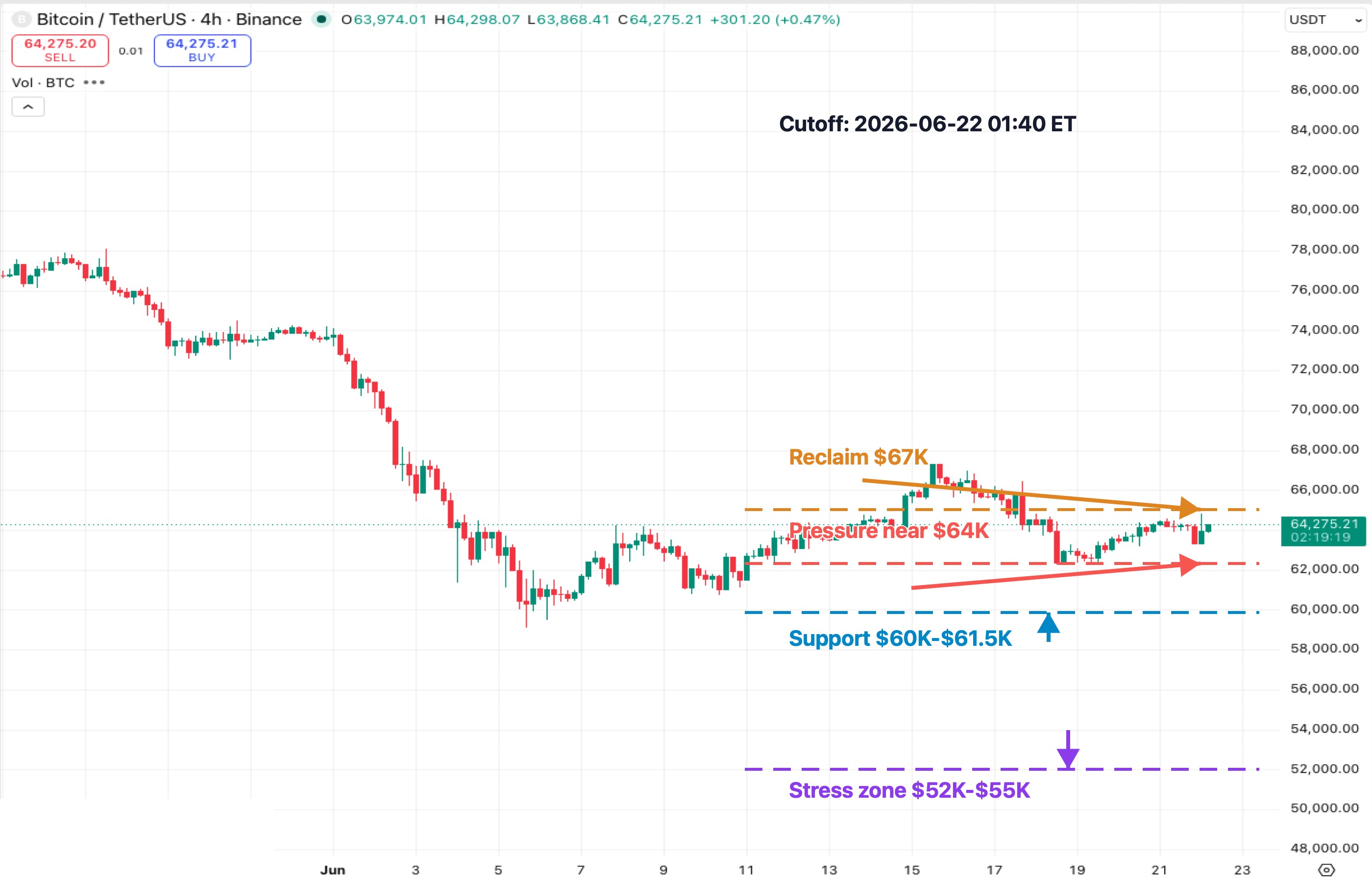
The BTCUSDT 4H chart explains the market’s hesitation better than the headline does.
Bitcoin is trying to stabilize near $64K, but the structure is still damaged from the earlier drop. The move down from the high-$70K area broke momentum, and the rebound has not yet reclaimed the $67K zone. That makes $67K the first real repair level.
The current pressure area is near $64K. BTC is trading around it, but not cleanly above it with conviction. That is why the chart still feels indecisive. Price is not collapsing, but it is also not proving that buyers are ready to chase.
The key support zone is $60K-$61.5K. This is where the recent rebound began to matter. If BTC loses that area, the market would likely stop talking about a harmless drift and start talking about another deeper downside test.
Below that sits the $52K-$55K stress zone. That is not the immediate base case, but it matters because a failure of the low-$60K area would make traders look for the next place where liquidity could appear.
The chart’s message is simple: Bitcoin needs to turn a sideways hold into an actual reclaim. Until then, the risk-on macro backdrop is interesting, but not decisive.
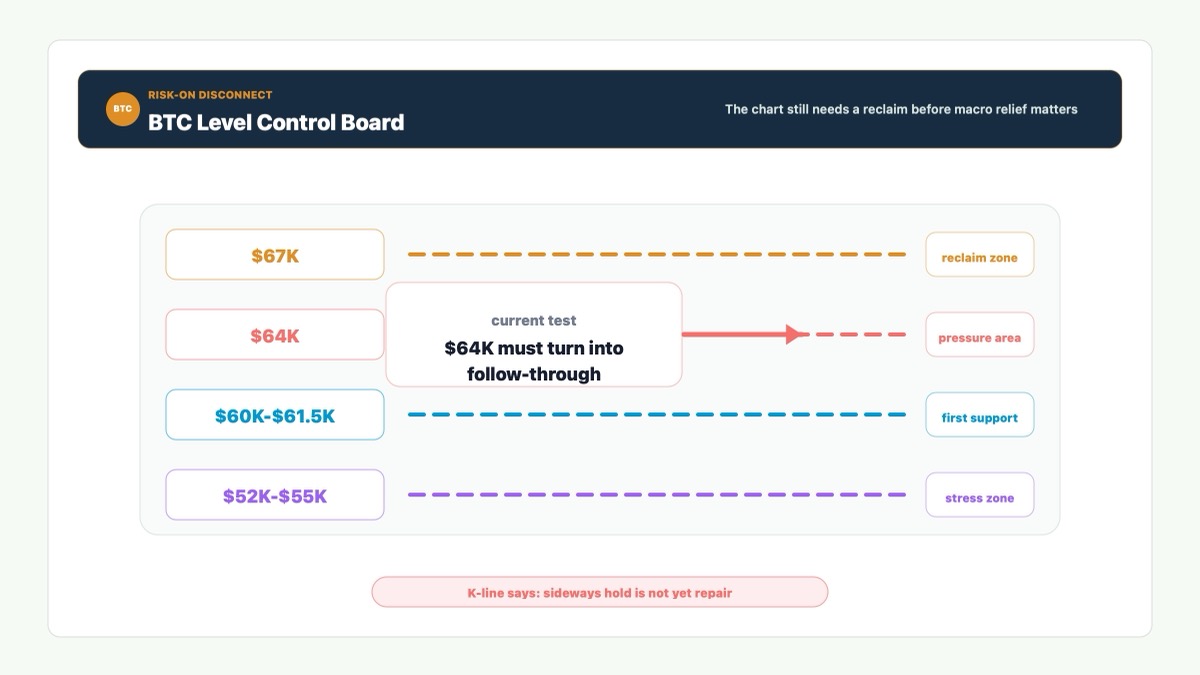
Key Levels to Watch
$67K reclaim zone: BTC needs this level to show that the rebound has repaired the latest breakdown structure.
$64K pressure area: This is the current battleground. Holding it helps, but BTC needs stronger follow-through to change the tone.
$60K-$61.5K support: This remains the first major downside test if sellers regain control.
$52K-$55K stress zone: This becomes relevant if the low-$60K support zone breaks cleanly.
Conditional Forecast
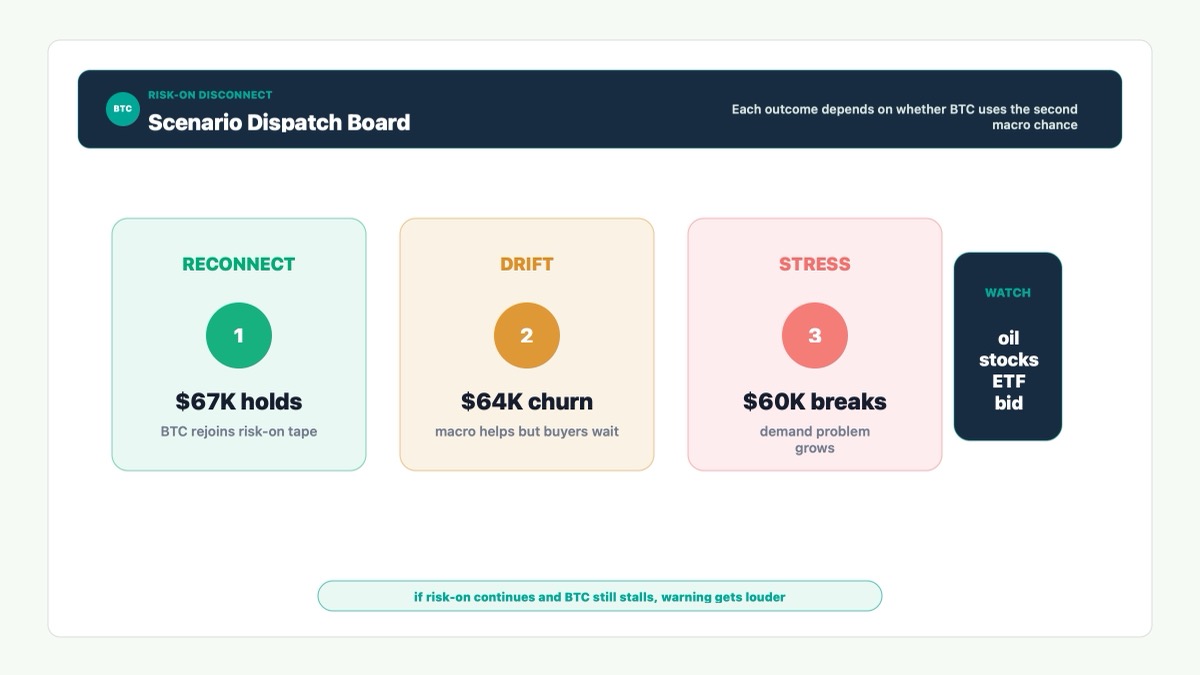
If BTC reclaims $67K and holds it on 4H and daily closes, the market can begin treating the current weakness as a lagging response rather than a serious warning. That would also make it easier for ETH, SOL and larger altcoins to stabilize.
If BTC keeps failing near $64K, the market remains stuck in the awkward middle. In that case, stronger equities and lower oil may not be enough to pull crypto higher.
If BTC loses $60K-$61.5K, the risk-on disconnect becomes more concerning. A break there would suggest that crypto is not merely slow to respond to macro relief; it is dealing with its own demand problem.
If the US-Iran roadmap holds, oil stays lower and equities continue rising, crypto gets a second chance to reconnect with broader risk appetite. If it still fails to respond, that would be a louder warning than the first miss.
Investment Takeaway
The investment takeaway is not that Bitcoin is broken. It is that Bitcoin is being asked to prove it still deserves the risk-on label.
Good macro news helped other markets. Bitcoin mostly drifted. That kind of divergence does not automatically mean downside, but it does mean traders should stop assuming that every positive macro headline will turn into crypto upside.
For traders, $67K is the repair level and $60K-$61.5K is the line that should not fail. For investors, the bigger question is whether Bitcoin can attract demand when the outside world becomes less hostile.
The market got a friendlier backdrop. Now Bitcoin needs to do something with it.
Sources
- CoinDesk: Bitcoin holds near $64,000 as US-Iran talks progress but crypto sits out the rally
- Bloomberg reporting cited by CoinDesk on US-Iran talks, Qatar and Pakistan mediation, and Strait of Hormuz communication channels.
- TradingView: BINANCE:BTCUSDT 4H chart
|
DISCLAIMER:
1. All content on this website (including but not limited to articles, data, charts, and analyses) is for general informational purposes only and does not constitute any form of investment advice, trading recommendation, or financial guidance. 2. Cryptocurrencies and digital assets are subject to extreme price volatility and high investment risk; you may lose part or all of your principal. Past performance does not predict future results. 3. The information on this website is based on sources we believe to be reliable, but we do not guarantee its accuracy, completeness, or timeliness. Any investment decisions made based on this website’s information are at your own risk. 4. We strongly recommend that you conduct your own thorough research and consult an independent, licensed financial advisor before making any investment decisions. |
Recommended reading
Latest News