
Key Takeaways
- Michael Saylor blamed Bitcoin's selloff on AI infrastructure absorbing capital, but Arca says that explanation misses the real issue.
- Arca argues Strategy's 32 BTC sale mattered because it raised fear that the world's biggest corporate BTC buyer could become a recurring seller.
- BTC is still trading defensively near $61K-$62K, with $60K as the line the market keeps testing.
- A reclaim of $63K-$64K would calm the chart; losing $60K would make the forced-seller narrative louder.
What Happened
Bitcoin had a bad week, and then the market did what markets do after bad weeks: it started arguing about the cause.
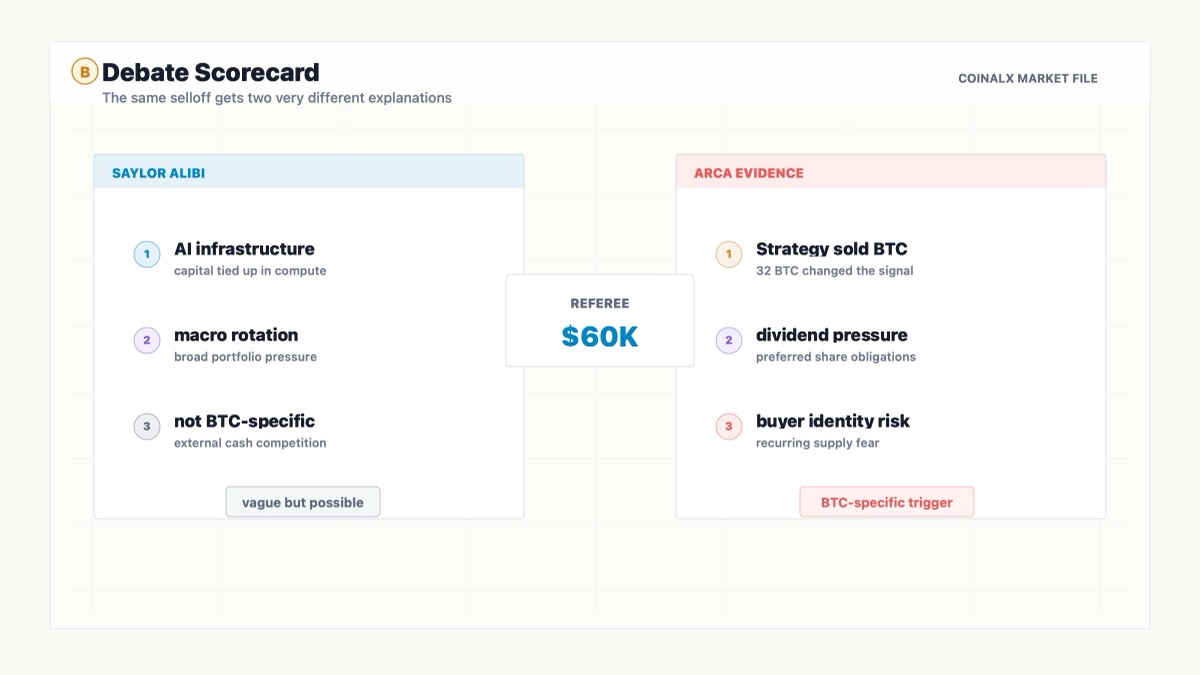
Michael Saylor's explanation was macro and futuristic. AI infrastructure, he said, is absorbing capital at historic scale. In that version, Bitcoin was not broken. It was temporarily pressured because the market's cash was busy funding the next giant buildout of compute, data centers and artificial intelligence.
Arca's Jeff Dorman looked at that explanation and basically said: no.
According to the CoinDesk report, Dorman argued that last week's Bitcoin selloff was "clearly" driven by Strategy-related news, not AI capital rotation. Strategy disclosed on June 1 that it had sold 32 BTC in the prior week. The dollar amount was tiny by Bitcoin market standards, roughly $2.5 million. Strategy still holds 845,256 BTC. So if you only look at the sale itself, the market reaction seems absurd.
But Dorman's point is that the sale was not important because of size. It was important because of what it implied.
Strategy has built its whole market identity around being Bitcoin's most aggressive public-company accumulator. It is supposed to be the buyer. If that buyer sells even a small amount while carrying preferred-share dividend obligations, the market starts asking an unpleasant question: what if this was not a one-off?
Dorman argued that Strategy may need to sell more BTC to meet dividend obligations on preferred shares, including STRC. He also said Strategy has roughly five months of cash flow remaining, leaving investors to wonder whether small, repeated sales could become a standing overhang.
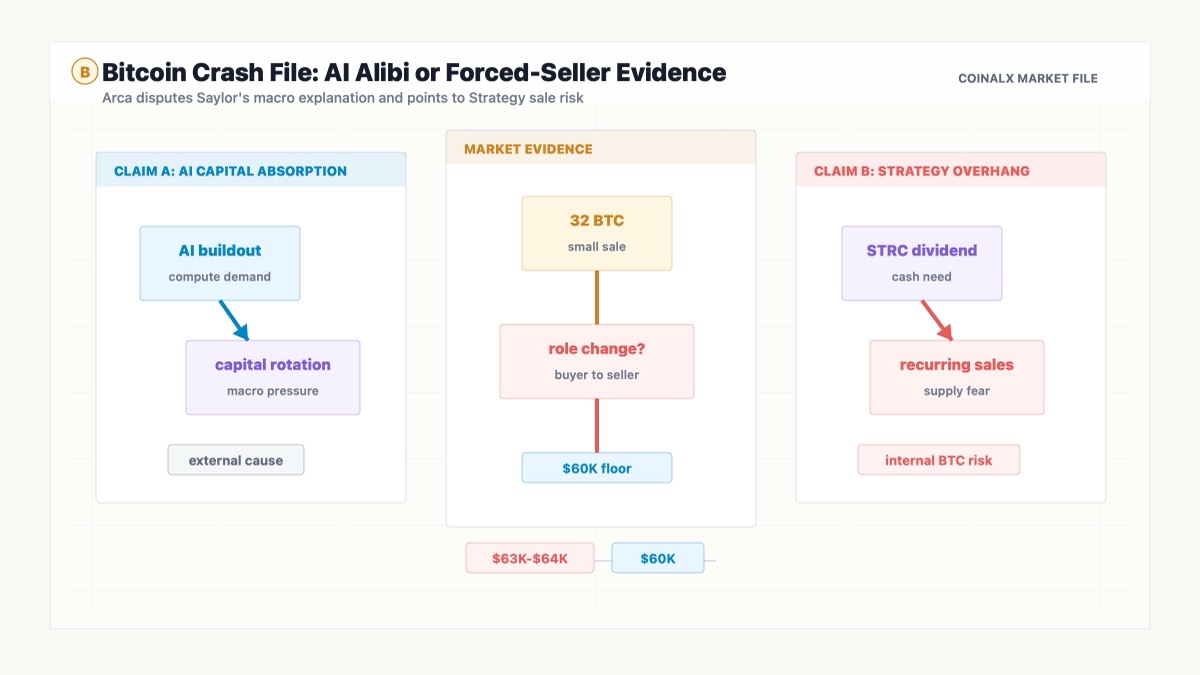
That is why the debate matters. Saylor is saying Bitcoin is being pulled down by external capital competition. Arca is saying the wound is internal: the market is repricing Strategy from permanent buyer to possible forced seller.
Those are very different stories.
Why This Matters for Bitcoin and Crypto Markets
The market does not hate sellers.
It hates sellers it thought were buyers.
That is the emotional machinery underneath this story. A normal holder selling 32 BTC is a shrug. A whale selling 32 BTC is maybe a headline for five minutes. Strategy selling 32 BTC is different because Strategy is not just another holder in the Bitcoin narrative. It is a pillar in the story people tell about institutional conviction.
So the market is not really reacting to 32 BTC. It is reacting to a possible identity change.
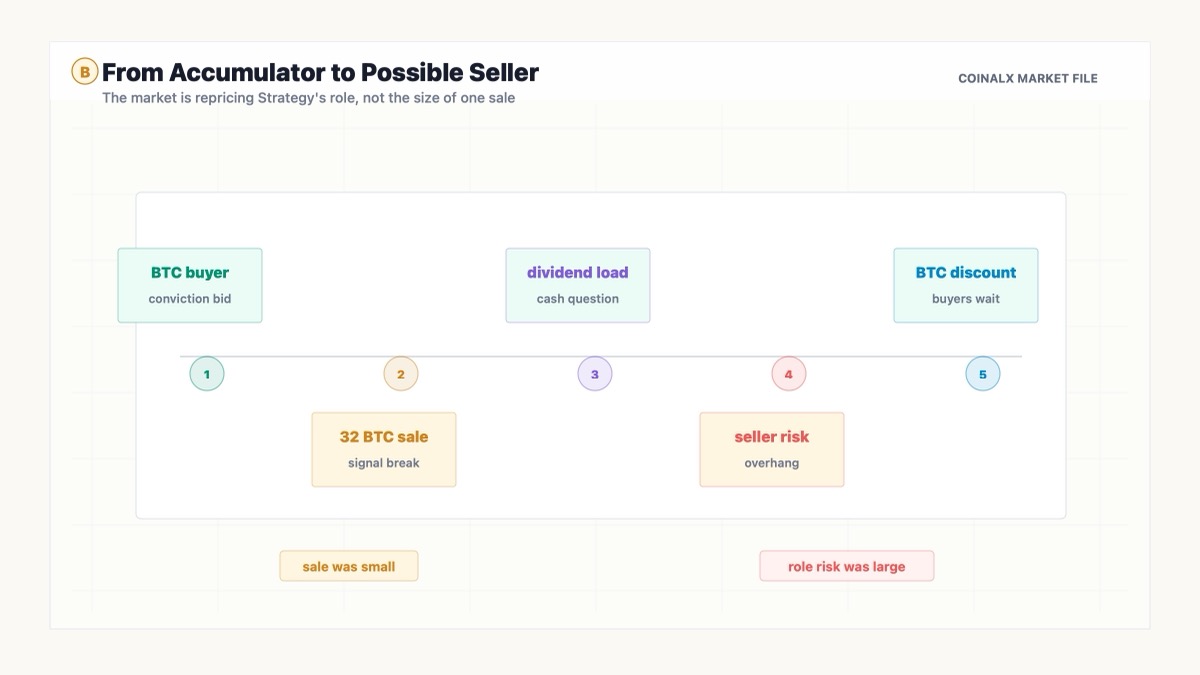
If Strategy is still a buyer with temporary cash-management noise, the selloff may look overdone. If Strategy becomes a recurring seller to cover preferred dividends, the market has to price a new supply rhythm. Not huge at first, maybe. But persistent. And in a nervous market, persistent is often scarier than large.
This is why Arca's argument lands harder than the AI explanation. AI may be absorbing capital, and that may be true in a broad portfolio sense. But AI capital rotation is vague. It explains a general headwind. It does not explain why BTC weakened on its own idiosyncratic news while parts of the broader crypto market initially held up.
Dorman noted that BTC's dominance fell for a second week and slipped below 58% for the first time since September. In his view, the early part of the selloff actually showed growing market sophistication: investors were treating Bitcoin's problem as Bitcoin-specific rather than dumping every digital asset at once.
That is a useful distinction. If the problem were simply "AI is taking all the money," you would expect a wider risk-off wash. If the problem is "Bitcoin's biggest corporate buyer might need to sell," then a BTC-specific hit makes more sense.
The chart is now the referee. Narratives can argue. Price has to decide whether $60K is real support or just a pause before the next uncomfortable question.
Historical Parallel: Luna Foundation Guard's 2022 BTC Reserve Sale
A useful historical parallel is the Luna Foundation Guard's Bitcoin reserve sale during the TerraUSD crisis in May 2022.
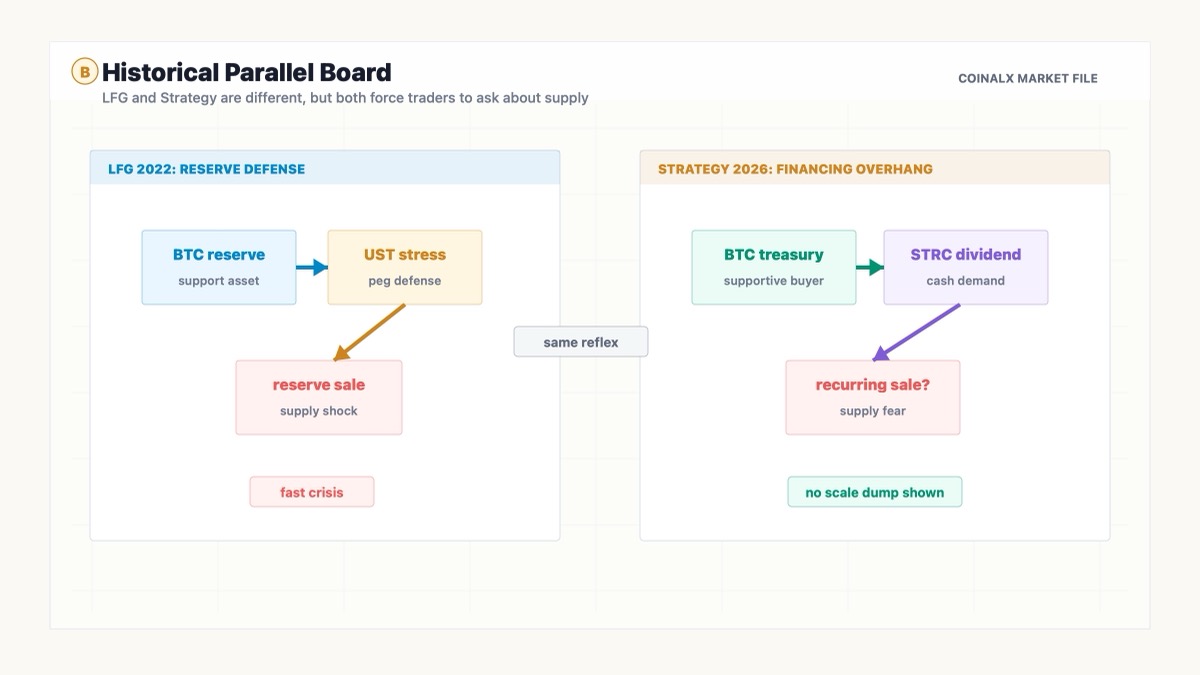
Before the collapse, LFG had built a large BTC reserve meant to help defend UST's dollar peg. The idea was simple enough: Bitcoin would act as a reserve backstop. In calmer times, that made BTC look like part of the defense system. But once UST came under pressure, the reserve became potential sell-side supply. LFG later said it used most of its Bitcoin holdings in an attempt to defend the peg, and blockchain data showed large BTC movements during the crisis.
The similarity to the current Strategy debate is not that Strategy is Terra. It is not. The balance-sheet structure, asset quality and underlying situation are very different. The similarity is psychological. In both cases, the market had to reprice a large, previously supportive holder as a possible source of supply. That shift can matter more than the first sale itself.
In 2022, the fear was that BTC reserves would be sold to defend a collapsing stablecoin mechanism. In the current case, Arca's concern is that Strategy could sell BTC to meet preferred-share dividend obligations. One was a peg-defense crisis. The other is a corporate-financing overhang. Different machine, similar market reflex: if the buyer becomes the seller, traders back away.
The difference is also important. LFG's sale happened inside a fast systemic failure. Strategy's 32 BTC sale is tiny, and the company still holds an enormous Bitcoin position. There is no evidence from the article that Strategy is dumping reserves at scale.
But the lesson is uncomfortable: markets do not wait for the full forced sale before repricing the risk. They usually move when the possibility becomes credible.
For BTC now, that means the question is not whether 32 BTC caused a crash. It is whether 32 BTC changed what traders think Strategy might do next.
Bitcoin Price Reaction and K-Line Analysis
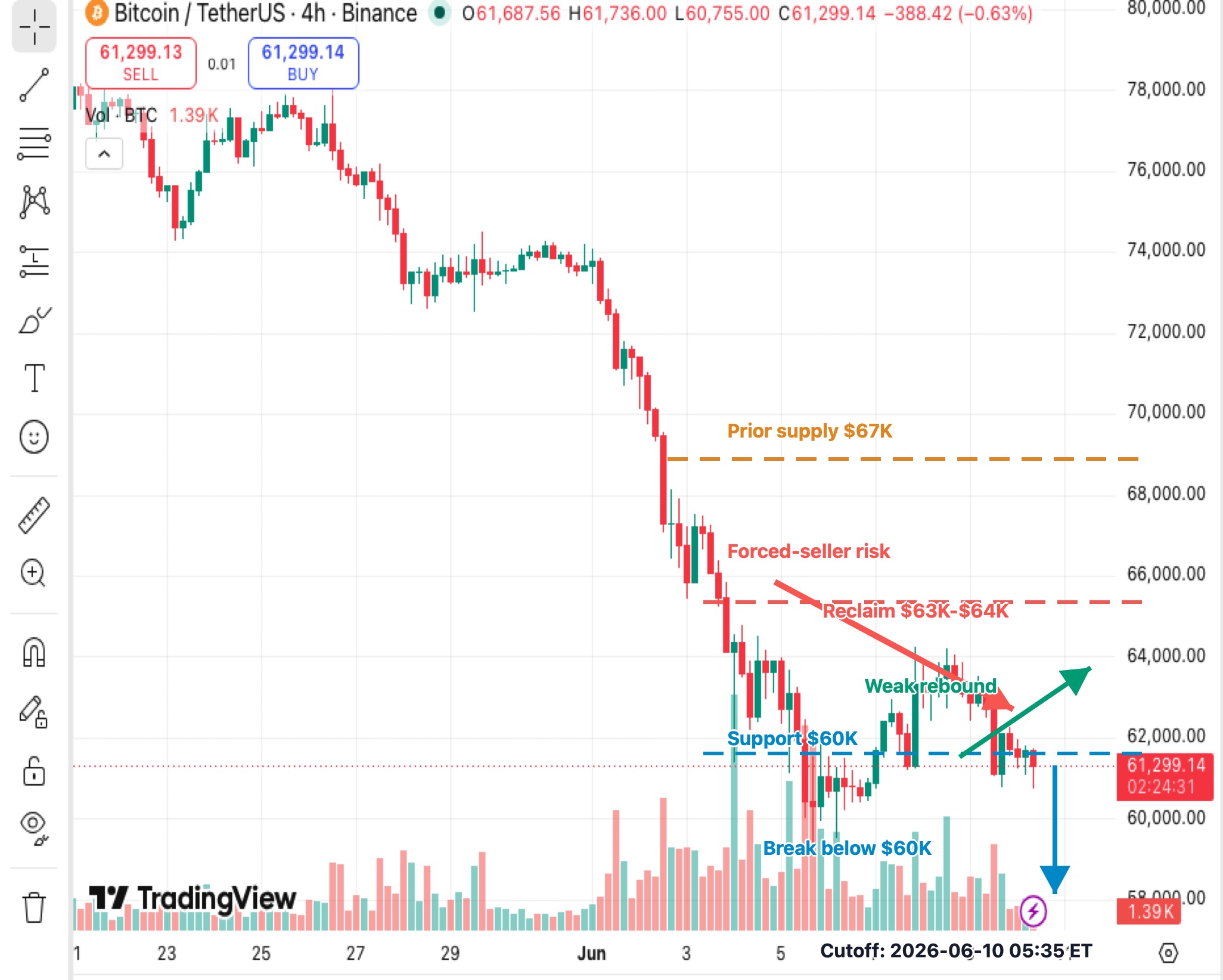
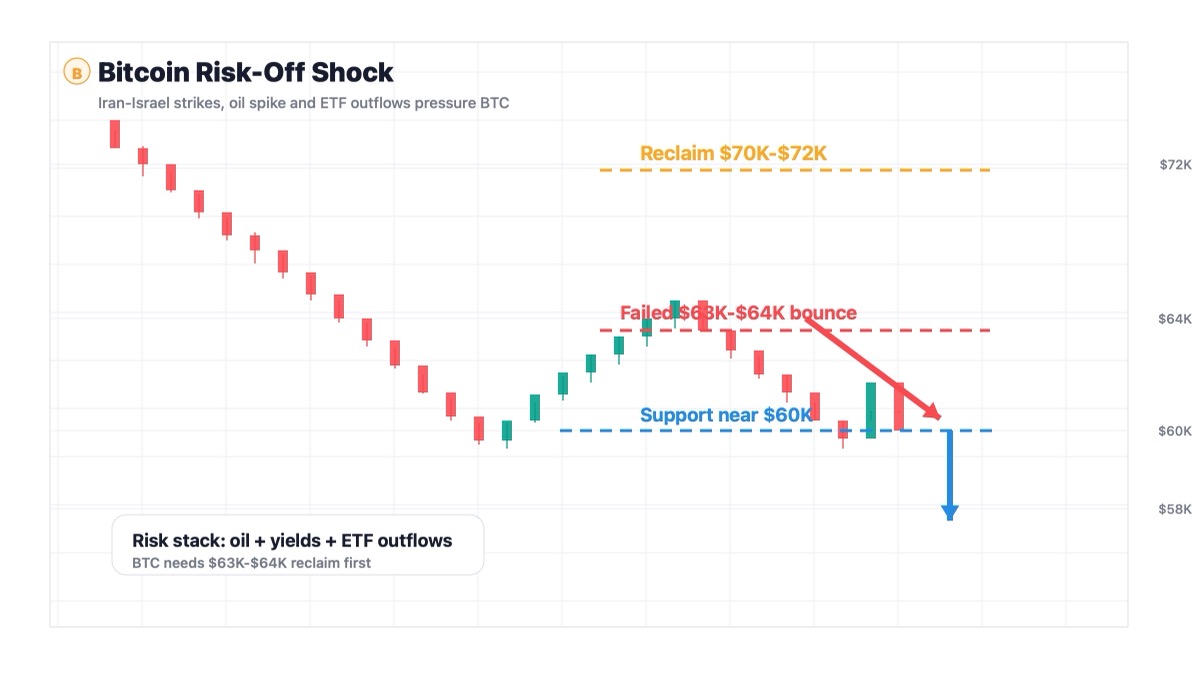
The BTC seven-day K-line structure fits Arca's argument better than Saylor's.
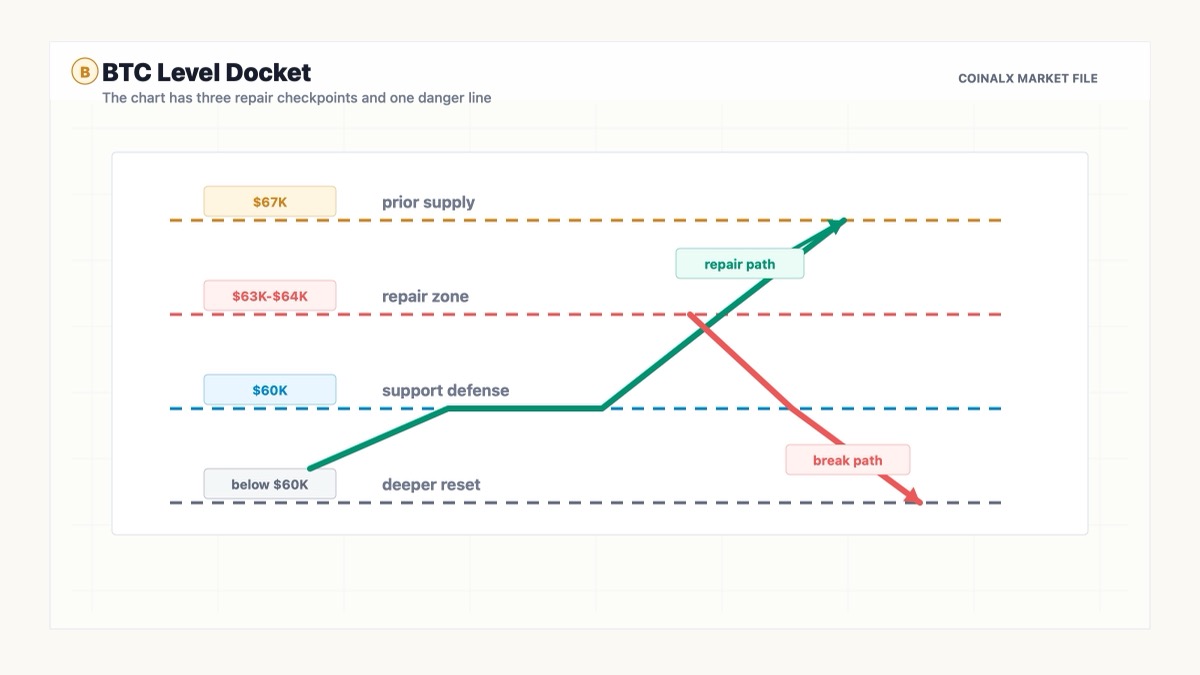
The chart shows a BTC-specific breakdown from the $67K area toward the $60K support zone. That was not a gentle rotation. It was a fast repricing, followed by a weak rebound that could not cleanly reclaim $63K-$64K.
That $63K-$64K band is the first repair zone. If BTC can reclaim it and hold above it, the market can begin treating the selloff as a nasty but contained Strategy scare. If it keeps failing below that area, the chart says buyers are still demanding a discount for the overhang.
The $60K area is the bigger line. BTC already dipped toward it, bounced and then faded again. That makes $60K more than a round number. It is the boundary between "the market is nervous but still defending the structure" and "the market is pressing the forced-seller story again."
The $67K zone is now prior supply. That was the area before the breakdown began. Any move back there would probably meet sellers who bought the prior range and now want out.
The important part is the shape of the rebound. It is not strong enough yet to prove that buyers reject Arca's concern. It is only strong enough to show that $60K has not broken cleanly.
That is a very different thing.
Key Levels to Watch
The first level is $63K-$64K. This is the immediate repair zone and the place where BTC must prove the rebound is not just short covering.
The second level is $60K. A clean break below it would make the forced-seller narrative harder to dismiss.
The third level is $67K. This is prior supply and the area where the chart would begin looking repaired rather than merely stabilized.
The lower risk zone begins below $60K. If BTC loses that level while Strategy financing concerns remain unresolved, traders may start pricing a deeper reset.
Conditional Forecast
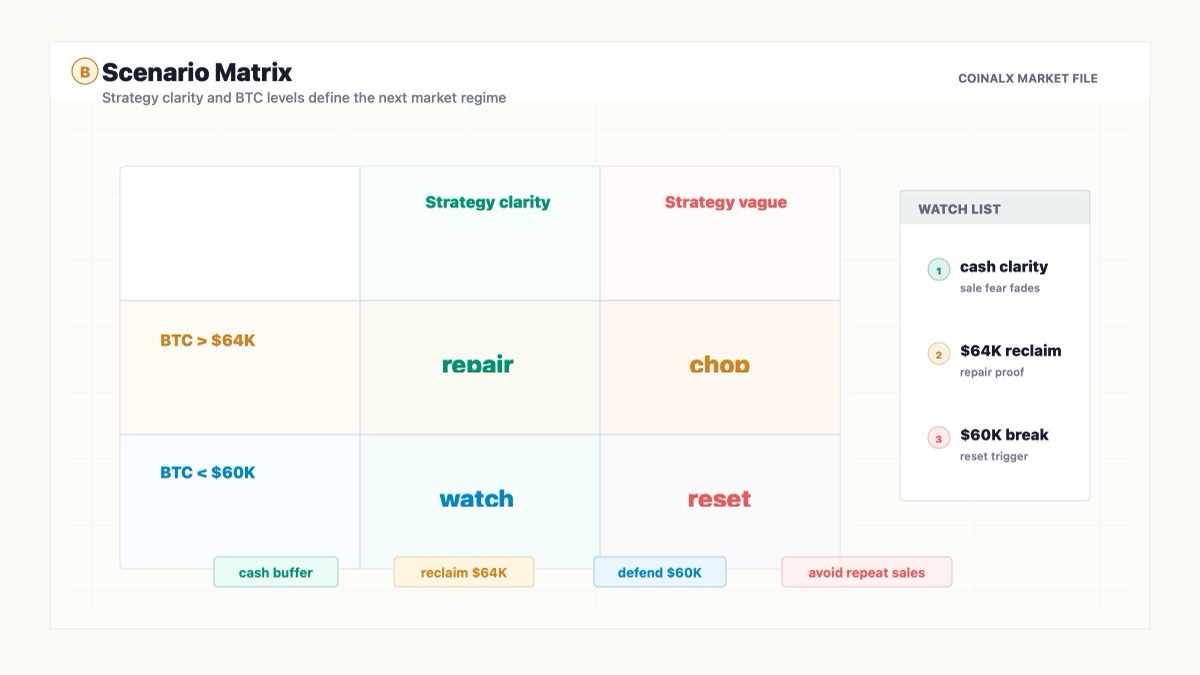
If Strategy provides a credible cash buffer, or if the market becomes convinced the 32 BTC sale was not the start of a recurring pattern, BTC can reclaim $63K-$64K and grind back toward $67K. In that scenario, Saylor's AI explanation may matter as background noise, but the immediate pressure fades because the forced-seller fear fades.
If Strategy stays vague, and traders continue to believe dividend obligations could require monthly BTC sales, the rebound may keep failing below $64K. That would leave BTC stuck in a defensive range where every bounce is questioned.
If BTC breaks $60K, the market will probably stop debating whether 32 BTC was small and start debating how much future BTC supply could matter if confidence in Strategy's buyer identity cracks further.
The clean bullish path is simple: no recurring sale concern, reclaim $64K, rebuild toward $67K.
The bearish path is also simple: uncertainty stays, $64K rejects, $60K breaks.
Investment Takeaway
This debate is not really about AI.
It is about narrative ownership.
Saylor wants the selloff framed as an external capital-allocation issue: AI is huge, capital is temporarily busy, Bitcoin remains the long-term winner. Arca wants it framed as a balance-sheet confidence issue: the biggest corporate Bitcoin buyer sold a little, and the market is now afraid it may have to sell more.
For investors, the second explanation is more immediately tradable because it creates clear levels and clear questions. Does Strategy remove the overhang? Does BTC reclaim $63K-$64K? Does $60K hold?
Until those answers improve, the chart deserves caution. Bitcoin does not need a huge seller to get nervous. Sometimes it only needs the market to wonder whether a famous buyer has changed roles.
That is the awkward part.
Sources
- CoinDesk: Saylor blamed AI for bitcoin crash. Arca has one word for that: Nonsense
- The Wall Street Journal: Michael Saylor Says Bitcoin's Fall Is About AI
- Strategy: Strategy Announces STRC Dividend Rate Increase
- CoinGecko: Bitcoin price and market data
- Luna Foundation Guard: May 2022 reserve update
- CoinDesk: Luna Foundation Guard says it spent nearly all BTC reserves defending UST peg
|
DISCLAIMER:
1. All content on this website (including but not limited to articles, data, charts, and analyses) is for general informational purposes only and does not constitute any form of investment advice, trading recommendation, or financial guidance. 2. Cryptocurrencies and digital assets are subject to extreme price volatility and high investment risk; you may lose part or all of your principal. Past performance does not predict future results. 3. The information on this website is based on sources we believe to be reliable, but we do not guarantee its accuracy, completeness, or timeliness. Any investment decisions made based on this website’s information are at your own risk. 4. We strongly recommend that you conduct your own thorough research and consult an independent, licensed financial advisor before making any investment decisions. |
Recommended reading
Latest News