
Key Takeaways
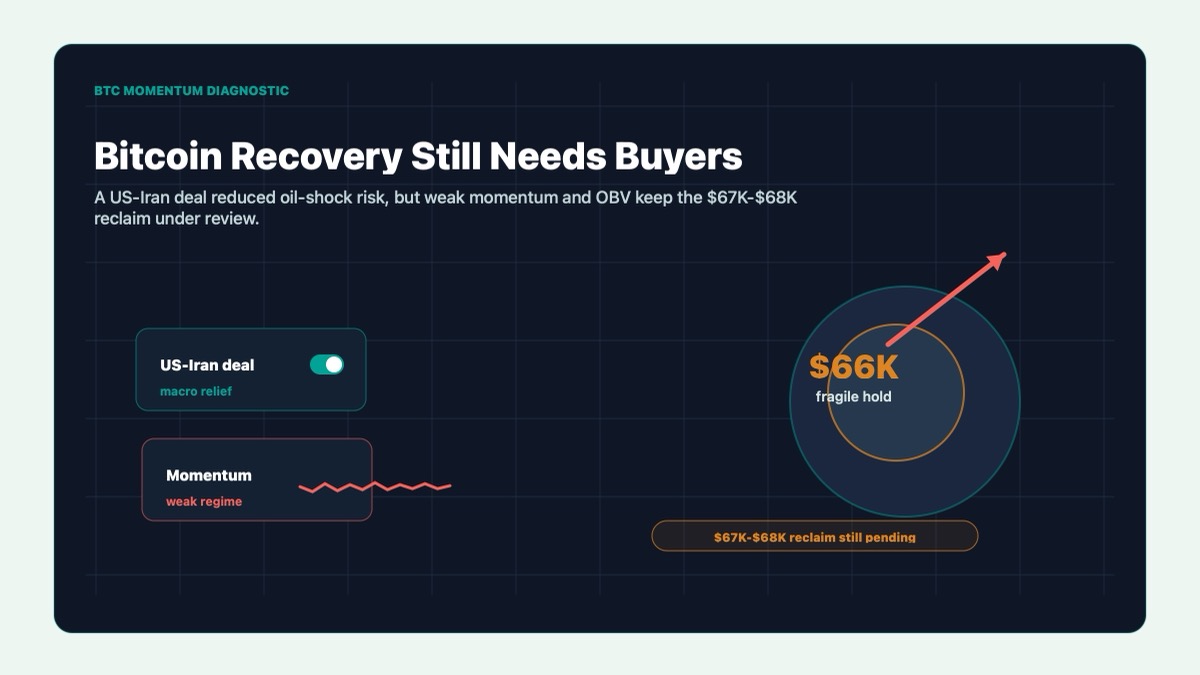
- Bitcoin reclaimed $67K after the US-Iran peace deal headline, but Swissblock says momentum and OBV remain in a weak participation regime.
- The recovery is still vulnerable because price strength has not yet been confirmed by volume or onchain participation.
- BTC needs to reclaim the $67K-$68K zone with stronger demand; otherwise, the $60K-$62K retest risk remains alive.
What Happened
Bitcoin got the headline it wanted.
It did not yet get the confirmation it needed.
According to Cointelegraph, BTC recently reclaimed $67,000 after falling below $60,000 on June 6, helped by news that the United States had completed a peace deal with Iran. The deal is expected to reopen the Strait of Hormuz and reduce some of the oil-shock risk that had been hanging over markets.
That is the good part.
The less comfortable part is that Bitcoin's internal market signals still look weak. Nick Ruck, director at LVRG Research, told Cointelegraph that Bitcoin's momentum remains weak, with declining volume and stagnant onchain metrics suggesting the recovery lacks conviction and could fade quickly.
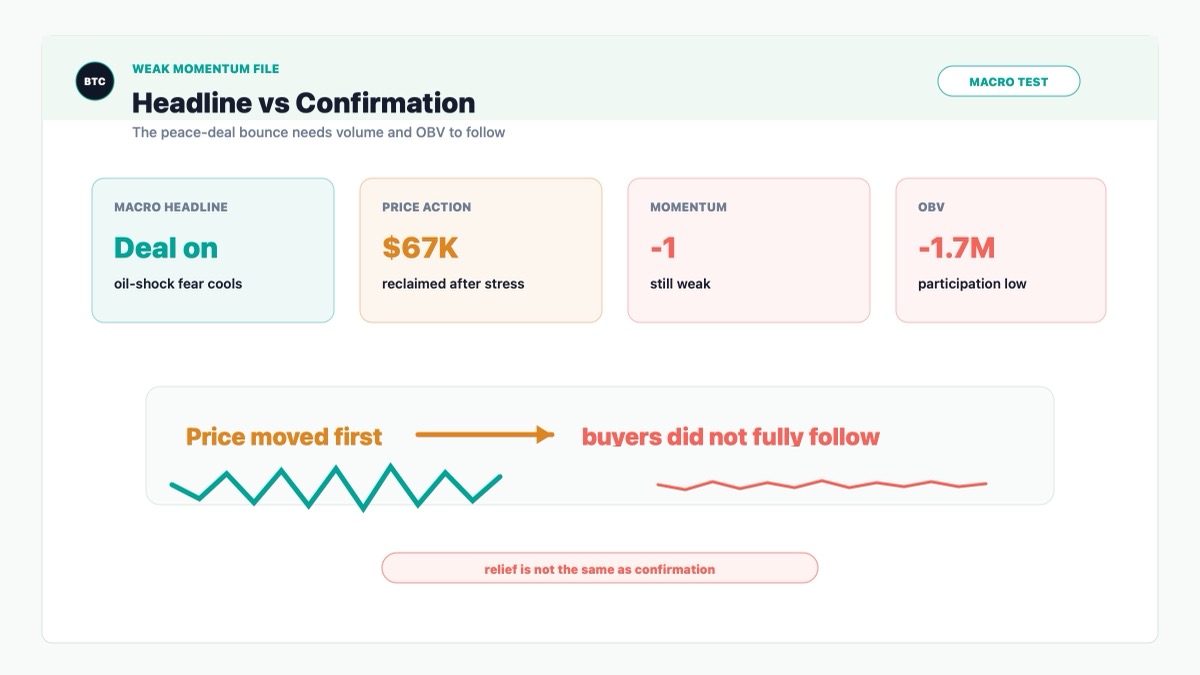
Swissblock's data pointed in the same direction. The firm said Bitcoin's price momentum and on-balance volume, or OBV, remain in a weak momentum and participation regime. Price momentum was around -1, while OBV was near -1.7 million, its lowest level in years.
That sounds technical, but the idea is simple.
Price moved first.
Participation did not really follow.
This distinction matters because a market can bounce for two very different reasons. It can bounce because real buyers are stepping in. Or it can bounce because the bad news pauses, shorts cover and sellers temporarily run out of energy. Those two things look similar for a few candles. Then they become very different markets.
Bitcoin is currently stuck between those two explanations.
The US-Iran deal helped reduce one macro pressure point. But if the deal breaks down, Ruck warned that renewed geopolitical instability and potential oil shocks could put Bitcoin back on a volatile path.
So BTC has a recovery.
It just does not yet have a sturdy one.
Why This Matters for Bitcoin and Crypto Markets
The dangerous thing about a relief rally is that it feels like an answer.
Sometimes it is only a pause.
Bitcoin's move back above $67K looked important because it came after a sharp drop below $60K. When a market falls that hard and then reclaims a major level, people naturally want to call the low. The brain likes clean endings. Markets, being inconvenient, prefer making everyone wait.
This is why momentum and OBV matter.
Price tells us where Bitcoin is.
Momentum and participation tell us whether buyers are actually pushing it there.
If price rises while volume weakens and onchain participation stays flat, the market is not giving a full vote of confidence. It is more like a room where everyone has stopped panicking, but nobody has confidently sat back down yet.
That is a very different mood from a true reversal.
The macro layer makes this even more fragile. The US-Iran deal lowered the immediate fear of an energy shock. Lower oil can help risk assets because it reduces inflation pressure and gives rate-sensitive markets more breathing room. Bitcoin benefited from that.
But Bitcoin did not create the macro relief. It received it.
That means the recovery depends partly on something outside the chart: whether the peace deal holds, whether oil keeps falling and whether broader risk appetite stays calm. If those conditions weaken, BTC needs internal demand to carry the move. Right now, Swissblock's indicators suggest that demand is not loud enough yet.
So the market has two tests.
The first is geopolitical: does the US-Iran deal hold?
The second is structural: do Bitcoin buyers show up with real volume?
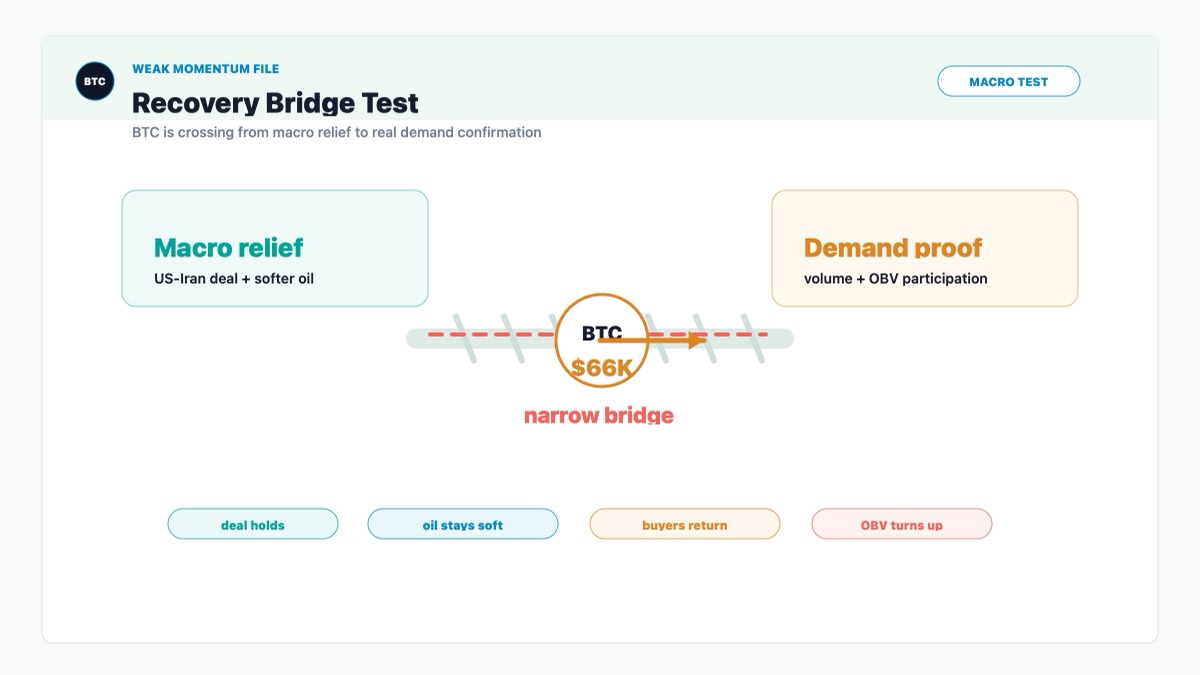
Until both improve, the recovery is still walking on a narrow bridge.
Historical Parallel
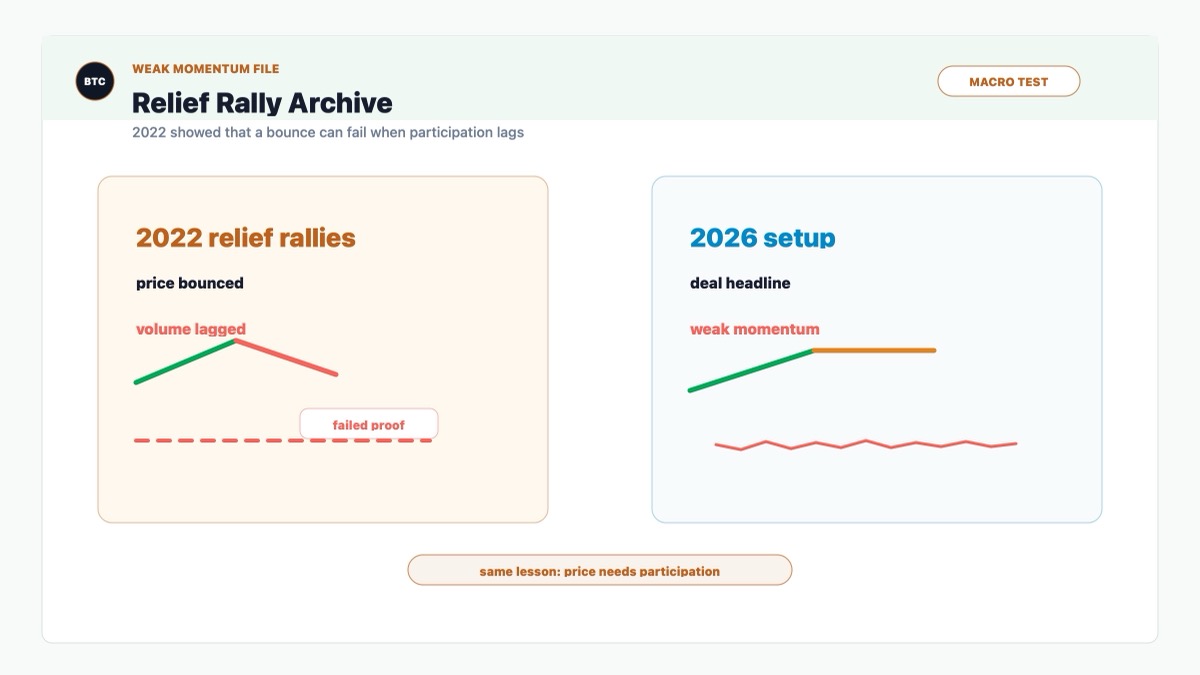
A useful historical parallel is Bitcoin's relief rallies during the 2022 bear market, especially after sharp macro-driven selloffs. There were several moments when BTC bounced hard after bad news cooled, yields paused or risk assets stabilized. Those moves looked encouraging on price alone because Bitcoin reclaimed nearby levels and forced short sellers to back off.
The problem was confirmation. Many of those rallies did not come with strong volume, broad participation or a clean shift in market structure. Price moved, but conviction lagged. When the macro backdrop turned negative again, or when crypto-specific stress returned, the rallies faded and Bitcoin retested lower zones.
The similarity to the current setup is the gap between relief and proof. Today, Bitcoin has a genuine macro reason to bounce: the US-Iran peace deal lowers immediate oil-shock risk and improves the risk-asset backdrop. That is real. But Swissblock's weak momentum and OBV readings suggest the market has not yet flipped into a healthier participation regime. In plain English, the bounce has a reason, but it still needs buyers.
The difference is that the current market has more institutional infrastructure than 2022. Spot Bitcoin ETFs, deeper derivatives markets and broader corporate treasury participation can change how quickly demand returns. That gives BTC a better support system than it had during the worst parts of the last bear cycle.
But support system is not the same thing as confirmation.
The lesson is simple: relief rallies can travel farther than skeptics expect, but they become durable only when participation follows price. Bitcoin has reclaimed ground.
Now it has to prove people actually want to stand there.
Bitcoin Price Reaction and K-Line Analysis
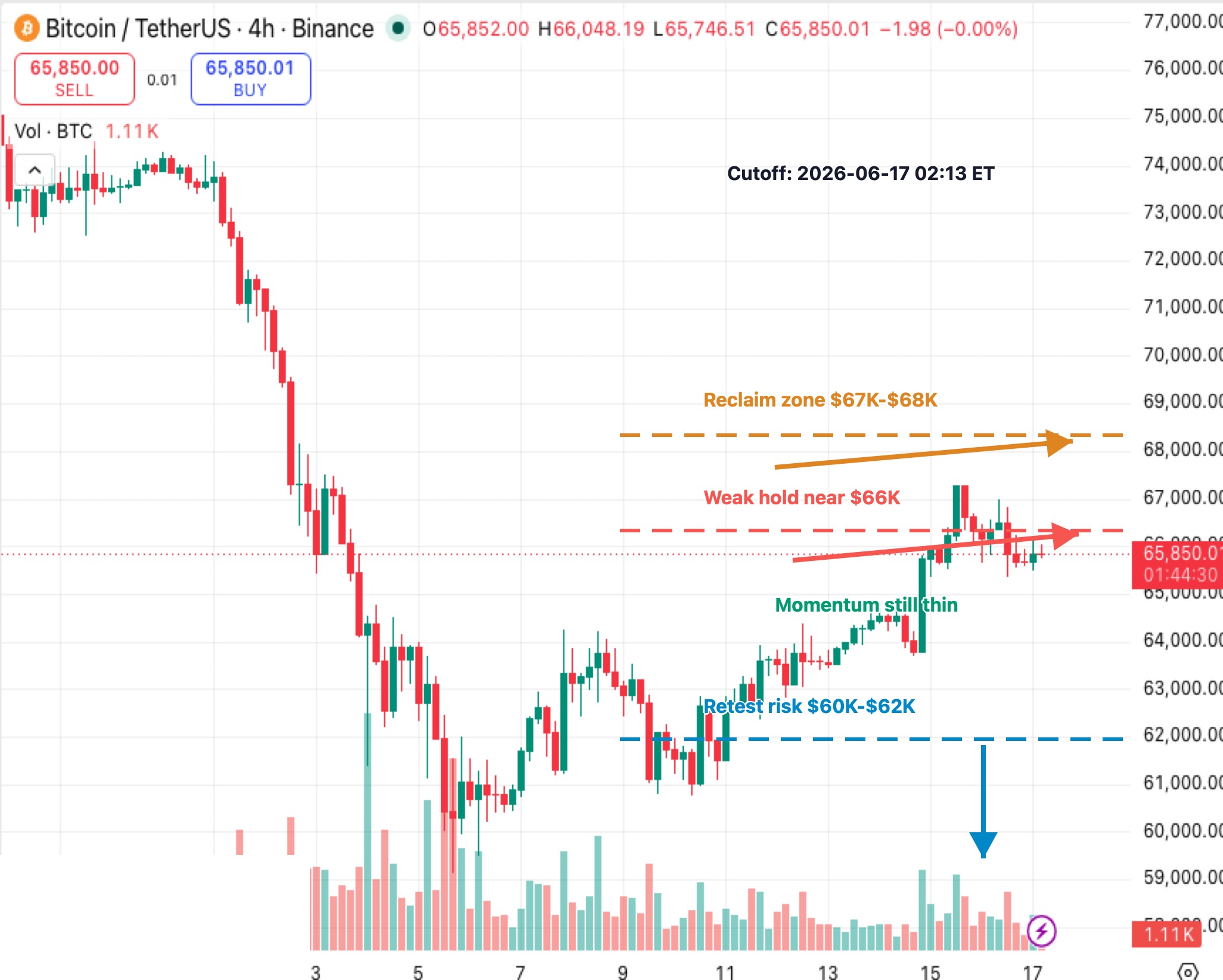
The BTCUSDT 4H chart shows the problem clearly.
Bitcoin fell hard from the mid-$70K area into the $60K region, then built a recovery back toward $67K. That recovery is meaningful. It shows sellers lost some control after the sub-$60K scare and that the US-Iran relief headline gave the market a reason to breathe.
But the rebound has not yet turned into a clean trend repair.
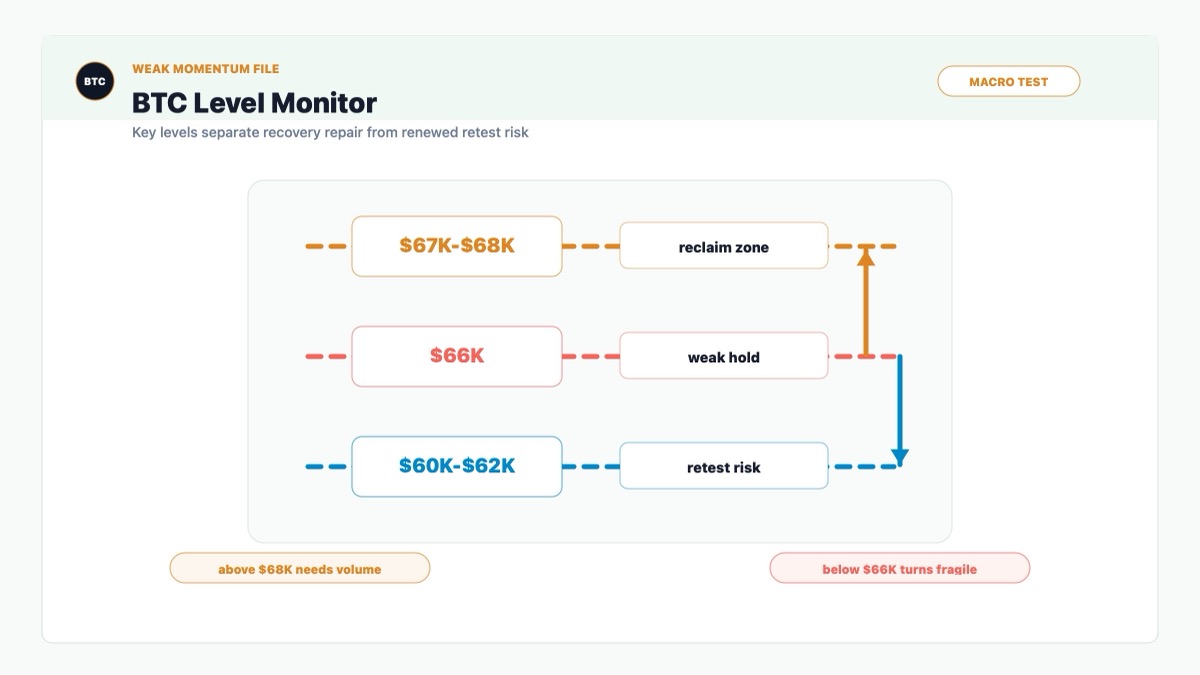
The $67K-$68K zone is the first major reclaim area. BTC pushed into that region, but the follow-through has been thin. Instead of accelerating higher, price slipped back toward $66K and began moving sideways. That matches the Swissblock read: the chart recovered, but participation did not fully confirm.
$66K is now the fragile hold area. If BTC can stabilize there and push back through $67K-$68K, the recovery starts to look more convincing. That would suggest buyers are willing to defend the rebound and challenge the prior breakdown zone.
The downside risk sits around $60K-$62K. That is the area traders will watch if the current hold fails. A move back into that zone would not just be a normal pullback. It would tell the market that the peace-deal bounce did not generate enough demand to keep BTC elevated.
This is the chart in one sentence:
Bitcoin bounced, but it has not yet earned the right to relax.
Key Levels to Watch
- $67K-$68K: The reclaim zone. BTC needs to break and hold this area to show real recovery strength.
- $66K: The current weak hold area. Losing it would make the rebound look less stable.
- $60K-$62K: The retest-risk zone if momentum fades again.
- Above $68K: Confirmation would improve if BTC reclaims this area with stronger volume and participation.
Conditional Forecast
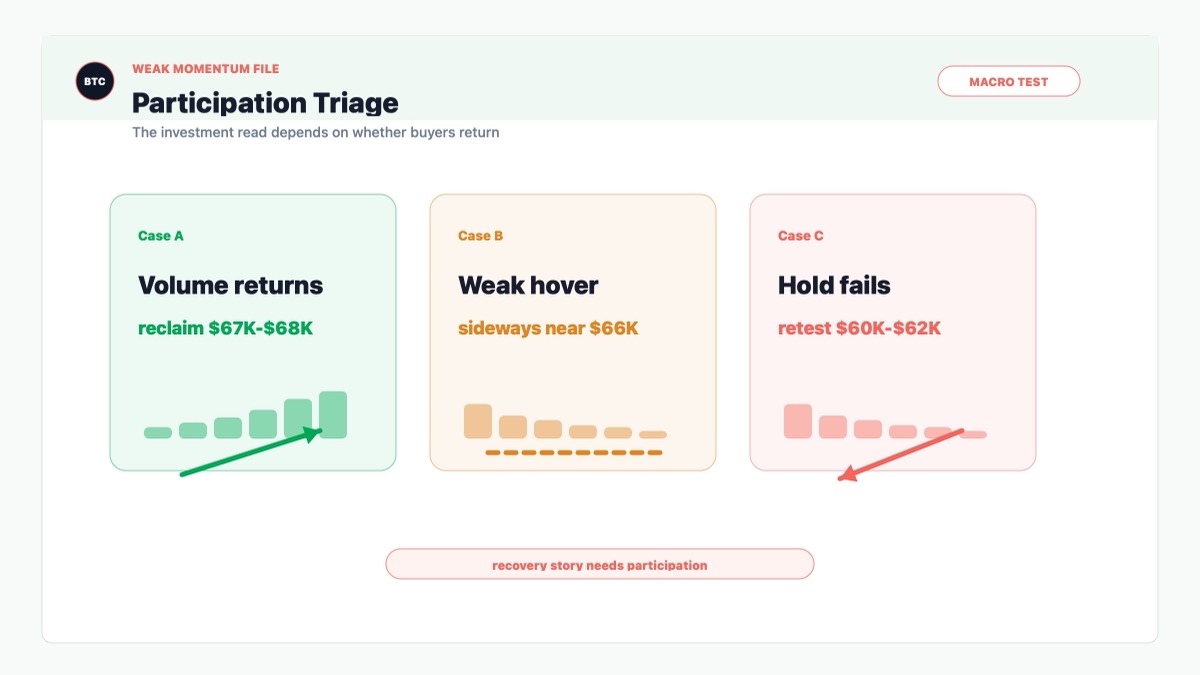
If BTC reclaims $67K-$68K with stronger volume, the recovery becomes more credible. That would suggest the US-Iran deal did more than trigger a short relief bounce.
If BTC keeps hovering around $66K without stronger participation, the market remains vulnerable. Sideways action can be healthy, but only if it gradually builds demand. If it just drains volume, it becomes a warning.
If BTC loses $66K and slips toward $60K-$62K, the weak-momentum argument gains force. Traders would likely treat the recovery as incomplete and look for evidence of whether the recent low can hold.
The geopolitical condition matters too. If the US-Iran deal holds and oil stays soft, Bitcoin gets a friendlier macro backdrop. If the deal breaks down, oil-shock fear can return quickly.
That is the uncomfortable setup.
Bitcoin is not only trading its chart.
It is trading the durability of the headline that helped rescue the chart.
Investment Takeaway
Bitcoin's recovery is real enough to respect.
It is not strong enough to trust blindly.
The peace-deal headline helped BTC reclaim important ground, but weak momentum and OBV say the market has not fully confirmed the move. That is the difference between "price recovered" and "buyers are back."
For investors, the practical read is simple: above $67K-$68K, Bitcoin starts to look healthier. Around $66K, it is still vulnerable. Below $60K-$62K, the market is back to asking whether the recent low was actually a low.
The recovery has a story.
Now it needs participation.
Sources
- Cointelegraph: Bitcoin recovery rests on US-Iran deal as momentum remains weak
- Cointelegraph: Can BTC rebound to $69K as oil price plunges? Five things to know in Bitcoin this week
- Associated Press: Iran nuclear and sanctions negotiations coverage
- Trading Economics: Brent crude oil price
- TradingView: BTCUSDT chart
|
DISCLAIMER:
1. All content on this website (including but not limited to articles, data, charts, and analyses) is for general informational purposes only and does not constitute any form of investment advice, trading recommendation, or financial guidance. 2. Cryptocurrencies and digital assets are subject to extreme price volatility and high investment risk; you may lose part or all of your principal. Past performance does not predict future results. 3. The information on this website is based on sources we believe to be reliable, but we do not guarantee its accuracy, completeness, or timeliness. Any investment decisions made based on this website’s information are at your own risk. 4. We strongly recommend that you conduct your own thorough research and consult an independent, licensed financial advisor before making any investment decisions. |
Recommended reading
Latest News

