
Key Takeaways
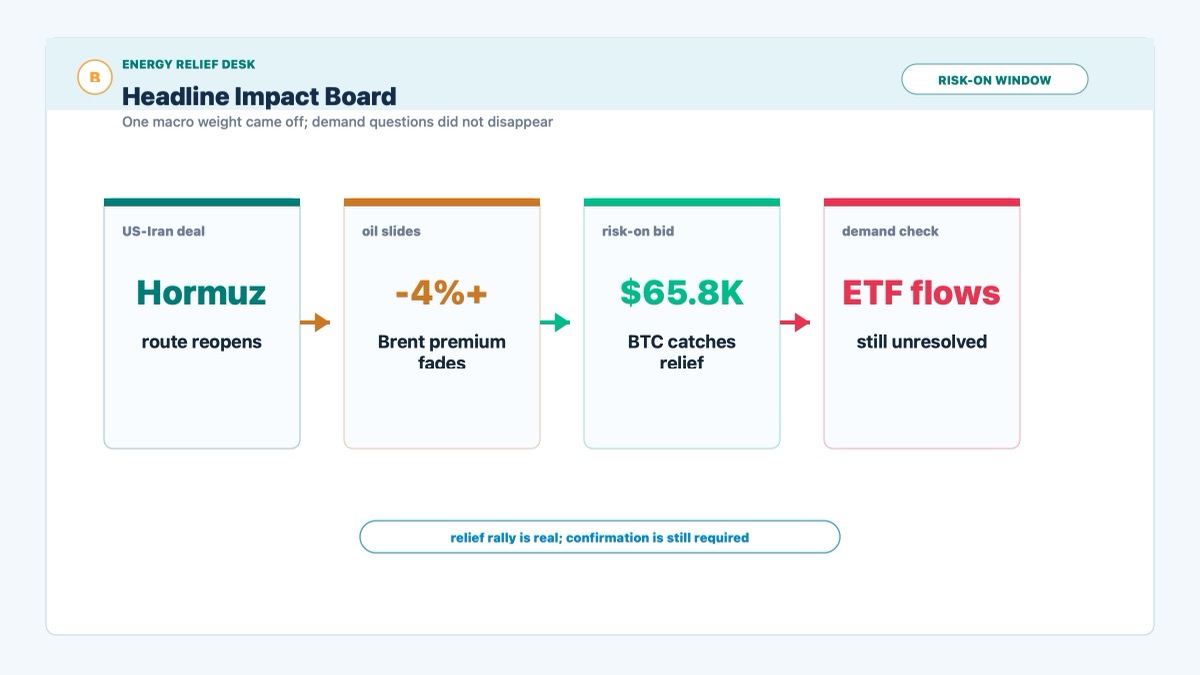
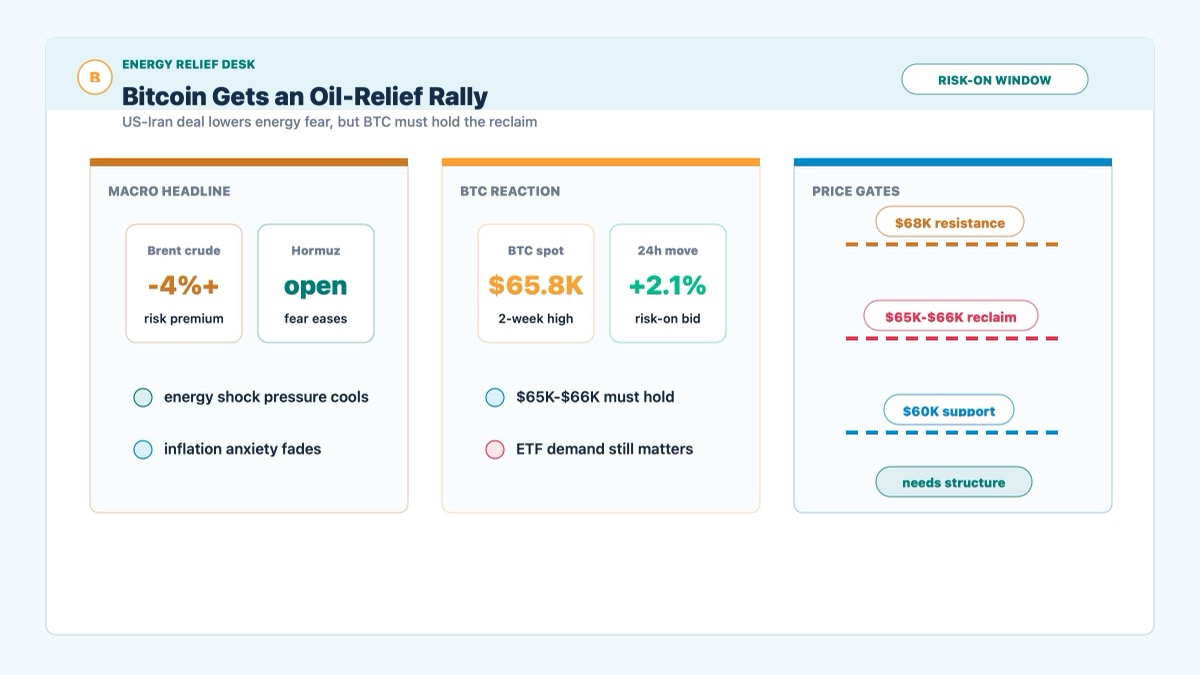
- Bitcoin rose about 2% to roughly $65,800 after a US-Iran deal eased energy-supply fears and sent Brent crude down more than 4%.
- The rally reflects a cleaner risk-on setup: lower oil reduces inflation anxiety, which can soften rate-pressure fears for crypto.
- BTC still needs to hold the $65K-$66K reclaim zone; ETF outflows and Strategy-related demand concerns have not disappeared.
What Happened
Bitcoin finally got a macro headline that did not arrive carrying a brick.
According to CoinDesk, BTC climbed to around $65,844 on Monday, up 2.1% over 24 hours, after the United States and Iran reached a deal to end hostilities and reopen the Strait of Hormuz. The move took Bitcoin to its highest level in nearly two weeks and about 9% above last week's sub-$60,000 low, its weakest level since October 2024.
The market reaction was not subtle. Brent crude fell more than 4% toward $83 a barrel as traders removed some of the geopolitical premium that had been sitting in oil since late February. Risk assets moved the other way. Ether rose 2.5%, Solana gained 3.6%, XRP added 3.2%, and HYPE jumped 7.5%. Asian stocks rallied, S&P 500 futures rose, and the dollar weakened.
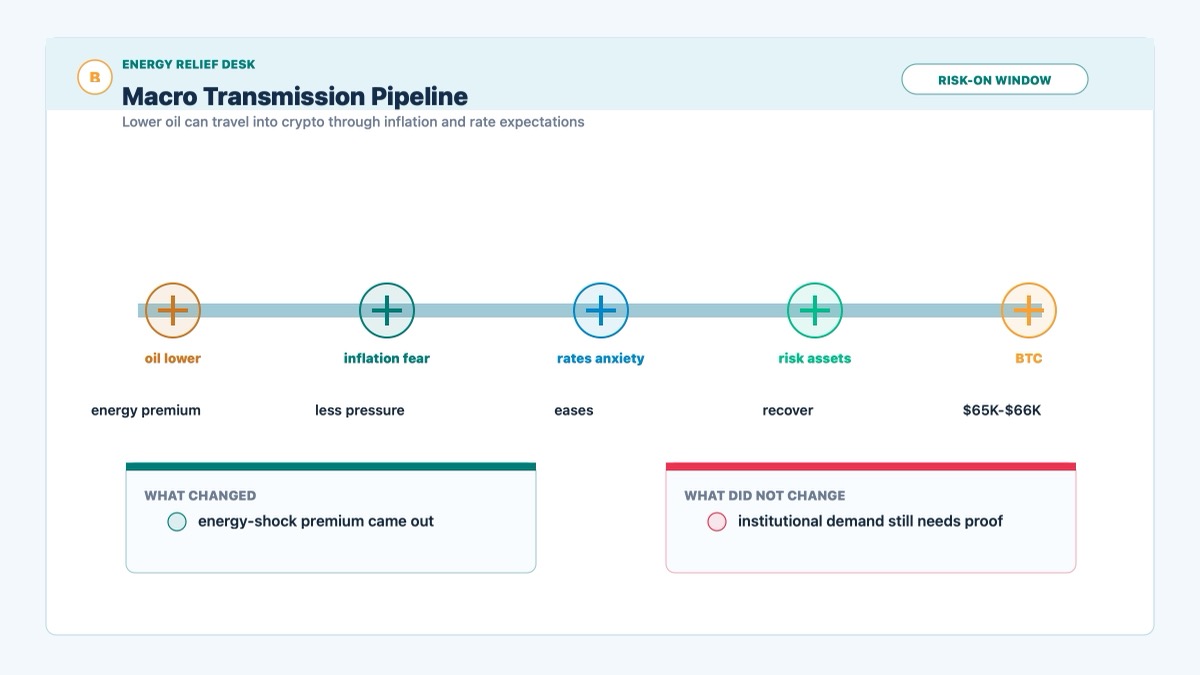
The mechanism is simple enough. If Hormuz reopens and oil falls, the market worries less about an energy shock. If the market worries less about an energy shock, it worries a little less about inflation. If inflation pressure looks less threatening, traders can breathe around rates. And when rate fear eases, crypto tends to notice.
That is the good news.
The less fun part is that not every problem gets solved by a peace headline. CoinDesk also noted that ETF outflows and Strategy's recent sale of 32 BTC to fund preferred share dividends remain pressure points. The deal may remove one macro weight. It does not automatically restore institutional demand.
So the move matters.
But it still needs confirmation.
Why This Matters for Bitcoin and Crypto Markets
Bitcoin is not oil. It does not run on barrels, tankers or shipping lanes.
But Bitcoin does run through the same risk pipeline as everything else when macro stress gets loud enough. Oil shocks can raise inflation expectations. Higher inflation expectations can push yields and rate expectations higher. Higher rates can pull money away from long-duration and speculative assets. Crypto, being crypto, tends to feel that quickly.
This is why the US-Iran deal mattered. It did not make Bitcoin fundamentally different overnight. It changed the pressure around Bitcoin.
Think of it like a room where everyone has been trading with one hand on the exit. Higher oil prices were making that room hotter. The Hormuz deal opened a window. People did not suddenly become fearless, but they stopped leaning quite so hard toward the door.
That is the risk-on part.
The institutional-demand part is a different machine. ETF flows and large balance-sheet buyers are not automatically fixed by lower oil. If ETF outflows continue, or if traders decide Strategy's tiny BTC sale is symbolically bigger than its actual size, the recovery can stall even with the geopolitical premium fading.
So the current market has two layers.
The first layer is macro relief: lower oil, weaker dollar, stronger stocks, stronger crypto. That supports the bounce.
The second layer is demand confirmation: do real buyers come back, or does Bitcoin just get a one-day relief trade?
That is why the $65K-$66K area matters. It is where the macro headline has to become price structure. If BTC holds there, the deal becomes part of a repair story. If it fails there, the market may decide it was only a fast exhale after a bad week.
Historical Parallel
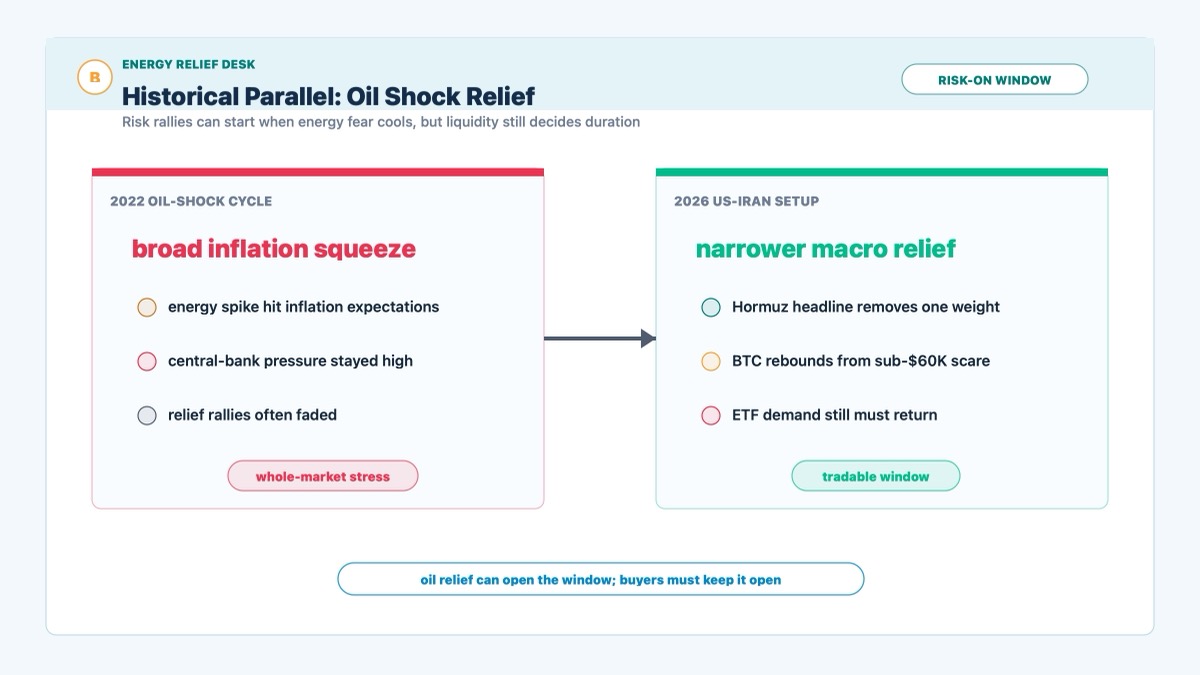
A useful historical parallel is the 2022 market reaction around major oil shocks and risk-asset relief rallies during the Russia-Ukraine war period. When energy prices spiked, markets quickly translated that into inflation fear, central-bank pressure and weaker risk appetite. When oil cooled after supply fears eased or policy responses appeared, risk assets often bounced because one of the main inflation inputs looked less threatening.
The similarity to the current US-Iran setup is the transmission chain. Bitcoin does not need to be directly linked to oil for oil to matter. The chain is indirect but powerful: energy shock, inflation fear, rate pressure, liquidity stress, risk-asset weakness. When that chain reverses, Bitcoin can rebound even if nothing onchain has changed.
That is what appears to be happening now. The Hormuz reopening story pulled Brent crude lower, which reduced the immediate fear of an energy-supply shock. Bitcoin, sitting in a damaged but oversold structure after dropping below $60,000, had room to bounce once that macro pressure eased.
The difference is that the 2022 environment was a broad inflation and tightening cycle. Crypto was also dealing with internal leverage, lender failures and a collapse in trust across the industry. Today's setup is narrower. The oil relief is real, but the crypto-specific issues are more about institutional demand, ETF flows and whether large BTC holders remain reliable buyers.
The lesson is that oil relief can create a tradable risk-on window, but it does not automatically create a durable Bitcoin bottom. In 2022, some relief rallies faded because the deeper liquidity and credit problems were still there. Today, BTC has to prove that the drop below $60K was exhaustion, not the start of another leg lower.
Macro removed a weight.
The chart still has to lift itself.
Bitcoin Price Reaction and K-Line Analysis
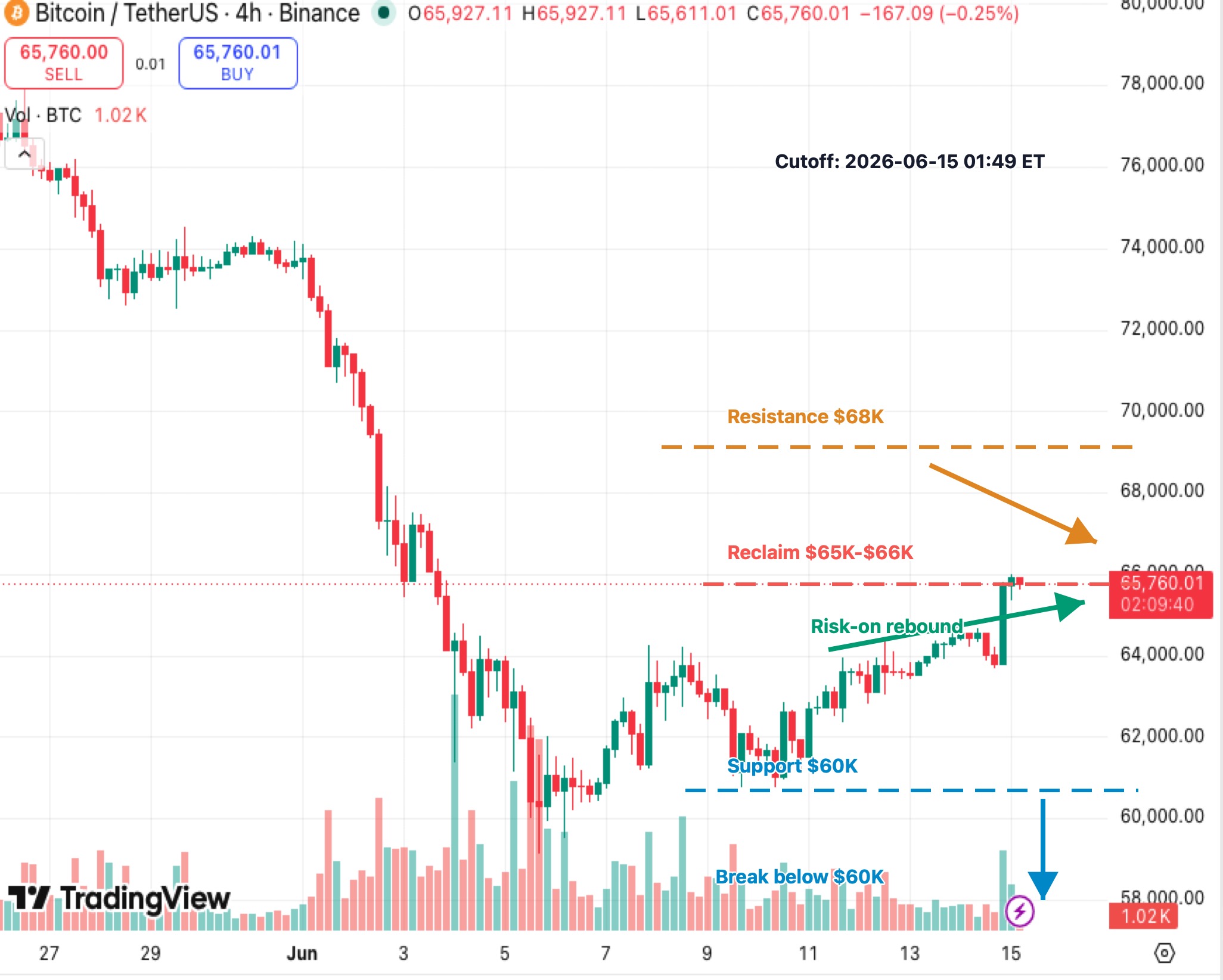
The BTCUSDT 4H chart shows a clean relief rebound from a damaged base.
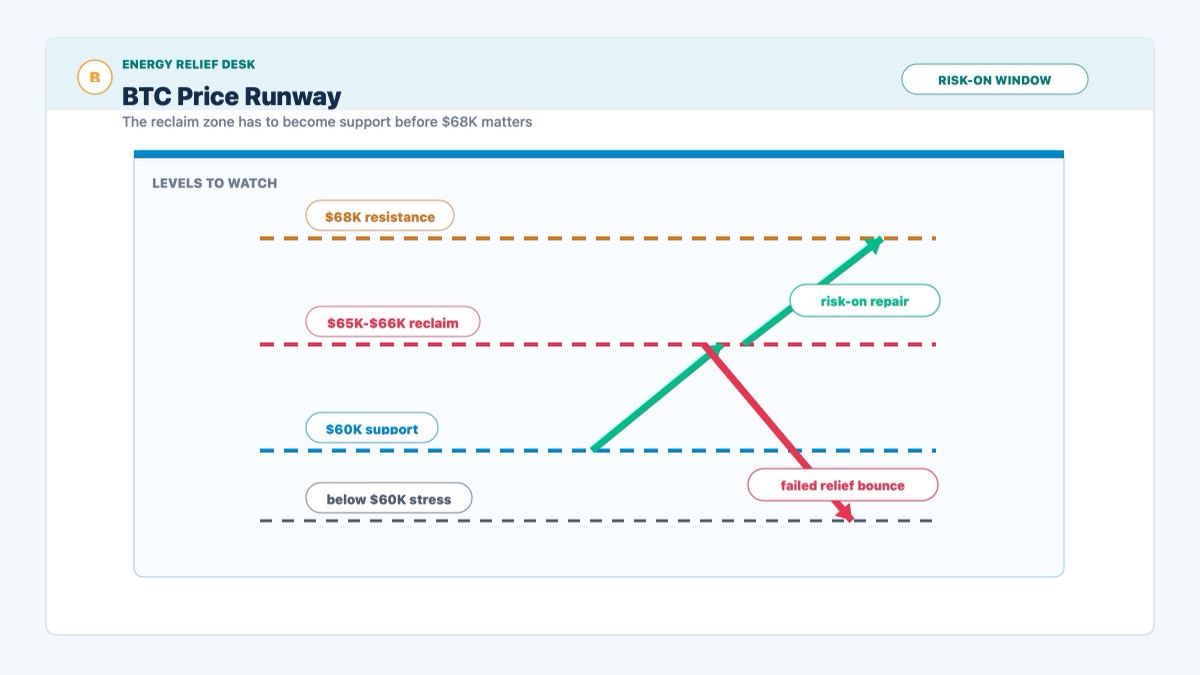
Bitcoin fell hard from the upper $70K zone into the $60K area, then built a recovery that accelerated into the $65K-$66K reclaim zone after the oil-risk headline improved. That is a meaningful move because $65K-$66K is no longer just a random price band. It is the first place where the bounce has to prove it is more than a reaction.
If BTC can hold above that area, the recovery starts looking healthier. It would suggest buyers are not merely responding to one headline, but are willing to defend a higher base after the sub-$60K scare.
The next upside level is around $68K. That is where resistance and prior supply can become more important. A move into that zone would show that the market is beginning to repair the breakdown, not just retrace it.
The downside remains clear. $60K is the line that keeps the larger structure from becoming ugly again. If BTC falls back below $60K, the oil-relief story loses a lot of force. The market would then shift from "risk-on rebound" back to "failed recovery."
That is the entire chart in one sentence: the headline helped, but $65K-$66K has to hold.
Key Levels to Watch
- $65K-$66K: The key reclaim zone. BTC needs to hold this area to confirm the risk-on rebound.
- $68K: The next resistance level, where sellers may test the strength of the recovery.
- $60K: The major support zone. Holding it keeps the rebound structure alive.
- Below $60K: The danger zone. A breakdown would invalidate much of the relief-bounce argument.
Conditional Forecast
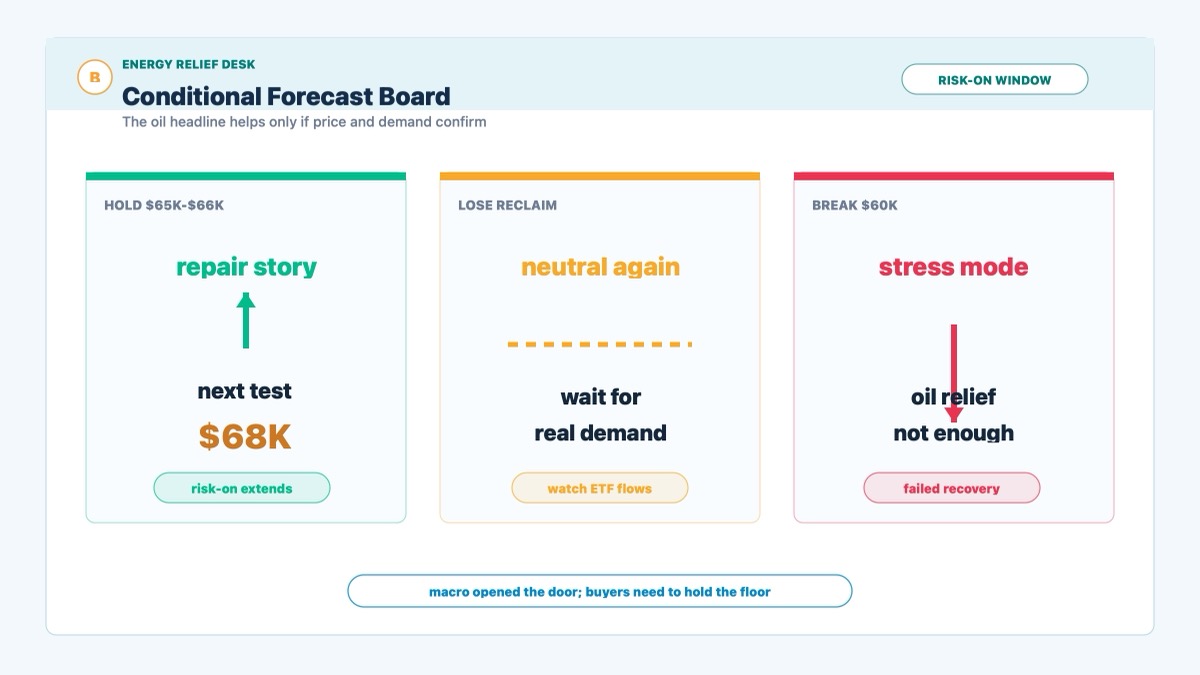
If BTC holds $65K-$66K, the next logical upside test is $68K. That would suggest the market is treating lower oil and reduced geopolitical stress as more than a one-day headline.
If BTC loses $65K-$66K but stays above $60K, the setup becomes neutral again. The rally would still matter, but traders would likely wait for evidence that institutional demand is improving.
If BTC breaks below $60K, the structure weakens quickly. In that case, the market would likely conclude that oil relief was not enough to offset ETF outflows, Strategy-related concerns and broader demand hesitation.
Investment Takeaway
The US-Iran deal gave Bitcoin a cleaner macro backdrop. That matters.
Lower oil reduces one of the pressures that had been feeding inflation fear and rate anxiety. It gives risk assets room to breathe. It explains why BTC could pop above $65,500 so quickly.
But a breath is not the same thing as a new trend.
For investors, the practical read is simple: above $66K, Bitcoin starts to look repaired. Near $68K, the recovery becomes more convincing. Below $60K, the market is back in stress mode.
The peace headline opened the door.
Now buyers have to walk through it.
Sources
- CoinDesk: Bitcoin hits a two-week high above $65,500 as the US-Iran deal sends oil sliding
- Trading Economics: Brent crude oil price
- The Straits Times: Oil falls over 4% as US-Iran peace deal paves way for reopening of Hormuz
- Business Insider: Global stocks surge and oil slumps on US-Iran deal to open the Strait of Hormuz
- TradingView: BTCUSDT chart
|
DISCLAIMER:
1. All content on this website (including but not limited to articles, data, charts, and analyses) is for general informational purposes only and does not constitute any form of investment advice, trading recommendation, or financial guidance. 2. Cryptocurrencies and digital assets are subject to extreme price volatility and high investment risk; you may lose part or all of your principal. Past performance does not predict future results. 3. The information on this website is based on sources we believe to be reliable, but we do not guarantee its accuracy, completeness, or timeliness. Any investment decisions made based on this website’s information are at your own risk. 4. We strongly recommend that you conduct your own thorough research and consult an independent, licensed financial advisor before making any investment decisions. |
Recommended reading
Latest News