
Key Takeaways
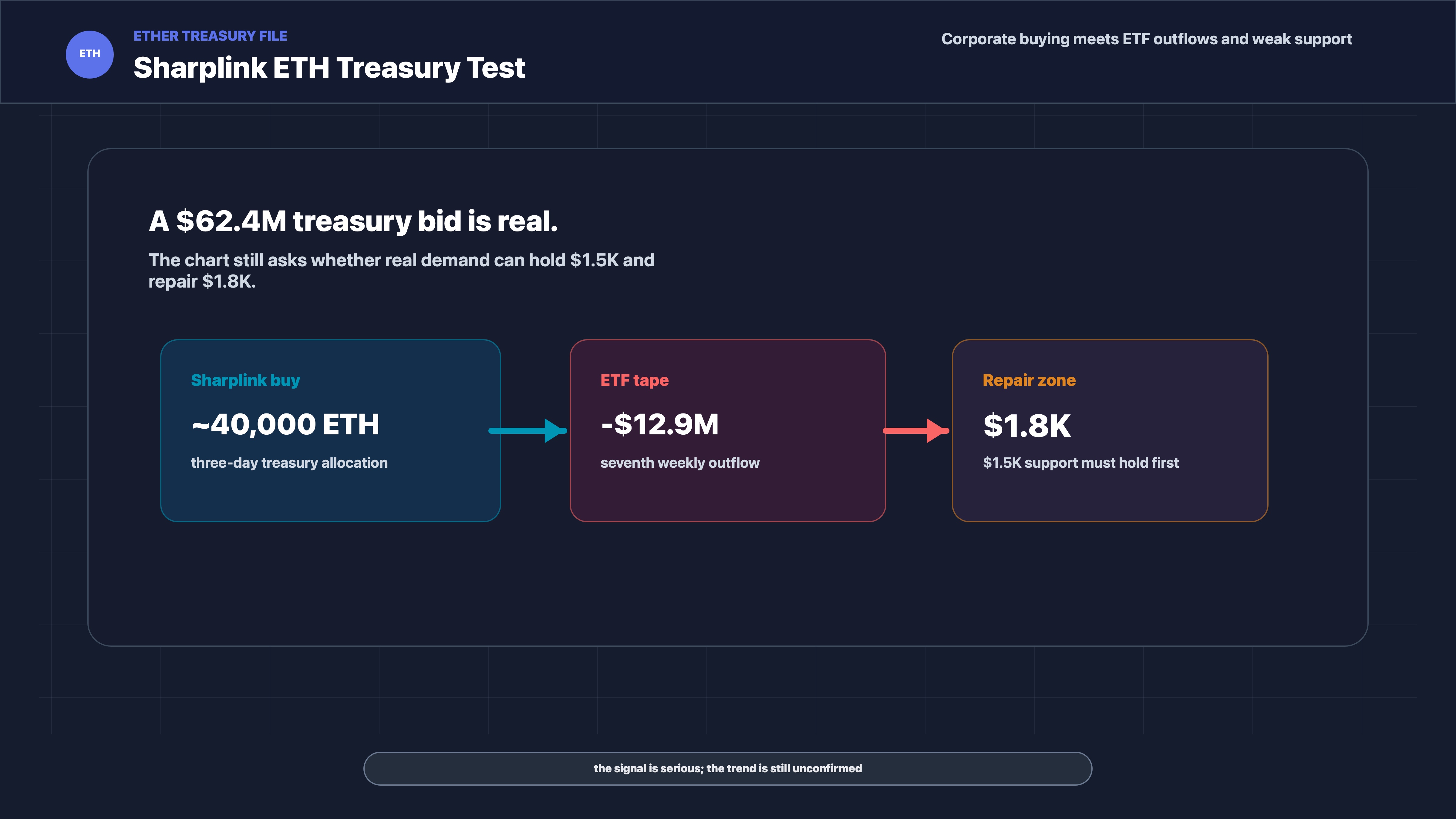
- Sharplink bought nearly 40,000 ETH worth $62.4 million after an eight-month pause in its Ether accumulation strategy.
- The purchases came as Sharplink, Bitmine, Joe Lubin and other Ethereum contributors backed Ethlabs, a nonprofit focused on institutional Ethereum adoption.
- Ether remains under pressure, down 22.8% month-on-month and nearly 50% from the start of the year, while US spot Ether ETFs saw a seventh straight week of outflows.
- The ETH chart needs a $1.8K reclaim to make the treasury-buying story look like more than a defensive bid near $1.5K support.
What Happened
Sharplink bought Ether again.
That is the simple version, and it is useful as far as it goes. But with Ethereum right now, the simple version does not go very far. A treasury company buying ETH sounds bullish. A treasury company buying ETH while ETH is down 22.8% for the month, nearly 50% from the start of the year, and spot Ether ETFs are still bleeding money is a stranger object.
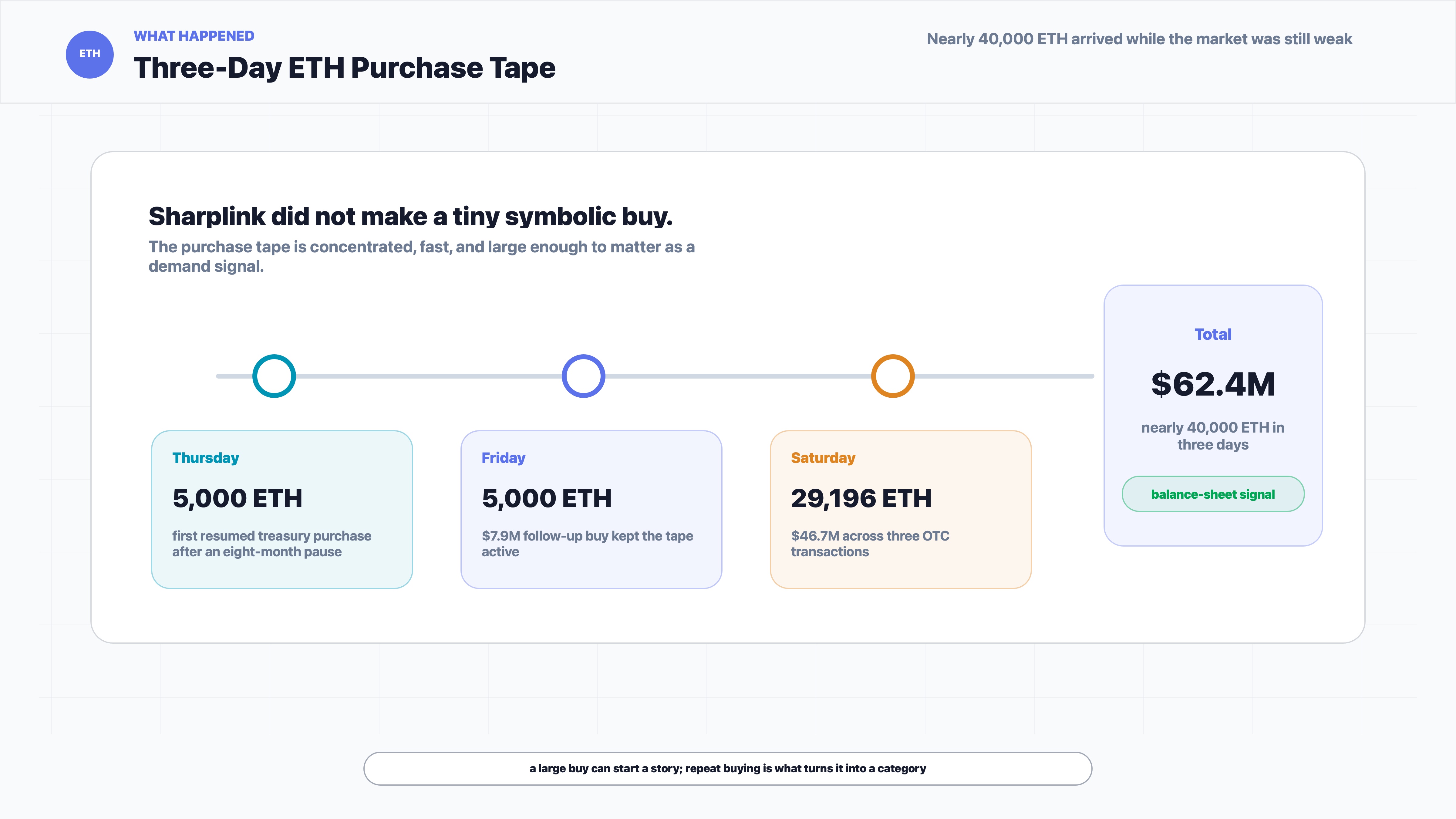
According to Cointelegraph, Sharplink bought a total of $62.4 million worth of Ether since Thursday after an eight-month pause. The company bought 5,000 ETH on Thursday, another 5,000 ETH worth $7.9 million on Friday, and 29,196 ETH worth $46.7 million across three over-the-counter transactions on Saturday, citing onchain data from Arkham.
That adds up to nearly 40,000 ETH in three days.
Sharplink declined to comment on the reason and timing of the purchase when Cointelegraph first contacted the company. That silence matters a little. In crypto, the market rarely waits for an official explanation when it can invent four unofficial ones before breakfast.
The purchases also came in the same week that Sharplink and Bitmine backed Ethlabs, a research and development nonprofit meant to make Ethereum more ready for institutional use. Sharplink said Ethlabs was formed to prepare Ethereum for the next phase of institutional adoption, with Ethereum co-founder and Sharplink chairman Joe Lubin and other contributors backing the initiative.
So there are two stories here. One is financial: Sharplink is adding ETH to its balance sheet. The other is institutional: Sharplink is helping fund the plumbing that would make more serious Ethereum usage possible.
The problem is that ETH price is not politely matching the story yet.
Why This Matters for Bitcoin and Crypto Markets
This is not only an Ethereum story. It is a test of whether crypto treasury buying can become a real demand category outside Bitcoin.
Bitcoin already has a familiar version of this trade. A public company buys BTC, investors treat the company as a partial proxy for bitcoin exposure, and the company becomes both an operating business and a market narrative. The mechanics can get complicated, but the idea is easy to draw: balance sheet turns into crypto exposure, crypto exposure turns into equity story, equity story can help fund more crypto exposure.
Ethereum has always had a harder version of that story.
Bitcoin is easier to explain as a treasury asset because its pitch is narrow: scarce monetary asset, no operating committee, no yield promise, no complicated application layer required. Ethereum is broader. It is settlement layer, smart contract platform, stablecoin rail, tokenized asset venue, DeFi base, and now maybe the preferred substrate for institutional onchain finance. That breadth is powerful, but it also creates a marketing problem. When something is everything, investors sometimes ask the annoying but necessary question: which part is doing the work?
Sharplink is trying to answer that by combining two moves: buy the asset and fund the infrastructure story around the asset.
That is rational. It does not make the chart healthy.
The Cointelegraph article points to the uncomfortable counterweight: Ether is down sharply, Tether's USDt briefly surpassed Ether in market capitalization last week, and US spot Ether ETFs recorded $12.9 million in net outflows for their seventh straight week of outflows, led mainly by withdrawals from BlackRock's iShares Ethereum Trust.
That is the fight. Sharplink is behaving like ETH is a long-term treasury asset. ETF flows are behaving like investors are still not convinced. The chart is behaving like it would like everyone to stop giving speeches and show actual demand.
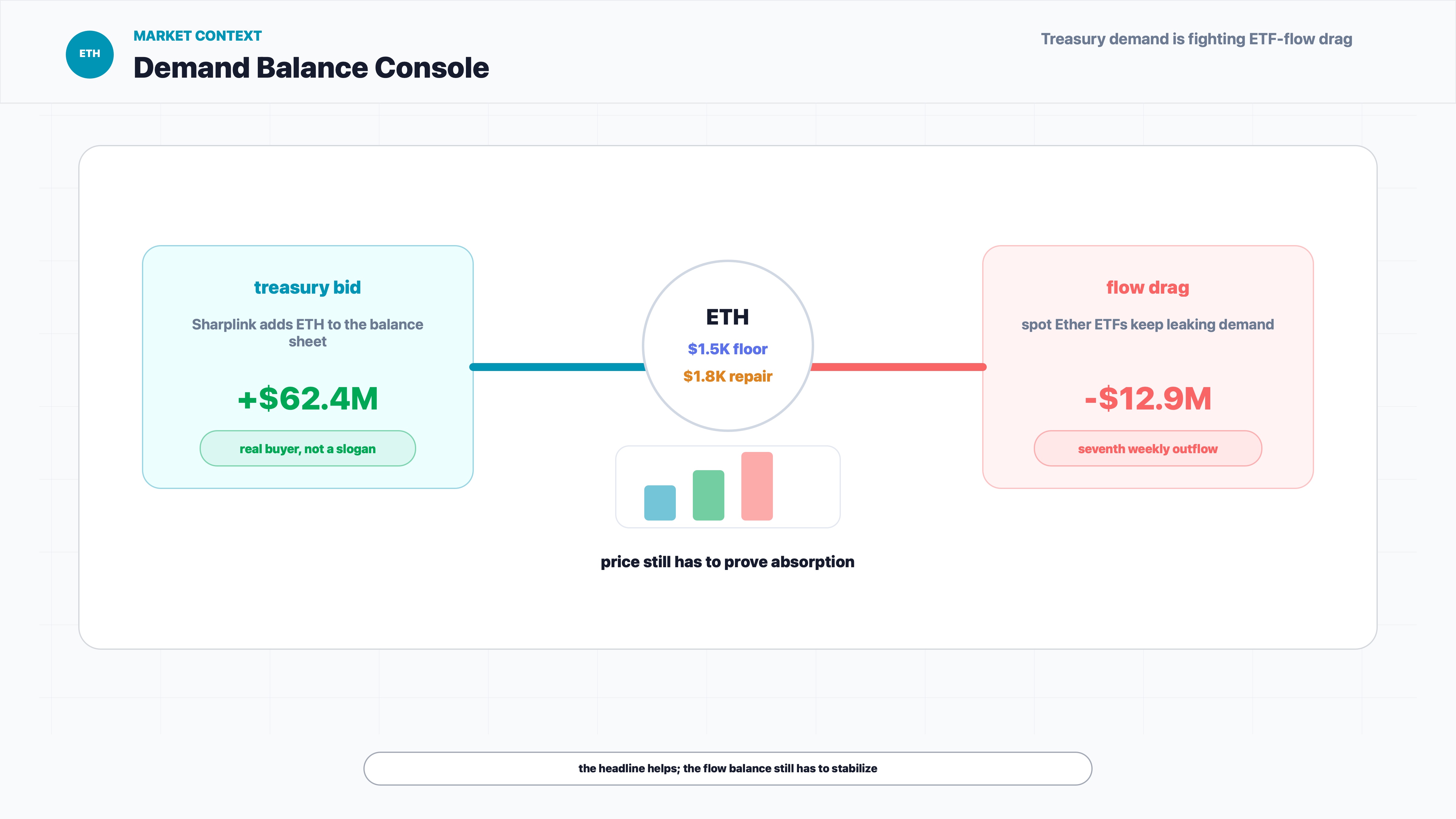
For the broader crypto market, the implication is simple. If ETH treasury buying becomes repeatable, it gives Ethereum a new balance-sheet buyer class. If it stays isolated, it is just one corporate actor catching a falling asset and hoping it is catching, not juggling.
Historical Parallel
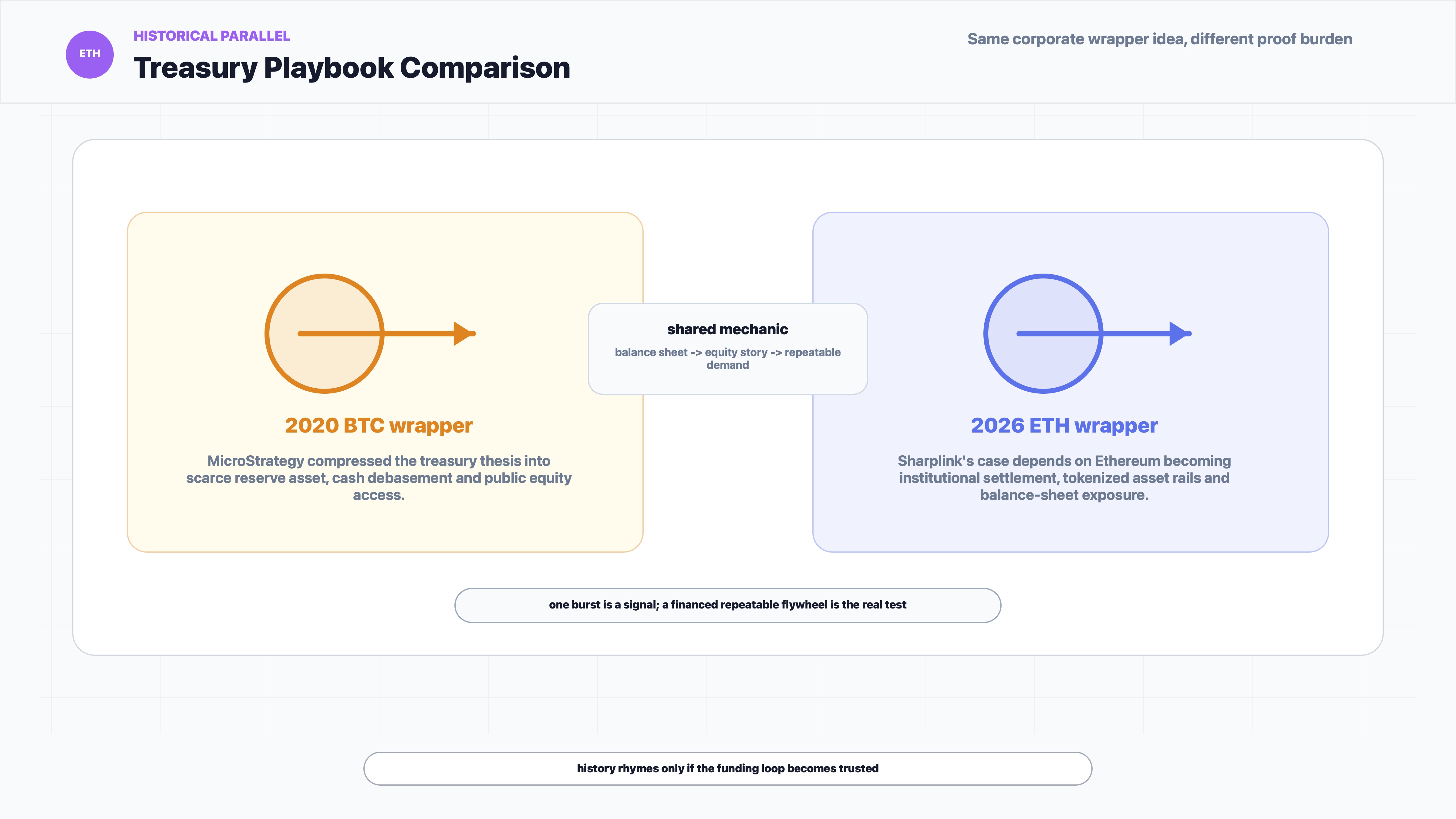
The obvious historical parallel is MicroStrategy's move into Bitcoin in 2020. In August 2020, MicroStrategy announced that it had adopted bitcoin as its primary treasury reserve asset. That was not just a purchase. It was a new corporate wrapper around a crypto thesis: instead of buying bitcoin directly, public-market investors could buy a company that had made bitcoin central to its balance-sheet identity.
The similarity is structural. Sharplink's ETH purchases are not merely a trade if they become part of a repeatable treasury strategy. They turn Ether from a token on an exchange into a corporate capital allocation decision. That changes the audience. Traders care about the candle. Treasury companies care about reserve policy, financing, disclosure, investor appetite and whether the market rewards the strategy with a higher equity valuation. Different room, different furniture.
But the differences are large. MicroStrategy's Bitcoin thesis was easier to compress: cash was losing purchasing power, bitcoin was scarce, and the company wanted a harder reserve asset. Sharplink's Ethereum thesis has more moving parts. It depends on Ethereum becoming the settlement layer for stablecoins, tokenized assets, funds and institutional onchain activity. That may be a bigger market, but it is also a more complex proof burden.
The market backdrop is different too. Sharplink is buying while ETH is weak, ETFs are seeing outflows, and the chart is still under trend pressure. That makes the purchase more interesting, but not automatically more bullish. Buying weakness can be conviction. It can also be early.
The lesson from MicroStrategy is not "corporate buying makes number go up." The lesson is narrower: corporate treasury demand matters when it becomes repeated, financed, legible and trusted by equity investors. One burst of ETH buying is a signal. A sustained treasury flywheel would be a different story.
Ethereum Price Reaction and K-Line Analysis
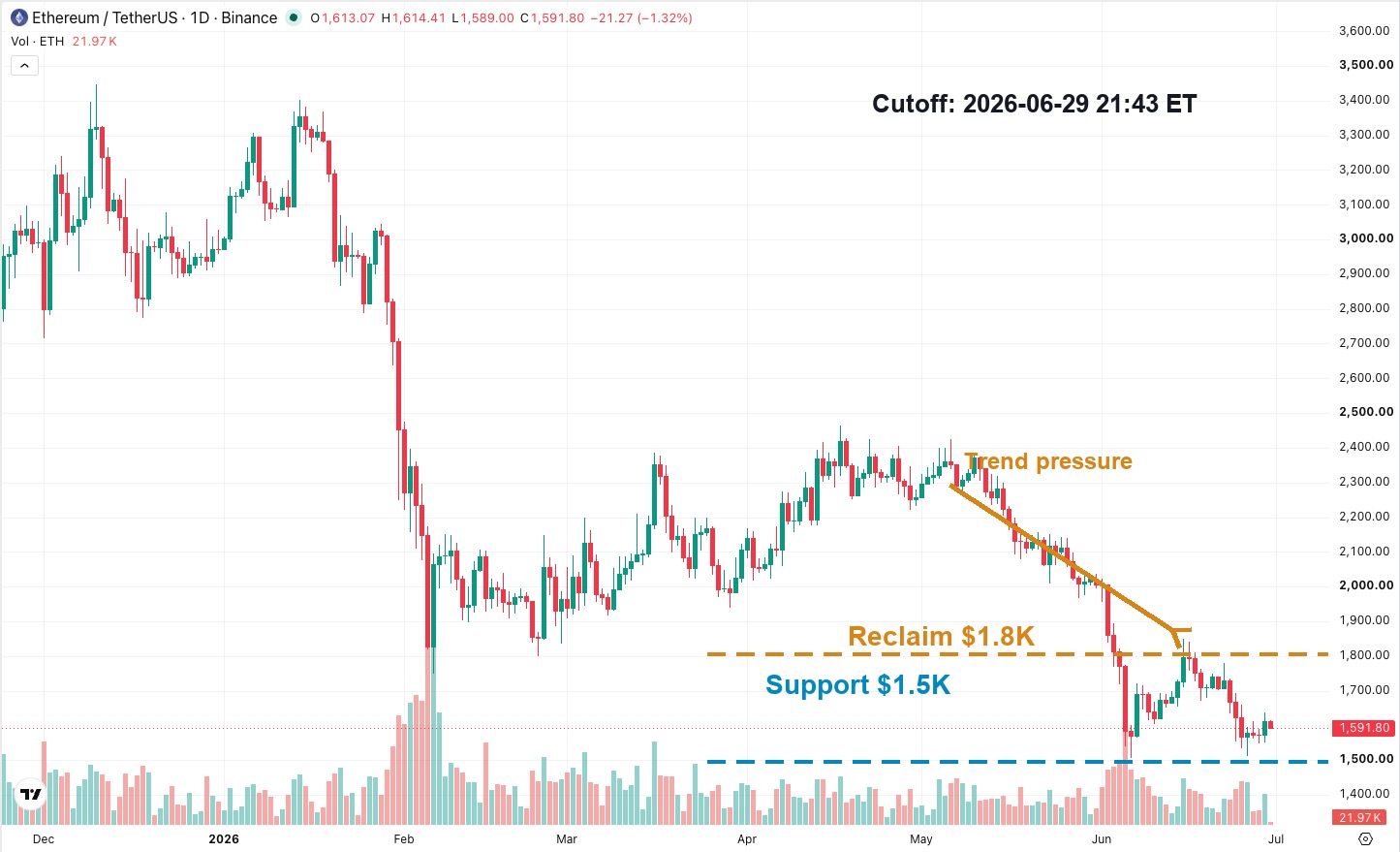
The ETHUSDT daily chart gives the news a useful reality check.
Sharplink's buying is a demand signal, but the chart is still under pressure. ETH has been moving lower since May, with the June breakdown pushing price into the $1.5K-$1.6K area. That is why the chart annotation focuses on two levels rather than five decorative lines pretending to be insight.
The first level is $1.5K. This is the support area the market is currently testing. If ETH can hold above it, Sharplink's purchase can be read as part of a broader attempt to absorb supply after a heavy drawdown. It would not prove a trend reversal. It would at least prove that the floor did not immediately collapse under the headline.
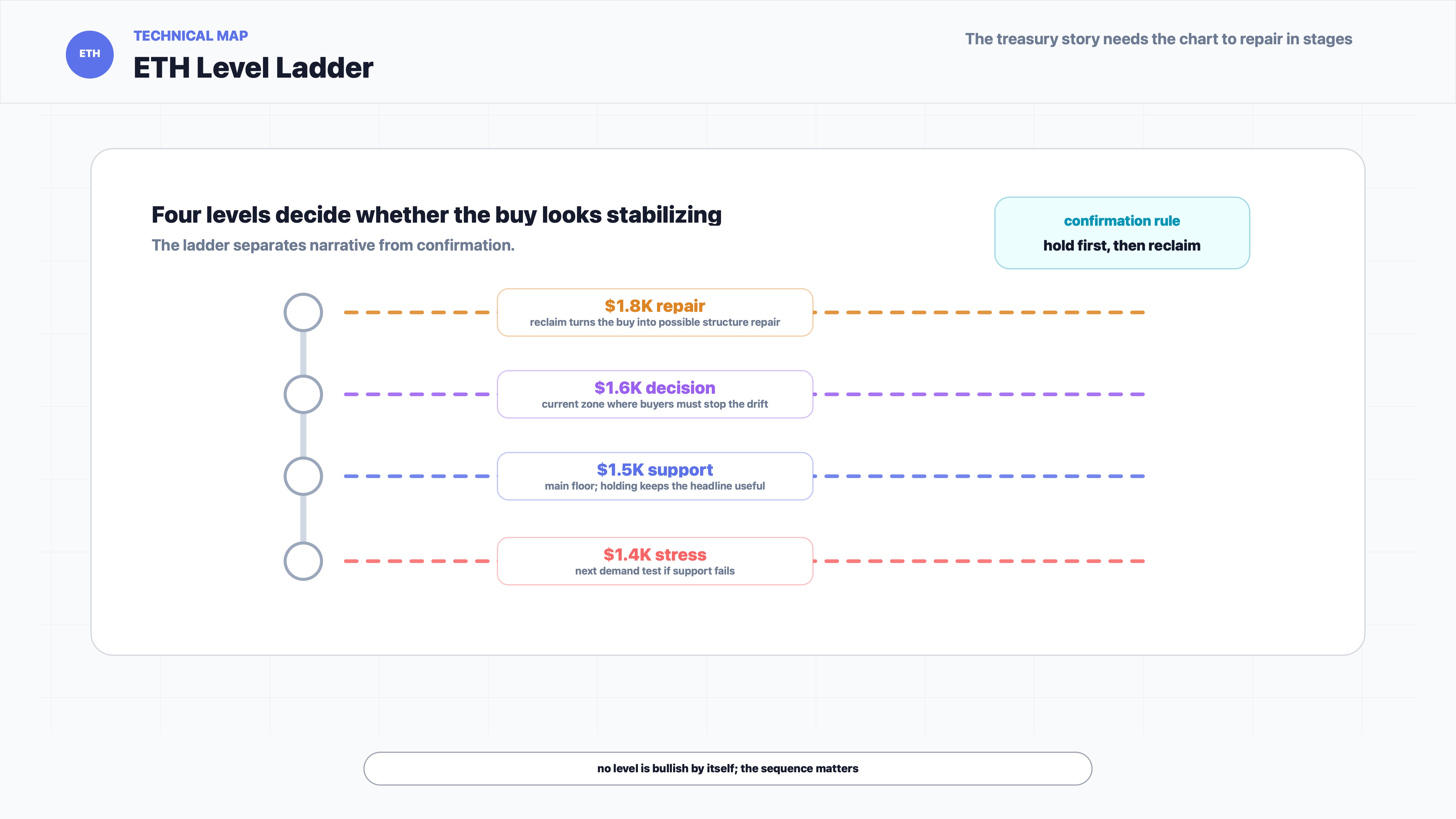
The second level is $1.8K. That is the repair level. ETH needs to reclaim it before the treasury-buying story starts to look technically persuasive. Below $1.8K, rallies still look like reactions inside a downtrend. Above $1.8K, the market can begin asking whether buyers are strong enough to rebuild structure.
The arrow on the chart shows the problem: trend pressure has been doing the work. May's lower highs rolled into June's breakdown, and the late-June bounce has not yet changed that larger pattern.
So the chart is not rejecting the Sharplink story. It is just refusing to confirm it cheaply.
Key Levels to Watch
- $1.8K: The first repair level. ETH needs to reclaim this area before the buying story can look like trend repair.
- $1.6K: The current decision zone. Holding near this area keeps the market from immediately retesting support.
- $1.5K: The main support level. A clean break would make the Sharplink purchase look early rather than stabilizing.
- $1.4K: The next stress zone if $1.5K fails and ETF outflows continue to weigh on sentiment.
Conditional Forecast
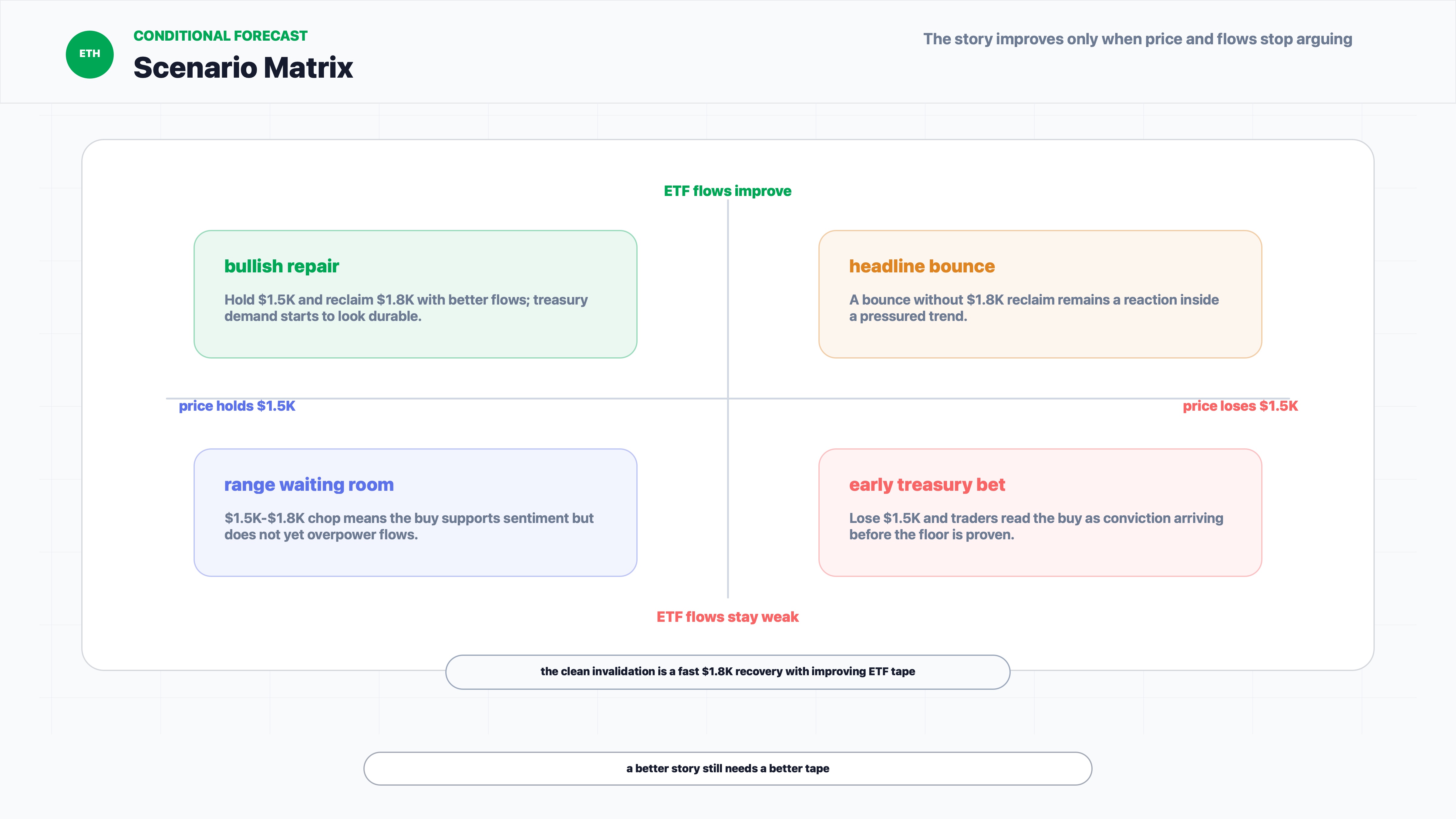
Bullish scenario: If ETH holds $1.5K and reclaims $1.8K, the market can start treating Sharplink's purchase as more than opportunistic buying. The stronger interpretation would be that treasury demand is arriving while price is distressed, and that the institutional Ethereum thesis still has buyers willing to act before the chart looks comfortable.
Neutral scenario: If ETH stays between $1.5K and $1.8K, the news is supportive but not decisive. That would mean Sharplink is absorbing some ETH, but not enough to overpower ETF outflows, weak sentiment and the existing downtrend. The market would still be waiting for proof.
Bearish scenario: If ETH loses $1.5K, the purchase becomes a weaker signal. In that case, traders may read it as a balance-sheet bet made into a falling market rather than the start of a durable institutional bid. The next area to watch would be around $1.4K.
Invalidation for the bearish reading would be a quick recovery above $1.8K with improving ETF flows. Without that, ETH remains in the awkward zone where the story is better than the chart.
Investment Takeaway
Sharplink's purchase is not meaningless. A company does not buy nearly 40,000 ETH in three days by accident.
But the cleaner investment read is conditional: treasury buying matters if it becomes repeated demand, not if it only creates a headline. ETH needs more than a buyer. It needs a structure where treasury demand, ETF flows and price action stop contradicting each other.
Right now, the story says institutional conviction. The chart says support test. ETF flows say hesitation.
That is not a contradiction to ignore. It is the whole point. ETH is trying to prove that its institutional adoption narrative can survive a market that is still pricing it like a damaged asset. Until $1.8K is reclaimed, Sharplink's buy is best treated as a serious signal inside an unconfirmed trend, not as proof that the hard part is over.
Sources
- Cointelegraph: Ether treasury Sharplink bought $62.4M ETH last week (https://cointelegraph.com/news/ether-treasury-sharplink-buys-624m-of-eth-in-3-days)
- GlobeNewswire: Ethlabs founded by former Ethereum Foundation contributors and funded by Bitmine, Sharplink and Joe Lubin (https://www.globenewswire.com/news-release/2026/06/22/3315546/0/en/ethlabs-founded-by-former-ethereum-foundation-contributors-and-funded-by-bitmine-sharplink-and-joe-lubin-launches-to-accelerate-ethereum-s-institutional-supercycle.html)
- TradingView: ETHUSDT daily chart (https://www.tradingview.com/chart/?symbol=BINANCE%3AETHUSDT&interval=D)
- SEC Exhibit 99.1: MicroStrategy August 2020 Bitcoin treasury announcement (https://www.sec.gov/Archives/edgar/data/1050446/000119312520215604/d921849dex991.htm)
|
DISCLAIMER:
1. All content on this website (including but not limited to articles, data, charts, and analyses) is for general informational purposes only and does not constitute any form of investment advice, trading recommendation, or financial guidance. 2. Cryptocurrencies and digital assets are subject to extreme price volatility and high investment risk; you may lose part or all of your principal. Past performance does not predict future results. 3. The information on this website is based on sources we believe to be reliable, but we do not guarantee its accuracy, completeness, or timeliness. Any investment decisions made based on this website’s information are at your own risk. 4. We strongly recommend that you conduct your own thorough research and consult an independent, licensed financial advisor before making any investment decisions. |
Recommended reading
Latest News