
Key Takeaways
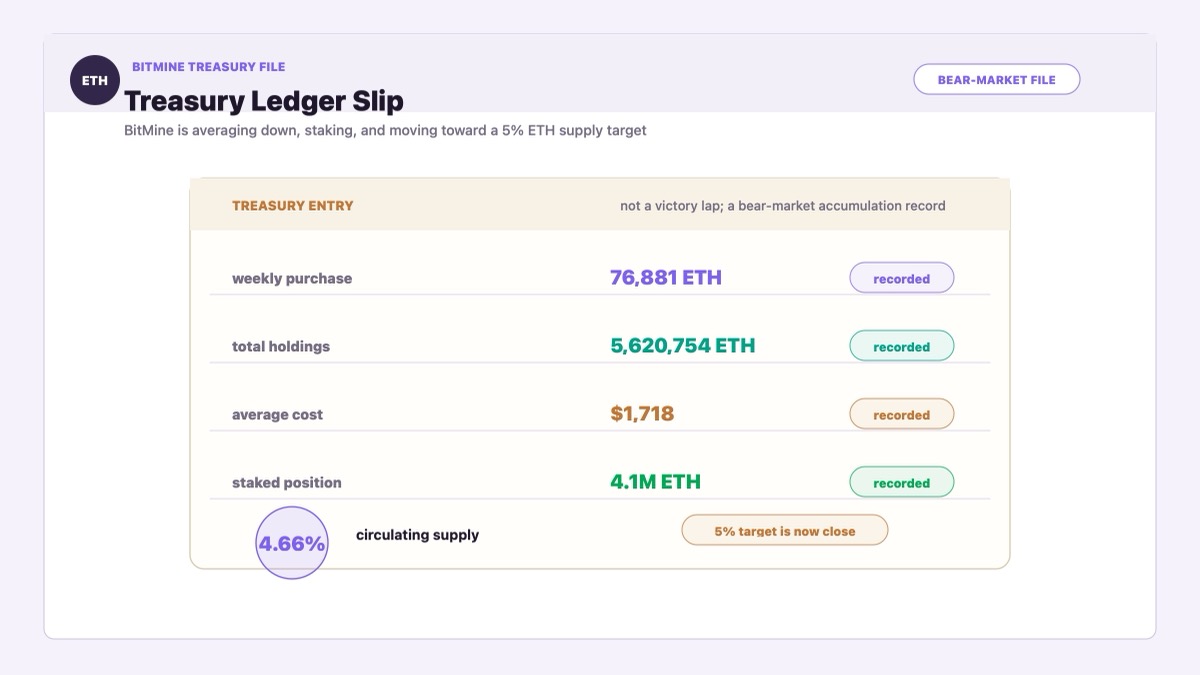
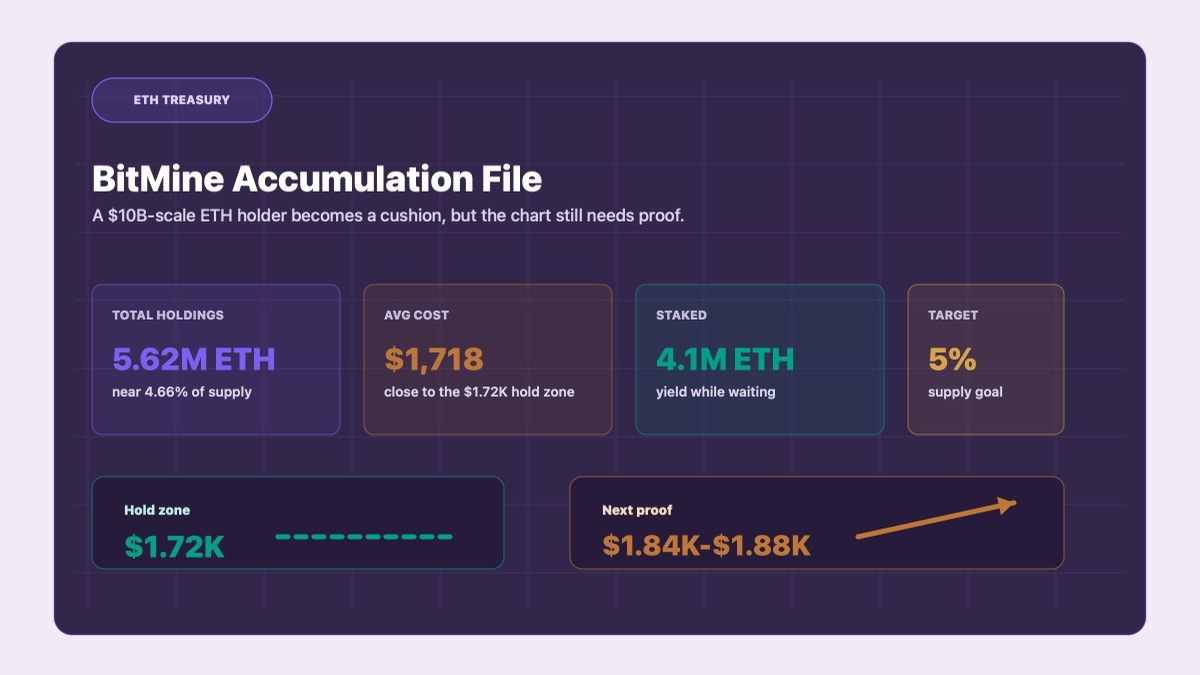
- BitMine bought another 76,881 ETH, lifting its Ether holdings to 5,620,754 ETH at an average cost of $1,718.
- The company now controls roughly 4.66% of ETH's circulating supply and is moving closer to its stated goal of owning 5%.
- The accumulation story is supportive, but ETH still needs to hold the $1.72K area and reclaim $1.84K-$1.88K to prove price structure is improving.
What Happened
BitMine is doing the thing that sounds simple until you remember the market is bleeding: buying more ETH.
According to Cointelegraph, BitMine Immersion Technologies acquired 76,881 Ether over the past week, bringing its total holdings to 5,620,754 ETH. The company has accumulated that position at an average price of $1,718, and its portfolio was worth roughly $10.2 billion at the cited ETH price of $1,843.69.
That is the clean part of the story.
The messy part is that BitMine is also sitting on a large unrealized loss, estimated by DropsTab data at nearly $9 billion. In other words, this is not a victory-lap treasury update. It is a bear-market accumulation update.
BitMine now controls about 4.66% of ETH's circulating supply, which brings it closer to its stated goal of owning 5% of all Ether. The company has also staked more than 4.1 million ETH, worth roughly $8.1 billion at current prices, allowing it to earn protocol rewards while holding through the downturn.
That makes the strategy more interesting than a simple "company buys coin" headline.
BitMine is not only betting that ETH goes up. It is also using Ethereum's proof-of-stake design to generate yield while it waits. The treasury position becomes a hybrid thing: part balance-sheet bet, part staking operation, part long-term claim on Ethereum's role in tokenization and onchain finance.
But Ethereum's backdrop is not exactly wearing a party hat.
Spot Ether ETFs recorded four consecutive days of net outflows last week. Mainnet fee revenue and ETH burn dynamics remain under pressure as more activity moves to layer-2 networks. The Ethereum Foundation has also faced a wave of senior departures and governance debate.
So BitMine is accumulating into weakness.
That can be smart.
It can also be early.
Why This Matters for Bitcoin and Crypto Markets
This story matters because Ethereum has a different kind of institutional narrative than Bitcoin.
Bitcoin's treasury story is usually simple: scarce asset, corporate balance sheet, hard-money thesis. Ethereum's treasury story is messier. ETH is a monetary asset, yes, but it is also a staking asset, a gas asset, a settlement asset and a claim on future network usage.
That makes BitMine's bet more complicated.
If a company accumulates Bitcoin, the market mostly asks whether Bitcoin will appreciate. If a company accumulates ETH, the market asks more questions. Will staking yield compensate for volatility? Will Ethereum mainnet capture enough value from layer-2 activity? Will ETF demand return? Will ETH's burn mechanics matter again? Will institutional investors treat ETH as infrastructure or just another volatile token?
This is why BitMine's purchase matters beyond one company's balance sheet. It is a test case for whether ETH can support a treasury model during a bad market.
The bullish read is obvious. A large public company keeps buying and staking ETH despite drawdowns. That removes supply from the market, creates recurring staking income and signals long-term conviction at a time when short-term traders are exhausted.
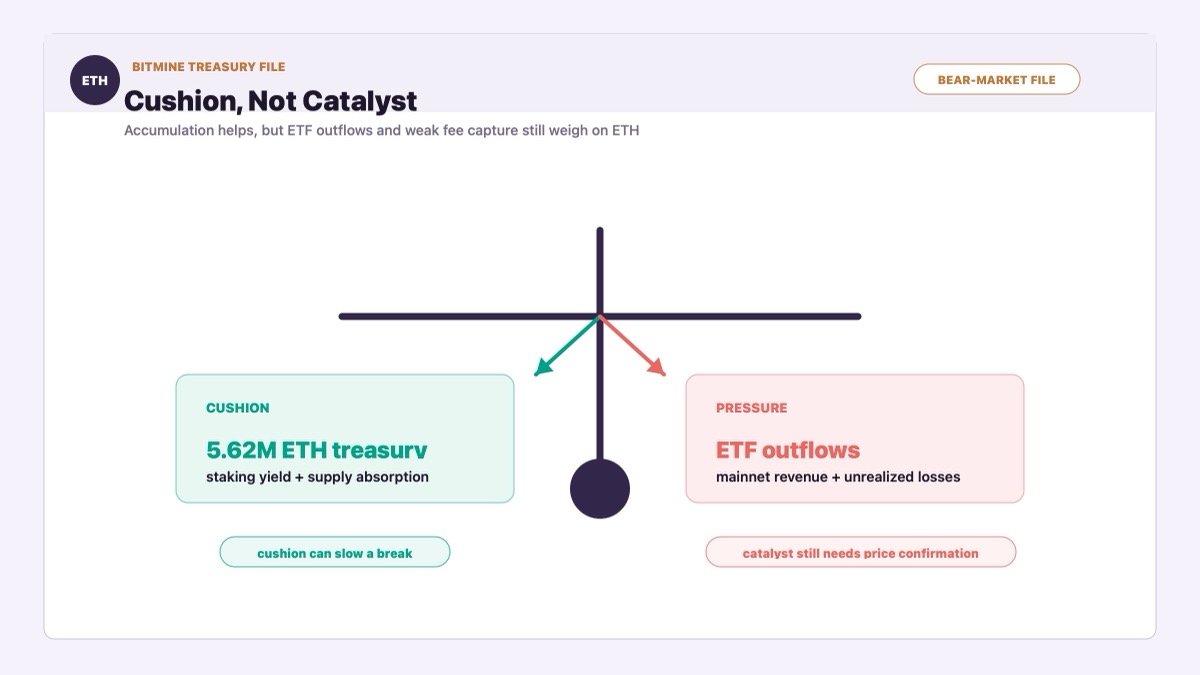
The bearish read is also obvious, which is annoying but useful. If ETF flows are negative, mainnet economics are under pressure and the largest ETH treasury is carrying deep unrealized losses, then the market may not reward accumulation immediately. It may treat the buying as a cushion, not a catalyst.
That distinction matters.
A cushion helps stop a market from breaking.
A catalyst helps it start climbing.
Right now, BitMine looks more like a cushion for ETH than a full catalyst. The chart still has to confirm that buyers beyond BitMine are willing to defend higher levels.
Historical Parallel
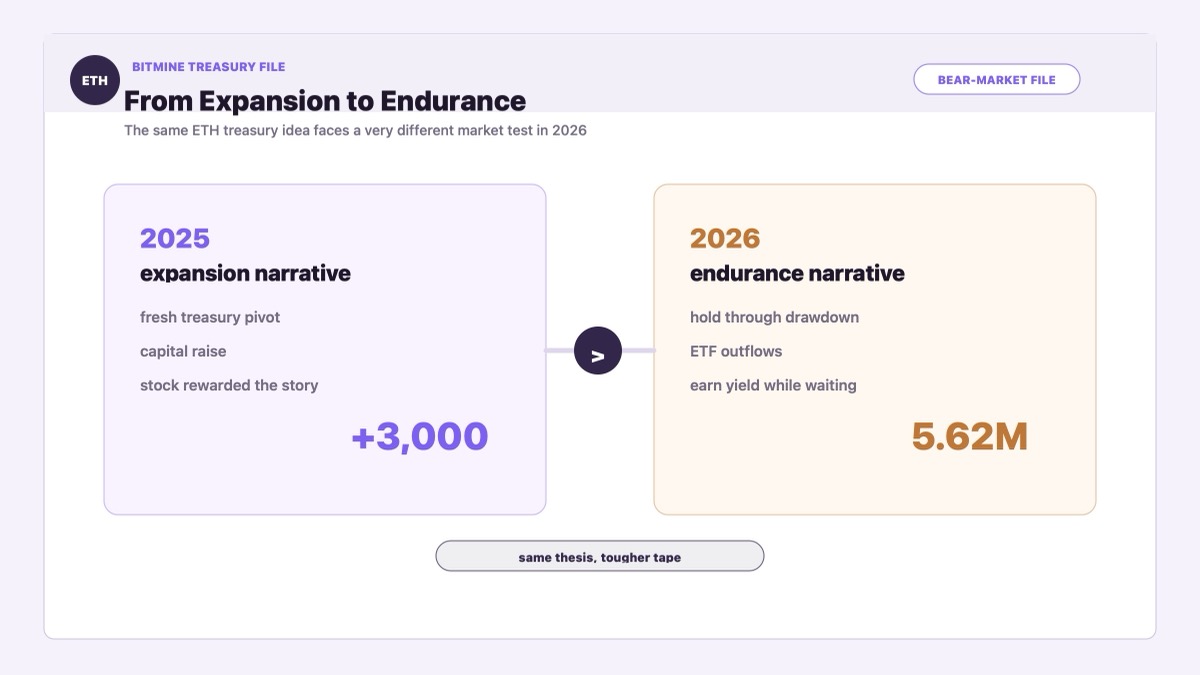
A useful historical parallel is BitMine's original Ethereum treasury pivot in mid-2025. Business Insider reported that BitMine's stock surged more than 3,000% over five trading days after the company announced a $250 million capital raise to buy Ethereum as its primary treasury reserve asset. Around that time, the market treated the move as a new category: a public company trying to do for ETH what Strategy had done for Bitcoin.
The similarity is the institutional framing. In both cases, BitMine was not simply buying ETH as a trade. It was building a balance-sheet identity around Ethereum. The company was making a long-term claim that ETH is not just a token to speculate on, but an asset that can sit inside a treasury, generate staking yield and provide exposure to the broader Ethereum economy.
That same logic is still visible now. BitMine's latest purchase pushes its holdings above 5.6 million ETH and brings it closer to the 5% supply target. The company is still telling the market: we are not renting this narrative, we are trying to own it.
The difference is the environment. In 2025, the treasury pivot was fresh, surprising and risk-on. Investors were rewarding the idea of corporate ETH accumulation before the hard questions had fully arrived. Today, the questions are sitting at the front of the room. ETH is weaker. Spot Ether ETFs have seen outflows. Layer-2 migration is pressuring mainnet fee capture. BitMine's holdings are large, but so are its unrealized losses.
The lesson is that treasury accumulation can create a powerful narrative, but the market eventually asks whether the narrative earns its keep. In 2025, the story was expansion. In 2026, the story is endurance.
That is a tougher story.
But sometimes the tougher story is the one that matters more.
Ethereum Price Reaction and K-Line Analysis
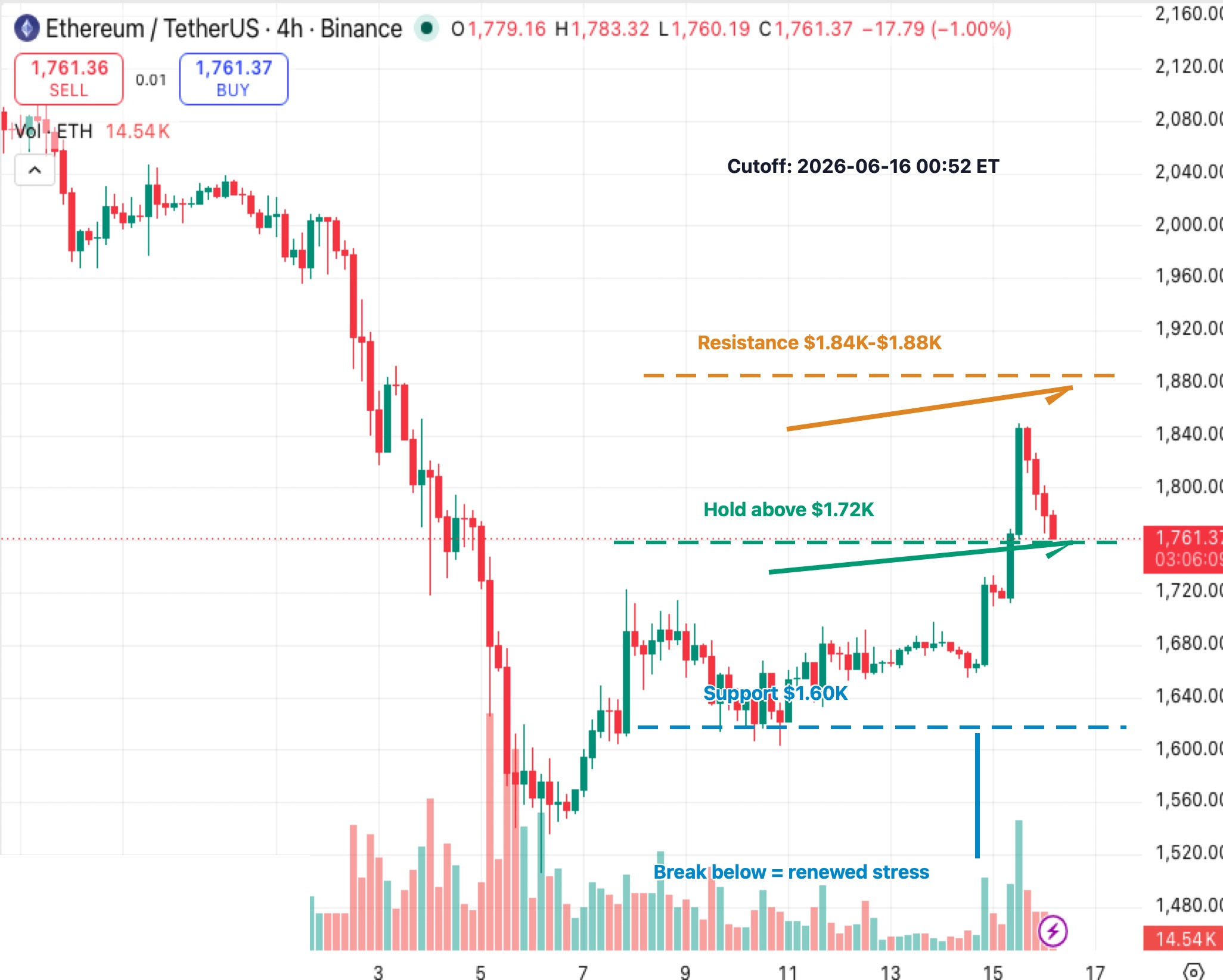
The ETHUSDT 4H chart shows a market trying to recover after a hard repricing.
ETH fell from above $2,000 into the $1,500s, then built a base around the $1.60K region before rebounding toward the $1.80K area. That is a meaningful repair attempt, but it is not yet a clean trend reversal.
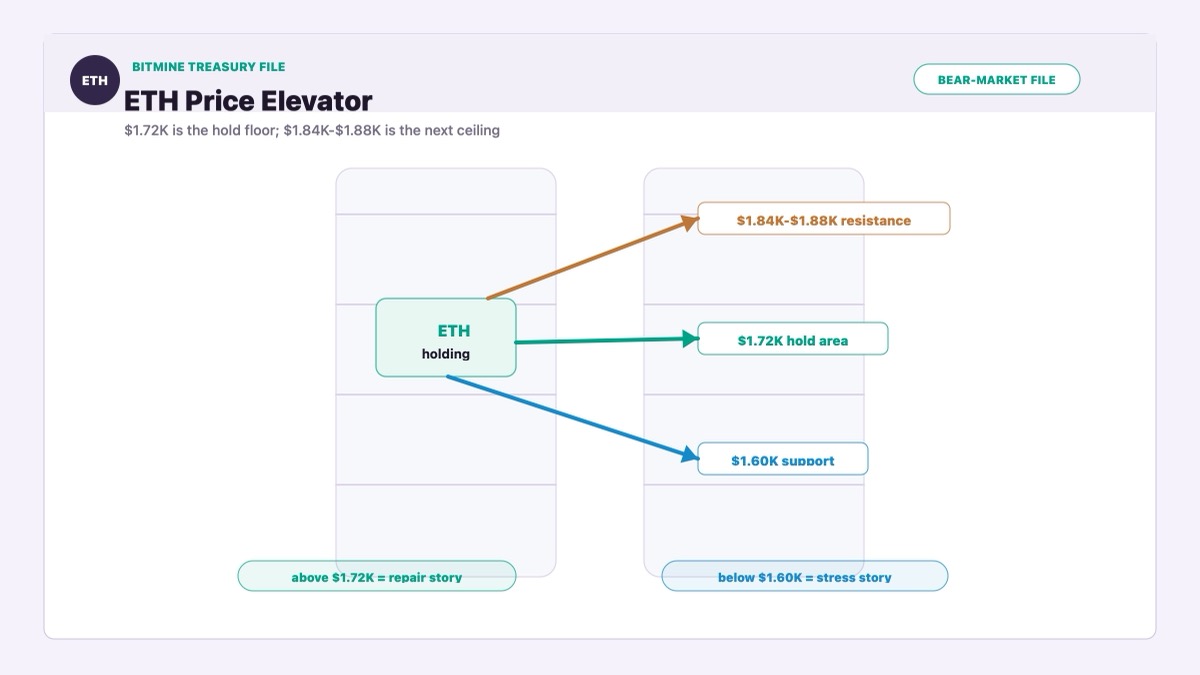
The first level to watch is around $1.72K. That area sits close to BitMine's reported average acquisition cost and also lines up with the near-term price zone ETH needs to hold after its rebound. If ETH can stay above $1.72K, the market can argue that buyers are defending a higher base.
The next resistance zone sits around $1.84K-$1.88K. That is where the latest rebound started to run into selling pressure. A break above that area would make the BitMine accumulation story look more useful on the chart because price would be moving beyond simple relief.
The danger zone is $1.60K.
That level matters because it marks the area where ETH recently tried to stop the decline. If ETH loses $1.60K again, the market will probably stop talking about treasury support and start talking about renewed stress.
So the chart has a very clear message.
BitMine may be buying.
But ETH still has to hold.
Key Levels to Watch
- $1.72K: The near-term hold area and a key zone for keeping the rebound intact.
- $1.84K-$1.88K: The next resistance band. A break above it would strengthen the recovery case.
- $1.60K: Major support after the recent drawdown. Losing it would put stress back on the chart.
- Below $1.60K: The invalidation zone where treasury accumulation would likely look defensive rather than supportive.
Conditional Forecast
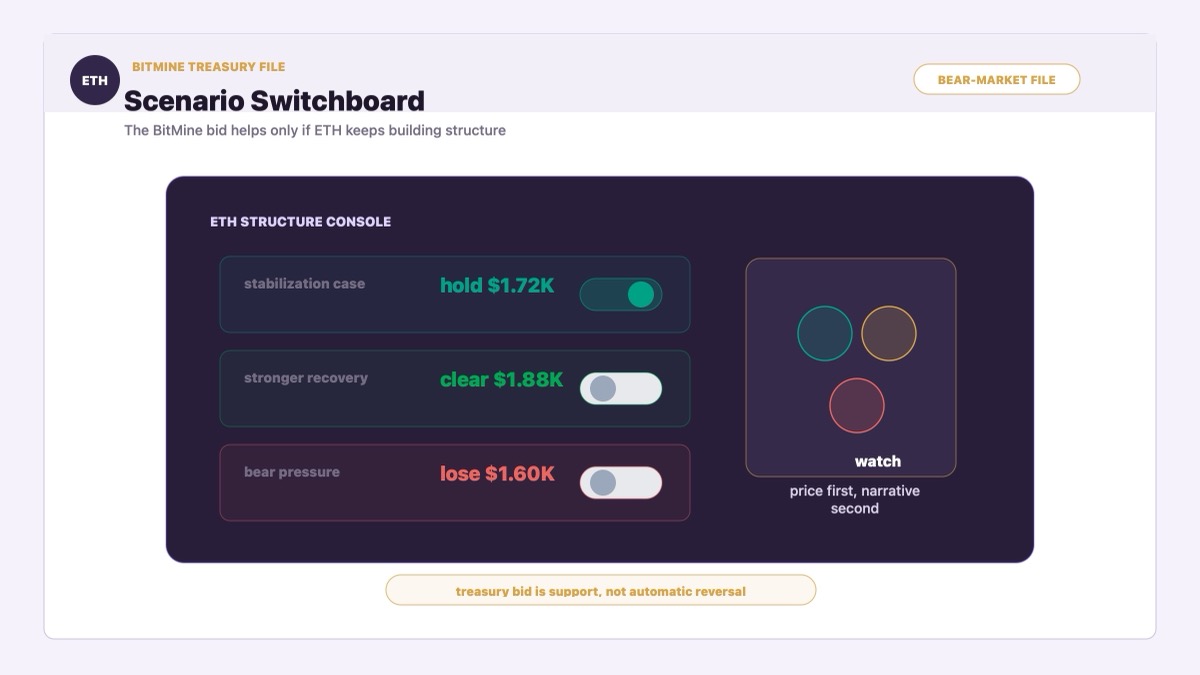
If ETH holds above $1.72K, the market can keep treating the BitMine update as part of a stabilization story. The next upside test would be $1.84K-$1.88K.
If ETH breaks above $1.88K with stronger volume, the recovery becomes more convincing. That would suggest the market is not just respecting BitMine's accumulation, but also bringing in broader buyers.
If ETH loses $1.72K and then breaks below $1.60K, the story changes quickly. In that case, BitMine's buying would look less like a catalyst and more like a large holder averaging down into a weak structure.
That is the clean split.
Above $1.72K, ETH has a repair story.
Below $1.60K, it has a stress story.
Investment Takeaway
BitMine's ETH accumulation is important because it gives Ethereum a large, visible treasury buyer at a time when the market badly needs signs of commitment.
But one large buyer does not solve every problem.
ETF outflows still matter. Layer-2 economics still matter. Ethereum Foundation uncertainty still matters. Most of all, price still matters, because markets are rude that way.
For investors, the practical read is simple: BitMine's buying supports the long-term ETH thesis, but the chart needs confirmation. Holding $1.72K keeps the recovery alive. Reclaiming $1.84K-$1.88K gives bulls something stronger to work with. Losing $1.60K puts the bear-market pressure back in control.
BitMine is building the position.
Now ETH has to build the structure.
Sources
- Cointelegraph: BitMine boosts ETH holdings closer to $10B as bear market accumulation continues
- EQS News: BitMine announces ETH holdings reach 5.54 million tokens
- Business Insider: The stock of a small crypto miner soared 3,000% in a week on a plan to amass a trove of ethereum
- SoSoValue: US spot Ethereum ETF data
- TradingView: ETHUSDT chart
|
DISCLAIMER:
1. All content on this website (including but not limited to articles, data, charts, and analyses) is for general informational purposes only and does not constitute any form of investment advice, trading recommendation, or financial guidance. 2. Cryptocurrencies and digital assets are subject to extreme price volatility and high investment risk; you may lose part or all of your principal. Past performance does not predict future results. 3. The information on this website is based on sources we believe to be reliable, but we do not guarantee its accuracy, completeness, or timeliness. Any investment decisions made based on this website’s information are at your own risk. 4. We strongly recommend that you conduct your own thorough research and consult an independent, licensed financial advisor before making any investment decisions. |
Latest News

