Key Takeaways
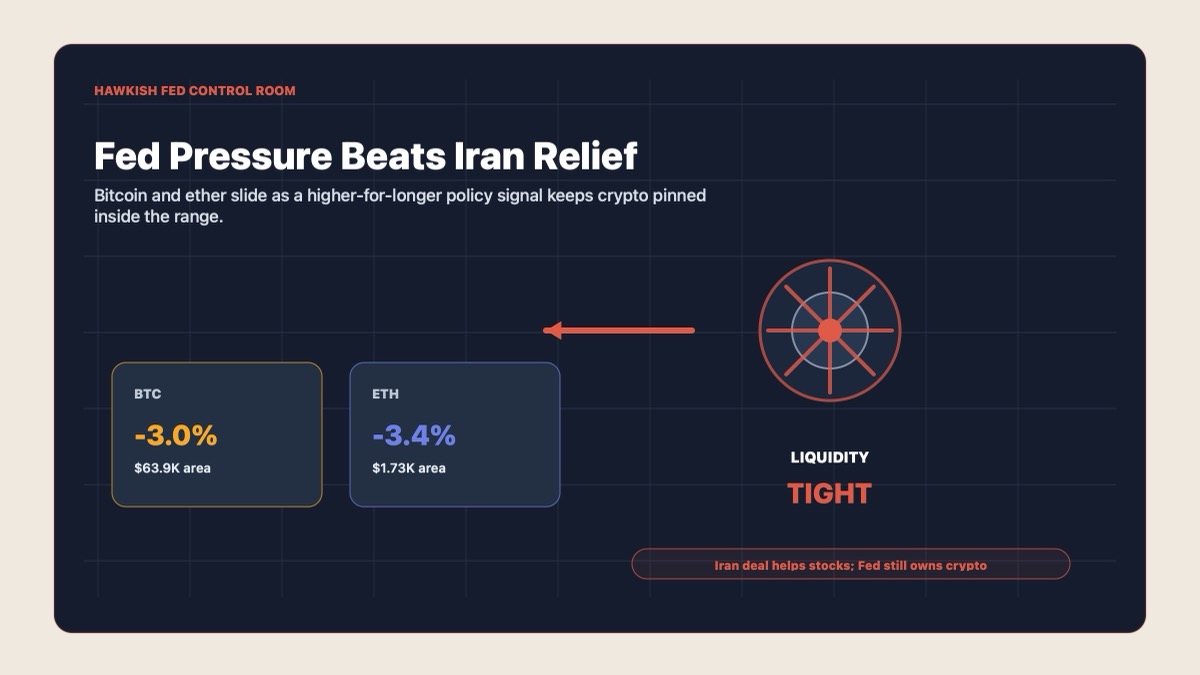
- Bitcoin fell about 3% to roughly $63,900, while ether dropped 3.4% and solana lost 3.6% after the Fed signaled a higher-for-longer stance.
- Trump's signed Iran deal helped stocks and pushed Brent crude toward $78, but crypto traded more on Fed liquidity pressure than geopolitical relief.
- BTC remains stuck in a $60K-$70K range unless a stronger catalyst appears, such as clearer crypto legislation, further de-escalation or a less restrictive Fed tone.
What Happened
Crypto got good news.
Then it got the Fed.
According to CoinDesk, major crypto assets fell Thursday even after President Donald Trump signed an interim deal to end the war with Iran and reopen the Strait of Hormuz. Stocks liked the deal. Oil liked the deal. Crypto looked at the Federal Reserve and decided to be miserable anyway.
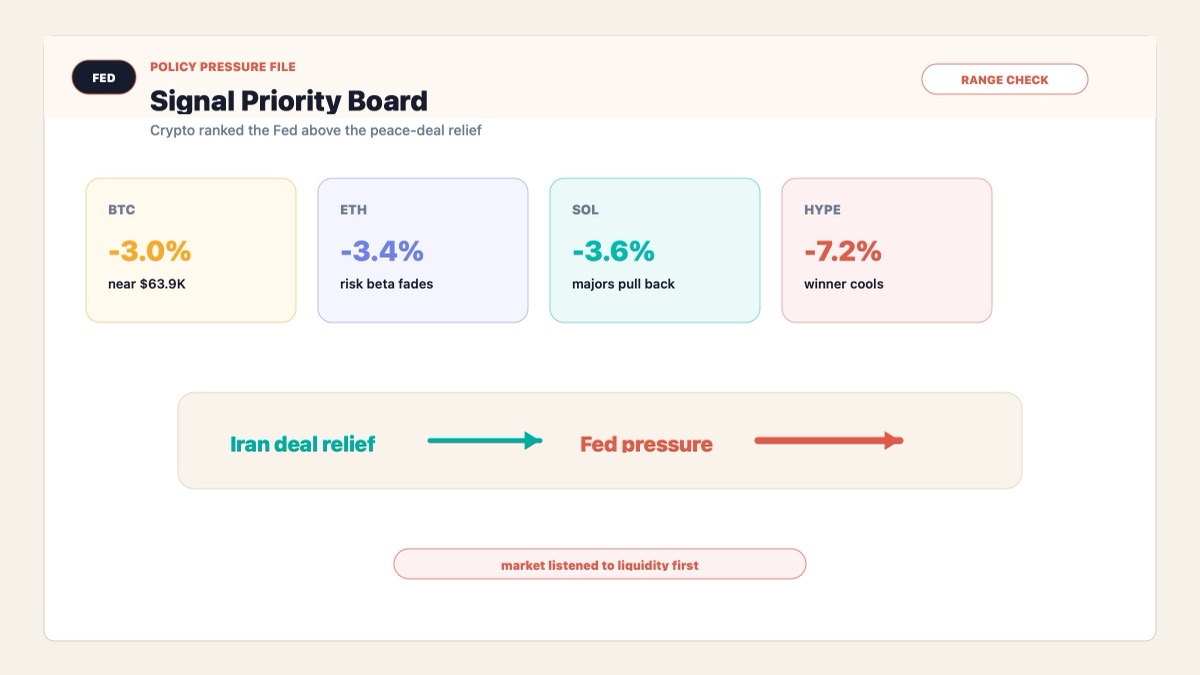
Bitcoin traded around $63,900, down about 3% over 24 hours, though still up 2% on the week. Ether fell 3.4% to $1,733. XRP dropped 3.9% to $1.17. Solana lost 3.6% to $71. Hyperliquid's HYPE, the week's standout winner, fell 7.2% to $69, while Tron was the lone major asset in the green, up 0.9%.
The reason was not mysterious.
The Fed held rates unchanged at 3.5% to 3.75%, which was expected. But the message around the decision was more hawkish than crypto wanted. Updated projections pointed to higher inflation, a slower pace of future rate cuts and even the possibility that rates may still need to rise.
That was the problem.
Crypto did not need a rate cut. It needed a softer path. Instead, the Fed said, in effect: inflation still matters, and financial conditions may need to stay tight.
That is not the kind of sentence risk assets frame and hang on the wall.
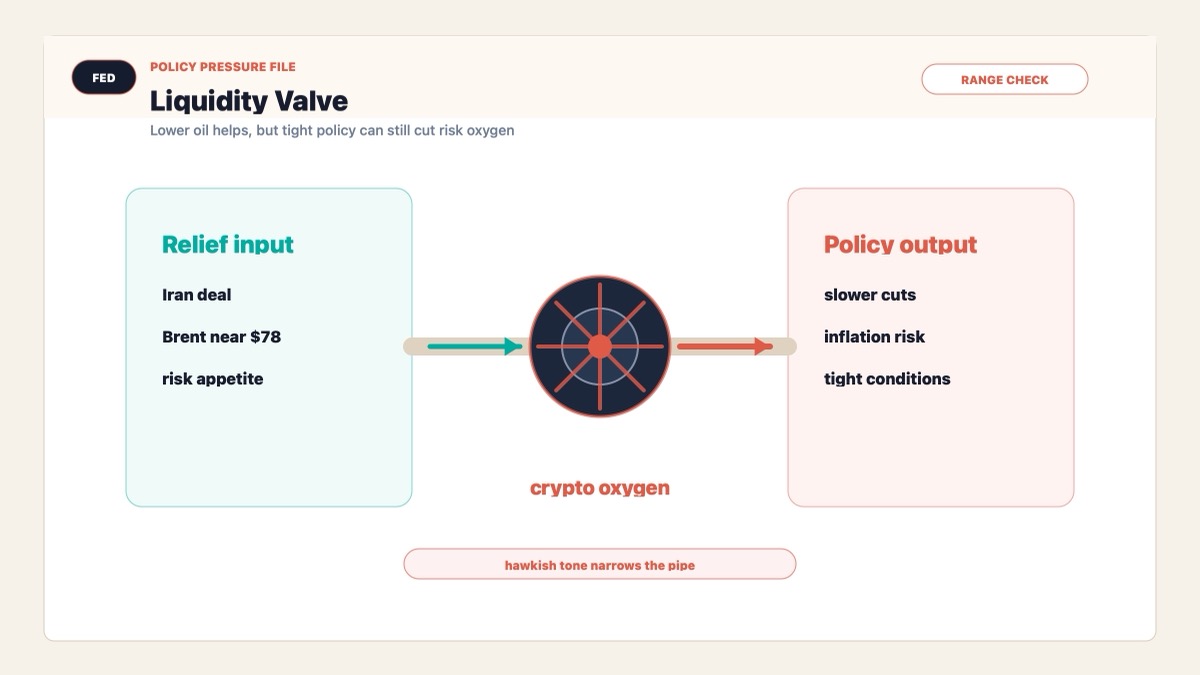
The Iran deal still mattered. It helped S&P 500 futures rise as much as 0.9%, pushed Nasdaq futures up 1.5% and sent Brent crude toward $78 a barrel. Lower oil should ease inflation pressure. A reopened Strait of Hormuz should reduce geopolitical risk. In a cleaner market, that might have been enough to lift crypto too.
But this was not a cleaner market.
For now, the Fed is louder than the peace deal.
Why This Matters for Bitcoin and Crypto Markets
This story matters because it shows which macro variable crypto is listening to first.
The Iran deal is a relief story. It reduces the risk of an energy shock. It helps stocks breathe. It lowers the immediate fear that oil will spike and feed inflation. That is all supportive for risk assets.
But crypto is not only a risk asset.
It is also a liquidity asset.
That distinction is the whole article hiding in plain sight.
When the Fed sounds hawkish, the market hears tighter financial conditions. Tighter financial conditions mean money costs more, leverage gets less comfortable and speculative assets lose some of their oxygen. Bitcoin can survive that. Ether can survive that. Solana can survive that. But they do not usually throw a parade for it.
So the market had two signals.
One signal said geopolitical risk is cooling.
The other signal said liquidity may stay tight.
Crypto chose the second signal.
That tells us something useful about the current market structure. Bitcoin is not trading like an asset ready to break out on every good headline. It is trading like an asset trapped in a range, waiting for a stronger catalyst. Hashdex's Gerry O'Shea told CoinDesk that BTC may continue trading between $60,000 and $70,000 absent a major catalyst, such as the CLARITY Act becoming law or further US-Iran de-escalation.
That is a polite way of saying the market needs more than a nice headline.
It needs a reason to leave the range.
Until then, good news can lift stocks, oil can fall and crypto can still sag if the Fed keeps a hand on the liquidity valve.
Not elegant.
But very crypto.
Historical Parallel
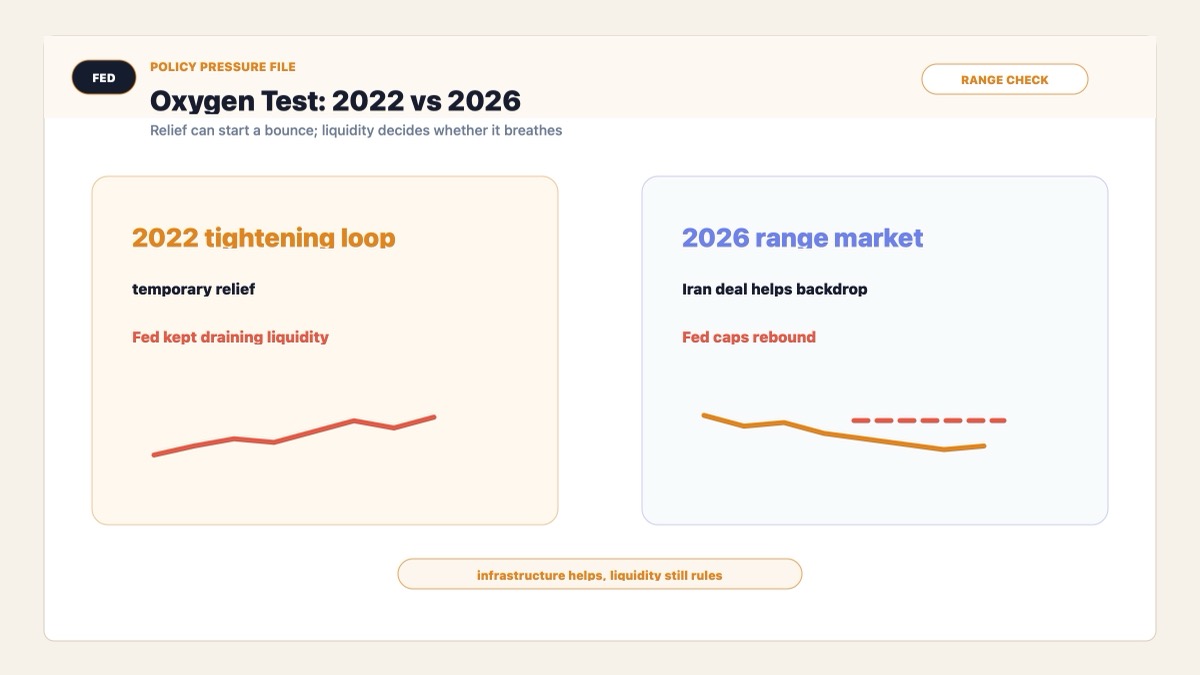
A useful historical parallel is the 2022 period when crypto repeatedly tried to rally on temporary macro relief, only to fade when the Fed kept tightening financial conditions. There were moments when stocks bounced, inflation fears cooled slightly or geopolitical risks became less urgent. Bitcoin and ether would catch a bid for a few sessions. Then the market would remember the larger problem: rates were still rising, liquidity was still being drained and speculative assets were still being repriced.
The similarity is the hierarchy of signals. In both cases, crypto was not ignoring good news. It was ranking it. A single relief catalyst could help price, but it could not fully overpower the Fed's message. When borrowing costs stay high and policy remains restrictive, traders become less willing to pay up for assets whose value depends heavily on future growth, liquidity and risk appetite.
That is what appears to be happening now. Trump's signed Iran deal reduces one major source of uncertainty. Brent crude falling toward $78 helps the inflation backdrop. Stocks were willing to respond positively. But crypto sold off because the Fed's updated projections pointed to higher inflation, slower cuts and the possibility of more tightening.
The difference is that the current market has more institutional infrastructure than 2022. Spot ETFs, regulated products, public-company treasury strategies and clearer policy debates give Bitcoin and ether more support than they had during the last tightening cycle.
But infrastructure does not repeal liquidity.
The lesson is simple: geopolitical relief can create a bounce, but a hawkish Fed can decide whether that bounce gets oxygen. Right now, crypto has the relief.
It does not yet have the oxygen.
Bitcoin Price Reaction and K-Line Analysis
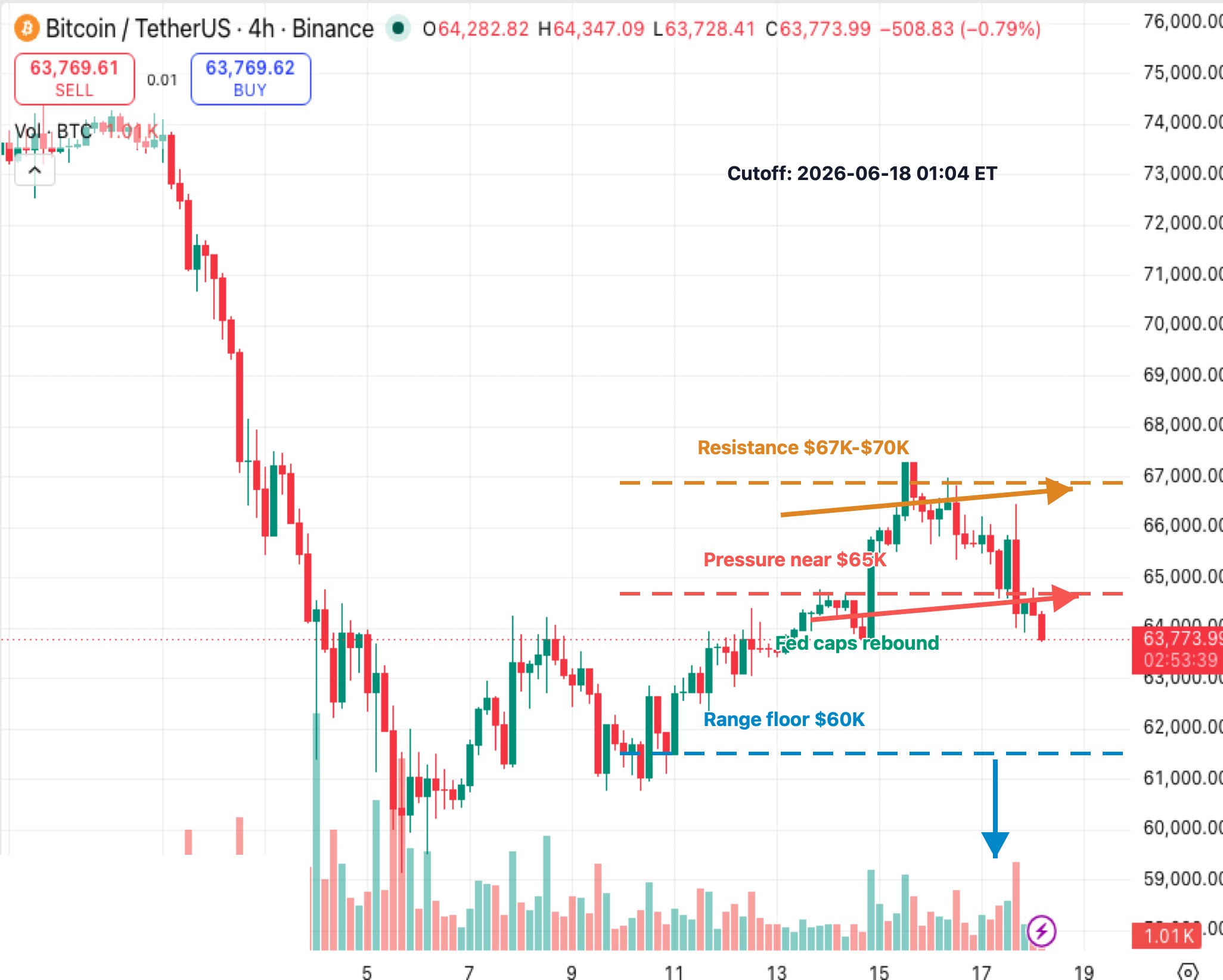
The BTCUSDT 4H chart looks like a market that tried to recover and then ran into the ceiling.
Bitcoin bounced from the $60K area into the mid-$60Ks, briefly pushing toward the $67K region. That recovery mattered because it showed the market was not in freefall after the earlier selloff. But the rally did not break the larger range.
The $67K-$70K area remains the important resistance band. That is where BTC needs to prove that buyers can do more than defend the lower part of the range. So far, they have not.
The current pressure is closer to $65K. After the Fed, BTC slipped back toward $64K, which shows how quickly the market repriced the hawkish message. The Iran deal gave crypto a potential macro tailwind, but the Fed created a liquidity headwind, and the chart shows which force mattered more.
$60K remains the range floor.
That level is the real line in the sand. As long as BTC holds above it, the market can still argue this is consolidation rather than breakdown. But if $60K fails, the conversation changes. Then the market stops asking whether Bitcoin can break the range and starts asking how deep the Fed-driven stress can go.
So the chart is not dramatic.
It is worse than dramatic.
It is indecisive.
And indecision near the lower half of a range is not where bulls want to build their victory speech.
Key Levels to Watch
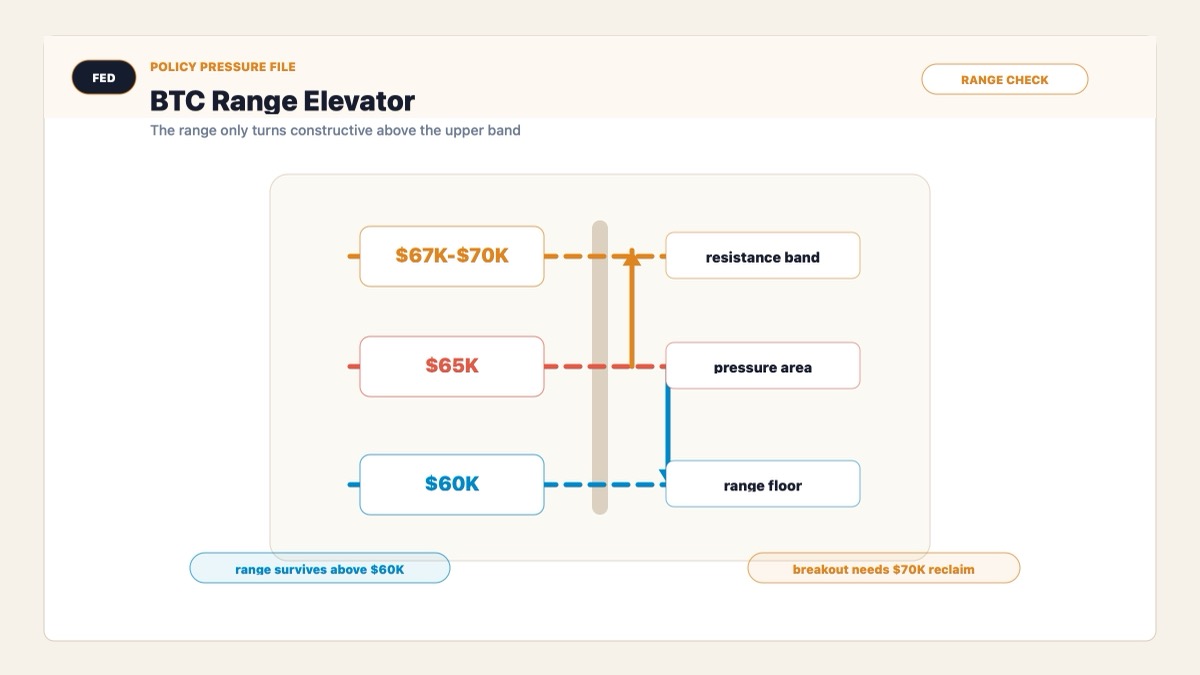
- $67K-$70K: The resistance band BTC needs to reclaim before the range can turn constructive.
- $65K: Near-term pressure area after the hawkish Fed reaction.
- $60K: Main range floor and the most important downside level.
- Below $60K: Breakdown risk, where the rangebound thesis would weaken quickly.
Conditional Forecast
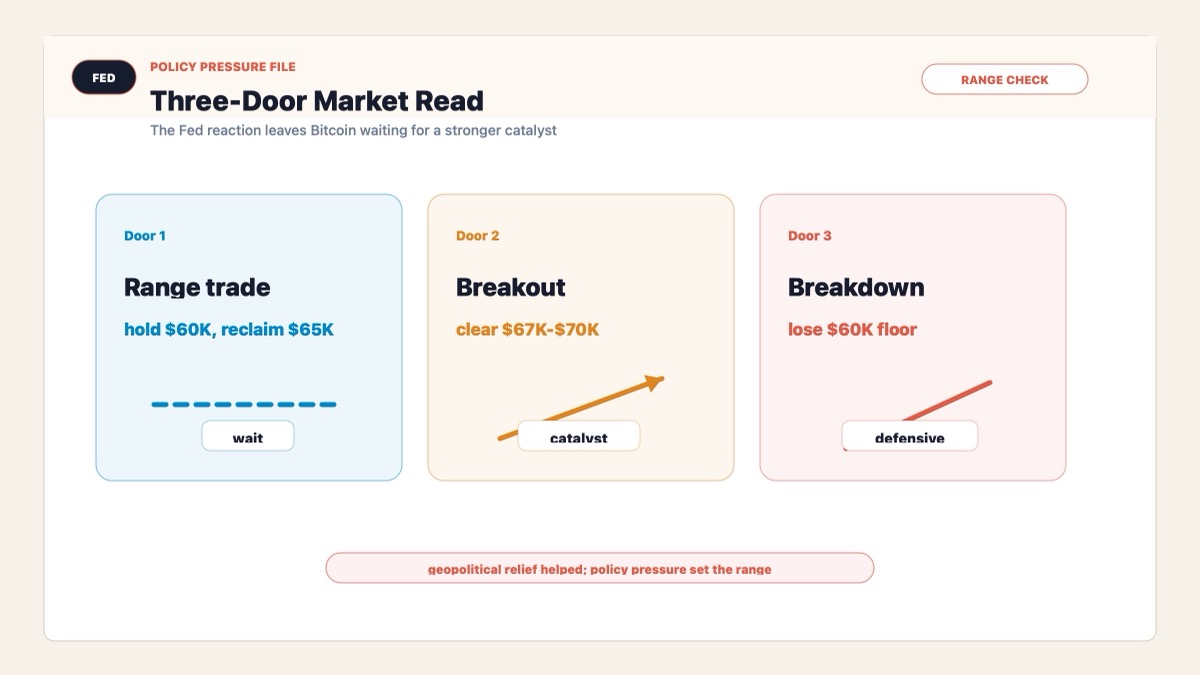
If BTC holds above $60K and reclaims $65K, the market can stay rangebound while waiting for a stronger catalyst. That would support the view that the Fed selloff was pressure, not panic.
If BTC breaks above $67K-$70K, the story changes. That would suggest buyers are willing to look past the hawkish Fed and price in either regulatory progress, further US-Iran de-escalation or improving liquidity expectations.
If BTC loses $60K, the setup turns defensive fast. In that case, the Iran deal would look like a failed relief catalyst, and the market would likely focus on higher-for-longer rates, weaker sentiment and fading demand across majors.
For now, the cleanest expectation is boring but useful: range trade first, breakout later.
Crypto wants a catalyst.
The Fed just made that catalyst harder to find.
Investment Takeaway
This was not a simple bad-news day.
It was a priority test.
The market had to choose between geopolitical relief and Fed pressure. Stocks leaned toward the relief. Crypto leaned toward the pressure. That matters because it tells investors what is currently driving the asset class: not just headlines, not just oil, but liquidity.
For investors, the practical read is straightforward. Bitcoin above $60K is still consolidating. Bitcoin above $67K-$70K starts looking healthier. Bitcoin below $60K is a different and uglier conversation.
The Iran deal helped the backdrop.
The Fed still owns the range.
Sources
- CoinDesk: Bitcoin, ether slide after a hawkish Fed, even as Trump's signed Iran deal lifts stocks
- CoinDesk: Fed holds rates steady in first decision under new Chairman Kevin Warsh
- Trading Economics: Brent crude oil price
- TradingView: BTCUSDT chart
|
DISCLAIMER:
1. All content on this website (including but not limited to articles, data, charts, and analyses) is for general informational purposes only and does not constitute any form of investment advice, trading recommendation, or financial guidance. 2. Cryptocurrencies and digital assets are subject to extreme price volatility and high investment risk; you may lose part or all of your principal. Past performance does not predict future results. 3. The information on this website is based on sources we believe to be reliable, but we do not guarantee its accuracy, completeness, or timeliness. Any investment decisions made based on this website’s information are at your own risk. 4. We strongly recommend that you conduct your own thorough research and consult an independent, licensed financial advisor before making any investment decisions. |
Recommended reading
Latest News