
Bitcoin Trims Losses as Softer Core CPI Gives BTC a Brief Macro Lifeline
Key Takeaways
- May headline CPI matched expectations, but core CPI cooled to 0.2%, giving Bitcoin a short-term macro relief signal.
- BTC bounced from pressure near $60K, yet the chart still needs a clean reclaim of $63K-$64K to look healthier.
- The market reaction is less about inflation being """fixed""" and more about traders briefly reducing the probability of a harsher Fed path.
What Happened
Bitcoin caught a small bid after U.S. inflation data came in a little less hostile than feared.
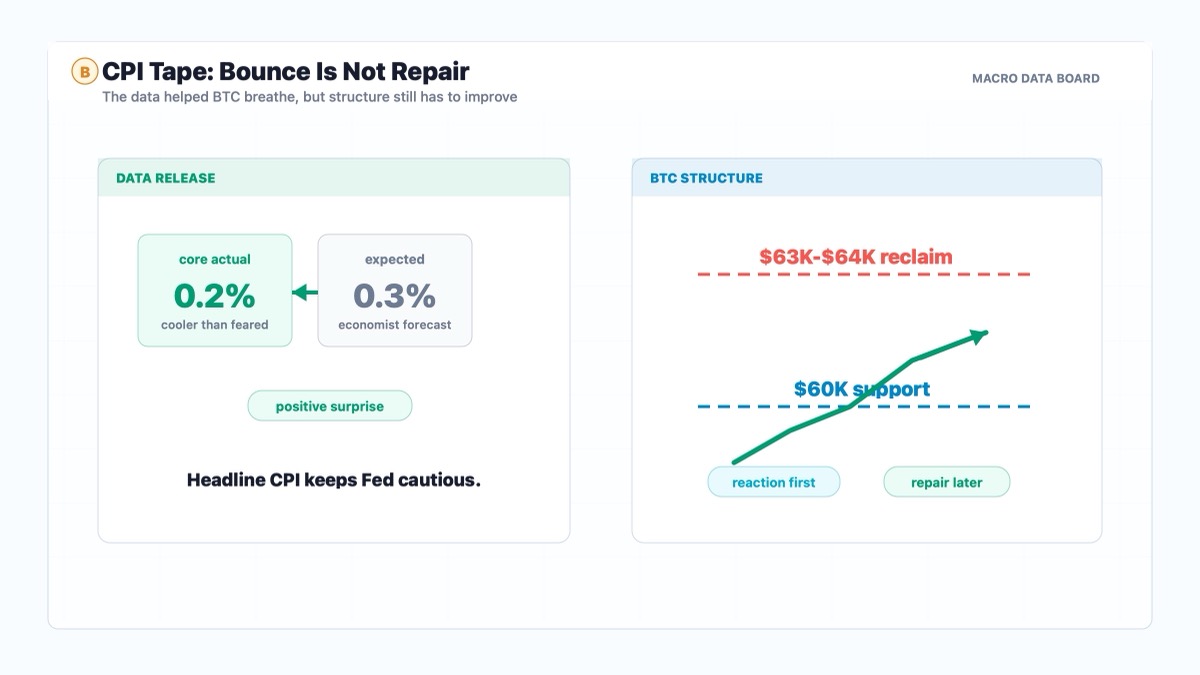
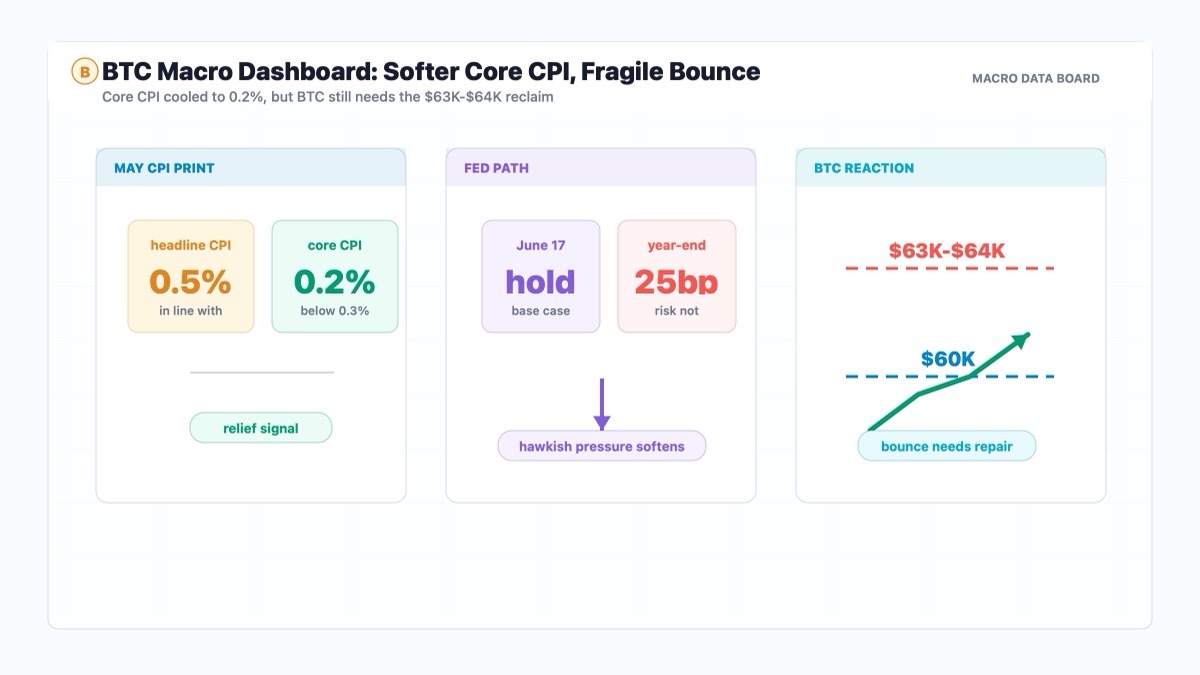
That is the important distinction. The report was not a magical all-clear for risk assets. Headline CPI rose 0.5% in May and 4.2% year over year, which was in line with forecasts. The relief came from the core number, which strips out food and energy. Core CPI rose 0.2% month over month, below the 0.3% economists expected.
Markets like that kind of surprise because it gives them a sentence they can say out loud without sounding ridiculous: maybe the Fed does not have to lean even harder.
Bitcoin traded around $61,400 after the report, according to the original CoinDesk article, and later hovered closer to the low $62K area on the TradingView chart used below. That is a bounce, but it is not yet a repaired market. The difference matters. A bounce is a reaction. A repair is a structure.
Right now, BTC has the first thing. It still has to earn the second.
Why This Matters for Bitcoin and Crypto Markets
Bitcoin is not a CPI token, obviously. No one is mining blocks with a spreadsheet from the Bureau of Labor Statistics.
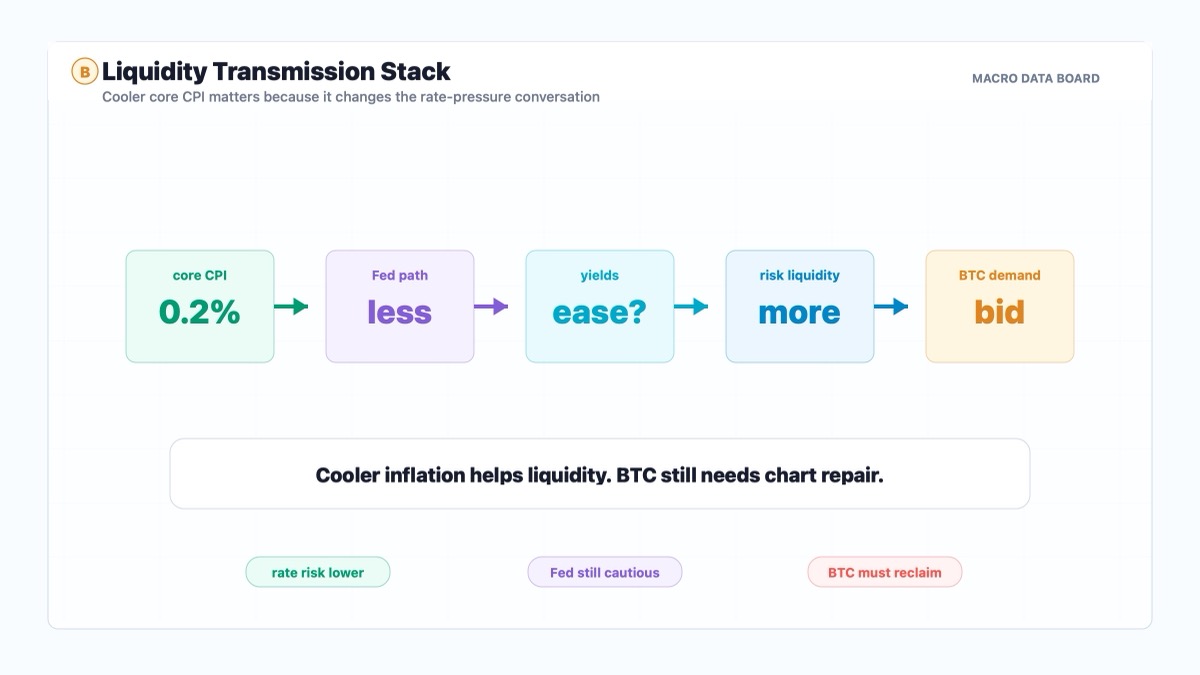
But BTC does live inside the liquidity weather system. When inflation comes in hotter, the market worries about higher rates, tighter financial conditions, and less oxygen for long-duration risk assets. When inflation comes in cooler, even slightly, traders start asking whether the pressure valve can loosen.
That is why the core CPI miss mattered more than the headline number. Headline inflation staying at 4.2% year over year still keeps the Fed cautious. But core CPI at 0.2% gives bulls something more useful: a reason to argue that the worst parts of the inflation story may not be accelerating.
For crypto, this matters in three layers.
First, it can steady spot demand. Bitcoin was already under stress, so even a modest macro improvement can stop sellers from pressing quite as aggressively.
Second, it can change the tone around rates. The original article noted that markets were heavily pricing no change at the June 17 Fed meeting, while still considering a possible 25 bps increase by year-end. Softer core inflation does not erase that path, but it makes the hawkish version of the path a little harder to sell.
Third, it can separate Bitcoin from panic trading. When BTC is falling, every negative narrative starts wearing the same jacket: AI rotation, IPO liquidity drains, tariff stress, ETF outflows, forced sellers, rate pressure. A softer core CPI print does not solve all of those. It simply removes one heavy object from the pile.
That is helpful.
It is not the same as bullish confirmation.
Historical Parallel
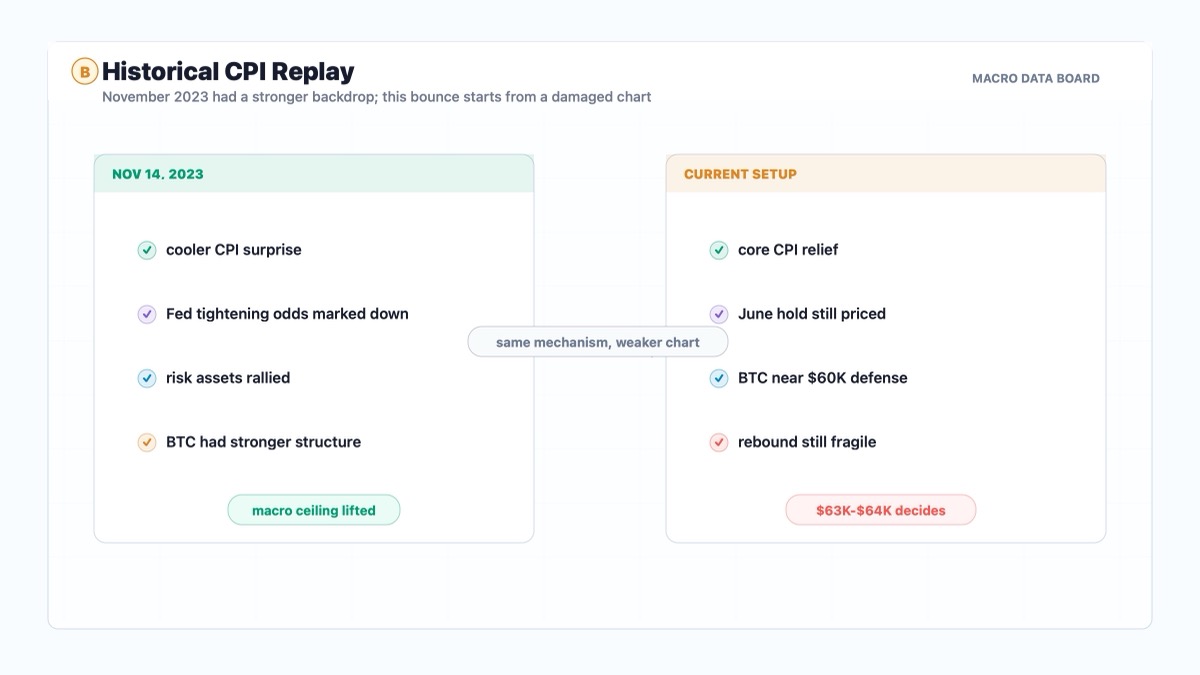
A useful parallel is the U.S. CPI release on November 14, 2023, when October inflation came in cooler than expected and risk assets rallied as traders quickly marked down the odds of more Fed tightening. The basic market mechanism was simple: if inflation is cooling faster than expected, the Fed has less reason to keep pushing rates higher, and assets that hate tight liquidity suddenly get room to breathe.
That episode was not about Bitcoin suddenly discovering a new internal catalyst. It was about the macro ceiling lifting. Treasury yields fell, rate expectations softened, equities jumped, and Bitcoin benefited from the broader risk-on move. The market did what markets often do around inflation surprises: it treated one data point as a permission slip to bring forward a friendlier liquidity story.
The similarity to the current setup is clear. In both cases, the interesting part was not just """CPI happened.""" It was the gap between fear and reality. Traders went into the data worried that inflation would keep the Fed trapped in a harder stance. The softer piece of the report gave them a reason to reduce that fear, at least temporarily. Bitcoin, being highly sensitive to liquidity expectations, responded.
The difference is just as important. In late 2023, Bitcoin was moving inside a stronger structural backdrop, with ETF anticipation and improving risk appetite helping the market absorb macro noise. This time, BTC is reacting after a damaged slide toward the $60K area, with traders already focused on whether rebounds are being sold. That makes the current CPI relief more fragile.
The lesson is not that one softer core CPI print automatically starts a Bitcoin rally. The lesson is that macro relief works best when the chart is ready to receive it. If BTC reclaims $63K-$64K and holds it, the CPI print can become part of a repair story. If BTC fails there, the market may treat the report as a temporary exhale before returning to the larger downtrend problem.
Bitcoin Price Reaction and K-Line Analysis
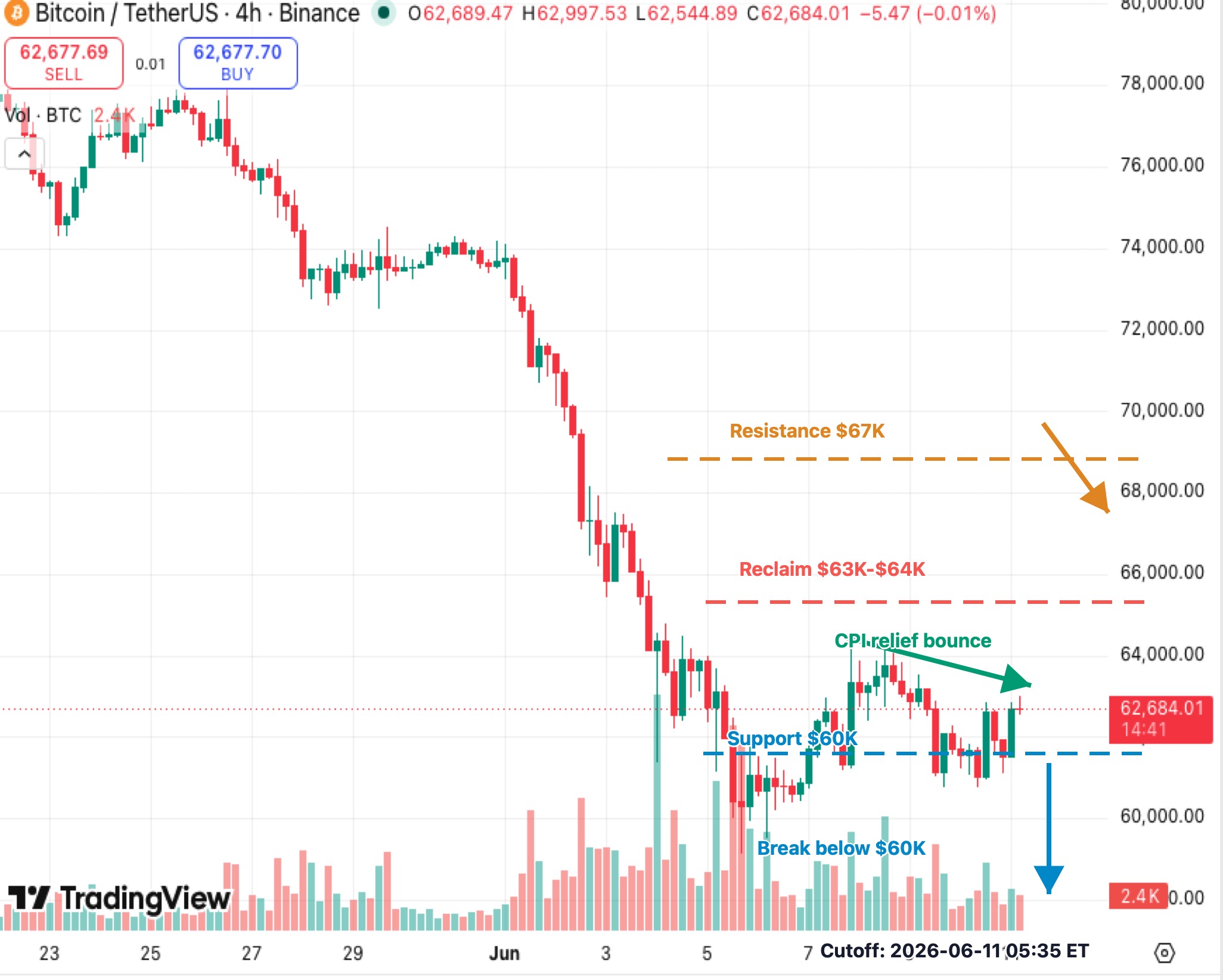
The 4H BTCUSDT chart shows a market trying to stop the bleeding, not a market that has already reversed.
The selloff from the upper $70K zone created a clear lower-high structure and drove price into the $60K support area. That support held on the first major test, which is why the post-CPI bounce matters. It tells us buyers are still willing to defend the round-number zone when macro pressure eases.
But the bounce is running into the uncomfortable part of the chart: $63K-$64K. That zone now acts like a test chamber. If BTC can reclaim it and hold above it, the market can begin to argue that the CPI print helped build a short-term floor. If BTC keeps failing below it, the rebound becomes less impressive. It becomes a reflex move inside a weak trend.
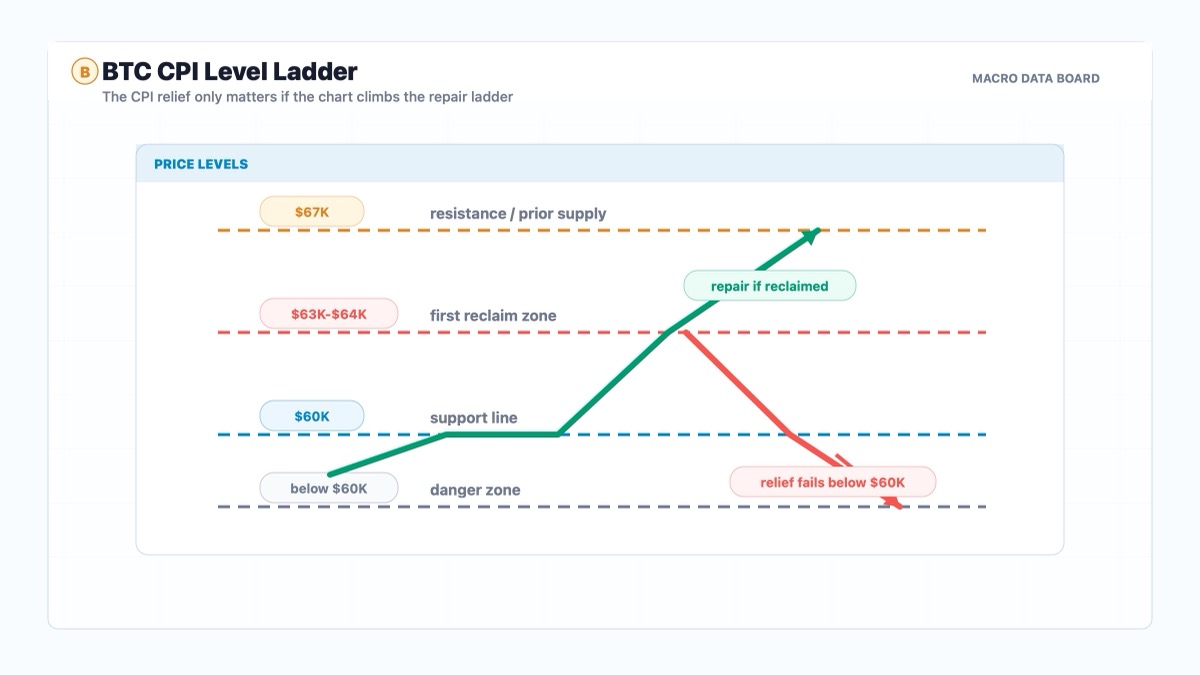
The next upside level is around $67K. That is where prior supply can start to matter again. A move into that area would suggest buyers are no longer just defending support; they are forcing sellers to reprice the bounce.
The downside is cleaner. If BTC loses $60K with force, the CPI relief story loses its usefulness quickly. At that point, the market would stop debating whether the data was """better than hoped""" and start debating how deep the next liquidity washout can go.
Key Levels to Watch
- $63K-$64K: The first reclaim zone. BTC needs this area to turn the CPI reaction into something more durable.
- $67K: The next resistance area, where a stronger recovery would run into prior supply.
- $60K: The key support level. Holding it keeps the market in repair mode.
- Below $60K: The danger zone. A breakdown would suggest the macro relief was too small to offset the broader selling pressure.
Conditional Forecast
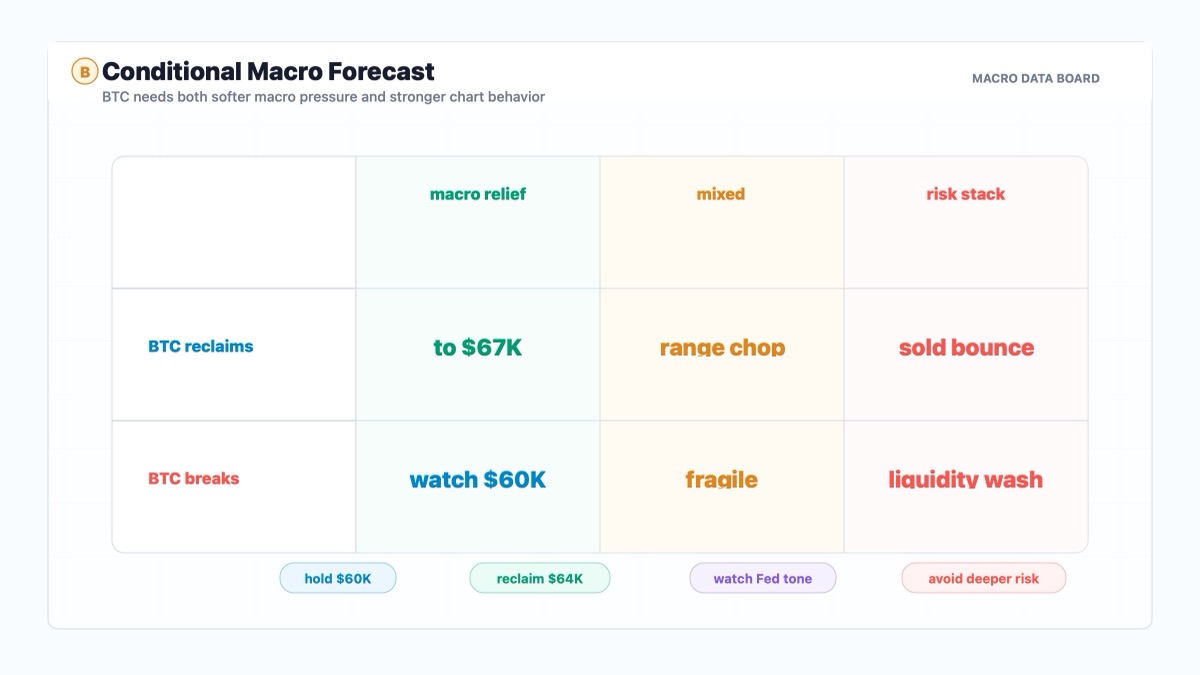
If BTC holds $60K and reclaims $63K-$64K, the market can stretch toward $67K as traders reprice the softer core CPI signal. That would not make the chart fully bullish, but it would move Bitcoin from """damaged and defensive""" to """stabilizing with upside room."""
If BTC fails at $63K-$64K, the bounce should be treated carefully. In that scenario, sellers remain in control of the structure, and the CPI reaction looks more like a pause than a turn.
If BTC breaks below $60K, the setup changes fast. The market would likely stop caring about the one soft core CPI line and refocus on the larger risk stack: rates, liquidity, equities, ETF flows, and forced de-risking.
Investment Takeaway
The CPI report gave Bitcoin a reason to breathe. It did not give Bitcoin a new bull market by itself.
For investors, the clean read is this: softer core inflation reduces one macro pressure point, but BTC still has to prove that buyers can convert relief into structure. The chart is not asking for a speech. It is asking for a reclaim.
Above $63K-$64K, the market starts to look constructive again. Below that zone, the bounce remains vulnerable. Below $60K, the conversation gets much darker.
So the practical stance is patient, not dramatic. The data helped. The chart still has work to do.
Sources
- CoinDesk: U.S. inflation data better than hoped, boosting BTC
- Bureau of Labor Statistics: Consumer Price Index news release
- CME Group: FedWatch Tool
- Bureau of Labor Statistics archive: Consumer Price Index release, November 14, 2023
- TradingView: BTCUSDT chart
|
DISCLAIMER:
1. All content on this website (including but not limited to articles, data, charts, and analyses) is for general informational purposes only and does not constitute any form of investment advice, trading recommendation, or financial guidance. 2. Cryptocurrencies and digital assets are subject to extreme price volatility and high investment risk; you may lose part or all of your principal. Past performance does not predict future results. 3. The information on this website is based on sources we believe to be reliable, but we do not guarantee its accuracy, completeness, or timeliness. Any investment decisions made based on this website’s information are at your own risk. 4. We strongly recommend that you conduct your own thorough research and consult an independent, licensed financial advisor before making any investment decisions. |
Recommended reading
Latest News

