
Key Takeaways
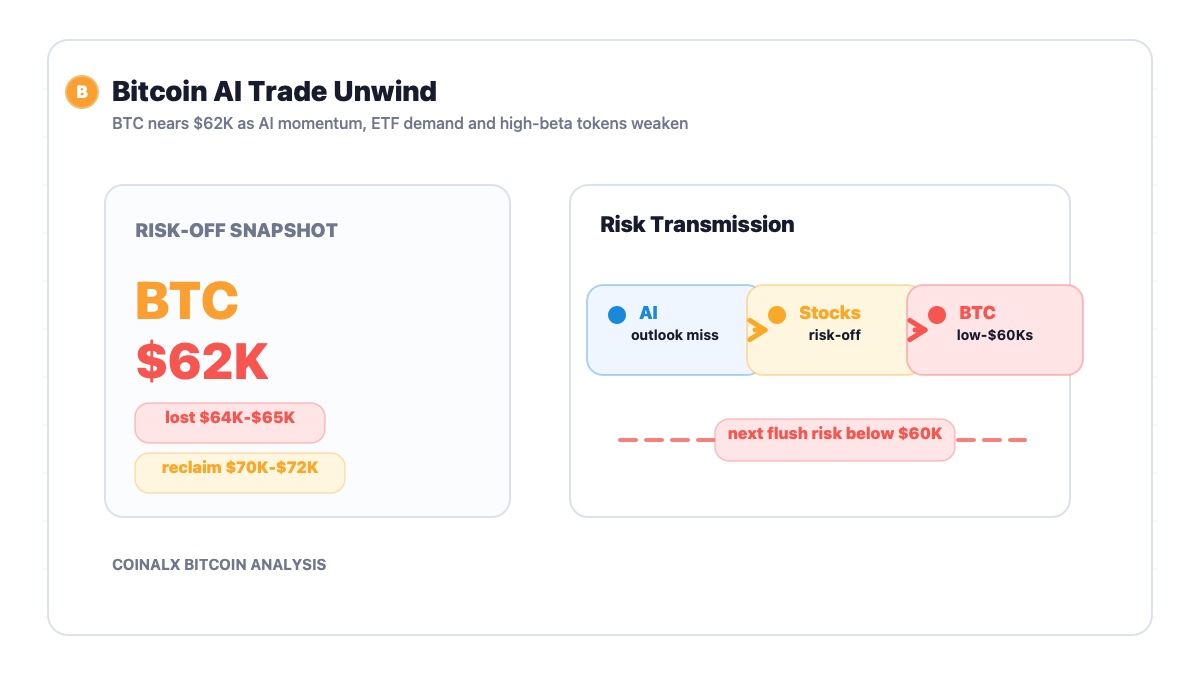
- Bitcoin fell to $62,715 in Asian trading, down 1.9% on the day and 14.5% on the week, as the AI-led risk trade weakened.
- The selloff was not isolated to crypto: Broadcom's AI-chip outlook disappointed, Nasdaq 100 futures fell, and South Korea's KOSPI dropped 4.7%.
- Crypto's structural bid has weakened, with U.S. spot Bitcoin ETFs logging 13 straight sessions of outflows totaling about $4.4 billion.
- BTC needs to reclaim $70,000-$72,000 to repair the chart; failure near $60,000 keeps the next downside flush risk alive.
What Happened
Bitcoin did not fall in a vacuum. It fell while the market's favorite shiny object, the AI trade, started wobbling.
According to CoinDesk, BTC slid to $62,715 during Asian hours on Friday, down 1.9% on the day and 14.5% on the week. Ether dropped more sharply, falling 4.8% to $1,696, while Solana lost 5.4% to $66.51. Hyperliquid's HYPE, which had recently stood out as one of the few strong tokens in a weak crypto tape, fell 14.8% to $62.14.
That last part matters. HYPE was supposed to be the exception for a moment. Then the market looked at the exception and politely threw it into the same bucket as everything else.
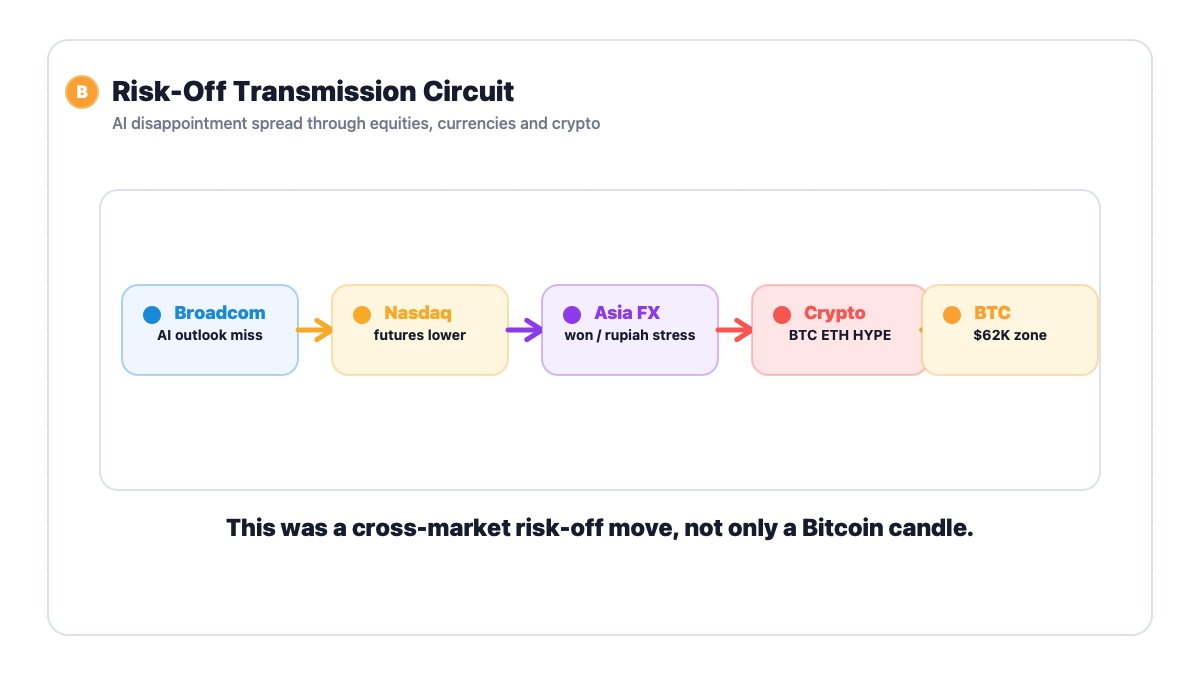
The pressure started outside crypto. Broadcom's quarterly AI-chip outlook missed elevated expectations, hitting the semiconductor complex and dragging global risk assets lower. Nasdaq 100 futures fell 0.9%, extending the index toward a third straight day of declines. South Korea's KOSPI, one of the cleanest equity expressions of the AI buildout, dropped 4.7%, while SK Hynix fell 8%.
Currency markets added their own warning lights. The Korean won slid to a 2009 low, while the Indonesian rupiah traded near record lows against the dollar. In other words, this was not only a Bitcoin chart having a bad morning. It was a coordinated risk-off move across equities, currencies and crypto.
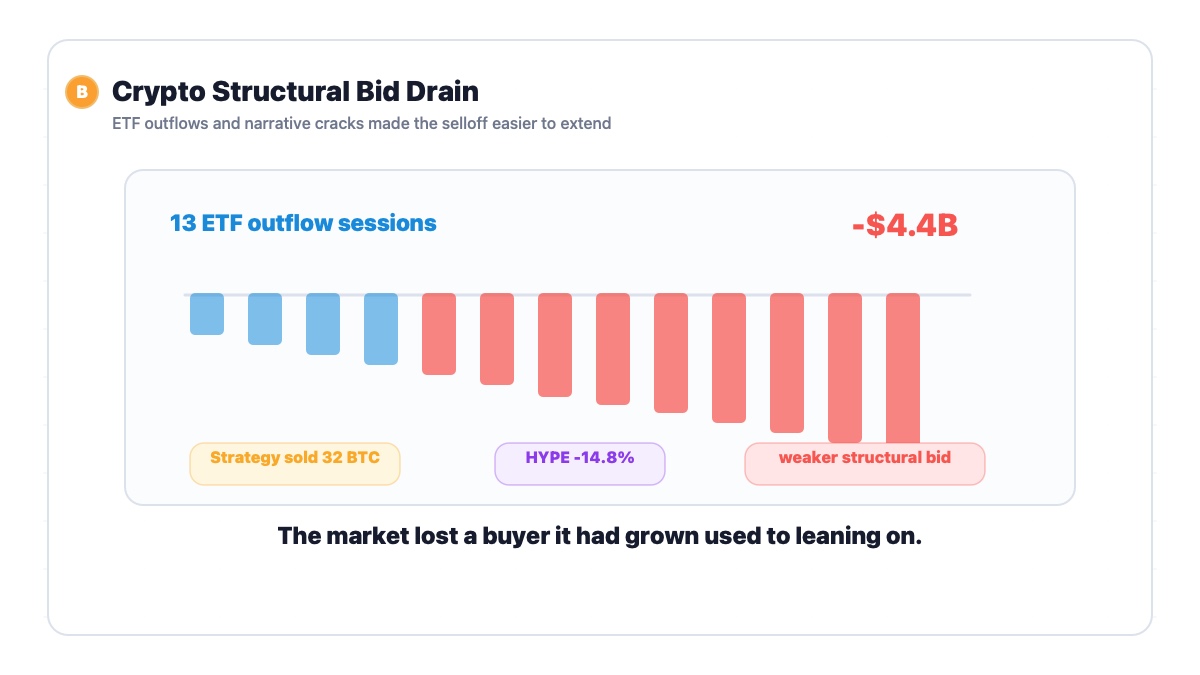
The crypto-specific backdrop was already weak. CoinDesk reported that U.S. spot Bitcoin ETFs had posted 13 consecutive sessions of net outflows totaling roughly $4.4 billion since mid-May. Strategy also disclosed its first Bitcoin sale since 2022, selling 32 BTC to fund preferred stock dividend obligations.
The next major catalyst is the U.S. nonfarm payrolls report. A soft print could revive expectations for Federal Reserve cuts, lower real yields and help the AI trade recover. A hot print would do the opposite. Until then, the market is not guessing from a position of strength. It is guessing while sliding.
Why This Matters for Bitcoin and Crypto Markets
This matters because Bitcoin's recent weakness is coming from both outside and inside the crypto market.
The outside pressure is the AI trade unwind. For much of 2026, AI-linked equities have been the engine of global risk appetite. When that engine is roaring, Bitcoin can benefit even if the crypto-native story is messy. Liquidity likes friends. But when AI stocks start slipping, Bitcoin can get treated less like digital gold and more like one more high-beta risk asset standing too close to the exit.
The inside pressure is the missing structural bid. Spot Bitcoin ETFs were a major support mechanism for the past 18 months. When those products shift from inflow machine to 13-day outflow streak, the market loses a buyer it had grown emotionally attached to. That attachment is rarely healthy, but it is very real.
Strategy's small BTC sale is not large enough by itself to break the market. Thirty-two BTC is not the meteor. But symbolically it matters because Strategy had been one of the clearest examples of corporate Bitcoin accumulation. When even that narrative shows a small crack, traders notice. Markets are not always rational, but they are excellent at smelling narrative weakness.
HYPE's drop adds another layer. It shows that even tokens with recent relative strength can be pulled lower when the broader risk engine sputters. The idea that capital was rotating into high-cash-flow or strong crypto-specific names lasted about as long as a trader's coffee staying warm during a liquidation cascade.
For Bitcoin, the key question is whether this is just a fast risk-off flush or the start of a deeper repricing. The answer depends on three things: whether AI equities stabilize, whether ETF outflows slow, and whether macro data gives the Fed room to cut.
Historical Parallel: 2022's High-Beta Risk Repricing
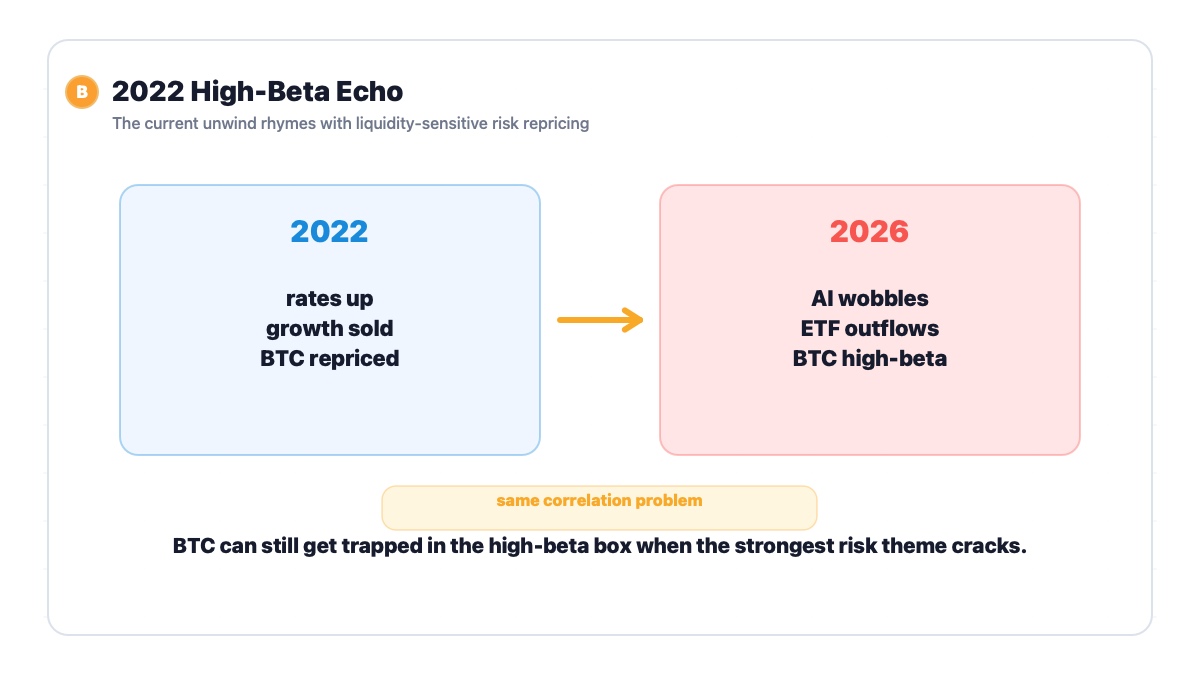
The closest historical parallel is the 2022 repricing of high-beta risk assets, when growth stocks, crypto assets and liquidity-sensitive trades all weakened as rates rose and investors stopped rewarding speculative duration. Bitcoin did not fall because one crypto headline was bad. It fell because the entire market changed how it valued risk.
That is the useful comparison for the current selloff. The June 2026 move is not simply about Bitcoin being weak. It is about a broader risk trade, led by AI and semiconductor enthusiasm, starting to lose momentum. When the market's strongest theme begins to unwind, weaker assets rarely get to stand aside and watch with popcorn. They get repriced too.
The similarity is correlation. In 2022, Bitcoin behaved less like an independent monetary hedge and more like a liquidity-sensitive asset. As real yields rose and speculative appetite faded, BTC sold off alongside growth stocks. In the current setup, Broadcom's AI outlook, Nasdaq weakness, Asian equity pressure and crypto losses are all part of the same risk-off map.
The difference is that the current market has spot Bitcoin ETFs, a more institutional BTC ownership base, and a different macro trigger. In 2022, the dominant pressure was a rate-hiking cycle. Now the immediate pressure is an AI trade wobble combined with ETF outflows and uncertainty around the U.S. jobs report. That makes the path more data-sensitive. A soft payroll print could revive rate-cut hopes and repair risk appetite faster than a 2022-style tightening regime allowed.
The lesson is conditional. If AI equities stabilize and ETF outflows slow, this can become a painful but contained flush. If the AI unwind continues and macro data keeps real yields firm, Bitcoin may remain trapped in the same high-beta box it has spent years trying to escape.
Bitcoin Price Reaction and K-Line Analysis
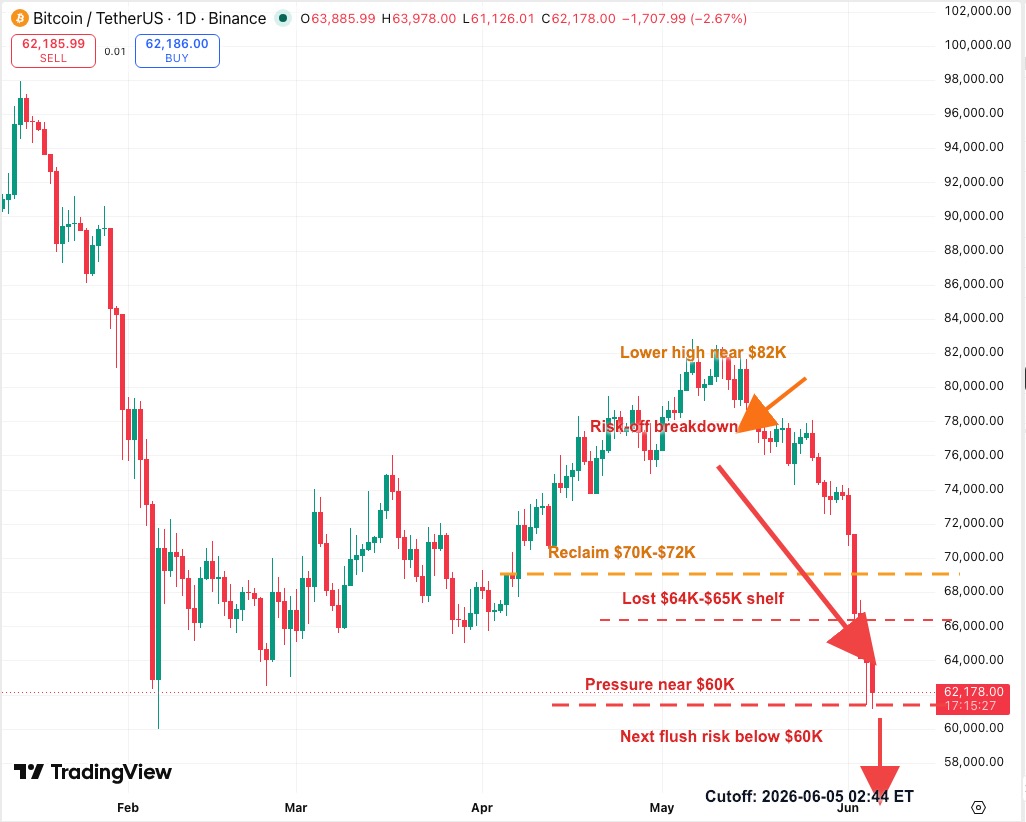
The BTCUSDT daily chart shows the selloff with very little subtlety.
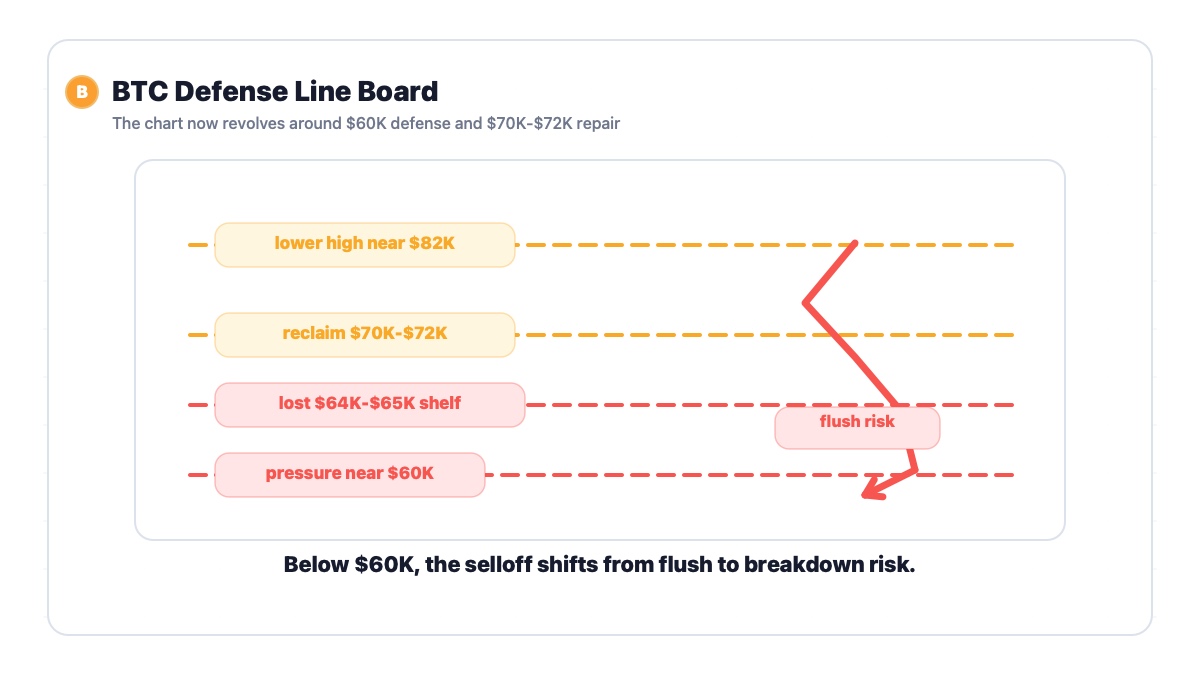
Bitcoin formed a lower high near the $82,000 area in May, then rolled over. That lower high matters because it shows the market was losing strength before the latest AI-led risk-off move. Once BTC failed to hold the $64,000-$65,000 shelf, the slide accelerated toward the low-$60,000s.
The first repair zone is $70,000-$72,000. BTC needs to reclaim that band before the chart can look less damaged. A bounce that fails below it would look like a normal relief rally inside a downtrend, which is market-speak for "nice try, still ugly."
The immediate pressure zone is near $60,000. This is where the chart starts to ask whether buyers are defending a major psychological level or simply waiting lower. If BTC loses $60,000 cleanly, the next flush risk becomes much more real, especially if ETF outflows continue and AI equities remain under pressure.
The chart also shows why HYPE's drop matters even though HYPE is not on this price axis. A broad risk-off move does not respect individual token narratives for long. If BTC breaks, relative-strength tokens usually get tested. Some survive. Many simply learn that being "less weak" is not the same as being strong.
Key Levels to Watch
The immediate support area is around $60,000. Holding this zone keeps the selloff from turning into a deeper breakdown.
The lost shelf is $64,000-$65,000. BTC needs to regain this area to show that the latest selloff is being absorbed.
The first major reclaim zone is $70,000-$72,000. A recovery above this band would weaken the bearish structure.
The lower high zone is near $82,000. BTC would need to recover much more ground before the broader downtrend damage is truly repaired.
For market context, watch Nasdaq futures, semiconductor stocks, ETF flow data and the U.S. jobs report. In this setup, Bitcoin is not driving the bus alone.
Conditional Forecast
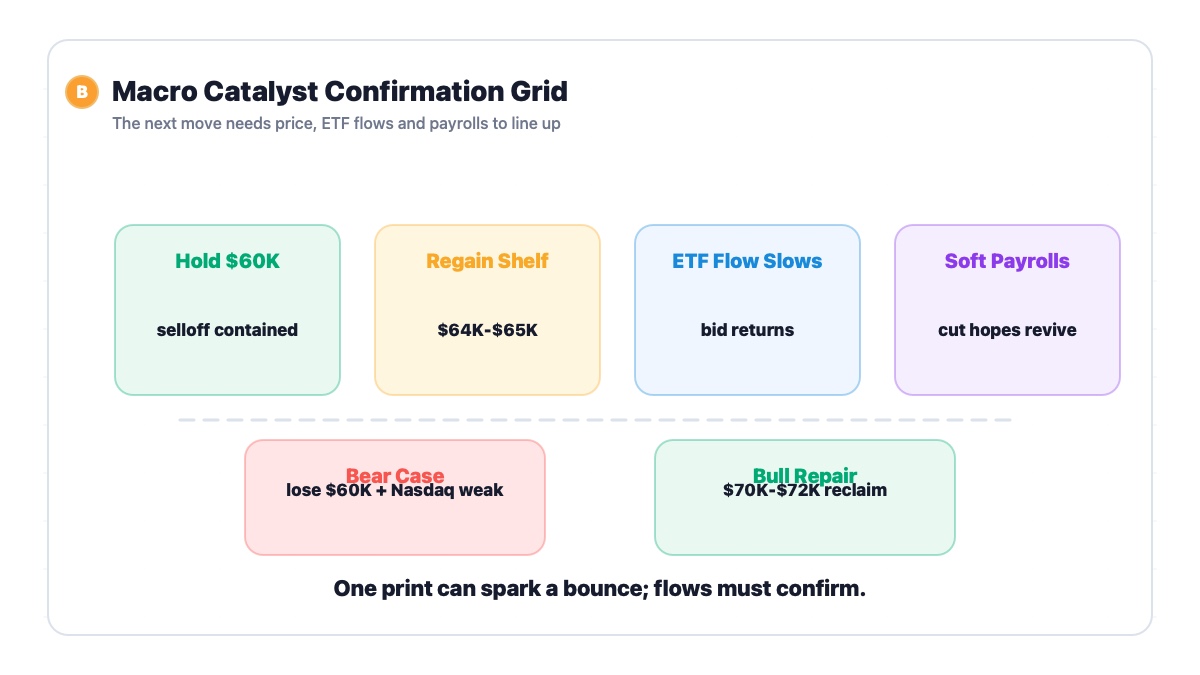
If BTC holds $60,000 and reclaims $64,000-$65,000, the market can treat this as a risk-off flush that may stabilize before the next macro catalyst.
If BTC reclaims $70,000-$72,000, the bearish structure weakens materially, especially if ETF outflows slow and AI equities bounce after the jobs report.
If BTC loses $60,000 while Nasdaq weakness continues, the selloff can extend into a deeper deleveraging move. In that scenario, altcoins and high-beta tokens such as HYPE would likely remain under heavier pressure than Bitcoin.
If payroll data comes in soft enough to revive Fed-cut expectations, risk assets could bounce quickly. But that bounce needs confirmation from ETF flows and price reclaim levels, not just one cheerful candle.
Investment Takeaway
The clean takeaway is that Bitcoin is still behaving like part of the risk-asset ecosystem.
That does not destroy the long-term BTC thesis. It does mean traders should stop pretending every Bitcoin dip is purely crypto-native. Sometimes Bitcoin falls because miners sell. Sometimes it falls because ETFs bleed. And sometimes it falls because an AI chip outlook disappoints and the market suddenly remembers that all its favorite trades were standing on the same chair.
For short-term traders, the map is simple: defensive below $64,000-$65,000, cautiously constructive only after a reclaim of $70,000-$72,000, and vulnerable if $60,000 fails.
For longer-term investors, this is a test of whether Bitcoin can keep institutional confidence when the AI trade stops doing free emotional labor for the entire risk market.
Sources
- CoinDesk: Bitcoin plunges to near $62,000 as the AI trade unwinds, HYPE falls 14%
- TradingView: BTCUSDT chart, Binance
- Broadcom: Investor relations
- U.S. Bureau of Labor Statistics: Employment Situation reports
|
DISCLAIMER:
1. All content on this website (including but not limited to articles, data, charts, and analyses) is for general informational purposes only and does not constitute any form of investment advice, trading recommendation, or financial guidance. 2. Cryptocurrencies and digital assets are subject to extreme price volatility and high investment risk; you may lose part or all of your principal. Past performance does not predict future results. 3. The information on this website is based on sources we believe to be reliable, but we do not guarantee its accuracy, completeness, or timeliness. Any investment decisions made based on this website’s information are at your own risk. 4. We strongly recommend that you conduct your own thorough research and consult an independent, licensed financial advisor before making any investment decisions. |
Recommended reading
Latest News

