Kalshi's $1B Round Puts a $22B Price on Prediction Markets
2026-05-08 02:41:04
## Kalshi's new valuation turns prediction markets into a capacity test

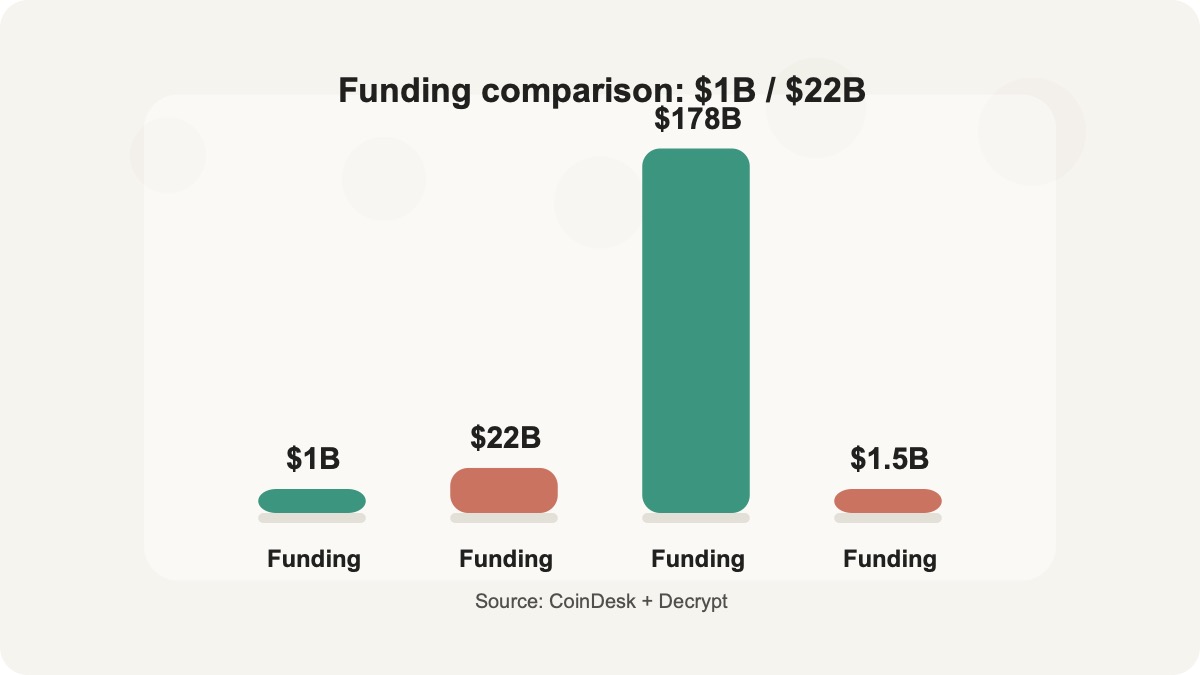
According to [CoinDesk](https://www.coindesk.com/business/2026/05/07/kalshi-confirms-usd1-billion-raise-at-usd22-billion-valuation-amid-prediction-market-boom), Kalshi said on May 7, 2026 that it raised $1 billion in a Series F round at a $22 billion valuation, with Coatue leading and Sequoia Capital, Andreessen Horowitz, Paradigm, IVP, Morgan Stanley and ARK Invest participating. The headline is simple: capital has arrived faster than the regulatory perimeter around event contracts has settled.
### What the two reports lock down
CoinDesk framed the round around institutional services: block trading tools, broker integrations and risk products for asset managers and insurers. [Decrypt](https://decrypt.co/367108/prediction-market-startup-kalshi-boosts-valuation-22-billion) added the operating picture: Kalshi says it has 2 million monthly users, $1.5 billion in annualized revenue, 90% of U.S. prediction-market activity and $178 billion in annualized volume, up from $52 billion six months earlier.
### The Decrypt-only numbers change the valuation question
A $1 billion funding headline shows capital entering the company; $178 billion in annualized volume and $1.5 billion in annualized revenue test whether usage has already moved beyond the early-platform phase. The problem is that trading volume is not a regulatory exemption. The larger the marketplace becomes, the harder it is to treat state gambling rules, CFTC jurisdiction and institutional compliance as side issues.
> "Event contracts could become a trillion-dollar market."
> - Tarek Mansour, Kalshi co-founder and CEO
## The money is aimed at institutional channels, not just more event contracts
Kalshi said the new capital will support hedge funds, asset managers, proprietary trading firms and insurance companies. That direction matters because it pushes event contracts closer to traditional market infrastructure: larger ticket sizes, cleaner reporting, steadier execution and a legal responsibility chain that institutions can explain to clients and risk committees.
### Coatue, Morgan Stanley and Paradigm at the same table show a split narrative
The investor roster itself is a useful signal. Coatue and Morgan Stanley point toward institutional market access, while Paradigm keeps the crypto-native prediction-market thesis in view. That leaves Kalshi with a double test: prove event contracts can serve macro-risk and real-world probability use cases, and prove those contracts will not be reclassified under state-level rules in ways that weaken the model.
#### The valuation gap with Polymarket is really a compliance-path gap
Decrypt noted that Polymarket is reportedly seeking $400 million at a $15 billion valuation, while the two platforms reached $150 billion in lifetime volume in March. The useful comparison is not which platform carries the higher valuation. It is that Kalshi relies on a U.S.-regulated exchange framework, while Polymarket brings a more crypto-native history. Demand may rhyme; the regulatory load is different.
## Legal classification is the risk boundary, not the growth curve
CoinDesk reported that Nevada, New Jersey, Illinois and other states have issued cease-and-desist orders or launched legal challenges against Kalshi, arguing that some event contracts resemble unlicensed sports-betting products. Kalshi argues that its federally regulated exchange belongs under Commodity Futures Trading Commission oversight rather than state gambling regimes.
### If the federal-exchange logic holds, institutionalization gets easier; if not, scale raises compliance cost
That is the central issue behind the round. If event contracts are treated mainly as CFTC-supervised risk products, Kalshi's institutional expansion has a clearer base. If sports, entertainment or political-event contracts keep triggering state-level challenges, $178 billion in annualized volume becomes not only evidence of growth but also a larger review surface. The practical verification frame is narrow: whether state litigation narrows, whether institutional tools move from plans to usage, and whether high-dispute contracts are separated cleanly from the rest of the market.
---
Author: Coinalx Editorial Team|First published: 2026-05-07 | Last updated: 2026-05-07
Source: [coindesk.com](https://www.coindesk.com/business/2026/05/07/kalshi-confirms-usd1-billion-raise-at-usd22-billion-valuation-amid-prediction-market-boom)
DISCLAIMER:
1. All content on this website (including but not limited to articles, data, charts, and analyses) is for general informational purposes only and does not constitute any form of investment advice, trading recommendation, or financial guidance.
2. Cryptocurrencies and digital assets are subject to extreme price volatility and high investment risk; you may lose part or all of your principal. Past performance does not predict future results.
3. The information on this website is based on sources we believe to be reliable, but we do not guarantee its accuracy, completeness, or timeliness. Any investment decisions made based on this website’s information are at your own risk.
4. We strongly recommend that you conduct your own thorough research and consult an independent, licensed financial advisor before making any investment decisions.