• Thai-listed company DV8 has announced plans to build a corporate treasury of 10,000 Bitcoin.
• DoorDash, Chainlink & Oblong Market Shifts Guide (2026)
• Blockchain AI Convergence: Fact-Check & Market Guide (2026)
• Polygon's mainnet will undergo the Giugliano upgrade on April 8.
• PsiQuantum has started building its million-qubit quantum facility. Scientists say a machine this po
• Anthropic Discontinues Subscription Support for Third-Party Tools
• XRP ETF Forecasts & Bitmine’s $20B ETH Bet: 2026 Analysis
• Crypto & Tech Market Trends 2026: Pi, XRP, Robotaxi Safety
• DoorDash, Chainlink & Oblong Market Shifts Guide (2026)
• SEC v. Ripple Case Ends: XRP Outlook & Monero 51% Attack (2026)
Goldman Sachs Report Reveals Hidden Battle: How Autonomous Vehicles Will Squeeze Bitcoin Mining'
2026-04-18 14:24:40
## The AI Payoff Question Has an Answer—And It's Squeezing Bitcoin Miners
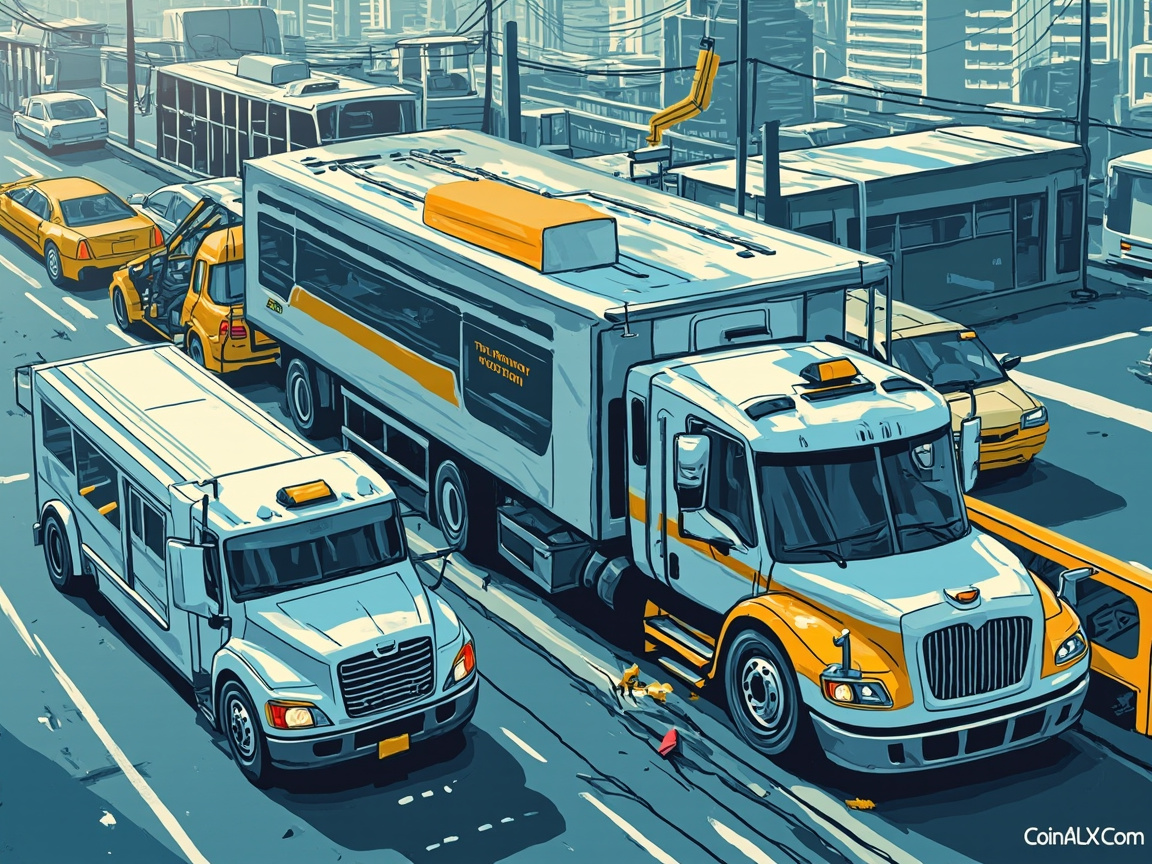
After $700 billion poured into artificial intelligence development, investors have been asking one question: where's the return? Goldman Sachs' latest report provides a clear answer: autonomous vehicles. The investment bank projects robotaxis and self-driving trucks will create a market exceeding $1 trillion by 2035, with gross profit pools approaching $300 billion.
While this appears to be a battle between tech giants and automakers, crypto investors should focus on the hidden conflict: the massive computing power required for autonomous vehicles directly competes with Bitcoin mining for the same chips and energy resources. This isn't a parallel development—it's a looming collision in the computing power arena.
## The Computing Power Migration Is Already Underway
Goldman's most compelling data points aren't predictions but current realities. Waymo has captured 30% of the ride-hailing market in San Francisco after just 20 months of commercial operation—real adoption, not PowerPoint promises.
Every kilometer driven by an autonomous vehicle requires real-time data processing, environmental perception, and decision-making—all demanding high-performance computing chips. A single Level 4 autonomous vehicle generates nearly 4TB of data per hour, requiring computing power equivalent to dozens of high-end servers.
Bitcoin mining consumes the same resource: computing power.
When Nvidia's chip production gets locked up by autonomous vehicle companies, and when data center electricity quotas tilt toward AI training, miners will receive fewer resources. This isn't speculation—it's already happening through supply chain pressure.
## Three Ways Autonomous Vehicles Will Squeeze Bitcoin Miners
Goldman's trillion-dollar projection represents a pressure test for crypto mining operations.
**1. The Chip War Escalates**
Autonomous vehicles require low-latency, high-reliability computing chips that sit between AI training chips and Bitcoin mining ASICs. Nvidia's Drive platform and Tesla's Dojo are already competing for TSMC's advanced manufacturing capacity.
While mining chips can optimize existing processes temporarily, next-generation miners needing better energy efficiency will require more advanced manufacturing—where autonomous vehicle clients will likely receive priority over mining hardware manufacturers.
**2. Energy Allocation Shifts**
As autonomous fleets scale, their supporting data centers and edge computing nodes will consume massive electricity. Mining hubs like Texas and Quebec are also prime testing grounds for autonomous vehicles.
When local governments allocate cheap power, will they prioritize autonomous vehicle projects that create jobs and supply chains, or Bitcoin mining operations? The answer seems clear.
**3. Policy Winds Change Direction**
Goldman's report notes accelerated autonomous vehicle deployment in the U.S., China, and Europe—making this a national competitiveness issue.
When autonomous vehicles receive the "national priority" label, expect tighter chip export controls, computing infrastructure protection, and data security regulations. This directly limits miners' flexibility in globally allocating computing resources.
## How Miners Can Adapt: Three Strategic Paths
Facing this computing power squeeze, miners have three viable options.
**Path 1: Move Upstream**
Since autonomous vehicles consume computing power, miners can participate directly in supplying it. Some mining pools already deploy edge computing nodes to process autonomous vehicle data in real-time. This isn't abandoning mining but extending operations—miners can process vehicle data during off-peak hours, potentially doubling computing utilization.
**Path 2: Bet on Efficiency Breakthroughs**
While autonomous vehicles have rigid computing demands, Bitcoin mining efficiency still has room for improvement. Next-generation miners that reduce energy consumption by 30% could produce more computing power within existing electricity allocations. This isn't just a technical challenge—it's a survival imperative.
**Path 3: Find Computing Power Havens**
Autonomous vehicle companies prioritize developed regions, leaving opportunities in emerging markets with surplus electricity and favorable policies. Central Asia, Africa, and South America offer underutilized grids and governments more welcoming to computing infrastructure.
But this path carries risks: inadequate infrastructure, political instability, and higher operational costs require stronger localization capabilities and risk hedging.
## Reality Check: The Computing Power War Reaches Critical Phase by 2026
Goldman predicts autonomous vehicles will begin true scaling next year, establishing a clear timeline for the computing power competition.
By 2026, watch for three key signals:
1. **Mining hardware delivery times**—If next-generation miners take over nine months from order to delivery, chip capacity is truly constrained.
2. **North American mining electricity costs**—If Texas mining electricity prices jump 20% or more, energy allocation is shifting toward autonomous vehicles.
3. **Mining pool distribution**—If North American computing power share declines while Central Asian and African shares grow, the migration is underway.
Crypto investors should monitor Nvidia's earnings calls, TSMC's capacity plans, and Waymo/Tesla fleet expansion more closely than Bitcoin price movements.
Autonomous vehicles aren't a distant future—they're already pulling up to Bitcoin mining's doorstep. In this hidden computing power war, winners won't be those who avoid the conflict, but those who strategically reposition their computing resources before the squeeze intensifies.
Goldman's report matters not for its predictions but for establishing the timeline: by 2026, the computing power battle will reach its decisive phase. Miners will either find new territory or get pushed off the field entirely.
| DISCLAIMER: The information on this website is provided as general market commentary and does not constitute investment advice. We encourage you to do your own research before investing. |
Recommended reading






Markets
2026-03-24
Markets
2026-02-26
Markets
2026-03-23
Latest News