Data shows that dollar-cost averaging (DCA) into Bitcoin is one of the safest ways to gain long-term
DCA Bitcoin Through the Dip: How $250 a Week Since 2021 Turned Into $120K
Smart money plays the long game. When markets go south—like Bitcoin's 50% slide over the last five months—the move isn't to panic. It's to dollar-cost average. DCA, for short. Same amount, same interval, every time. Rain or shine.
History and forward-looking models both say the same thing: steady wins the race. Let's run the numbers.
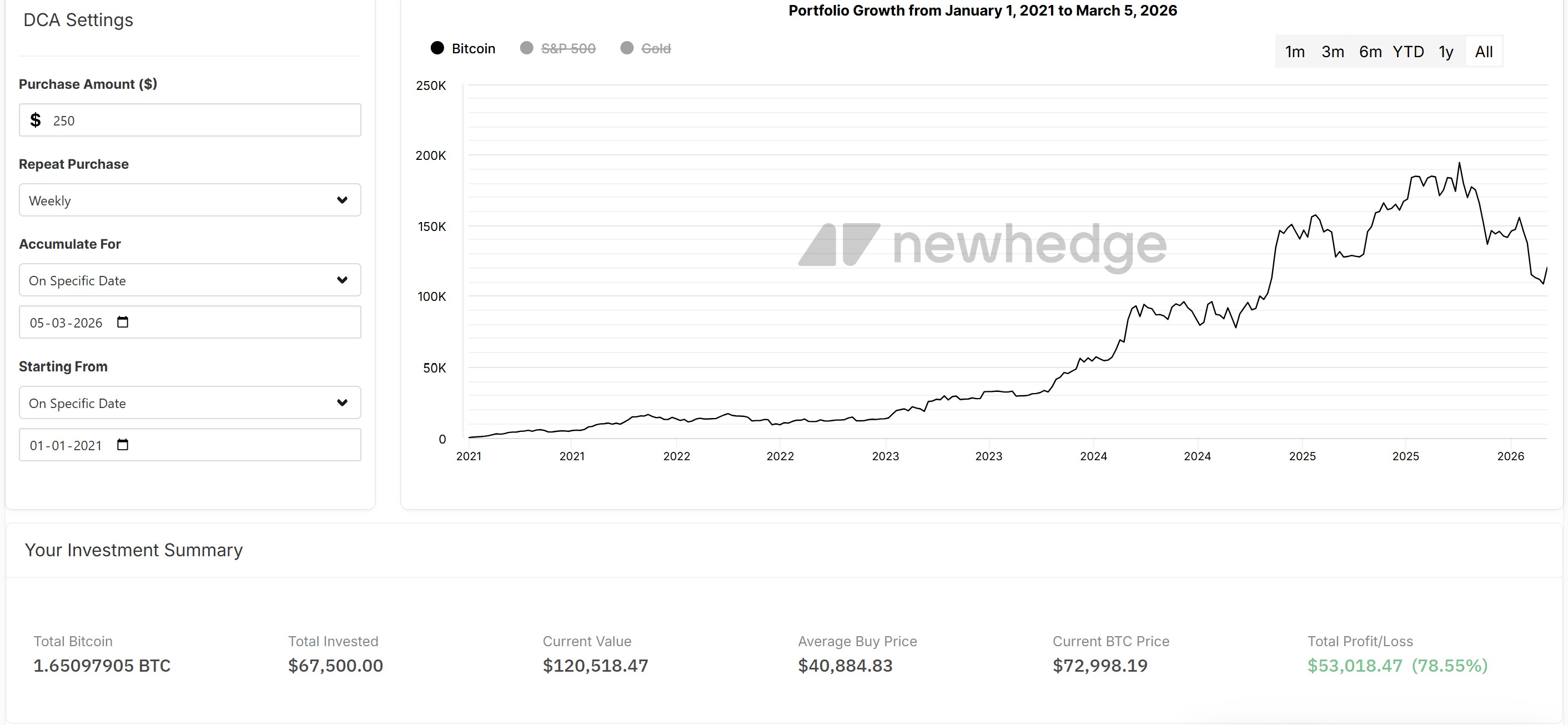
Five Years of DCA: $67.5K In, $120K Out Say you started in January 2021, throwing $250 at Bitcoin every week. Five years later, you've put in $67,500. According to DCA sims, you'd have scooped up about 1.65 BTC at an average price of $40,884.
At today's $71,000? That stack's worth $120,518. A clean 76% gain. If Bitcoin hits $100,000, you're looking at $165K. At the October 2025 peak near $126K? That's $208K.
Start later, and the math shifts. A $250 weekly DCA from January 2024 to now? $28,500 in, 0.3686 BTC out, average buy at $77,312. At current prices, that's a 6% unrealized loss. But if Bitcoin climbs to $100K, you're up to $36,863. At $126K, $46,448. Still solid, just different timing.
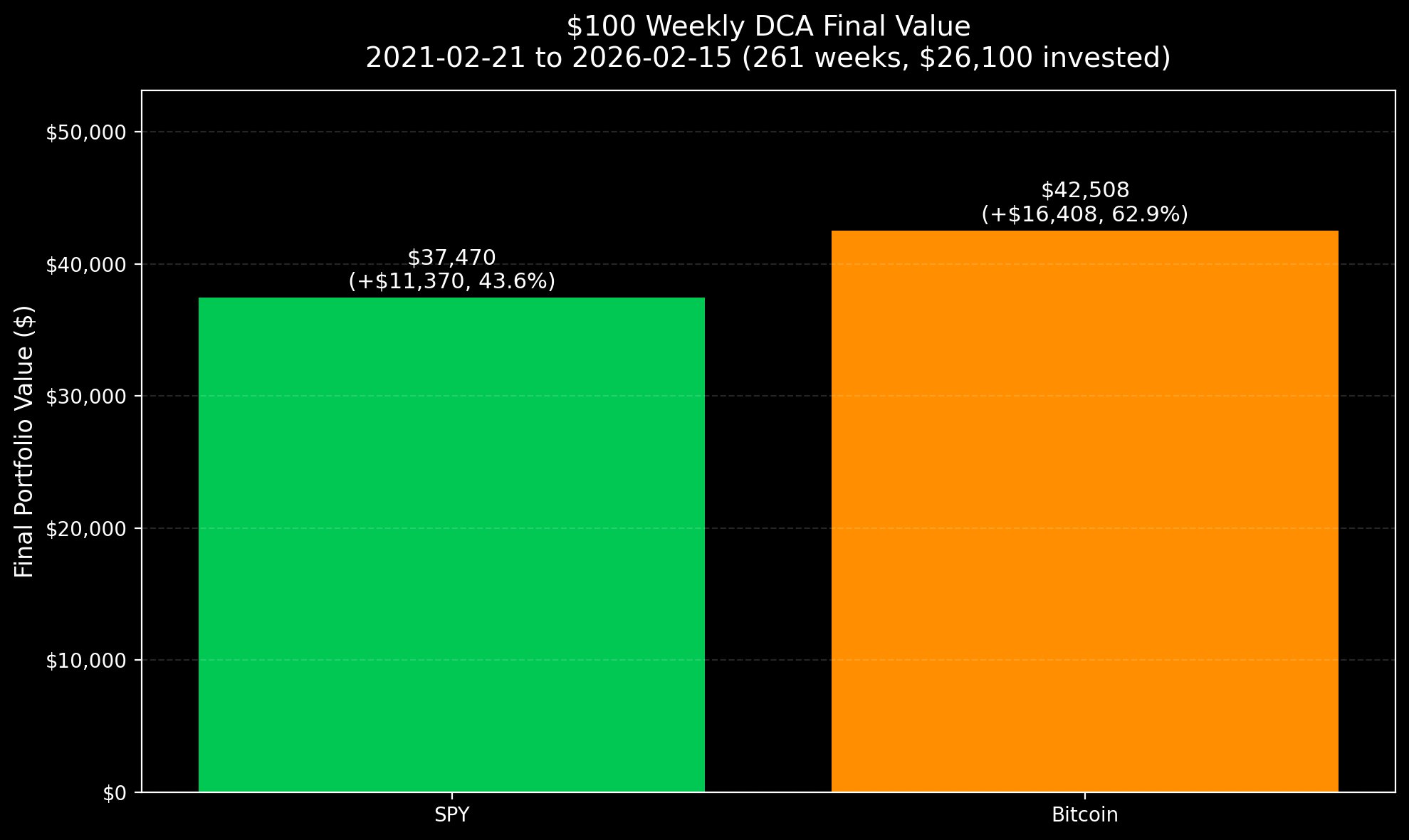
Swan Bitcoin's Adam Livingston ran a comparison on X earlier this year. $100 a week into Bitcoin over five years? $42,508. Same cash into the S&P 500? $37,470. That's 62.9% vs. 43.6%. Volatility? Sure. But the upside's been worth it.
Looking Ahead: DCA Through 2030 Now let's peek forward. Say you start in January 2026, same $250 weekly, ride it out to March 2030. Total invested: about $54,250.
Price projections come from Bitcoin's power law—a log-scale model that's tracked historical price pretty well. It spits out a median of around $430,278 by March 2030. But crypto's never that neat. So factor in deviation bands: lower bound at $274,000, upper at $900,000.
Under that scenario, four years of DCA gets you about 0.30 BTC.
At $274K: $82,200
At $430K (median): $129,000
At $900K: $270,000
Timing Matters, But Time Matters More Back in November 2025, researcher Sminston With ran the numbers. Even buying 20% above the current price ($94,000) and selling 20% below a 2035 median projection? After ten years, you'd still be up nearly 300%. Total savings hit 7.7x the initial principal.
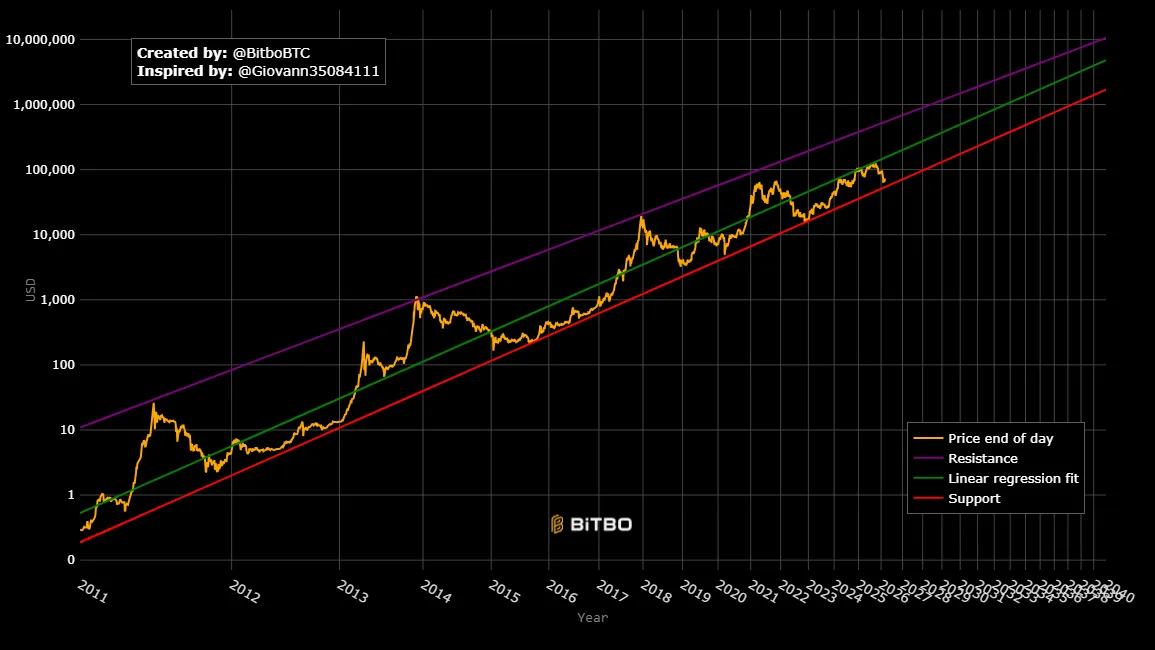
The takeaway? Entry points shift the range. But the long hold is what actually pays.
| DISCLAIMER: The information on this website is provided as general market commentary and does not constitute investment advice. We encourage you to do your own research before investing. |
Recommended reading







Latest News